

 Français (France)
  Nederlands (nl-NL)
 The Kalyan Minaret is a twelfth-century religious monument located within the Po-i-Kalyan complex in Bukhara, Uzbekistan. Built during the Qarakhanid period, it is the oldest surviving structure of the monumental ensemble that also includes the Kalyan Mosque and the Mir-i-Arab Madrasa. For centuries, it has been associated with the religious and urban development of the city. Its original function was closely connected to the neighbouring mosque, with which it forms an important architectural landmark. Today, the minaret is part of the Historic Centre of Bukhara, which has been included on the UNESCO World Heritage List since 1993.
Monument profile
Kalyan Minaret
Monument category: Minaret
Monument family: Mosque, Minaret or Madrasa
Monument genre: Religious
Cultural heritage: Islamic
Geographic location: Bukhara • Uzbekistan
Construction period: 12th century AD
This monument in Bukhara is inscribed on the UNESCO World Heritage List since 1993 and is part of the serial property "Historic Centre of Bukhara".See the UNESCO monuments featured on this site
• Links to •
• List of videos about Bukhara on this site •
Bukhara, oasis on the silk road • Uzbekistan
The Kalyan Minaret and Its Place in the History of Bukhara
Construction under the Qarakhanids
The Kalyan Minaret was constructed between 1121 and 1127 during the reign of the Qarakhanid ruler Arslan Khan. Its erection formed part of a broader programme of religious and urban development in Bukhara, which at that time was one of the principal cities of Transoxiana. The monument was designed as the minaret of the city’s congregational mosque and quickly became one of the most visible elements of the urban landscape.
Historical sources generally attribute the design of the structure to an architect named Bako. The minaret was intended to serve both practical and symbolic purposes. It provided a platform for the call to prayer and simultaneously demonstrated the political authority and religious commitment of its patrons. Its exceptional height made it visible from considerable distances and reinforced the status of Bukhara as an important Islamic centre.
The name “Kalyan” or “Kalon,” meaning “great” in Persian, reflects the monumental ambitions associated with the project. From the time of its completion, the tower became one of the defining landmarks of the city and a prominent feature of the Qarakhanid architectural legacy.
Survival through the Mongol Invasion and Later Developments
One of the most significant events in the history of the minaret occurred during the Mongol invasion of 1220. The armies of Genghis Khan devastated much of Bukhara, destroying numerous religious and civic structures. The Kalyan Minaret, however, survived the conquest.
Later accounts describe how the monument impressed the Mongol conquerors and escaped demolition. Although the details of these narratives remain difficult to verify, the survival of the tower itself is well documented. While neighbouring buildings were damaged or rebuilt in subsequent centuries, the minaret remained standing and continued to dominate the city skyline.
The religious complex surrounding the structure underwent substantial changes over time. Earlier mosque buildings disappeared, and new monuments were constructed during later dynastic periods. In the sixteenth century, the Shaybanids rebuilt the Kalyan Mosque and erected the Mir-i-Arab Madrasa nearby. Rather than being replaced, the minaret was incorporated into the new Po-i-Kalyan ensemble and retained its central position within the complex.
This continuity makes the monument the oldest surviving component of the present-day ensemble and one of the few major Qarakhanid structures preserved in Bukhara.
Religious, Urban and Symbolic Functions
For centuries, the minaret remained closely associated with the neighbouring mosque. Its primary role was linked to religious practice, particularly the call to prayer. The tower also functioned as a visual reference point within the city, helping define the urban identity of Bukhara.
As dynasties changed and political circumstances evolved, the structure acquired an increasingly symbolic significance. It represented continuity across periods of conquest, reconstruction and political transformation. Its survival contributed to its reputation as one of the most enduring monuments of the city.
Some historical accounts mention secondary uses of the tower, including occasional observation functions. Later traditions also associate it with judicial executions carried out during certain periods, leading to the nickname “Tower of Death.” Although these episodes occupy a place in local historical memory, they represent only a minor aspect of the monument’s long history.
During the era of the Emirate of Bukhara and later under Russian influence, the minaret continued to serve as a prominent landmark. Its significance gradually expanded beyond its original religious purpose, becoming an important symbol of the city itself.
Global Historical Context
The construction of the Kalyan Minaret in the early twelfth century coincided with the final years of the Northern Song dynasty in China. In Western Europe, major Romanesque cathedrals were being erected. The Crusades were shaping relations between Europe and the eastern Mediterranean. In northern India, regional Hindu kingdoms remained dominant before the establishment of the Delhi Sultanate.
UNESCO Recognition and Preservation
The remarkable preservation of the Kalyan Minaret results from both the quality of its original construction and a series of conservation efforts undertaken over the centuries. Restoration campaigns have focused on maintaining the structural stability of the tower while preserving its historic fabric and decorative brickwork.
The monument forms part of the “Historic Centre of Bukhara,” which was inscribed on the UNESCO World Heritage List in 1993. Within this protected urban ensemble, the minaret occupies a particularly important position because it predates most of the surrounding structures.
Today, the Kalyan Minaret remains one of the best-preserved monuments from the Qarakhanid period. Its continued presence provides valuable evidence of medieval construction techniques and the historical development of Bukhara. As both an architectural landmark and a historical monument, it remains an essential component of the city’s cultural heritage.
Structural Design and Architectural Characteristics of the Kalyan Minaret
Position within the Po-i-Kalyan Complex and Overall Configuration
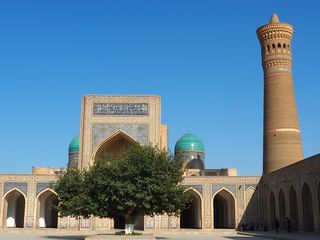
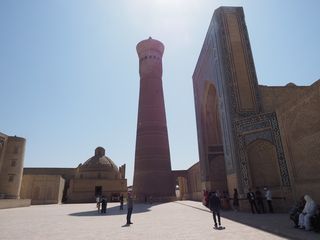
The Kalyan Minaret occupies a central position within the Po-i-Kalyan complex in Bukhara. Located between the Kalyan Mosque and the Mir-i-Arab Madrasa, it serves as the dominant vertical element of the ensemble. Its placement establishes a visual anchor that organizes the surrounding architectural composition and contributes significantly to the spatial identity of the historic centre.
The monument follows a remarkably simple plan consisting of a single cylindrical tower rising from a substantial circular base. Unlike the neighbouring mosque and madrasa, the minaret contains no courtyards, halls or subsidiary structures. The entire architectural concept focuses on a self-contained vertical form whose proportions were carefully designed to combine functionality, stability and visual impact.
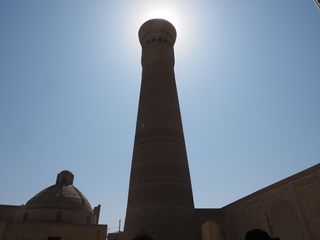
The tower reaches approximately 46 metres in height. Its profile narrows gradually toward the summit, creating an impression of elegance while simultaneously reducing structural loads. This subtle tapering contributes to the monument’s distinctive silhouette and enhances its visual prominence within the urban landscape.
As the oldest surviving component of the Po-i-Kalyan complex, the minaret provides a direct architectural link to the Qarakhanid period and remains one of the most recognizable structures in Bukhara.
Foundations, Structural Engineering and Construction Methods
The remarkable longevity of the Kalyan Minaret is closely connected to its engineering design. Historical studies indicate that the structure rests on exceptionally deep foundations built of fired brick. These foundations extend several metres below ground level and distribute the immense weight of the tower over a broad area.
The monument is constructed entirely of baked brick laid with great precision. The walls are particularly thick at the base and gradually decrease in thickness as the tower rises. This arrangement creates a stable load-bearing structure capable of supporting the considerable weight of the upper sections.
The tower functions as a hollow cylinder. Rather than relying on internal columns or secondary supports, the masonry shell itself carries all structural loads. The circular geometry distributes pressure evenly throughout the structure and minimizes weak points that could develop over time.
Within the tower, a spiral staircase ascends through the interior. This staircase is integrated directly into the masonry and provides access to the upper gallery. Its incorporation demonstrates an advanced understanding of spatial organization, allowing circulation without compromising structural integrity.
The slight conical form of the tower also improves resistance to wind forces. Combined with the depth of the foundations and the thickness of the masonry, this design has enabled the monument to withstand centuries of environmental stress, seismic activity and urban change.
Brick Ornamentation and Exterior Surface Treatment
One of the most distinctive architectural characteristics of the Kalyan Minaret is its decorative programme executed almost entirely in brick. Unlike many later monuments in Bukhara that rely heavily on glazed ceramic decoration, the minaret derives much of its visual richness from the manipulation of masonry itself.
The exterior surface is divided into multiple horizontal decorative bands. Each band features a different arrangement of bricks, creating a sequence of geometric patterns that encircle the tower. These motifs include projecting elements, recessed courses and intricate combinations of brick placement that generate texture across the façade.
The decorative zones are not merely ornamental additions applied to the structure. Instead, they are integrated into the masonry construction and form part of the architectural fabric. This close relationship between structure and decoration contributes to the monument’s coherence and durability.
Changes in sunlight throughout the day produce constantly shifting patterns of light and shadow across the brickwork. The relief created by the decorative bands enhances the visual depth of the tower and emphasizes its vertical form. This effect is particularly noticeable during the early morning and late afternoon when shadows become more pronounced.
Certain decorative sections incorporate inscriptions executed directly in brick. These inscriptions are integrated into the ornamental programme and contribute to the rhythm of the façade without interrupting the overall composition.
Upper Gallery, Lantern Structure and Vertical Organization
The upper section of the minaret contains the architectural elements most directly associated with its original function. Near the summit, a circular gallery projects outward from the main shaft. Historically, this platform served as the location from which the call to prayer was announced.
The gallery is supported by a ring of elaborately arranged brick corbels. These projecting elements create a structural transition between the cylindrical shaft and the wider balcony. Their arrangement produces a strong visual emphasis that clearly distinguishes the upper section from the body of the tower.
Above the gallery rises a narrower cylindrical lantern. This upper structure extends the vertical composition while providing protection for the platform below. The proportions between the shaft, gallery and lantern demonstrate a carefully balanced design in which each component contributes to the overall silhouette.
The organization of the monument follows a clear vertical hierarchy. The broad base establishes stability, the tapering shaft creates height and continuity, and the gallery and lantern provide a visually distinct termination. This sequence produces a coherent architectural composition despite the simplicity of the overall plan.
Architectural Conservation and Preservation
The survival of the Kalyan Minaret for nearly nine centuries has required periodic conservation efforts. Restoration campaigns have focused primarily on stabilizing masonry, repairing weathered brickwork and maintaining the structural integrity of the upper gallery.
During the nineteenth and twentieth centuries, several interventions addressed deterioration caused by environmental conditions and age. Particular attention was given to preserving the decorative brick patterns that form one of the monument’s defining characteristics.
Recent conservation work has emphasized the retention of original materials and traditional construction techniques wherever possible. These efforts seek to preserve both the structural and aesthetic qualities of the monument while ensuring its long-term stability.
Today, the Kalyan Minaret retains the essential features of its twelfth-century design. Its deep foundations, cylindrical form, internal spiral staircase, projecting gallery and sophisticated brick ornamentation make it one of the most accomplished surviving examples of Qarakhanid architecture. Within the architectural landscape of Bukhara, it remains an exceptional demonstration of medieval engineering and monumental design.