

 Français (France)
  Nederlands (nl-NL)
 The Mosque-Cathedral of Córdoba is located in the city of Córdoba in the region of Andalusia, southern Spain. This religious monument is among the most prominent historical landmarks of the Iberian Peninsula. It occupies a significant place in the cultural and historical heritage of the city and attracts large numbers of visitors each year. The site reflects the succession of religious traditions that shaped the history of Córdoba and is widely regarded as a major monument within European architectural heritage. Today it plays an important role in the cultural and tourist life of the region and remains a widely recognized symbol of the historical identity of Andalusia.

Cordoba • Mosque-Cathedral: the forest of columns
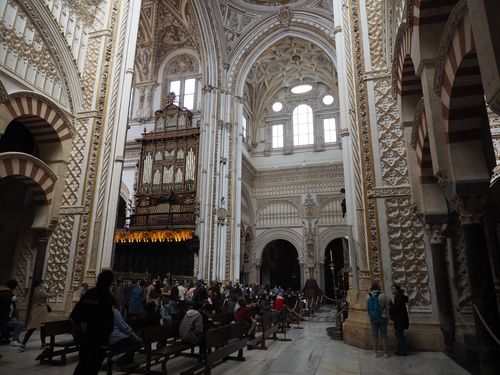
Cordoba • Mosque-Cathedral: Capilla Mayor

Cordoba • Mosque-Cathedral: Capilla Major ceilings
Monument profile
Mosque-Cathedral
Monument categories: Mosque, Cathedral
Monument families: Mosque, Minaret or Madrasa • Church, cathedral, basilica, chapel
Monument genres: Religious
Cultural heritages: Christian, Islamic
Geographic location: Cordoba • Andalusia • Spain
Construction period: 8th century AD
This monument in Cordoba is inscribed on the UNESCO World Heritage List since 1984 and is part of the serial property "Historic Centre of Cordoba".See the UNESCO monuments featured on this site
• Links to •
• List of videos about Cordoba on this site •
Cordoba, the Mosque-Cathedral, Andalusia • Spain
• References •
UNESCO: Historic Centre of Cordoba
History of the Mosque–Cathedral of Córdoba
Foundation of the Great Mosque in the Umayyad Emirate
The origins of the Mosque–Cathedral of Córdoba are closely linked to the establishment of Umayyad authority in al-Andalus during the eighth century. After the overthrow of the Umayyad Caliphate in Damascus in 750 during the Abbasid revolution, the Umayyad prince Abd al-Rahman ibn Muʿawiya fled to the Iberian Peninsula. In 756 he established an independent emirate with Córdoba as its political capital. The construction of a large congregational mosque formed an essential component of this political consolidation, providing the capital with a central religious institution and reinforcing the legitimacy of the new regime.
The site chosen for the mosque occupied a central location within the existing urban fabric of Córdoba. Historical sources indicate that a Visigothic church dedicated to Saint Vincent previously stood on the site. Following the Muslim conquest of the Iberian Peninsula in the early eighth century, the building appears to have been used jointly by Christian and Muslim communities. Around 785 Abd al-Rahman I purchased the entire property and ordered the construction of a mosque capable of accommodating the growing Muslim population of the city.
The new building fulfilled both religious and political functions. It served as the principal space for the Friday congregational prayer and as a symbolic demonstration that the Umayyad dynasty had successfully re-established its authority in the western Islamic world. By erecting a monumental mosque in his capital, Abd al-Rahman I reinforced the continuity of Umayyad political traditions despite the loss of their eastern caliphate.
Expansion of the Mosque under the Umayyad Emirs
The initial mosque soon became insufficient for the expanding population of Córdoba, which was developing into one of the most important cities in the western Mediterranean. Successive Umayyad rulers therefore undertook several expansions of the building during the ninth century.
During the reign of Abd al-Rahman II (822–852), the mosque was enlarged by extending the prayer hall southward. This expansion increased the capacity of the building while maintaining the structural and architectural system established during the first phase of construction. The enlargement reflected both demographic growth and the political stability achieved by the emirate during this period.
These expansions also reinforced the symbolic role of the mosque as a representation of Umayyad authority. Major religious buildings in Islamic capitals functioned not only as places of worship but also as institutional spaces where the political legitimacy of the ruler was publicly affirmed.
The Caliphate of Córdoba and Monumental Development
The architectural importance of the mosque increased significantly during the tenth century when Abd al-Rahman III proclaimed the Caliphate of Córdoba in 929. By adopting the title of caliph, he asserted the independence of al-Andalus from both the Abbasid caliphate in Baghdad and the Fatimid caliphate in North Africa. The capital of Córdoba became the center of a powerful state that controlled much of the Iberian Peninsula.
As part of this political transformation, Abd al-Rahman III commissioned the construction of a monumental minaret for the mosque. The tower served both practical and symbolic purposes. It allowed the call to prayer to be heard throughout the city and visually expressed the authority of the caliphal regime over the urban landscape.
Further architectural development occurred during the reign of his successor al-Hakam II (961–976). The mosque underwent a major expansion in which the prayer hall was again extended southward. This phase also included elaborate decorative programs and structural refinements that reflected the cultural prosperity of Córdoba during the caliphal period.
At this time Córdoba had become one of the largest cities in Europe. It possessed extensive markets, libraries, and educational institutions. The mosque served as an important intellectual center where religious scholars taught law, theology, and other disciplines associated with Islamic learning.
The Final Expansion under Almanzor
The final major enlargement of the mosque took place at the end of the tenth century under the rule of al-Mansur Ibn Abi Amir, often known in European sources as Almanzor. Although he did not hold the title of caliph, he exercised effective political control over the caliphate as chief minister.
Because the earlier expansions had already extended the building southward to its spatial limits, the enlargement undertaken by Almanzor was carried out toward the east. This extension significantly increased the overall size of the mosque and allowed it to accommodate the growing population of Córdoba.
The expansion also reflected the political ambitions of Almanzor, who sought to reinforce his authority through large-scale architectural projects associated with the caliphal capital.
Crisis of the Caliphate and Political Fragmentation
The early eleventh century brought a period of political instability known as the Fitna of al-Andalus. Internal conflicts weakened the caliphal administration and led to the collapse of centralized authority. In 1031 the Caliphate of Córdoba formally ended, and the Iberian Peninsula fragmented into a series of smaller political entities known as taifa kingdoms.
Despite these political upheavals, the mosque continued to function as the principal religious institution of the city. Its architectural scale and symbolic importance ensured its continued role within Córdoba’s urban life even after the city lost its status as the capital of a unified state.
Christian Conquest and Transformation into a Cathedral
The most significant transformation in the history of the monument occurred during the Christian reconquest of Córdoba in 1236. The city was captured by King Ferdinand III of Castile during the expansion of Christian kingdoms into southern Iberia. Following the conquest, the mosque was immediately consecrated as a Christian cathedral.
Unlike many other Islamic religious buildings that were demolished or replaced after the reconquest, the structure of the mosque was largely preserved. The new Christian authorities adapted the building to accommodate Catholic worship while retaining much of the existing architecture.
Over the following centuries a series of chapels were constructed along the interior walls of the building. These chapels were often financed by noble families or religious confraternities who wished to establish burial sites and devotional spaces within the cathedral.
The Construction of the Renaissance Cathedral
The most dramatic architectural intervention occurred in the sixteenth century when the cathedral chapter decided to construct a large Christian church within the center of the former mosque. The project introduced a Renaissance nave, choir, and transept into the middle of the Islamic hypostyle hall.
This new structure created a vertical architectural focus that contrasted with the horizontal organization of the original mosque. The addition fundamentally altered the interior spatial experience of the building while leaving large sections of the earlier structure intact.
The resulting architectural composition reflects the coexistence of two religious traditions within a single monument. The Renaissance cathedral stands within the forest of columns of the original mosque, producing a unique spatial relationship between the two architectural systems.
The Monument within the Urban Development of Córdoba
Throughout the medieval and early modern periods, the Mosque–Cathedral remained the central landmark of Córdoba. The surrounding urban fabric developed around the monument, with streets, squares, and residential quarters structured in relation to its presence.
As the cathedral of the city, the building became the center of ecclesiastical authority and an important location for public ceremonies. At the same time, the visible remains of the earlier mosque preserved a record of Córdoba’s Islamic past within the Christian city.
This layered architectural and historical character contributed to the distinctive cultural identity of Córdoba.
Cultural Role in the Modern Period
In the modern era the Mosque–Cathedral has become one of the most significant historical monuments in Spain. It continues to function as the cathedral of the Roman Catholic Diocese of Córdoba while also serving as a major cultural and tourist site.
The building represents a unique testimony to the complex history of the Iberian Peninsula, where Islamic and Christian societies succeeded one another over several centuries. Its architectural and historical significance attracts visitors from across the world.
The monument also plays a central role in the cultural identity of the city of Córdoba, forming a focal point for historical research, heritage conservation, and educational initiatives.
Conservation and Heritage Protection
The preservation of the Mosque–Cathedral requires continuous conservation efforts due to the complexity of its structure and the diversity of materials resulting from its long construction history. The monument includes architectural elements from multiple periods, including Umayyad, medieval Christian, and Renaissance phases.
Modern restoration programs focus on maintaining structural stability while protecting the decorative and architectural features that illustrate the building’s historical evolution. Conservation strategies must also address the impact of high visitor numbers and environmental factors affecting the structure.
The Mosque–Cathedral of Córdoba was inscribed on the UNESCO World Heritage List in 1984. In 1994, the designation was expanded with the inscription of the Historic Centre of Córdoba, incorporating the monument into a larger protected urban ensemble.
This international recognition emphasizes the exceptional historical and cultural significance of the site and requires coordinated management measures aimed at preserving the integrity and authenticity of the monument within its historic urban environment.
Architecture of the Mosque–Cathedral of Córdoba
General spatial organization of the monument
The Mosque–Cathedral of Córdoba represents one of the most complex architectural ensembles of the medieval Mediterranean world. Its current structure reflects a sequence of construction phases extending from the late eighth century to the sixteenth century. The monument combines the spatial logic of an Islamic congregational mosque with later Christian interventions that transformed the building into a cathedral while preserving much of the earlier structure.
The overall composition consists of two principal architectural zones. To the north lies the former courtyard of the mosque, known today as the Patio de los Naranjos. This space corresponds to the sahn of the original mosque complex and functioned as the transitional area between the urban environment and the interior prayer hall. To the south extends the vast hypostyle hall that formed the principal prayer space of the Islamic building.
The later insertion of a Christian cathedral in the center of the mosque introduced a new vertical architectural element within a structure originally defined by horizontal repetition. The coexistence of these two spatial systems produces the distinctive architectural character of the monument.
The hypostyle prayer hall and its structural system
The most recognizable architectural feature of the building is the immense hypostyle hall formed by a dense grid of columns supporting superimposed arcades. This spatial system developed from the earliest construction phase under the Umayyad emir Abd al-Rahman I beginning in 785.
The hall is organized into longitudinal aisles running perpendicular to the qibla wall, the southern wall oriented toward the direction of prayer. The repetitive arrangement of supports creates a modular system that allowed successive rulers to extend the structure without altering its fundamental organization.
The columns were largely reused from earlier Roman and Visigothic structures. These spolia elements vary in material and dimension, including marble, granite, and other stone types extracted from dismantled classical buildings throughout the region. Because the reused columns differed in height, the architects developed a structural solution that would become one of the defining characteristics of the monument.
The system of superimposed arcades consists of a lower level of horseshoe arches supporting a second tier of semicircular arches. This configuration increased the overall height of the interior space while allowing the builders to use columns that would otherwise have been too short to support the roof structure. The result produced a visually complex network of arches that contributes to the sense of depth and continuity within the hall.
Structural innovation of the double-tiered arches
The double-tiered arcade system represents one of the most significant architectural innovations of the building. The lower arches are horseshoe-shaped, a form associated with Visigothic and early Islamic architecture in the Iberian Peninsula. These arches spring directly from the column capitals and stabilize the horizontal thrust generated by the upper level.
Above them, semicircular arches support the wooden roof structure. This upper tier redistributes vertical loads while allowing the roofline to reach a higher elevation than would have been possible using a single arch system.
The alternating use of stone and brick in the construction of the arches created the characteristic red-and-white pattern visible throughout the interior. The contrast between materials emphasizes the geometry of the arches and enhances the rhythmic visual effect created by the repeated structural modules.
The double-tiered system also provided a flexible framework for later expansions of the mosque. Because the structural unit could be replicated easily, new sections could be added without disrupting the architectural coherence of the interior space.
Expansion of the mosque and architectural continuity
Successive enlargements of the mosque between the ninth and tenth centuries maintained the structural principles established during the initial construction phase. When Abd al-Rahman II extended the building in the ninth century, the new sections reproduced the system of columns and double arcades already present in the earlier structure.
This strategy preserved visual continuity across the expanding prayer hall. The structural grid of columns allowed the building to grow incrementally while maintaining a unified architectural language.
The most refined architectural phase occurred during the reign of the caliph al-Hakam II in the tenth century. His extension introduced a more elaborate decorative program and more sophisticated structural elements, particularly in the area surrounding the mihrab and the royal prayer enclosure.
The final enlargement carried out under Almanzor at the end of the tenth century extended the mosque eastward rather than southward due to spatial constraints. This expansion significantly increased the size of the building while preserving the modular logic of the hypostyle hall.
The mihrab and the ceremonial zone of the maqsura
The architectural focus of the mosque lies in the southern section of the building where the mihrab marks the direction of prayer. Under al-Hakam II this zone was transformed into one of the most elaborate architectural compositions in the Islamic West.
The mihrab itself takes the form of a small octagonal chamber rather than a simple niche. Its entrance arch is framed by intricately carved stone decoration and surrounded by mosaics composed of glass tesserae and gold elements. These mosaics were produced by artisans sent from the Byzantine Empire, illustrating diplomatic and artistic connections between Córdoba and Constantinople.
Adjacent to the mihrab lies the maqsura, a space reserved for the ruler during communal prayer. This area is enclosed by a network of interlacing arches that create an intricate structural composition distinct from the rest of the hypostyle hall.
Above the maqsura rise a series of ribbed domes resting on intersecting arches. These domes represent an important development in Islamic architectural engineering. The intersecting ribs distribute structural loads while forming geometric patterns that anticipate later developments in both Islamic and European architectural traditions.
Decorative programs and ornamental architecture
The decorative system of the mosque integrates multiple artistic traditions within a coherent architectural framework. Carved stone panels, vegetal motifs, and calligraphic inscriptions appear throughout the building, particularly in the sections constructed during the caliphal period.
The mosaics of the mihrab area constitute the most elaborate decorative ensemble. Their motifs consist primarily of stylized plant forms and Qur’anic inscriptions arranged in geometric compositions. The shimmering surfaces created by gold tesserae interact with the architectural forms of the arches and domes, emphasizing the spatial hierarchy of the ceremonial zone.
The capitals of the columns display a wide range of forms due to the reuse of earlier materials. Some capitals retain classical Corinthian features, while others were carved specifically for the mosque in simplified vegetal patterns.
The horseshoe arch became one of the most recognizable architectural elements of the monument. Its curved profile extends beyond the semicircular form of Roman arches, creating a distinctive visual identity that later became characteristic of architecture in al-Andalus.
The courtyard and its architectural functions
The northern courtyard, originally part of the mosque complex, played an essential role in the organization of the building. Known today as the Patio de los Naranjos, this space functioned as a transitional area between the city and the prayer hall.
The courtyard contained fountains used for ritual ablutions before prayer. Its rectangular layout mirrored the orientation of the prayer hall and allowed large numbers of worshippers to gather before entering the interior space.
Rows of trees planted in regular alignments structure the courtyard visually. Although the current orange trees were introduced in later periods, the spatial organization of planted rows reflects earlier garden traditions associated with Islamic courtyard design.
Arcaded galleries surrounding the courtyard provided shaded circulation routes and reinforced the architectural connection between the open space and the enclosed hall of prayer.
Transformation of the minaret into a bell tower
The original mosque included a minaret constructed in the tenth century under the caliph Abd al-Rahman III. The tower served the traditional function of enabling the call to prayer to be heard throughout the city.
Following the Christian conquest of Córdoba in 1236, the minaret was converted into a bell tower for the cathedral. The structure remained largely intact until the sixteenth century, when a Renaissance tower was constructed around the earlier Islamic core.
The current bell tower therefore contains the remains of the original minaret within its internal structure. This architectural layering illustrates the adaptation of Islamic architectural elements to new religious functions following the transformation of the mosque into a cathedral.
Construction of the Renaissance cathedral within the mosque
The most significant architectural intervention occurred during the sixteenth century when the cathedral chapter decided to build a new Christian church within the center of the former mosque. The project introduced a Renaissance nave, choir, and transept rising above the surrounding forest of columns.
This new structure contrasts sharply with the horizontal emphasis of the hypostyle hall. The cathedral introduces verticality through its tall vaults and elevated central space. The difference in scale and proportion between the two architectural systems produces a striking spatial juxtaposition.
The Renaissance cathedral incorporates elements typical of Spanish ecclesiastical architecture of the period, including ribbed vaults and a clearly defined liturgical axis. Despite this intervention, large portions of the earlier Islamic structure remained intact, allowing both architectural traditions to coexist within the same building.
Dimensions and structural characteristics
The Mosque–Cathedral occupies an area of approximately twenty-three thousand square meters, making it one of the largest religious monuments constructed in medieval Europe. The original mosque contained nineteen aisles running perpendicular to the qibla wall.
The interior forest of columns originally numbered more than eight hundred supports. Although later alterations reduced this number slightly, the impression of an extensive grid of columns remains one of the defining spatial characteristics of the monument.
The repetitive structural modules create a visual effect in which individual architectural elements merge into a continuous spatial pattern. This organization allows the interior space to appear larger than its physical dimensions.
The roofing system originally consisted of wooden beams supporting tiled coverings. This lightweight roof structure allowed the extensive network of columns to support the building without the need for massive load-bearing walls.
Architectural conservation and preservation challenges
The conservation of the Mosque–Cathedral requires careful management due to the coexistence of multiple construction phases and materials. The structure incorporates elements from Roman, Visigothic, Islamic, medieval Christian, and Renaissance periods.
Restoration programs must therefore address the preservation of stone columns, brick arches, carved decoration, and later structural additions. Maintaining structural stability within the hypostyle hall requires particular attention because the large number of columns distributes loads across the entire interior space.
Visitor circulation presents another challenge for conservation. The monument receives large numbers of visitors each year, and maintaining the integrity of the architectural surfaces requires protective measures and controlled access to sensitive areas.
The Mosque–Cathedral of Córdoba was inscribed on the UNESCO World Heritage List in 1984. In 1994, the designation was expanded with the inscription of the Historic Centre of Córdoba, integrating the monument into a broader protected urban ensemble.
The recognition reflects the exceptional architectural significance of the building as a monument shaped by successive religious and cultural traditions over more than a millennium.