

 Français (France)
  Nederlands (nl-NL)
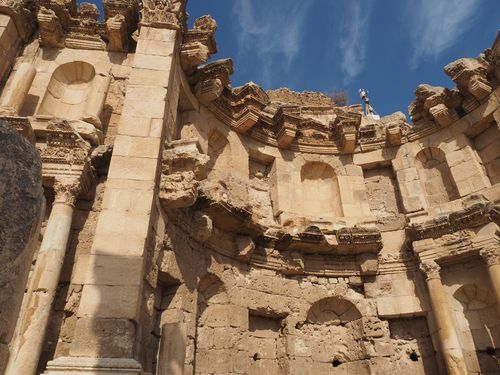
 The cathedral in Jerash, Jordan, stands as a remarkable example of early Christian architecture. Located within the extensive ruins of the ancient city of Gerasa, this cathedral reflects the area's rich cultural and religious history. Although now partially in ruins, the cathedral remains a significant attraction for visitors worldwide, drawn by its historical significance and majestic architecture. Excavations and research at the site have provided valuable insights into the religious and social life during the prosperous period of Jerash under the Roman Empire.


Monument profile
Cathedral
Monument categories: Cathedral, Archaeological, Ancient mosaics
Monument families: Church, cathedral, basilica, chapel • Archaeological
Monument genres: Religious, Archaeological site
Cultural heritages: Byzantine, Christian
Geographic location: Jerash • Jordan
Construction period: 4th century AD
• Links to •
• List of videos about Amman, Jerash, Umm Qais on this site •
Jordan • the Roman Jordan
Jerash, Pompeii of the East • Jordan
• Sources •
Digital Sources
- Encyclopædia Britannica - Jerash - A comprehensive source on the history and significance of Jerash.
- The Jordan Museum - Provides insights into archaeological findings and the history of Jordan, including Jerash.
Books and Publications
- Ali Khouri, "Jerash: A Frontier City of the Roman East", Cambridge University Press, 2019. - A detailed book on the historical and archaeological specifics of Jerash.
- Thomas M. Weber-Karyotakis, "The Archaeology and History of Jerash: 110 Years of Excavations", De Gruyter, 2021. - This book provides an in-depth overview of the excavations and findings in Jerash over more than a century.
History of the Cathedral in Jerash, Jordan
The cathedral at Jerash in Jordan, part of the extensive archaeological site that was once the ancient city of Gerasa, stands as a symbol of both historical continuity and transformation. Its construction, various uses over the centuries, and ongoing conservation efforts provide insight into the socio-political dynamics of the region and its interactions with broader historical trends.
Historical and Social Motivations for Construction
The construction of the cathedral in Jerash during the Byzantine era was driven by both religious and political imperatives. As Christianity became the dominant religion of the Roman Empire following Emperor Constantine's conversion, there was an increased emphasis on expressing the Christian faith through monumental architecture. The cathedral served as a visual and cultural representation of the Christianization of the Empire, reflecting both the religious convictions of the era and the centralized authority of Constantinople.
Major Historical Events and Their Impact
The history of Jerash, particularly its cathedral, is marked by several significant events:
- Christianization in the Byzantine Period: The initial construction of the cathedral in the 4th or 5th century AD represented the growth and institutionalization of Christianity in the region.
- Persian and Muslim Conquests: These invasions during the 7th century led to profound shifts in the region’s political landscape, impacting Jerash and leading to changes in the use and structure of its religious buildings.
- The Earthquakes of the 8th Century: These natural disasters caused significant damage to Jerash, including the cathedral, which led to a decline in its prominence and use.
Comparative Global Context
Globally, the period during which the cathedral was active was one of transition and cultural synthesis. Similar to regions under the Byzantine Empire, areas within the reach of the expanding Islamic Caliphates experienced significant architectural and cultural transformations. For example, in regions like Andalusia in Spain and Sicily in Italy, Islamic and Christian architectural elements can be found intertwined, showing a blend of Eastern and Western influences.
Transformations of the Cathedral Over Centuries
The cathedral's architecture reflects various layers of cultural influence:
- Byzantine Foundations: Originally constructed to serve a thriving Christian community, its grand design was typical of Byzantine architecture.
- Islamic Alterations: Following the Muslim conquest, the cathedral likely underwent modifications reflecting Islamic architectural styles and uses.
- Modern-Day Ruins: Today, the cathedral stands partially in ruins, with restoration efforts aimed at preserving its original Byzantine characteristics.
Cultural Significance and Conservation Status
The cathedral's ruins are not just historical artifacts but also cultural symbols that narrate the story of Jerash through different epochs. Its current state of conservation is a testament to the challenges faced in preserving such ancient structures. Weathering, unauthorized excavations, and tourism have all posed threats to its integrity.
Preservation Challenges
Preserving the cathedral’s historical authenticity involves managing several modern threats:
- Environmental Factors: Weathering due to rain, wind, and seismic activity continues to threaten the structural integrity of the ancient stones.
- Human Interference: The site faces challenges from both looting and the impact of increasing numbers of tourists.
- Financial Constraints: Adequate funding is crucial for ongoing restoration and preservation efforts, yet it is often limited.
Conclusion
The cathedral in Jerash is more than a relic; it is a chronicle of the region’s historical and cultural evolution. Like many ancient monuments around the world, it faces the dual challenge of preserving its structure and historical significance while adapting to the realities of modern threats. As efforts continue to maintain its integrity, the cathedral remains a key symbol of the historical identity of Jerash and a focal point for understanding the broader historical interactions across the Middle East.
Main Architectural Features of the Cathedral in Jerash, Jordan
The cathedral at Jerash in Jordan, part of the extensive archaeological site that was once the ancient city of Gerasa, stands as a symbol of both historical continuity and transformation. Its construction, various uses over the centuries, and ongoing conservation efforts provide insight into the socio-political dynamics of the region and its interactions with broader historical trends.
Historical and Social Motivations for Construction
The construction of the cathedral in Jerash during the Byzantine era was driven by both religious and political imperatives. As Christianity became the dominant religion of the Roman Empire following Emperor Constantine's conversion, there was an increased emphasis on expressing the Christian faith through monumental architecture. The cathedral served as a visual and cultural representation of the Christianization of the Empire, reflecting both the religious convictions of the era and the centralized authority of Constantinople.
Major Historical Events and Their Impact
The history of Jerash, particularly its cathedral, is marked by several significant events:
- Christianization in the Byzantine Period: The initial construction of the cathedral in the 4th or 5th century AD represented the growth and institutionalization of Christianity in the region.
- Persian and Muslim Conquests: These invasions during the 7th century led to profound shifts in the region’s political landscape, impacting Jerash and leading to changes in the use and structure of its religious buildings.
- The Earthquakes of the 8th Century: These natural disasters caused significant damage to Jerash, including the cathedral, which led to a decline in its prominence and use.
Comparative Global Context
Globally, the period during which the cathedral was active was one of transition and cultural synthesis. Similar to regions under the Byzantine Empire, areas within the reach of the expanding Islamic Caliphates experienced significant architectural and cultural transformations. For example, in regions like Andalusia in Spain and Sicily in Italy, Islamic and Christian architectural elements can be found intertwined, showing a blend of Eastern and Western influences.
Transformations of the Cathedral Over Centuries
The cathedral's architecture reflects various layers of cultural influence:
- Byzantine Foundations: Originally constructed to serve a thriving Christian community, its grand design was typical of Byzantine architecture.
- Islamic Alterations: Following the Muslim conquest, the cathedral likely underwent modifications reflecting Islamic architectural styles and uses.
- Modern-Day Ruins: Today, the cathedral stands partially in ruins, with restoration efforts aimed at preserving its original Byzantine characteristics.
Cultural Significance and Conservation Status
The cathedral's ruins are not just historical artifacts but also cultural symbols that narrate the story of Jerash through different epochs. Its current state of conservation is a testament to the challenges faced in preserving such ancient structures. Weathering, unauthorized excavations, and tourism have all posed threats to its integrity.
Preservation Challenges
Preserving the cathedral’s historical authenticity involves managing several modern threats:
- Environmental Factors: Weathering due to rain, wind, and seismic activity continues to threaten the structural integrity of the ancient stones.
- Human Interference: The site faces challenges from both looting and the impact of increasing numbers of tourists.
- Financial Constraints: Adequate funding is crucial for ongoing restoration and preservation efforts, yet it is often limited.
Conclusion
The cathedral in Jerash is more than a relic; it is a chronicle of the region’s historical and cultural evolution. Like many ancient monuments around the world, it faces the dual challenge of preserving its structure and historical significance while adapting to the realities of modern threats. As efforts continue to maintain its integrity, the cathedral remains a key symbol of the historical identity of Jerash and a focal point for understanding the broader historical interactions across the Middle East.