

 Français (France)
  Nederlands (nl-NL)
 The Cardo Maximus in Jerash, Jordan, is one of the main streets of this ancient Roman city. Stretching approximately 800 meters, this paved road runs through the city from north to south. Lined with Corinthian columns, it is flanked by various public and commercial structures. The paving stones still bear the marks of the chariots that traveled it centuries ago. The Cardo Maximus stands as a testament to Roman urban ingenuity and provides a fascinating glimpse into daily life in a metropolis of the Roman Empire.
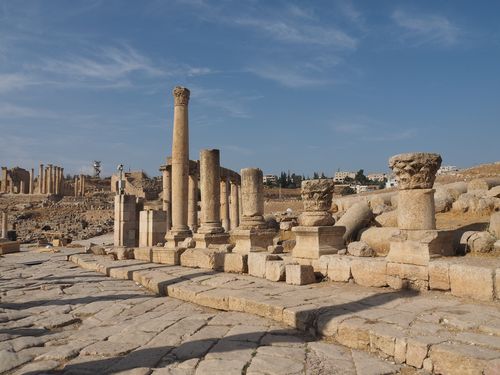
Jerash • Cardo Maximus

Jerash • Cardo Maximus
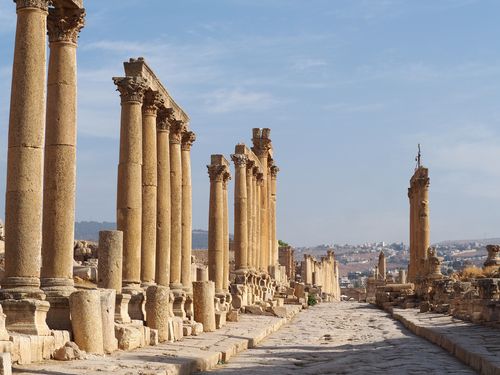
Jerash • Cardo Maximus
Monument profile
Cardo Maximus
Monument categories: Archaeological, Main thoroughfare
Monument families: Archaeological • Civil engineering structures (bridges, wells, etc.) and factories
Monument genres: Archaeological site, Economic
Cultural heritage: Roman antiquity
Geographic location: Jerash • Jordan
Construction period: 1er siècle
• Links to •
• List of videos about Amman, Jerash, Umm Qais on this site •
Jordan • the Roman Jordan
Jerash, Pompeii of the East • Jordan
• Sources •
Digital Sources
Books and Publications
- Ball, W. (2000). "Rome in the East: The Transformation of an Empire." Routledge.
- Glueck, N. (1939). "The Other Side of the Jordan." American Schools of Oriental Research.
- Ward-Perkins, J.B. (1970). "Roman Imperial Architecture." Yale University Press.
The Cardo Maximus of Jerash: Political and Social Motivations, Historical Events, and Conservation
Political and Social Motivations
The Cardo Maximus in Jerash, known as Gerasa in antiquity, was constructed during the 1st century AD as a testament to Roman engineering and urban planning. Politically, its construction was a means to demonstrate the power and grandeur of the Roman Empire, integrating Jerash into the empire’s vast network of trade and administration. Socially, the Cardo Maximus served as the main artery of urban life, facilitating commercial activities, religious processions, and social interactions among citizens. The construction of such an impressive and functional street underscored the Roman commitment to creating well-organized and thriving urban centers.
Major Historical Events
Several major historical events have marked Jerash and the Cardo Maximus, influencing the political and social development of the region. Under Roman rule, Jerash flourished as a member of the Decapolis, a league of ten autonomous cities. This period saw significant prosperity and architectural expansion, including the construction of numerous temples, theaters, and public baths.
In the 3rd century, Jerash faced destructive earthquakes and invasions by the Sassanid Persians, which marked the beginning of its decline. The arrival of Arab Muslim forces in the 7th century further transformed the region, incorporating Jerash into the Islamic Caliphate. Despite these changes, the city continued to be inhabited and used, though its importance waned over time.
Global Context and Comparison
During the construction of the Cardo Maximus in the 1st century AD, the Roman Empire was at its zenith, exerting influence over vast territories in Europe, North Africa, and the Middle East. Concurrently, China under the Han Dynasty experienced a period of stability and cultural and technological advancement. In the Indian subcontinent, the Gupta Empire fostered a golden age of science, culture, and art. The Cardo Maximus of Jerash exemplifies Roman architectural refinement and its lasting impact on urban planning and engineering.
Transformations and Cultural Influences
Over the centuries, the Cardo Maximus has undergone numerous transformations reflecting changes in power and cultural influences. Following earthquakes and Persian invasions, reconstructions and modifications incorporated Byzantine and Islamic elements. For instance, some of the original Corinthian columns were replaced or modified to align with the architectural styles of subsequent periods.
Cultural influences are also evident in the mosaics and inscriptions found along the Cardo Maximus, showcasing a blend of Roman, Greek, Byzantine, and Islamic traditions.
Cultural Importance and Current State of Conservation
Today, the Cardo Maximus in Jerash is a major tourist attraction and a significant archaeological site. It provides a fascinating glimpse into Roman urbanism and the cultural interactions over the centuries. The site is relatively well-preserved, with many architectural remnants still visible, including columns, paving stones, and surrounding structures.
Conservation Challenges
The conservation of the Cardo Maximus faces several challenges, including environmental risks such as erosion and earthquakes, as well as the impacts of mass tourism. Balancing the preservation of ancient structures with accommodating visitors is crucial to maintaining the site’s historical integrity.
Ongoing conservation efforts are essential to stabilize structures, restore damaged sections, and implement protective measures against future damage. Collaboration between local authorities, archaeologists, and international organizations is vital to ensure the long-term preservation of the Cardo Maximus.
Conclusion
The Cardo Maximus of Jerash is more than an ancient Roman road; it is a testament to the grandeur of the Roman Empire and the cultural dynamics that have shaped the region over the centuries. Its preservation is essential to maintaining its historical legacy and allowing future generations to explore and learn from this exceptional site.
Architectural Significance of the Cardo Maximus in Jerash: Technological Advances and Innovations
Technological Advances and Innovations
The Cardo Maximus in Jerash, Jordan, is a remarkable example of Roman engineering and urban planning. Constructed in the 1st century AD, this main thoroughfare reflects the technological advances and architectural innovations of the Roman Empire. Stretching over 800 meters, the Cardo Maximus was designed to facilitate commercial activities, social interactions, and religious processions, showcasing the empire's ability to create organized and functional urban spaces.
Materials and Construction Techniques
The primary materials used in constructing the Cardo Maximus were local limestone and imported marble. Limestone was quarried from the surrounding areas and used extensively for the columns, paving stones, and surrounding structures. Marble, which was a symbol of wealth and prestige, was used for decorative elements and statues.
Construction techniques included the precise cutting and fitting of large limestone slabs for paving, ensuring a flat and stable surface. The Corinthian columns that lined the Cardo Maximus were erected with meticulous precision, and the architraves connecting the columns demonstrated the advanced engineering skills of the Romans. Additionally, a sophisticated drainage system was integrated beneath the paving stones to prevent flooding and keep the street functional in all weather conditions.
Architectural and Decorative Features
The architectural and decorative features of the Cardo Maximus illustrate a unique blend of regional artistic traditions and foreign influences. Key elements include:
- Corinthian Columns: These columns, adorned with floral and vegetal motifs, reflect both Greek and Roman influences. The Corinthian capitals added a touch of grandeur and elegance to the street.
- Stone Paving: The street's surface was made of large limestone slabs, providing a durable and robust foundation for pedestrian and commercial traffic.
- Nymphaea and Fountains: Decorative structures along the street served both to beautify the city and to supply fresh water to its inhabitants.
These elements demonstrate how Jerash integrated Roman architectural styles while incorporating local artistic traditions, creating a harmonious and distinctive aesthetic.
Notable Structure and Layout
The layout of the Cardo Maximus is significant for its north-south alignment, characteristic of Roman urban planning. This orientation facilitated trade and movement throughout the city, connecting major plazas, temples, and public buildings. The Cardo Maximus intersected with the Decumanus Maximus, an east-west street, creating an efficient and well-organized transportation network.
Statistics and Anecdotes
The construction of the Cardo Maximus involved a substantial workforce and is a testament to Roman organization and discipline. A famous anecdote suggests that the limestone slabs were so precisely fitted that even a knife blade could not pass between them, illustrating the meticulous attention to detail.
International Recognition and UNESCO Impact
Although the Cardo Maximus in Jerash is not individually listed as a UNESCO World Heritage site, it is part of the larger archaeological site of Jerash, which is recognized for its historical and cultural significance. This recognition has helped draw international attention and funding for its preservation.
Conservation Challenges
The conservation of the Cardo Maximus faces several challenges, including environmental threats such as erosion and earthquakes, as well as the impact of mass tourism. Balancing the preservation of ancient structures with accommodating visitors is crucial to maintaining the site’s historical integrity.
Ongoing conservation efforts are essential to stabilize structures, restore damaged sections, and implement protective measures against future damage. Collaboration between local authorities, archaeologists, and international organizations is vital to ensure the long-term preservation of the Cardo Maximus.
Conclusion
The Cardo Maximus of Jerash is more than an ancient Roman road; it is a testament to the grandeur of the Roman Empire and the cultural dynamics that have shaped the region over the centuries. Its preservation is essential to maintaining its historical legacy and allowing future generations to explore and learn from this exceptional site.