

 Français (France)
  Nederlands (nl-NL)
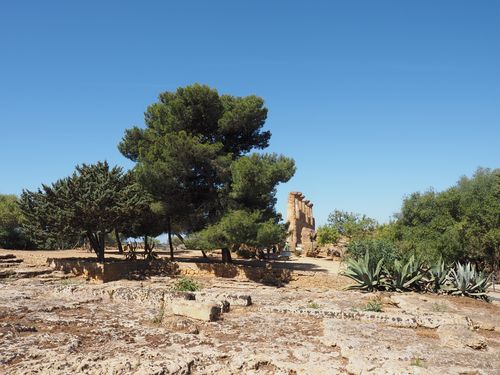
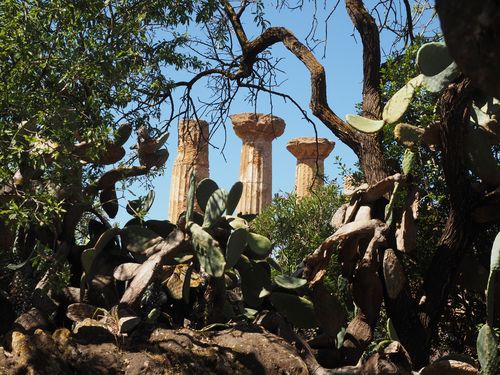
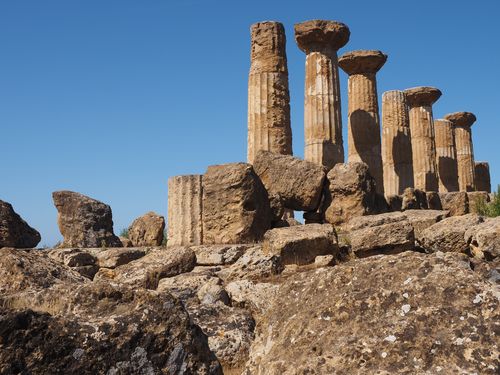
 The Temple of Heracles in Agrigento, Sicily, is one of the oldest temples in the renowned Valley of the Temples. Dedicated to the demigod Heracles, it dates back to the 6th century BCE and reflects the classic Doric style. Though partially ruined, eight of its columns have been restored, offering a glimpse of the monument's grandeur. The temple is located in a region that was once one of the largest Greek colonies, highlighting the Greek civilization's influence in Sicily.
Monument profile
Temple of Heracles
Monument categories: Ancient, Greek temple
Monument families: Temple • Archaeological
Monument genres: Religious, Archaeological site
Cultural heritage: Greek antiquity
Geographic location: Agrigento • Sicily • Italy
Construction period: 6th century BC
This monument in Agrigento is inscribed on the UNESCO World Heritage List since 1997 and is part of the serial property "Archaeological Area of Agrigento".See the UNESCO monuments featured on this site
• Links to •
• List of videos about Agrigento on this site •
Agrigento, the Valley of the Temples, Sicily • Italy
• References •
Sicile-Sicila: Temple d’Hercule – Agrigente
Wikipedia FR: Vallée des Temples
UNESCO: Archaeological Area of Agrigento
The Political and Social Motivations Behind the Construction of the Temple of Heracles in Agrigento: Historical Context and Legacy
Origins and Purpose of the Temple of Heracles
The Temple of Heracles, located in the ancient city of Akragas (modern-day Agrigento, Sicily), was built around the end of the 6th century BCE. As one of the oldest temples in the Valley of the Temples, it played a crucial role in both the political and religious life of the city. Akragas was a prominent Greek colony, and its leaders aimed to showcase their wealth, power, and piety by constructing monumental temples dedicated to revered deities such as Heracles, the demigod known for his strength and heroism.
The temple’s construction served two key purposes: political affirmation and social cohesion. Politically, the rulers of Akragas sought to assert their dominance over the region by aligning themselves with the gods, particularly Heracles, a figure associated with strength and protection. By building a grand temple in his honor, they sought to legitimize their rule, strengthen their city’s identity, and demonstrate their supremacy within the Greek world. This also helped position Akragas as a leading power in the western Mediterranean, rivalling other major Greek cities such as Syracuse and Selinunte.
Socially, the temple acted as a focal point for communal worship and reinforced the collective identity of the city’s inhabitants. It provided a space for citizens to gather during religious festivals, thereby strengthening social bonds and fostering unity. The temple’s significance was not merely religious but extended into the civic and political life of Akragas, reflecting the ancient Greek practice of intertwining religious worship with public affairs.
Historical Events and Their Impact on the Temple and the Region
The 6th century BCE was a period of expansion and consolidation for the Greek colonies in Sicily. Akragas, founded by Greek settlers from Gela, rapidly grew into one of the most prosperous cities in the Mediterranean. The construction of monumental temples like the Temple of Heracles was emblematic of this growth and ambition.
However, Akragas faced numerous challenges throughout its history, particularly during periods of conflict with rival powers. The city was besieged by the Carthaginians in 406 BCE, a significant event that marked the decline of Akragas' dominance. The Carthaginian invasion led to the destruction of many of the city’s structures, including parts of the Temple of Heracles. Despite these setbacks, Akragas remained an important city, though it never fully regained its former prominence.
The subsequent Roman conquest of Sicily in the 3rd century BCE brought new influences to the region. The Romans, who admired Greek culture, contributed to the restoration and preservation of several temples, including the Temple of Heracles. Roman influence helped integrate Sicily further into the Roman Empire, transforming Akragas into Agrigentum, a city that continued to thrive as a Roman province.
Comparison with Global Developments in the Same Period
The construction of the Temple of Heracles in Akragas occurred during a time when monumental architecture was flourishing in other parts of the world. In the Mediterranean, the Greek world was at its peak, with cities like Athens, Corinth, and Sparta building impressive temples dedicated to their gods. In parallel, other cultures were also constructing large-scale religious and political buildings. In Egypt, for example, monumental construction projects continued under the rule of the pharaohs, including the construction of vast temples dedicated to Egyptian gods like Amun-Ra.
In Mesopotamia, the Neo-Babylonian Empire was known for its monumental architecture, such as the ziggurat of Etemenanki, while in India, the Maurya Empire was beginning to take shape, laying the groundwork for future monumental Buddhist architecture, such as the stupa at Sanchi. The global context highlights the importance of temple construction as a means of political and religious expression in ancient civilizations.
Transformations and Cultural Influences Over the Centuries
The Temple of Heracles, like many ancient monuments, has undergone significant transformations over the centuries. During the Roman period, the temple was partially restored, reflecting the Roman practice of preserving and incorporating Greek culture into their own. The influence of Roman architecture and engineering can be seen in the repairs made to the temple’s structure.
In the medieval period, as Sicily came under the rule of various powers, including the Byzantines, Arabs, and Normans, the temple fell into neglect. Parts of it were repurposed for other uses, and many of the stones were removed to construct new buildings. Despite this, the Temple of Heracles remained a symbol of the region’s ancient heritage.
The rediscovery and excavation of the temple in the 18th and 19th centuries, during the height of European interest in classical antiquity, helped re-establish its significance. Archaeologists and historians recognized the temple as an important relic of ancient Greek civilization in Sicily, and efforts were made to restore and preserve it.
Current State of Conservation and Challenges
Today, the Temple of Heracles stands as a partially restored monument, with eight of its original columns still standing. It is part of the UNESCO-listed Valley of the Temples, one of the most significant archaeological sites in the world. The inclusion of the temple within this World Heritage Site has played a crucial role in its preservation, attracting international attention and resources for its maintenance.
However, the temple faces ongoing challenges related to environmental degradation, including erosion from wind and rain, as well as the impacts of tourism. The delicate nature of the ancient stone, combined with modern pollution, has accelerated the deterioration of the remaining columns and other architectural elements. Conservationists must balance the need to protect the site with the demands of tourism, which provides essential funding for its upkeep but also risks damaging the fragile structure.
Conclusion
The Temple of Heracles in Agrigento serves as a powerful testament to the political and religious ambitions of the ancient Greek city of Akragas. Its construction reflected the desire of Akragas’ rulers to assert their power and cultural identity within the Greek world. Over the centuries, the temple has witnessed significant historical events, from the Carthaginian invasion to the Roman conquest, each leaving its mark on the monument. Today, the Temple of Heracles stands as both a symbol of Sicily’s rich ancient heritage and a reminder of the challenges that modern conservation efforts must address to protect these invaluable cultural treasures.
Architectural and Technological Innovations of the Temple of Heracles in Agrigento
The Temple of Heracles, located in Agrigento, Italy, is one of the oldest and most significant structures in the ancient city of Akragas. Built around the late 6th century BCE, this Doric-style temple showcases the technological and architectural advancements of its time, reflecting a combination of local craftsmanship and external influences. It remains an essential part of the Valley of the Temples, offering a unique glimpse into the ancient Greek architectural legacy in Sicily.
Construction Materials and Techniques
The primary material used in the construction of the Temple of Heracles was limestone, abundant in the region. Limestone was an accessible and durable material, ideal for building large-scale monuments. The limestone was cut into massive blocks and arranged using a system of dry masonry, with no binding mortar, a technique typical of ancient Greek construction. The precision of this technique allowed the builders to create a stable and resilient structure that has survived, at least in part, for over two millennia.
Another notable material was the use of stucco to cover the surface of the stone blocks, giving the temple a smoother, more polished appearance. The stucco would have been painted, bringing the temple to life with vibrant colors, a common practice in Greek architecture that is often overlooked due to the faded remains of ancient structures today.
The temple was built on a three-stepped crepidoma (platform), typical of Doric temples, which provided a sturdy foundation and elevated the structure, enhancing its visual prominence. The columns were fluted, and their height-to-diameter ratio exemplified the careful proportions that the Greeks used to create an appearance of harmony and balance.
Technological and Architectural Advancements
The Temple of Heracles demonstrates several architectural innovations, especially in its proportions and structural design. Measuring approximately 67 meters in length and 25 meters in width, the temple was a peripteral structure, meaning it was surrounded by a single row of columns (six at the front and 15 along the sides). This design followed the Doric order, known for its simplicity and strength, with the columns tapering slightly at the top (entasis) to create an optical illusion of perfect straightness.
One significant technological advancement was the system of stone clamps used to hold the large blocks of limestone together. These clamps, often made of iron or lead, were inserted into grooves cut into the stone blocks, helping to maintain the integrity of the structure. This technique allowed for larger and more complex buildings to be constructed without the need for additional support materials.
The temple’s orientation also speaks to the Greeks' understanding of astronomical and religious significance. Like most Greek temples, the Temple of Heracles was oriented east to west, allowing the rising sun to illuminate the statue of Heracles inside the cella, enhancing the spiritual experience of worshippers.
Regional and Foreign Artistic Influences
The architectural design of the Temple of Heracles is predominantly Doric, a style that originated in mainland Greece but was adapted in Sicily by local craftsmen. The simplicity of the Doric order, with its unadorned capitals and robust columns, reflects both the strength and restraint characteristic of the Greek architectural tradition.
However, the temple also shows influences from other regions, particularly in its decorative elements. The metopes (the space between the triglyphs in the frieze) likely featured sculptural reliefs depicting mythological scenes, although much of this decoration has not survived. These motifs were influenced by both Greek mainland traditions and local Sicilian artistic styles, showing how Akragas was a melting pot of cultural and artistic exchange during this period.
Additionally, some scholars argue that the influence of Phoenician and Carthaginian cultures, with which Akragas had contact, may have played a role in the temple’s stylistic development. The temple, therefore, stands as an example of how regional and foreign artistic traditions could merge in the creation of monumental architecture.
Notable Features and Layout
The layout of the Temple of Heracles follows the standard plan of ancient Greek temples, with a rectangular cella (inner chamber) housing the cult statue of Heracles, surrounded by a peristyle of columns. The temple’s dimensions and symmetrical design are emblematic of the Greek pursuit of harmony and balance in architecture.
One of the most distinctive features of the Temple of Heracles is its remaining standing columns, which give it a striking and imposing appearance even in its ruined state. Of the original 38 columns, only eight remain standing today, restored in the 1920s. The sheer size of the columns—over 10 meters tall—demonstrates the ambition and technical skill of the architects who designed the temple.
Anecdotes and Historical Significance
An interesting anecdote about the Temple of Heracles is its connection to a local legend involving the statue of Heracles housed within the temple. According to ancient sources, this statue was famous for its perceived healing powers, attracting worshippers who sought the protection of Heracles. The popularity of the cult of Heracles in Akragas was so great that the temple became one of the most important religious centers in the city.
The temple also witnessed the turbulent history of Akragas. In 406 BCE, the city was sacked by the Carthaginians, and many of its temples, including the Temple of Heracles, were damaged. Despite these destructions, the temple remained a key religious site, and efforts were made to restore it during the Roman period when Akragas (then Agrigentum) became part of the Roman Empire.
International Recognition and UNESCO Status
The Temple of Heracles is part of the Valley of the Temples, a UNESCO World Heritage Site since 1997. This recognition has significantly contributed to the temple’s international standing and conservation efforts. Being part of this prestigious listing ensures that the temple receives the attention and resources necessary to preserve it for future generations.
However, preserving such an ancient structure comes with many challenges. The temple has suffered from natural erosion, earthquakes, and human intervention over the centuries. Modern conservation efforts focus on maintaining the stability of the remaining columns and preventing further degradation caused by environmental factors such as wind and rain.
The inclusion of the Temple of Heracles in the Valley of the Temples UNESCO site has elevated its status as a cultural treasure, drawing visitors and scholars from around the world. Its recognition as part of this ancient landscape reflects the temple’s architectural significance and its enduring role as a symbol of the rich cultural exchange that took place in the Mediterranean.
Conclusion
The Temple of Heracles in Agrigento stands as a testament to the technological and architectural advancements of ancient Greek civilization in Sicily. Through its use of sophisticated construction techniques, locally sourced materials, and a design that embodies the principles of balance and harmony, the temple reflects both the grandeur of its time and the blending of regional and foreign influences. Today, as part of the UNESCO-listed Valley of the Temples, the Temple of Heracles continues to captivate visitors, offering a window into the ancient world and the legacy of Greek architecture in Sicily.