

 Français (France)
  Nederlands (nl-NL)
 The Gomateshwara Temple in Shravanabelagola, Karnataka, is one of the foremost Jain pilgrimage sites in India. It is renowned for its massive monolithic statue of Bahubali, a revered figure representing renunciation and inner peace. Visitors, pilgrims and scholars travel here to observe the impressive scale of the sculpture and its spiritual relevance. The site hosts significant religious ceremonies that periodically attract large gatherings. Today, the temple stands as a major cultural and devotional landmark while welcoming tourism and academic interest.
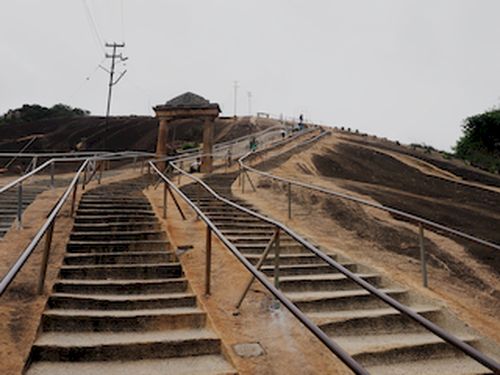
Shravanabelagola • Gomateshwara temple: the stairs

Shravanabelagola • Gomateshwara temple: the temple halfway

Shravanabelagola • Gomateshwara temple: statue of Gomateshvara
Monument profile
Gomateshwara temple
Monument categories: Pilgrimage site, Giant Statues, Jain temple
Monument families: Temple • Pilgrimage site or memorial • Giant statues or set of statues
Monument genres: Religious
Cultural heritage: Jain
Geographic location: Shravanabelagola • Karnataka • India
Construction period: 10th century AD
• Links to •
• Dynasties that contributed to the construction of the monument •

• List of videos about Shravanabelagola on this site •
Shravanabelagola • Holy Jain city, statue of Gomateshwara • India, Karnataka
• References •
Wikipedia EN: Gommateshwara statue
Britannica: Bahubali
The History of the Gomateshwara Temple at Shravanabelagola
The Gomateshwara monument at Shravanabelagola, in southern Karnataka, stands among the most emblematic religious landmarks of Jainism. Erected in the 10th century, this colossal monolithic statue honours Bahubali—also known as Gomateshwara—celebrated for his renunciation, victory over ego and embodiment of spiritual liberation. Far beyond being a devotional shrine, the monument reflects a world of political assertion, elite patronage, artistic ambition and ritual continuity. Its enduring religious centrality and powerful visual presence make it a key witness of India’s medieval history and the global culture of monumental sacral architecture.
Political and Social Context of Construction
The statue was commissioned in 981 CE by Chavundaraya, a prominent general and minister of the Western Ganga dynasty, which ruled parts of Karnataka between the 4th and 11th centuries. The Gangas governed during a period of rivalry and shifting alliances, particularly with the Rashtrakutas and the rising Cholas. Their rule was embedded in a pluralistic religious environment dominated by Jainism, Shaivism and Vaishnavism. Elite patronage of temples served not only devotional functions but also affirmed legitimacy and prestige.
The construction of Gomateshwara illustrates this nexus between faith and authority. Chavundaraya, himself a devout Jain, sought to proclaim political and spiritual distinction through patronage of an unprecedented monolithic form. The shrine symbolised both personal piety and dynastic ambition, anchoring the Gangas within a visible sacral geography. The ideals embodied by Bahubali—renunciation, discipline and transcendence—enhanced the moral stature of the dynasty. Moreover, Shravanabelagola was already an established Jain centre, renowned for monastic settlements and pilgrimage, making it a natural site for monumental religious investment.
Historical Developments Affecting the Site
The monument lived through profound dynastic shifts. After the decline of the Western Gangas in the early 11th century, the region came under the control of the Cholas, Hoysala Empire, Vijayanagara Empire and finally the Wodeyar rulers of Mysore. Each phase influenced the site differently. While no forcible destruction is recorded, periods of conflict—especially between Cholas and Western Chalukyas—periodically disrupted pilgrim movement and temple activities.
Under the Hoysalas, Jain patronage continued but was overshadowed by Shaiva structures, particularly in southern Karnataka. Despite this, Shravanabelagola retained ritual importance through monastic continuity and the support of wealthy Jain communities. Vijayanagara rule revived temple patronage generally, while the Wodeyars introduced systematic management of religious institutions. Throughout these shifts, inscriptions, ritual endowments and periodic restoration efforts ensured continued relevance.
Global Context at the Time of Construction
The Gomateshwara monument emerged during a remarkable global phase of monumental religious expression. In the 10th century, Europe saw large Romanesque cathedrals rising, while the Khmer Empire was shaping Angkor’s urban-temple structures. In China, Buddhist cave temples reached their late decorative phases, and Southeast Asia saw vast temple complexes dedicated to Hindu and Buddhist ideals. Across the Islamic world, mosque architecture was expanding with monumental domes and minarets. The Shravanabelagola statue fits into this broader trend: political authority, religious symbolism and architectural ambition merged to create lasting, visually dominant stone forms.
In India, the period corresponds to intense temple building by Cholas, Western Chalukyas and Palas. Monumentality served to manifest authority and religious legitimacy. The Gomateshwara statue aligns with this dynamic but stands apart for its extreme austerity: a rigid, unclothed human figure carved from a single block, in contrast to the ornate sculptural programs elsewhere. This minimalism emphasised Jain ideals of withdrawal and self-control.
Transformations Through the Centuries
The site evolved architecturally and ritually. The original statue stood exposed on Vindhyagiri hill, surrounded by simple mandapas. Later dynasties erected protective enclosures, gateways, subsidiary shrines and ritual platforms. Monastic structures expanded on both Vindhyagiri and nearby Chandragiri hill, accompanied by hundreds of inscriptions documenting donations, pilgrimages and ascetic achievements.
One of the most significant ritual transformations was institutionalisation of the Mahamastakabhisheka, the grand anointing ceremony held every 12 years. Though its origins are debated, inscriptions confirm its medieval development and periodic royal patronage. This ritual, involving bathing the statue in milk, sandal paste and other offerings, transformed the monument from static sacred sculpture into a living ritual centre, shaping collective memory and community cohesion.
Periods of relative neglect did occur, particularly during political fragmentation in the 14th and 15th centuries, but Jain merchant guilds and monastic networks continuously revived upkeep. Modern restoration efforts, including structural consolidation and cleaning campaigns, particularly in the late 20th and 21st centuries, prevent deterioration from rain, wind erosion and visitor pressure.
The Monument in the Modern Cultural Landscape
Today, Gomateshwara stands as both a religious pilgrimage point and a cultural icon for Jain identity. It symbolises ideals of nonviolence, self-discipline and rejection of worldly ego. Karnataka’s government promotes the site as a heritage tourism centre, while the Jain community retains spiritual guardianship.
The Mahamastakabhisheka remains one of India’s most celebrated rituals, attracting national leaders, global devotees and media attention. Its pageantry reinforces community cohesion and showcases the resilience of Jain traditions. Urban growth in Shravanabelagola has transformed the surrounding landscape, requiring controlled access, pedestrian pathways and preservation policies.
Conservation and Contemporary Challenges
Environmental threats include erosion from rainfall, temperature stress on granite, pollution and pressures from mass tourism during festivals. Urbanisation risks visual encroachment on the sacred hillscape. Conservation authorities—both state and Archaeological Survey of India—regulate repair campaigns, restrict construction and monitor visitor flow.
International recognition strengthened preservation: the monument and site entered India’s tentative World Heritage List, marking global acknowledgement of its universal value. If inscribed, this would impose stricter conservation standards, management planning and cultural landscape protection.
Conclusion
The Gomateshwara monument stands as a testimony to medieval Jain religiosity, dynastic ambition, monumental artistry and enduring ritual life. Its survival across political turnovers and transformations illustrates remarkable continuity of faith and custodianship. Its vast scale and stark symbolism resonate well beyond Jain communities, offering a window into India’s long tradition of sacred monumentality and the relationship between spiritual aspiration and public architectural display.
The Architecture of the Gomateshwara Monument at Shravanabelagola
The Gomateshwara monument at Shravanabelagola represents one of the most distinctive achievements of medieval Indian architecture. Erected in the late 10th century, the colossal monolithic statue of Bahubali stands on Vindhyagiri hill, overlooking a ritual landscape of shrines, gateways and monastic complexes. Its architectural significance is inseparable from its engineering audacity: carving a 17-metre-tall freestanding figure from a single granite mass demanded mastery of rock-cut technique, spatial planning and ritual symbolism. The monument synthesises religious ideals with physical form, demonstrating refined sculptural aesthetics, technological competence and long-term environmental adaptation.
Engineering Innovations and Construction Knowledge
The construction of the statue exemplifies remarkable knowledge of stone quarrying, monolithic sculpting and stress distribution. The artisans worked directly on exposed granite bedrock, rather than assembling structural elements, implying the use of chisels, wedges and controlled percussion methods refined in earlier rock-cut traditions. Achieving balance in such a monumental figure required precise assessment of load transfer through the legs and base. The statue’s broad shoulders, slightly forward posture and rooted stance distribute weight efficiently, reducing stress concentrations.
The site’s elevated location posed logistical challenges; tools, material and labour had to be transported up the hill along steep paths. Evidence of scaffolding holes around the base suggests the use of multi-tiered wooden platforms. The smooth finish, absent of major tool marks, attests to high-quality polishing techniques that prevented micro-fissures. The artisans harnessed high skill in negative sculpting, removing excess stone while preserving human proportion—a technique perfected in earlier Jain cave temples but unprecedented at this scale.
Materials and Their Architectural Implications
The statue is carved entirely from local granite, chosen for hardness, durability and uniform grain. Granite’s resistance to weathering ensured longevity amid seasonal rainfall and wind erosion. Its weight and density made it stable without reinforcement but required an understanding of fracture planes to avoid catastrophic cracking. The pale grey tone enhances the sculptural clarity, especially under strong sunlight, while the mildly reflective surface after polishing imbues the figure with visual softness.
Surrounding structures, including mantapas, gateways and the enclosure wall, are largely built from dressed stone blocks and laterite, with architectural additions in the Hoysala and Vijayanagara periods showing evolving masonry styles. Lime plaster coatings protected inscriptions and decorative surfaces. The stairs carved into the hillside, combined with retaining walls, function as both circulation devices and stabilising elements in the landscape.
Influences and Artistic Traditions
Architecturally, Gomateshwara belongs to the Jain monumental idiom, emphasising ascetic restraint, bodily stillness and spiritual transcendence. Unlike the figurative exuberance of contemporaneous Chola bronzes or Hoysala temple reliefs, the statue is devoid of ornament beyond minimal anklets and defined musculature. Its nudity reflects Digambara monastic values, visually affirming renunciation and inner purity.
Yet regional influences are evident. The flowing curls, almond-shaped eyes and subtle smile evoke classical Indian sculptural conventions inherited from the Gupta and Pallava periods. South Indian rock-cut traditions, seen at Badami or Elephanta, provided technical precedents for mass removal and proportional control. The surrounding architectural additions show stylistic layering: Vijayanagara period gateways adopt typical parapets and simple pillars, while monastic halls reflect more elaborate column arrangements.
Foreign influence is less direct but perceptible through global patterns of monumentality. The impulse to construct colossal figures parallels Buddhist statues in Afghanistan or Southeast Asia, although stylistic transmission is more conceptual than technical.
Spatial Organisation and Architectural Layout
The main statue stands atop Vindhyagiri hill, aligned to dominate the plateau and valley below. Its isolation emphasises spiritual ascension, while subsidiary shrines create a pilgrimage circuit. The visitor ascends stone steps, encountering mandapas and small Jain icons before reaching the enclosure wall. This sequential progression evokes metaphorical elevation from the material world to enlightenment.
The enclosure includes pillared spaces for devotees, distribution of ritual offerings and ceremonial platforms used during anointing rituals. Engravings on circumambulatory walls commemorate donors, integrating architecture with epigraphy as a visual archive of patronage.
Spatial proportion is intentional: the large head, elongated ears and straight torso reinforce vertical emphasis, directing gaze upward. The statue rises 17 metres high, with a base platform spreading to stabilise gravitational load. Unlike other Indian temples, it lacks a superstructure or tower; instead, the hill itself serves as sacred elevation, turning landscape into architecture.
Structural Particularities and Design Features
Among distinctive features is the statue’s seamless integration with the hill. The monolith grows organically from the rock, eliminating joints or bonding materials. This ensures resistance against seismic stress and wind forces. The figure’s rigid frontal alignment and symmetrical mass distribution enhance stability.
The austere composition contrasts with the intricacy of its symbolic details: vines carved along arms and legs represent prolonged meditation, while the neutral facial expression embodies liberation. The absence of deep undercutting was a conscious structural decision; shallow modelling prevents cracking and reduces water retention points.
Another notable element is the system for ritual application of liquids. The Mahamastakabhisheka ceremony requires pouring large quantities of milk, saffron water and paste on the statue. Channels formed by anatomy—the shoulders, arms and thigh contours—naturally direct flow downward without eroding carved lines.
Dimensions, Anecdotes and Legends
The monument measures approximately 17 metres in height, making it one of the world’s largest free-standing monolithic sculptures. Its footprint and pedestal elevate its total perceived height, commanding panoramic visibility. Oral legends attribute miraculous firmness to the statue, while inscriptional records emphasise the generosity of Chavundaraya, its patron. Stories recount that initial attempts at ritual consecration required divine intervention to complete, underscoring the monument’s sacred aura.
International Recognition and Conservation Issues
Today its architectural profile contributes to its international standing; few monuments combine austere monumental form, landscape integration and ritual longevity so effectively. Tentative inclusion on the UNESCO World Heritage list rests largely on its architectural value as an exemplar of Jain artistic thought and medieval monolithic engineering.
Conservation faces difficulty due to granite’s slow but continuous weathering, staining from ritual liquids, and wear from foot traffic. The hill environment magnifies erosion risk. Authorities implement cleaning regimes, controlled access and scaffolding systems during ceremonies to mitigate structural stress.
Conclusion
The Gomateshwara monument embodies the nexus of faith, landscape and architectural ingenuity. Its monolithic form reveals exceptional rock-cut mastery, while its sculptural minimalism conveys Jain ideals with profound clarity. Surrounding architectural layers tell a story of evolving aesthetics and sustained ritual relevance. As an object of worship, technical achievement and heritage identity, its architecture remains one of India’s most compelling expressions of spiritual commitment rendered in stone.