

 Français (France)
  Nederlands (nl-NL)
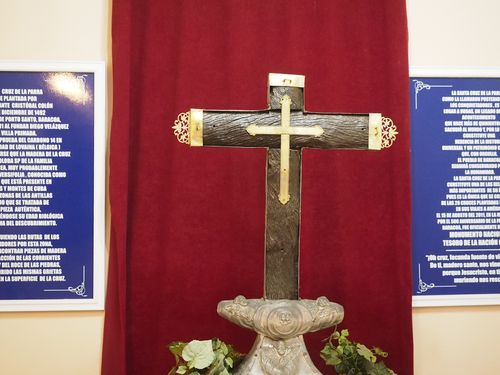
 Construction of the Cathedral of Our Lady of the Assumption in Baracoa began in 1807, during the Spanish colonial period. It suffered damage in 1833 and was largely rebuilt in 1886, with a portico added in 1905. Over the years, the structure deteriorated, leading to a full restoration completed in 2012. Since 1998, it has shared the role of cathedral for the Diocese of Guantánamo-Baracoa with Saint Catherine of Ricci Church. The cathedral also houses the Santa Cruz de la Parra, the only surviving cross believed to have been erected by Christopher Columbus during his first voyage in 1492. Made from native Cuban wood and carbon-dated to the late 15th century, it is considered a national treasure.

Monument profile
Cathedral of O.L. of the Assumption
Monument category: Cathedral
Monument family: Church, cathedral, basilica, chapel
Monument genre: Religious
Cultural heritage: Christian
Geographic location: Baracoa • Cuba
Construction period: 19th century AD
• Links to •
• List of videos about Baracoa on this site •
Baracoa, former capital • Cuba
Some historical places • Cuba
The Cathedral of Our Lady of the Assumption in Baracoa: A Historical and Cultural Chronicle
The Cathedral of Our Lady of the Assumption (Concatedral de Nuestra Señora de la Asunción) in Baracoa, Cuba, is one of the island’s most historically significant ecclesiastical buildings. More than a religious structure, it is a testament to the enduring legacy of Spanish colonization, the complex spiritual heritage of Cuba, and the resilience of a community shaped by centuries of upheaval. Its layered history, from colonial foundation to contemporary revival, reflects broader dynamics in Caribbean and world history.
Political and Social Context of Construction
The origins of the cathedral are inseparable from the founding of Baracoa in 1511 by Spanish conquistador Diego Velázquez de Cuéllar. Baracoa was the first permanent Spanish settlement in Cuba and the island’s initial capital. In the early 16th century, constructing a church was both a religious and political act. It served as a tool of Christian evangelization aimed at converting the indigenous Taíno populations and as a means of legitimizing Spanish sovereignty through spiritual authority.
The church was erected as part of a broader strategy employed throughout the Spanish Empire: the creation of religious centers in newly conquered lands to anchor colonial control. The church not only provided a physical place of worship but also functioned as a communal hub, a site for missionary instruction, and a symbol of the monarchy’s divine mandate. Its establishment thus reflected the ambitions of both the Spanish Crown and the Catholic Church to extend their reach across the Atlantic.
The socio-political stakes were high. The construction of a cathedral in a newly established colony like Baracoa symbolized permanence and domination. It reinforced a cultural hierarchy that placed European traditions at the center while simultaneously eroding indigenous religious practices. This context also involved strategic alliances with or subjugation of local chiefs (caciques), further embedding the Church in the colonial apparatus.
Major Historical Events and Transformations
Over the centuries, the cathedral has endured numerous physical and political transformations. The original structure from the early 1500s likely bore little resemblance to the current edifice, which was substantially rebuilt in 1807. This 19th-century iteration marked a new chapter for the building, coinciding with a renewed colonial push to modernize ecclesiastical architecture in Cuba, even as Spain’s grip on its American territories weakened.
In 1833, the structure suffered significant damage—possibly from a tropical cyclone, a frequent hazard in the region. A near-total renovation followed in 1886, incorporating stylistic and structural updates. The addition of the stone portico in 1905 gave the cathedral a neoclassical appearance still visible today. Despite these efforts, the building fell into disrepair during the second half of the 20th century, particularly following the Cuban Revolution of 1959, which drastically altered the role of religion in Cuban society.
A critical moment came in 1998, when Pope John Paul II established the Diocese of Guantánamo-Baracoa. The cathedral was elevated to the status of co-cathedral, sharing this role with the Cathedral of Saint Catherine of Ricci in Guantánamo. This recognition reinvigorated interest in the site and laid the groundwork for restoration campaigns.
By the early 2000s, however, the structure was in an advanced state of deterioration. A full restoration was initiated and completed in 2012, restoring structural stability and enhancing its role in the religious and cultural life of Baracoa.
Global Context at the Time of Construction
The construction of religious monuments in colonial territories was a widespread phenomenon during the Age of Discovery. Across Latin America, from Mexico City to Lima and Santo Domingo, cathedrals were erected as symbols of European dominance and religious conversion. These buildings combined imported architectural knowledge with local materials and labor, often blending European forms with indigenous craftsmanship.
Baracoa’s original cathedral project paralleled similar efforts across the Caribbean and the Americas. These churches served as beacons of colonial ideology, showcasing Spanish power and Catholic orthodoxy in territories far from the Iberian Peninsula. In many cases, they were built atop or near indigenous sacred spaces, further asserting Christian primacy.
By the early 19th century, when the current version of the cathedral was erected, the Spanish Empire was faltering. Revolutions in South America, the rise of Enlightenment ideas, and the growing discontent in the colonies influenced architectural projects. Religious buildings like Baracoa’s cathedral thus became not only spiritual refuges but also reminders of a colonial order under threat.
Architectural Changes and Urban Context
The cathedral’s architecture evolved with each renovation, adapting to both environmental pressures and aesthetic trends. The neoclassical elements added in the 19th century—columns, triangular pediments, and a symmetrical façade—reflected European tastes of the time, while the use of local limestone and coral stone grounded the structure in its Caribbean environment.
Its strategic location on Baracoa’s main square ensured its prominence within the urban fabric. Like many colonial cities, Baracoa was laid out according to Spanish urban planning principles, with the church and government buildings facing each other across a central plaza. This layout reinforced the unity of civil and ecclesiastical power.
Today, the cathedral still occupies this central location, surrounded by colonial-era buildings and facing the sea. The combination of historical continuity and evolving urban dynamics illustrates how the site has remained relevant despite the city’s shifting fortunes.
Religious and Cultural Importance Today
In contemporary Cuba, the Co-Cathedral of Our Lady of the Assumption functions as both a religious institution and a cultural monument. It hosts regular liturgical services and plays a key role in religious celebrations, particularly the Feast of the Assumption. It is also a major site for visitors exploring Cuba’s colonial heritage.
One of the cathedral’s most prized treasures is the Cruz de la Parra, or “Cross of the Vine,” reputedly erected by Christopher Columbus in 1492 during his first landing in Cuba. It is believed to be the only surviving cross of the 29 he is said to have planted across the Caribbean. Scientific testing has confirmed the wood’s age and local origin, adding to the relic’s authenticity. Displayed within the cathedral, it enhances the building’s historical and spiritual appeal, making it a pilgrimage site as well as a tourist attraction.
The cathedral’s presence contributes to Baracoa’s identity as Cuba’s oldest European settlement and a place where layers of history converge—from pre-Columbian cultures to colonial imposition, and from revolutionary redefinition to modern revival.
State of Conservation and Preservation Challenges
Despite the success of the 2012 restoration, the cathedral faces ongoing threats. The humid tropical climate, salt-laden air from the Atlantic, and occasional hurricanes pose continuous risks to its structure. Preservation efforts are complicated by economic constraints, particularly in a nation where state resources for heritage conservation are limited.
Urban development, while modest in Baracoa compared to Havana or Santiago, still introduces pressures—particularly as tourism grows. The cathedral’s location in a densely built historic center limits expansion and calls for sensitive urban management.
Although the building is not currently listed as a UNESCO World Heritage Site, it is protected under national heritage laws. Its continued preservation depends on careful maintenance, international awareness, and the engagement of both local communities and global heritage organizations.
Architectural Study of the Cathedral of Our Lady of the Assumption in Baracoa, Cuba
The Cathedral of Our Lady of the Assumption in Baracoa, located in Cuba's easternmost province of Guantánamo, stands as one of the island’s most historically and architecturally significant ecclesiastical structures. Originally founded in the early 16th century and extensively reconstructed in the 19th century, the cathedral illustrates both the legacy of Spanish colonial architecture and the adaptations necessary for construction in the Caribbean’s tropical environment. This analysis explores the architectural identity of the monument, focusing on innovations, materials, stylistic influences, structural organization, and conservation challenges, in order to highlight its importance within both local and global contexts.
Technological and Architectural Innovations
The cathedral’s current form largely dates from its major reconstruction in 1807, during a period when building techniques in Cuba were evolving in response to climatic conditions and material availability. Construction in this era was marked by pragmatic adaptations to seismic activity, hurricanes, and humidity. One of the key innovations evident in the cathedral is the implementation of passive ventilation strategies. The building incorporates high-set windows and strategically placed openings to ensure cross-ventilation, mitigating the accumulation of heat and moisture within the structure.
The architectural design also features modest wall heights and gently sloping gabled roofs, which serve to reduce wind resistance during hurricanes and facilitate the rapid drainage of rainwater. These elements, although appearing simple, reflect sophisticated knowledge of local environmental constraints. The alignment of the cathedral along the central plaza of Baracoa—consistent with Spanish colonial urbanism—demonstrates its integration into the town’s socio-political layout, emphasizing the combined authority of church and state.
Materials and Construction Techniques
Materials used in the construction of the cathedral were primarily sourced from the immediate environment. The thick structural walls are composed of coral limestone, a material both readily available and highly durable in the face of tropical weather. Coral stone was a common choice for colonial Caribbean architecture due to its workability and resistance to saline conditions. The use of lime-based mortar further contributed to the building’s resilience, allowing for natural expansion and contraction under varying temperatures.
The roof structure is supported by hardwood beams made from native species such as mahogany and cedar, known for their resistance to rot and insect damage. These tropical hardwoods enabled the creation of expansive interior spans without the need for excessive vertical support, thus preserving a sense of openness and grandeur within the nave. Construction methods involved a blend of European masonry techniques and local craftsmanship, with indigenous and African labor contributing significantly to the physical realization of the cathedral.
From a technological standpoint, the use of lime plasters and natural pigments for interior finishes allowed the walls to breathe, preventing moisture entrapment and extending the life of both masonry and decoration. While these materials and methods were not unique to Baracoa, their consistent application within a local context demonstrates a nuanced understanding of long-term sustainability in ecclesiastical construction.
Architectural and Artistic Influences
The Cathedral of Our Lady of the Assumption reflects a hybridization of architectural traditions. While its structural form is rooted in neoclassical European models—with symmetrical façades, triangular pediments, and engaged columns—the adaptation to Caribbean conditions creates a regional variant of the colonial church type. The 1905 addition of a portico, with its classical columns and simplified entablature, introduced a restrained monumentalism to the façade, typical of late colonial public architecture.
Inside the cathedral, decorative elements are modest but historically evocative. Remnants of painted motifs, geometric cornices, and floral ornamentation evoke both Spanish Baroque traditions and more localized, vernacular interpretations. The relative simplicity of the interior, likely due to limited funding and the scarcity of imported artisans in Baracoa, is offset by the symbolic presence of sacred relics, particularly the Cruz de la Parra, which adds spiritual grandeur to the space.
This cross, believed to be the only surviving relic among those erected by Christopher Columbus during his first voyage in 1492, provides a strong connection between the monument and the broader history of European exploration and Christian evangelization in the New World. As such, the cathedral becomes a repository not just of architectural significance, but of global historical memory.
Spatial Organization and Structural Features
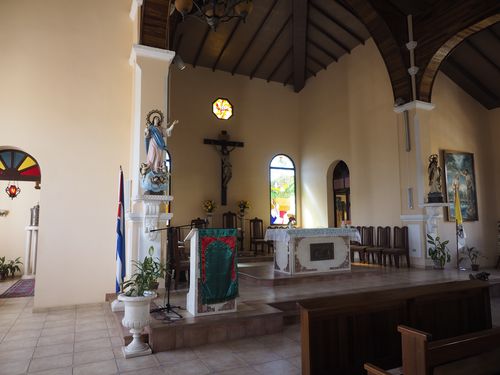
The cathedral is laid out in a traditional Latin cross plan, with a single nave flanked by shallow side chapels. The nave measures approximately 35 meters in length and 12 meters in width, with a vaulted ceiling rising to about 10 meters at its peak. The apse, slightly elevated, terminates in a semicircular shape that houses the high altar. The lack of transepts or a dome—a common feature in grander cathedrals—reflects both spatial and budgetary limitations, but also prioritizes simplicity and climatic adaptation.
One of the most striking external features is the square bell tower on the building’s south side, which rises to a height of roughly 20 meters. Its thick stone walls, narrow openings, and lack of ornate spires speak to a defensive as well as functional role. The belfry level includes arched vents for acoustic projection, and the tower serves as a vertical counterpoint to the otherwise horizontal massing of the structure.
The interior space is articulated by a rhythm of pilasters and archways, supporting a wooden ceiling structure and facilitating visual continuity along the nave. Balustrades and railings, likely added in the late 19th century, offer subtle detail while reinforcing spatial hierarchies within the liturgical space.
Notable Statistics and Anecdotes
The dimensions and materials of the cathedral are notable not for their grandiosity but for their endurance. The use of local limestone and tropical hardwoods, coupled with passive climate adaptations, has allowed the structure to survive multiple centuries of tropical weather, political shifts, and periods of neglect.
An intriguing historical anecdote concerns the reuse of stones from earlier structures in the foundation of the current cathedral. Some local traditions claim these stones may have originated from indigenous Taíno temples or from the initial 16th-century church, imbuing the building with layered cultural significance.
Furthermore, the Cruz de la Parra is not only a religious relic but also an object of historical inquiry. Carbon dating has confirmed that the cross dates from the late 15th century and is made from local wood, reinforcing its authenticity and adding to the cathedral’s reputation as a site of pilgrimage.
International Recognition and Conservation
While the Cathedral of Our Lady of the Assumption is not listed as a UNESCO World Heritage Site, it is recognized as a national monument in Cuba, providing it with a level of legal protection and conservation priority. Its architecture plays a central role in its cultural importance, embodying the transition from colonial authority to local heritage.
Restoration efforts completed in 2012 addressed major structural issues, including roof integrity, moisture infiltration, and façade deterioration. However, ongoing challenges remain. The tropical climate, occasional seismic activity, and salt-laden air from the nearby Atlantic continue to pose threats to the stonework and wood elements. Additionally, as tourism to Baracoa increases, careful visitor management will be necessary to prevent wear and ensure respectful engagement with the monument.
In conclusion, the Cathedral of Our Lady of the Assumption in Baracoa stands as a powerful example of adaptive colonial architecture. It marries Spanish design principles with Caribbean resilience, preserving not only a place of worship but also a symbol of continuity across five centuries of change. Its material choices, spatial organization, and enduring cultural role make it a cornerstone of Cuba’s architectural and spiritual landscape.