

 Français (France)
  Nederlands (nl-NL)
 Of Hindu tradition, (with additional Christian influence), the Perumpadappu Swaroopam dynasty ruled for approximately 699 years, ± between 1250 and 1949 over all or part of South India, during the Medieval Period and the Colonial Period.
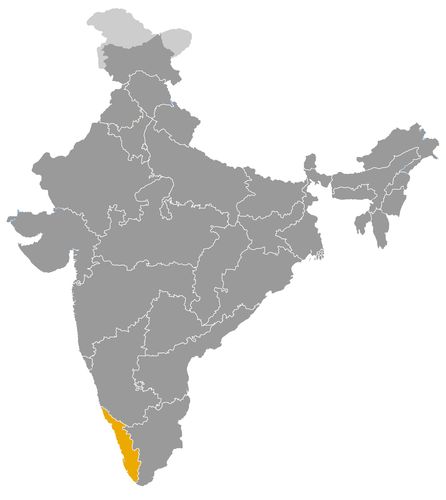
This map illustrates the maximum territory that the Perumpadappu Swaroopam Dynasty had reached at its height, covering the current regions of __ and Kerala in India. Its main purpose is to provide a visual aid to understand the geographical extent of this dynasty. However, it's important to note that the contemporary borders of these regions may not necessarily coincide with the historical territories.
The Perumpadappu Swaroopam and the Historical Role of the Kingdom of Cochin in India
A Kerala royal house linked to the history of Cochin
The Perumpadappu Swaroopam was the royal house that ruled Cochin, in present-day Kerala. Its history belongs to the political and maritime world of the Malabar Coast, a region shaped by trade, local principalities, temple networks, merchant communities and contact with foreign powers. Tradition links the origins of the dynasty to the political reorganisation that followed the decline of the older Chera order, although the succession becomes much more clearly documented from the early sixteenth century.
The importance of the Perumpadappu Swaroopam in Indian history does not rest on the creation of a large territorial empire. Cochin was a relatively small kingdom, but it occupied a strategic position on one of the most commercially active coasts of the Indian Ocean. Its rulers survived between more powerful neighbours, especially the Zamorin of Calicut and later Travancore, while also negotiating with successive European powers: the Portuguese, the Dutch and the British.
Cochin as a coastal kingdom in the politics of Malabar
Politically, Cochin played the role of an intermediate power in Kerala. It was neither the largest nor the most militarily dominant state of the region, but its location gave it considerable importance. The kingdom stood within the competitive political landscape of the Malabar Coast, where royal houses, temple authorities, local chiefs, aristocratic lineages and merchant groups all influenced power.
The arrival of the Portuguese at the beginning of the sixteenth century changed the position of Cochin. The rulers of Cochin allied with them partly to resist the pressure of the Zamorin of Calicut, who was then a major power on the Malabar Coast. This alliance strengthened Cochin against Calicut, but it also placed the kingdom within a new political order shaped by European naval power and commercial ambition.
After the decline of Portuguese influence, the Dutch East India Company became the principal European force at Cochin. Later, British supremacy transformed the kingdom into a princely state under colonial paramountcy. Through these successive phases, the Perumpadappu Swaroopam retained internal dynastic continuity, even while its external sovereignty became increasingly limited.
Political survival through diplomacy and adaptation
The history of the Perumpadappu Swaroopam is marked by survival rather than territorial expansion. The kingdom’s rulers had to manage threats from Calicut, Travancore, Mysore and European companies. Their political strategy depended on alliance-making, compromise, recognition of stronger powers and internal administrative consolidation.
In the eighteenth century, the expansion of Mysore under Hyder Ali and Tipu Sultan created serious pressure throughout Malabar and Kerala. Cochin’s vulnerability as a small coastal state became clear. The kingdom increasingly depended on external protection, especially as British influence grew in southern India. Under British rule, Cochin retained its ruling house and internal administration, but its foreign relations and military autonomy were restricted.
During the nineteenth and early twentieth centuries, several rulers of Cochin were associated with administrative reform. The princely state developed institutions related to finance, education, public works and local governance. This gave Cochin a reputation as one of the more effectively administered princely states of southern India. The role of the dynasty therefore shifted from regional warfare and diplomatic balancing to internal governance under colonial supervision.
Maritime trade and the economic foundations of Cochin
The economic importance of the Perumpadappu Swaroopam was inseparable from the geography of Cochin. The kingdom was located on the Malabar Coast, a region deeply involved in Indian Ocean trade. Pepper, spices, coconut products, timber, rice and other regional goods passed through coastal markets and port networks. Cochin’s economic role depended on both maritime commerce and access to the agricultural hinterland.
Merchant communities played a major role in this economy. Arab, Jewish, Christian, Muslim and Hindu trading groups contributed to Cochin’s commercial life. European companies did not create trade on the Malabar Coast, but they changed its organisation by introducing new military, naval and monopoly interests. The rulers of Cochin had to negotiate with these groups while preserving royal revenue and local authority.
Agriculture also remained essential. The kingdom’s resources came not only from port commerce but from villages, waterways, paddy fields, coconut groves and temple lands. Revenue from land and trade supported the court, religious patronage, administration and local institutions.
Cultural patronage in a plural society
The cultural role of the Perumpadappu Swaroopam must be understood within the diverse society of Kerala. Cochin was home to Hindu temple traditions, the Jewish community of Cochin, Saint Thomas Christians, Muslim merchants and later European settlements. The royal house governed within this plural environment and had to manage relations among different religious and social groups.
The dynasty supported Hindu temples, royal rituals and regional artistic traditions. Its authority was closely connected to the social structures of Kerala, including aristocratic lineages, temple institutions and matrilineal customs among ruling and elite groups. Royal patronage helped preserve ritual status and political legitimacy.
Cochin also became a place of cultural exchange. Its port environment connected Kerala with western Asia, Europe and other parts of the Indian Ocean. This did not erase local traditions, but it produced a distinctive urban and coastal culture in which Malayalam-speaking society interacted with global commercial networks.
A regional dynasty with lasting significance in Kerala
The Perumpadappu Swaroopam came to an end as a ruling power when Cochin was integrated into Travancore-Cochin in 1949, shortly after Indian independence. Its history shows how a small coastal kingdom could remain politically relevant for centuries through diplomacy, trade, adaptation and administrative continuity.
The dynasty did not reshape the entire Indian subcontinent, but it played an important role in the history of Kerala and the Malabar Coast. Its significance lies in the connection between local kingship, maritime trade, European intervention, religious plurality and princely-state governance. Through Cochin, the Perumpadappu Swaroopam became part of the wider history of India’s coastal regions and their links with the Indian Ocean world.
The Geographical Extension of the Perumpadappu Swaroopam on the Malabar Coast
A coastal kingdom centred on Cochin
The Perumpadappu Swaroopam, the royal house of Cochin, ruled a regional kingdom in present-day Kerala on the south-western coast of India. Its territory was never a large inland empire, but its geographical position gave it considerable importance. Cochin stood on the Malabar Coast, one of the most active maritime zones of the Indian Ocean, where pepper, spices, coconut products, timber, rice and other goods circulated through coastal and overseas trade.
The early history of the dynasty is linked to traditions surrounding the political fragmentation of Kerala after the decline of the older Chera order. Documentation becomes much clearer from the early sixteenth century, when the Portuguese entered into direct relations with Cochin. From that period onward, the kingdom can be understood as a compact coastal state with a fluctuating hinterland, dependent on waterways, ports, temples, markets and alliances with both local and foreign powers.
The territorial core around Cochin and central Kerala
The most stable base of the Perumpadappu Swaroopam lay around Cochin and the surrounding parts of central Kerala. This region included coastal settlements, lagoon systems, river channels, agricultural lands and market centres. The geography of the area favoured both maritime trade and inland communication. Unlike kingdoms built around large open plains, Cochin depended heavily on waterways and coastal access.
The royal house was associated with several centres over time. Perumpadappu belonged to the older dynastic memory, while Cochin became the main political and commercial focus during the early modern period. Later, Tripunithura emerged as an important royal residence, and Thrissur gained particular prominence under Shaktan Thampuran. These shifting centres reflect the dispersed and layered nature of political authority in Kerala, where royal power often coexisted with temples, local chiefs, aristocratic lineages and merchant communities.
A limited inland reach shaped by Kerala’s political structure
The inland extension of Cochin was more restricted than its maritime significance might suggest. The kingdom controlled parts of central Kerala, including agricultural villages, temple lands, markets and routes linking the coast to the interior. However, its authority was often discontinuous. In pre-colonial Kerala, political control was rarely a simple matter of uniform administration over a compact territory. Local houses, temple corporations, warrior elites and landed groups retained influence within and around royal domains.
The Western Ghats formed the eastern mountain barrier of Kerala, but the more immediate limitation for Cochin was political rather than purely geographical. The kingdom did not dominate the entire central Kerala hinterland. Its strength lay in controlling strategic coastal and riverine points that connected local production with maritime trade. This gave Cochin a role greater than its territorial size.
Northern rivalry with the Zamorin of Calicut
To the north, the most important rival of Cochin was the Zamorin of Calicut. Calicut was a major power on the Malabar Coast and had a strong position in the pepper trade and in maritime diplomacy. Cochin often found itself in a defensive position against Calicut’s influence. The struggle between the two states shaped the territorial history of the Perumpadappu Swaroopam for several centuries.
The arrival of the Portuguese at the beginning of the sixteenth century altered this balance. Cochin allied with the Portuguese partly to resist the Zamorin. This alliance helped preserve the kingdom’s autonomy, but it also brought Cochin into a new system of dependency. The territory of Cochin became strategically important not only to local rulers, but also to European powers competing for access to the Malabar trade.
Southern relations with Travancore
To the south, the rise of Travancore changed the political geography of Kerala. From the eighteenth century, Travancore became an expanding and increasingly powerful state. Its growth limited the territorial ambitions of smaller kingdoms, including Cochin. As Travancore consolidated its authority in southern Kerala, Cochin had to preserve its position through diplomacy rather than expansion.
Relations between Cochin and Travancore were shaped by rivalry, caution and occasional cooperation. Both states had to respond to the pressure of Mysore and, later, to British power. Travancore’s expansion meant that Cochin remained a smaller central Kerala kingdom rather than becoming the dominant power of the whole region. Its survival depended on managing its borders and accepting shifting regional hierarchies.
The impact of Mysore on Cochin’s territorial security
In the eighteenth century, the expansion of Mysore under Hyder Ali and Tipu Sultan placed severe pressure on the Malabar Coast and Kerala. Cochin’s territory was vulnerable because the kingdom lacked the military depth of larger inland states. Mysorean campaigns demonstrated that a coastal kingdom could be strategically important but militarily exposed.
This threat encouraged Cochin to seek external support. After earlier phases of Portuguese and Dutch influence, British power became increasingly decisive. Under British paramountcy, Cochin retained its internal territory and princely administration, but its external sovereignty was restricted. The kingdom’s borders became more stable, yet that stability depended on colonial protection rather than independent military strength.
Cochin as a princely state with a compact territory
During the British period, Cochin remained a princely state of modest size, positioned between Travancore, British Malabar and other administrative zones. Its territory included important urban centres, agricultural lands, waterways and port areas. Although it was no longer fully sovereign in external affairs, it retained a royal house, internal administration and a distinct political identity.
The geographical limits of Cochin also shaped its reforms. As a relatively compact state, it could focus on administration, public works, education, revenue management and urban development. Its rulers did not seek major territorial expansion during this period. Instead, the state’s significance rested on governance, trade, infrastructure and its position within the colonial princely system.
A small territory with wide maritime significance
The geographical history of the Perumpadappu Swaroopam shows that territorial size alone does not determine political importance. Cochin controlled a limited part of central Kerala, but its access to the Malabar Coast gave it a strategic role in Indian Ocean trade and regional diplomacy. Its relations with Calicut, Travancore, Mysore, the Portuguese, the Dutch and the British were all shaped by this coastal position.
The integration of Cochin into Travancore-Cochin in 1949 ended the effective sovereignty of the dynasty. Yet the historical importance of the Perumpadappu Swaroopam remains clear. It ruled a compact but strategically placed kingdom whose geography connected local Kerala society with the wider commercial and political world of the Indian Ocean.
This chronology follows the Cochin royal house, derived from the Perumpadappu Swaroopam. The period 1250–1503 corresponds to an early and traditional phase that is very poorly documented: the preserved names do not form a complete succession, and the dates should be understood as indicative. From 1503 onward, the succession of the rajas and later maharajas of Cochin is much better attested, until the state’s integration into Travancore-Cochin in 1949.
Early and traditional phase of the Perumpadappu Swaroopam, c. 1250–1503
- Veera Kerala Varma (c. 1250, traditional dating) • The first ruler traditionally associated with the Perumpadappu Swaroopam, he represents the early phase of the royal house before continuous documentation.
- Unni Goda Varma Koil Thirumalpad, or Unni Rama Koil I (c. 1500–1503) • Raja of Cochin when the Portuguese reached the Malabar Coast, he is linked to the first political contacts between Cochin and the Europeans.
Better documented rajas and maharajas of Cochin, 1503–1949
- Unniraman Koyikal II (1503–1537) • Raja of Cochin during the alliance with the Portuguese, he strengthened Cochin’s position against the Zamorin of Calicut.
- Veera Kerala Varma I (1537–1565) • He ruled during a period of strong Portuguese influence on the Malabar Coast.
- Keshava Rama Varma (1565–1601) • His reign is associated with the development of Cochin as a trading centre and with the lasting settlement of merchant communities.
- Veera Kerala Varma II (1601–1615) • He maintained the state amid rivalries between Cochin, Calicut and European powers.
- Ravi Varma I (1615–1624) • He ruled during a phase of political continuity under Portuguese protection.
- Veera Kerala Varma III (1624–1637) • He preserved dynastic authority in a period of regional and maritime pressure.
- Goda Varma I (1637–1645) • His reign belongs to the final phase of Portuguese predominance in Cochin.
- Veerarayira Varma (1645–1646) • His reign was brief and remains poorly documented.
- Veera Kerala Varma IV (1646–1650) • He ruled during a period of transition and internal tension.
- Rama Varma I (1650–1656) • He ruled before the regency of Rani Gangadharalakshmi and the dynastic reorganisation of the mid-seventeenth century.
- Rani Gangadharalakshmi (1656–1658, regency) • She exercised the regency during a delicate phase of succession.
- Rama Varma II (1658–1662) • He came to power after the regency and ruled on the eve of the shift toward Dutch alliance.
- Goda Varma II (1662–1663) • His brief reign immediately preceded the establishment of Dutch influence in Cochin.
- Veera Kerala Varma V (1663–1687) • He ruled after the Dutch victory over the Portuguese and Cochin’s entry into the orbit of the Dutch East India Company.
- Rama Varma III (1687–1693) • He maintained the dynasty under Dutch influence.
- Ravi Varma II (1693–1697) • His reign continued the political framework of the Dutch period.
- Rama Varma IV (1697–1701) • He ruled briefly in a context balancing local powers and European interests.
- Rama Varma V (1701–1721) • He was one of the important rulers of the Dutch period and strengthened Cochin’s position.
- Ravi Varma III (1721–1731) • He ruled amid increasing pressure in central Kerala.
- Rama Varma VI (1731–1746) • He governed before the expansion of Travancore and the political transformations of the eighteenth century.
- Kerala Varma I (1746–1749) • His reign was marked by the rapid evolution of power relations between Cochin, Travancore and neighbouring states.
- Rama Varma VII (1749–1760) • He ruled during a period of political pressure linked to the rise of Travancore.
- Kerala Varma II (1760–1775) • He governed before and during the tensions caused by Mysore’s expansion toward Malabar.
- Rama Varma VIII (1775–1790) • His reign was dominated by the Mysorean threat and the need to seek external support.
- Rama Varma IX, Shaktan Thampuran (1790–1805) • An energetic ruler, he strengthened administration and made Thrissur an important centre of the kingdom.
- Rama Varma X (1805–1809) • He ruled at the beginning of the formalised period of British dependency.
- Kerala Varma III (1809–1828) • He governed Cochin as a princely state under British paramountcy.
- Rama Varma XI (1828–1837) • His reign belongs to the phase of nineteenth-century administrative consolidation.
- Rama Varma XII (1837–1844) • He maintained the state within the British princely system.
- Rama Varma XIII (1844–1851) • He ruled during a period of political continuity limited by British supervision.
- Kerala Varma IV (1851–1853) • His reign was brief and belongs to the first half of the nineteenth-century princely period.
- Ravi Varma IV (1853–1864) • He governed during a phase of administrative change and adaptation to the colonial system.
- Rama Varma XIV (1864–1888) • He ruled during a period of gradual modernisation in the princely state of Cochin.
- Kerala Varma V (1888–1895) • He oversaw the transition toward the administrative reforms of the late nineteenth century.
- Rama Varma XV (1895–1914) • Known as Rajarshi or the Abdicated Highness, he carried out important reforms before his abdication.
- Rama Varma XVI (1914–1932) • He continued the administration of the princely state within the framework of the British Raj.
- Rama Varma XVII (1932–1941) • He ruled during a period of political and social change preceding Indian independence.
- Kerala Varma VI (1941–1943) • His brief reign took place during the Second World War.
- Ravi Varma V (1943–1946) • He governed at the end of the British colonial period.
- Kerala Varma VII (1946–1948) • He accompanied the final political changes before Cochin’s accession to the Indian Union.
- Rama Varma XVIII, Parikshith Thampuran (1948–1949, effective ruler) • The last official ruler of Cochin, he reigned until the state was integrated into Travancore-Cochin.