Français (France)
  Nederlands (nl-NL)
 Of Hindu tradition, (with additional Jain influence), the Vaghela dynasty ruled for approximately 60 years, ± between 1244 and 1304 over all or part of North India, during the Medieval Period.
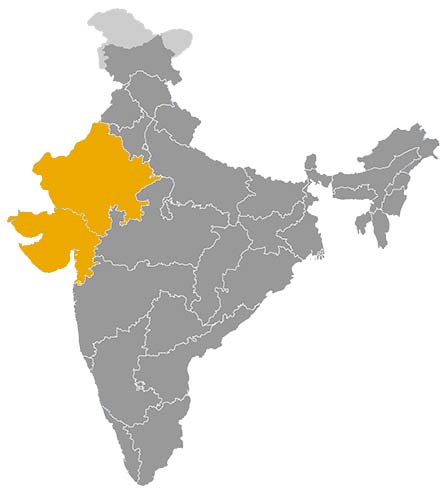
This map illustrates the maximum territory that the Vaghela Dynasty had reached at its height, covering the current regions of Rajasthan in India. Its main purpose is to provide a visual aid to understand the geographical extent of this dynasty. However, it's important to note that the contemporary borders of these regions may not necessarily coincide with the historical territories.
The Vaghela dynasty and its role in the history of medieval Gujarat
A transitional ruling house in western India
The Vaghela dynasty occupied an important but relatively brief place in the history of medieval India. It ruled mainly over Gujarat in the late thirteenth and early fourteenth centuries, after first rising to prominence under the weakening authority of the Chaulukyas, also known as the Solankis. Its fully sovereign phase is generally associated with the period from Visaladeva, around 1244, to the fall of Karna II in the early fourteenth century.
The Vaghelas were not founders of an entirely new political order. Their significance lies rather in their role as heirs, continuators and final representatives of a long tradition of regional Hindu rule in Gujarat before the expansion of the Delhi Sultanate. They governed a wealthy and culturally active region whose importance extended beyond its political boundaries because of its ports, merchant communities, temples and links with the wider Indian Ocean world.
The rise from Chaulukya service to sovereign authority
The emergence of the Vaghelas was closely connected with the decline of Chaulukya power. In the earlier phase, figures such as Lavanaprasada and Viradhavala exercised considerable regional authority, but they did so within a framework that still preserved Chaulukya legitimacy. They were powerful nobles, ministers and military leaders rather than fully independent monarchs.
This situation changed under Visaladeva, who is generally regarded as the first independent Vaghela ruler of Gujarat. The transition from service under the Chaulukyas to sovereign rule illustrates a wider pattern in medieval India, where strong aristocratic families could gradually take over the effective power of older dynasties while maintaining elements of continuity.
Politically, the Vaghelas helped preserve Gujarat as a distinct regional kingdom. They inherited administrative structures, fortified centres, land revenue networks and relationships with local elites. Their rule was therefore both conservative and adaptive. They maintained an existing regional order while responding to new military and political pressures.
Gujarat as a strategic and economic region
The importance of the Vaghela dynasty cannot be separated from the geography and economy of Gujarat. The kingdom was located in western India, with access to the Arabian Sea and to major inland routes linking Rajasthan, Malwa, the Deccan and northern India. This position made Gujarat one of the most valuable regions of the subcontinent.
Agricultural revenue formed the basis of royal power. The fertile plains and settled rural communities of Gujarat provided the income needed to support the court, the army, religious institutions and local administration. At the same time, the region’s towns and ports gave the kingdom a commercial importance that exceeded the scale of its territory.
Gujarat was linked to maritime trade across the Arabian Sea, including connections with the Persian Gulf, Arabia, East Africa and other parts of the Indian Ocean. Textiles, craft products, agricultural goods and imported commodities circulated through these networks. The Vaghelas inherited and maintained this prosperous economic environment, which later made Gujarat a major target for the Delhi Sultanate.
Relations with merchants, temples and religious communities
The cultural and economic life of Vaghela Gujarat was strongly shaped by urban and mercantile communities. Jain merchants and religious leaders were particularly influential in the region. They participated in trade, patronage, temple construction, manuscript culture and the financing of religious institutions.
The Vaghelas ruled within this environment of religious and social plurality. Hindu temples, Jain establishments, learned communities and pilgrimage centres contributed to the cultural identity of Gujarat. The dynasty’s cultural role was less that of a dramatic new artistic revolution than that of a ruling house preserving and supporting a well developed regional civilisation inherited from the Chaulukya period.
Architecture, sculpture and religious patronage continued to reflect the sophisticated traditions of western India. The temple culture of Gujarat, already highly refined under earlier rulers, remained an important element of public life. The Vaghela period therefore represents continuity in artistic and religious practices at a time of political change.
Political pressure from neighbouring powers
The Vaghelas ruled in a period when the balance of power in northern and western India was changing rapidly. To the north and northeast, Rajput states, Rajasthan polities and Malwa formed important political neighbours. These regions were connected to Gujarat by military routes, trade corridors and aristocratic networks.
The most decisive external pressure, however, came from the Delhi Sultanate. By the late thirteenth century, Delhi had become increasingly expansionist under rulers seeking to control wealthy provinces beyond the Gangetic heartland. Gujarat was especially attractive because of its revenue, cities, ports and commercial connections.
Karna II, the last important Vaghela ruler, faced this expansion. The defeat of the Vaghela kingdom and the incorporation of Gujarat into the sphere of the Delhi Sultanate marked a major turning point. It ended the independence of the old Hindu regional order in Gujarat and connected the region more directly to the Indo Islamic political networks of northern India.
A cultural bridge between two political eras
The Vaghela dynasty represents a bridge between two phases of Gujarat’s history. On one side stood the Chaulukya legacy, with its temple architecture, regional aristocracy, Jain patronage and established political traditions. On the other side came the period of Delhi Sultanate expansion, followed by new administrative, military and cultural influences.
The dynasty’s historical role is therefore not defined by long duration or imperial conquest. Its importance lies in the preservation of Gujarat’s regional structures during a period of transition. The Vaghelas maintained political continuity, supported a prosperous economy and governed a culturally rich society until external military pressure ended their sovereignty.
A brief dynasty with lasting regional significance
The Vaghela dynasty was short lived as an independent ruling power, but its place in Indian history remains significant. It marked the final phase of autonomous Hindu rule in medieval Gujarat before the consolidation of Delhi Sultanate influence. It preserved the economic vitality of a major trading region, continued the cultural traditions of western India and governed a territory of exceptional strategic value.
In the broader history of India, the Vaghelas stand as a regional dynasty whose importance was shaped by transition. They inherited an old order, maintained it for several decades and then gave way to a new political configuration. Their legacy is therefore tied to the continuity and transformation of Gujarat at a decisive moment in the history of western India.
The geographical extent of the Vaghela dynasty in medieval Gujarat
A regional kingdom centred on Gujarat
The Vaghela dynasty ruled mainly over Gujarat in western India during the late thirteenth and early fourteenth centuries. Its fully sovereign phase is usually placed between the reign of Visaladeva around 1244 and the defeat of Karna II in the early fourteenth century. Before this period, leading Vaghela figures such as Lavanaprasada and Viradhavala had already exercised considerable regional authority, but still within the political framework of the declining Chaulukya, or Solanki, kingdom.
The geographical extent of the Vaghela dynasty should therefore be understood as a continuation of the older Chaulukya territorial order. The dynasty did not create a vast new empire through large scale conquest. Instead, it inherited and maintained a powerful regional kingdom centred on Gujarat, a territory of major agricultural, urban and maritime importance. Its position in western India gave the Vaghelas strategic relevance beyond the size of their political domain.
Northern and central Gujarat as the political heartland
The core of Vaghela authority lay in northern and central Gujarat. This region contained long established political centres, fertile plains, temple towns, merchant settlements and routes connecting the interior with the coast. It formed the administrative and economic base from which the rulers could collect revenue, maintain troops and support religious and urban institutions.
The Vaghelas inherited this heartland from the Chaulukyas. Their authority was strongest in areas where older administrative networks, landed elites and religious establishments were already integrated into the political system. The transition from Chaulukya to Vaghela rule was therefore not a complete rupture. It was a shift of effective authority from an older royal line to a rising aristocratic family that gradually assumed sovereign power.
This continuity helped the Vaghelas maintain control over Gujarat during a period of political uncertainty. It also gave them access to the wealth needed to defend the region against neighbouring powers.
Coastal Gujarat and the Arabian Sea trade
One of the most important aspects of Vaghela territory was its connection with the coast of Gujarat. The region’s ports linked western India to the Arabian Sea and the wider Indian Ocean world. Through maritime commerce, Gujarat maintained contacts with the Persian Gulf, Arabia, East Africa and other regions of the subcontinent.
The Vaghela rulers did not necessarily control every commercial actor directly, but they benefited from the prosperity generated by port towns, merchant communities and inland trade routes. Goods from the interior moved toward the coast, while imported products entered Gujarat and circulated through urban markets.
This coastal dimension made the kingdom economically attractive and politically vulnerable. Control over Gujarat meant access not only to land revenue, but also to commercial wealth and maritime networks. This was one of the reasons why the Delhi Sultanate later considered Gujarat a valuable target for expansion.
Inland routes toward Rajasthan and Malwa
The Vaghela kingdom was also connected to Rajasthan and Malwa through inland routes. These regions formed important zones of military movement, trade and political contact. To the north and northeast, Rajput lineages and regional powers controlled forts, passes and territories that linked Gujarat with the wider political landscape of northern India.
Relations with Rajasthan were shaped by proximity, aristocratic networks and frontier concerns. The Vaghelas had to maintain stability along routes that could be used by allies, traders or hostile forces. These connections were important for the movement of horses, textiles, agricultural products and luxury goods.
Malwa, to the east, represented another important neighbouring region. Located between Gujarat, central India and the northern plains, it had strategic value for any power seeking influence across western and central India. The Vaghelas’ relations with Malwa were therefore shaped by competition, diplomacy and the need to protect Gujarat’s eastern approaches.
Local chiefs and uneven frontier control
The Vaghela kingdom was not a modern state with fixed borders and uniform administration. Its control was strongest in the core regions of Gujarat and more variable in frontier zones. Local chiefs, landed families, religious institutions and merchant groups retained significant influence in many areas.
This structure was typical of many medieval Indian regional kingdoms. Royal authority depended on negotiation as much as command. The ruler needed the support of local elites to collect revenue, defend territory and maintain legitimacy. In outlying regions, Vaghela influence may have taken the form of tribute, military pressure, alliance or recognition rather than direct administration.
This flexible territorial structure allowed the dynasty to govern a diverse region, but it also made the kingdom vulnerable when external pressure increased. If central authority weakened, local powers could shift allegiance or fail to provide effective resistance.
The decisive pressure of the Delhi Sultanate
The most important external challenge to the geographical integrity of the Vaghela kingdom came from the Delhi Sultanate. By the late thirteenth century, Delhi was expanding beyond its northern heartland and seeking control over wealthy provinces. Gujarat was an especially attractive objective because of its ports, cities, agricultural revenues and commercial connections.
Under Karna II, the Vaghela kingdom faced the full force of this expansion. The conquest of Gujarat by forces of the Delhi Sultanate ended the independent rule of the dynasty and altered the political geography of western India. The region became more directly integrated into the Indo Islamic political networks of northern India.
This conquest was not merely a dynastic change. It marked the end of an older regional order rooted in the Chaulukya and Vaghela traditions, and the beginning of a new phase in which Gujarat became a major province within broader imperial systems.
A compact but economically valuable territorial legacy
The geographical extent of the Vaghela dynasty was regional rather than imperial. It centred on Gujarat, especially its northern and central plains, its urban centres, its religious landscapes and its maritime connections. The dynasty’s power was strongest where it inherited established Chaulukya structures and weakest in frontier zones shaped by local chiefs and neighbouring powers.
Its location determined its relations with other dynasties. Rajasthan and Malwa formed important inland neighbours, while the Delhi Sultanate became the decisive external threat. The coast opened Gujarat to the Arabian Sea and gave the kingdom economic importance far beyond its territorial size. The Vaghelas therefore ruled a compact but highly valuable region, whose wealth and strategic position made it one of the most contested areas of medieval western India.
The Vaghela dynasty ruled Gujarat as a sovereign power mainly from c. 1244 to 1304. Lavanaprasada and Viradhavala belong to the family’s rise under the nominal authority of the last Chaulukyas and should not be confused with the fully independent rulers. The dates remain indicative, as chronological reconstructions vary according to historical sources.
Rise of the Vaghelas under Chaulukya authority
- Lavanaprasada (c. 1200–1240, regional power) • A leading Vaghela lord under the last Chaulukyas, he established the political strength of his family in Gujarat.
- Viradhavala (c. 1240–1244, regional power) • Son of Lavanaprasada, he strengthened family authority while remaining connected to the Chaulukya political order.
Independent Vaghela rulers of Gujarat
- Visaladeva (c. 1244–1262) • He is generally regarded as the first fully independent Vaghela ruler and consolidated dynastic power in Gujarat.
- Arjunadeva (c. 1262–1275) • He maintained Vaghela authority amid regional pressures and rivalries among western Indian powers.
- Ramadeva (c. 1275) • His brief and poorly documented reign marks a transition between Arjunadeva and Sarangadeva.
- Sarangadeva (c. 1275–1296) • He ruled during one of the last stable phases of the Vaghela kingdom and faced growing threats.
- Karna II (c. 1296–1304) • The last major Vaghela ruler, he was defeated during the expansion of the Delhi Sultanate into Gujarat.
 Links to the main sections of the site