

 Français (France)
  Nederlands (nl-NL)
 Of Hindu tradition, the Keonthal dynasty ruled for approximately 737 years, ± between 1211 and 1948 over all or part of the Himalayan region, during the Medieval Period and the Colonial Period.
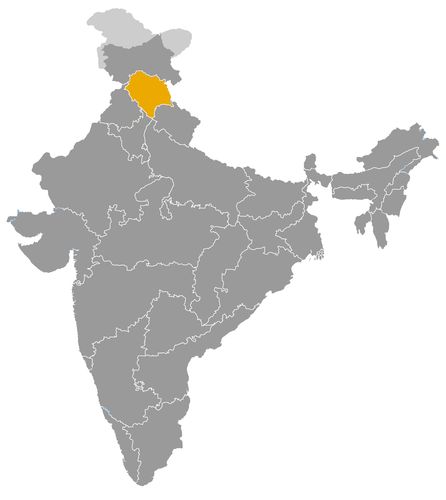
This map illustrates the maximum territory that the Keonthal Dynasty had reached at its height, covering the current regions of Himachal Pradesh in India. Its main purpose is to provide a visual aid to understand the geographical extent of this dynasty. However, it's important to note that the contemporary borders of these regions may not necessarily coincide with the historical territories.
The Keonthal Dynasty and Its Role in the History of the Himalayan Princely States
A Local Dynasty in the Hill States of Northern India
The Keonthal dynasty belonged to the complex political world of the western Himalayan hill states, in the region now forming part of Himachal Pradesh. Its historical importance was not based on the creation of a large territorial kingdom, but on the long survival of a local ruling house within a mountainous landscape of small principalities. Keonthal was one of the Simla Hill States, a group of princely states whose political life was shaped by geography, local lineages, regional rivalries and later British imperial supervision.
Dynastic tradition traces the ruling line back to Giri Sen, although the early chronology remains uncertain and partly belongs to genealogical memory. The better documented phase begins in the modern period, especially from the late eighteenth and early nineteenth centuries. During this later period, Keonthal emerged clearly as a princely state governed first by Ranas and later by Rajas under British suzerainty.
Political Authority in a Fragmented Mountain Region
The political role of Keonthal was closely connected to the structure of power in the Himalayan foothills. Unlike large imperial dynasties of the plains, the rulers of Keonthal governed a compact mountain territory made up of villages, valleys, forests, agricultural lands and local routes. Their authority depended on maintaining control over these resources while negotiating with neighbouring hill states.
In such a region, political power was rarely absolute. It was shaped by alliances, kinship relations, local obligations and the need to preserve balance with adjacent principalities. Keonthal’s rulers had to operate within a dense network of small states, each with its own ruling family and territorial interests. This made diplomacy and local legitimacy as important as military strength.
The Gurkha expansion into the western Himalayas at the beginning of the nineteenth century disrupted this older order. Keonthal, like several neighbouring states, experienced interruption or pressure during this period. After the defeat of the Gurkhas, the local rulers were restored under British protection. This restoration preserved the dynasty, but also placed it within a new political framework dominated by colonial authority.
Keonthal Under British Suzerainty
Under the British, Keonthal retained internal princely authority while losing independent control over external affairs. This was typical of many princely states in India. The ruling house continued to administer local matters, collect revenues and represent dynastic legitimacy, but its political autonomy was limited by the broader structure of imperial rule.
The recognition of the title of Raja in the nineteenth century was significant. It reflected the formalisation of Keonthal’s status within the hierarchy of princely India. The dynasty’s support for the British during the revolt of 1857 contributed to this recognition and strengthened its position within the colonial order.
Keonthal’s proximity to Shimla also increased its political relevance. Shimla became the summer capital of British India, making the surrounding hill states more visible within colonial administration. Although Keonthal remained territorially modest, its location gave it strategic and administrative importance within the Simla Hill States.
Economic Foundations of a Mountain Principality
The economy of Keonthal was shaped by its Himalayan environment. It relied primarily on agriculture, forest resources, pastoral activity, local taxation and regional exchange. The state’s revenues came from its villages, cultivated lands and natural resources rather than from large urban centres or extensive commercial networks.
In mountain principalities, economic management required careful control of land, water, forests and access routes. The ruling house depended on the productivity of rural communities and on the stability of relations with local elites. Fiscal authority was therefore closely connected to social negotiation.
During the British period, financial administration became more formalised. Some rulers faced difficulties in maintaining stable revenues, and colonial supervision sometimes intervened in matters of governance or fiscal management. This reflects the vulnerability of small princely states, whose resources were limited but whose administrative obligations increased under the colonial system.
Keonthal’s economic role was therefore regional rather than expansive. It did not dominate major trade routes on the scale of larger Indian states, but it formed part of the economic fabric of the Himalayan foothills, linking agrarian production, forest use, local markets and princely administration.
Cultural Continuity and Princely Identity
The cultural significance of Keonthal lies in its preservation of a distinctive form of Himalayan princely culture. The ruling family maintained traditions of courtly authority, local patronage, ritual legitimacy and architectural expression. These elements gave the dynasty a cultural role that extended beyond formal politics.
Palaces, residences and local religious institutions were central to this identity. The Chaumi Palace, associated with the ruling house, represents this princely world in architectural form. Such residences were not merely private homes. They expressed hierarchy, continuity, memory and the relationship between the ruler and the territory.
Keonthal’s culture was not that of a great imperial court, but of a smaller hill principality. Its importance lies precisely in this scale. It shows how aristocratic culture, local ritual practice and regional identity survived in compact mountain states. These traditions contributed to the diversity of India’s political and cultural heritage.
A Dynasty Representative of India’s Smaller Sovereignties
The Keonthal dynasty illustrates a part of Indian history that is often overshadowed by larger empires and more powerful dynasties. India’s past was not shaped only by Mauryas, Guptas, Mughals or Marathas. It was also formed by numerous small states that preserved local authority over long periods and adapted to changing regional and imperial circumstances.
Keonthal’s role was therefore not one of conquest or major territorial expansion. Its historical value lies in continuity, adaptation and regional embeddedness. The dynasty survived in a difficult mountain environment, negotiated with neighbouring rulers, endured external pressure, accepted British suzerainty and continued as a princely house until the integration of the state into Himachal Pradesh in 1948.
After that integration, Keonthal ceased to exist as a sovereign political unit. Yet its dynastic memory, architectural heritage and local identity remained part of the historical landscape of Himachal Pradesh. The dynasty stands as a representative example of the small Himalayan principalities that helped shape the political, cultural and economic diversity of northern India.
The Geographical Extent of the Keonthal Dynasty in the Simla Hill States
A Mountain Principality in the Western Himalayas
The Keonthal dynasty ruled over a small but historically significant princely state in the western Himalayan region, in what is now Himachal Pradesh. Its territory belonged to the group of principalities commonly known as the Simla Hill States. These states occupied a mountainous zone between the Punjab plains, the Himalayan foothills and the higher valleys of northern India. Keonthal was not a large kingdom, but its geographical position gave it a meaningful regional role.
The state was centred in the area around Junga, which served as the traditional capital, and was associated with princely residences such as Chaumi Palace. Its territory consisted of hill settlements, cultivated valleys, forested slopes, local routes and scattered administrative centres. In such an environment, political authority was not based on controlling vast continuous plains, but on managing a compact and varied mountain landscape.
A Compact Territory Shaped by Relief and Local Communities
The geographical extent of Keonthal was modest when compared with the larger princely states of India. Its land was fragmented by ridges, valleys, streams and forest zones. This type of terrain strongly influenced the nature of rule. The dynasty’s power depended on its ability to maintain authority over villages, agricultural lands, grazing areas, forest resources and access routes between settlements.
Mountain geography also meant that borders were not always experienced in the same way as in larger lowland states. Local rights, village dependencies, clan relations and traditional obligations could be as important as formal boundaries. The rulers of Keonthal had to govern through a network of local relationships, rather than through the highly centralised administration typical of larger kingdoms.
This compact territory gave the state a strong local identity. The dynasty was closely tied to its land, its residences, its temples and its rural communities. Keonthal’s influence was therefore regional and territorial rather than imperial.
Keonthal Within the Network of the Simla Hill States
Keonthal’s geography cannot be understood in isolation. It formed part of a dense political landscape made up of neighbouring hill states, each governed by its own ruling family. These principalities included territories of varying size and influence, but they shared similar geographical conditions and often similar political problems.
Relations with neighbouring dynasties were shaped by proximity. Disputes could arise over villages, forest rights, routes, revenue claims or precedence among ruling houses. At the same time, alliances, marriage connections and shared responses to external pressure helped maintain regional balance. Keonthal therefore operated in a world where diplomacy was essential.
The restricted size of the state limited its ability to expand aggressively. Instead, the ruling house focused on preserving its territory and status within the hill state system. Its geographical position made coexistence with neighbouring dynasties a constant necessity. Stability depended less on conquest than on negotiation, recognition and adaptation.
The Impact of Gurkha Expansion on Keonthal’s Territory
At the beginning of the nineteenth century, the expansion of Gurkha power into the western Himalayas disrupted the existing order among the hill states. Keonthal, like several neighbouring principalities, was affected by this military and political pressure. The Gurkha occupation interrupted local rule and exposed the vulnerability of the smaller Himalayan states.
This period changed the political geography of the region. The traditional hill principalities could no longer rely solely on local defences and alliances. The conflict brought them into the wider struggle between the Gurkhas and the British. After the defeat of the Gurkhas, Keonthal’s ruling house was restored under British protection.
The restoration preserved the state’s territorial identity, but it also altered the meaning of sovereignty. Keonthal retained internal authority over its lands, yet it now existed within a political framework shaped by British supremacy. Its territory was no longer merely part of an older hill state order, but also part of the colonial structure of northern India.
British Suzerainty and the Stabilisation of Boundaries
Under British suzerainty, Keonthal remained a princely state with internal administrative powers. Its rulers continued to manage local affairs, revenue, justice and relations with their subjects. However, external affairs, regional security and disputes between states were increasingly supervised or arbitrated by the British.
This had a major effect on relations with neighbouring dynasties. The possibility of territorial conflict did not disappear entirely, but it was more tightly controlled. The British system favoured stability among the hill states, especially because the region around Shimla acquired great administrative importance. Shimla became the summer capital of British India, and the surrounding principalities were therefore of particular interest to the colonial government.
Keonthal’s proximity to Shimla increased the practical importance of its location. Even though the state was small, it lay within a politically sensitive zone. Its territory formed part of the broader hill environment around one of the most important administrative centres of the British Raj.
Economic Consequences of a Mountain Territory
The territorial character of Keonthal shaped its economy. The state depended on agriculture, village revenues, forests, pastoral activity and local trade. Its economic base was not comparable to that of larger Indian states with major cities, ports or extensive plains. Instead, it reflected the conditions of a mountain principality.
Control over land and natural resources was central to princely authority. Forests provided material resources, slopes and valleys supported cultivation, and local routes connected villages to regional markets. The dynasty’s political stability depended partly on its capacity to manage these resources and maintain workable relations with rural communities.
The modest size of the state limited its economic reach, but also reinforced its local coherence. Keonthal functioned as a small territorial unit whose resources were closely tied to its geography.
A Limited Realm with Durable Regional Meaning
The geographical extent of the Keonthal dynasty was limited to a compact area of the Simla hills, centred on Junga and its surrounding territories. It was never an expansionist kingdom or a major regional empire. Its historical importance lies instead in the way it illustrates the functioning of small Himalayan principalities.
Keonthal’s territory shaped its relations with neighbouring dynasties, its response to Gurkha expansion, its integration into the British princely system and its economic structure. The dynasty’s history shows how political authority could endure in a restricted mountain landscape through adaptation, local legitimacy and external recognition.
With the integration of Keonthal into Himachal Pradesh in 1948, the state ceased to exist as a sovereign political unit. Its former territory became part of independent India, but its geographical and dynastic memory remains connected with the wider history of the Simla Hill States and the princely heritage of the western Himalayas.
The dynastic tradition of Keonthal traces the ruling line back to Giri Sen, but early dating varies between sources and partly belongs to genealogical memory. The rulers mainly used the title Rana until the nineteenth century, and later the title Raja under British suzerainty. The named chronology becomes much more verifiable from the modern period onward.
Early dynastic tradition of Keonthal
- Giri Sen (uncertain traditional date, sometimes c. 765 or c. 1211) • He is regarded in tradition as the founder of Keonthal and the ancestor of the local ruling line. His place belongs mainly to the genealogical tradition of the Simla Hill States.
- Early Ranas of Keonthal (from the medieval period to the late eighteenth century, individual reigns undocumented) • Tradition refers to a long succession of local chiefs before the modern period. Their names, order and reign dates are not securely established enough for a detailed list.
Better documented rulers from the modern period onward
- Bhup Sen (before 1801, poorly dated reign) • He is mentioned as the immediate predecessor of Raghunath Sen. The details of his rule remain uncertain.
- Raghunath Sen (1801–1803 and 1814–1831) • Rana of Keonthal, his rule was interrupted by the Gurkha occupation. After the defeat of the Gurkhas, his authority was restored under British protection.
- Sansar Sen (1831–1862, Rana and later Raja) • He ruled during the consolidation of Keonthal as a princely state under British suzerainty. His support for the British during the 1857 rebellion was followed by recognition of the title Raja.
- Mahendra Sen (1862–1882) • He succeeded Sansar Sen and ruled during a phase of administrative stabilisation. His reign is associated with financial recovery and with Keonthal’s integration into the framework of the Simla Hill States.
- Balbir Sen (23 August 1882–18 March 1901) • His reign was marked by internal difficulties and increased administrative supervision. The state remained part of the political group of the Simla Hill States.
- Bijey Sen (18 March 1901–2 February 1916) • He came to the throne at a young age and later received full ruling powers. His reign belongs to the period of princely administration under British supervision.
- Hemendra Sen (2 February 1916–1940, regency until 1926) • He ascended the throne during his minority and later ruled as Raja of Keonthal. His reign corresponded to a period of close control by the British administration.
- Hitendra Sen (1940–15 April 1948) • The last effective ruler of Keonthal, he reigned until the state was merged into Himachal Pradesh. After 1948, the dynastic title continued without political sovereignty.