Français (France)
  Nederlands (nl-NL)
 Of Hindu tradition, the Koch dynasty ruled for approximately 427 years, ± between 1522 and 1949 over all or part of East India, during the Medieval Period, the Colonial Period and the Modern Period.
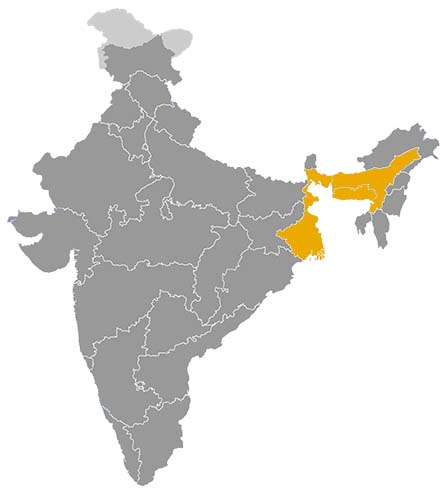
This map illustrates the maximum territory that the Koch Dynasty had reached at its height, covering the current regions of Assam, Meghalaya and West Bengal in India. Its main purpose is to provide a visual aid to understand the geographical extent of this dynasty. However, it's important to note that the contemporary borders of these regions may not necessarily coincide with the historical territories.
The Koch Dynasty and Its Role in the History of Eastern India
The Unified Koch Kingdom as a Regional Power
The Formation of Koch Authority in the Former Kamata Region
The Koch dynasty occupies an important place in the history of eastern and north-eastern India. It emerged in the sixteenth century in the former political space of Kamata, a region lying between northern Bengal, western Assam, the Himalayan foothills and the routes leading toward Bhutan. This location gave the dynasty a strategic role far beyond the size of its original territory.
The dynasty’s rise is associated with Biswa Singha, who transformed a local base of power into a structured regional kingdom. His achievement was significant because the area was ethnically, linguistically and geographically diverse. It included agricultural plains, forested zones, frontier settlements and communities linked to both Bengal and Assam. The Koch kingdom therefore developed as a political formation capable of integrating different local groups into a single royal framework.
This process also reflected a broader pattern in Indian history: the emergence of regional dynasties after the weakening of older political centres. The Koch rulers did not belong to one of the great imperial dynasties of the subcontinent, but they played a major role in organising a frontier region that connected several cultural and political worlds.
The Political Height Reached Under Nara Narayan and Chilarai
The reign of Nara Narayan marked the height of Koch power. With the military support of his brother Chilarai, the kingdom expanded its influence across northern Bengal and western Assam and asserted authority over several neighbouring areas. This expansion made the Koch dynasty one of the major powers of the north-east during the sixteenth century.
The kingdom’s political importance came from its position between larger and competing powers. To the east stood the Ahom kingdom of Assam, a durable regional force. To the south-west lay Bengal, first under regional sultanate influence and later under Mughal expansion. To the north were the Himalayan routes and the political world of Bhutan. The Koch kingdom therefore acted as both a buffer and an intermediary between these zones.
Its authority was not always exercised through direct administration. In many frontier regions, Koch influence could take the form of tribute, military pressure, local alliances or symbolic recognition. This flexible structure allowed the kingdom to expand rapidly, but it also made long-term unity difficult to preserve.
Cultural Patronage and Royal Legitimacy
The cultural role of the Koch dynasty lay in its ability to combine local traditions with broader Indian models of kingship. The early rulers gradually adopted forms of Hindu royal legitimacy, courtly titles, genealogical traditions and Sanskritic cultural references. This process helped situate the dynasty within the wider political culture of India while preserving its regional identity.
The court of Nara Narayan became associated with religious and intellectual patronage. The dynasty supported Hindu traditions and participated in the cultural life of the eastern frontier. In the Assam and Bengal regions, the Koch rulers also came into contact with devotional religious movements and local literary traditions. Their court helped create a bridge between regional cultures and the prestige of Sanskritic political models.
Koch Bihar as the Western Branch and Princely Successor
A Durable Line After the Division of the Kingdom
After the death of Nara Narayan, the Koch kingdom was divided between two main branches: Koch Bihar in the west and Koch Hajo in the east. Koch Bihar preserved the western core of the dynasty, centred on Cooch Behar and northern Bengal. Although it was smaller than the unified kingdom, it proved to be the more durable political successor.
Koch Bihar gradually shifted from an expansive kingdom to a more defensive regional state. Its rulers had to deal with Mughal influence from Bengal, Bhutanese intervention from the north and internal succession disputes. These pressures reduced its independence but did not destroy its dynastic continuity.
Integration Into the British Princely System
From the late eighteenth century, Koch Bihar came under British protection. This changed the nature of the dynasty’s political role. The rulers retained internal authority, courtly status and princely dignity, but external affairs and major political relations were increasingly controlled by the British.
Within the British Indian princely system, Cooch Behar became a recognised princely state. Several later rulers, especially in the nineteenth century, were associated with administrative reform, education, palace culture and closer links with other princely families. The title of Maharaja became part of this formal princely identity.
This phase gave the dynasty a new kind of importance. It no longer acted as an independent regional military power, but as a princely house adapting to colonial structures while preserving a distinct political and cultural identity.
Economic Foundations of Koch Bihar
The economy of Koch Bihar rested on land revenue, agriculture, forests, local markets and routes linking Bengal, Assam and the Himalayan foothills. Its position allowed it to benefit from regional exchange, while its rural base provided the fiscal foundation of princely administration.
Under British supervision, revenue management became more formalised. The state did not become a major economic power, but it maintained a stable regional economy based on agrarian production and administrative continuity. Its economic history reflects the transformation of a frontier kingdom into a regulated princely state.
Koch Hajo as the Eastern Branch in the Assam Frontier
A Strategic Territory Between the Mughals and the Ahoms
Koch Hajo represented the eastern branch of the divided Koch kingdom. Its territory lay mainly in western Assam and the lower Brahmaputra valley. This made it strategically important, but also highly vulnerable. The region formed a passage between Bengal and Assam and was contested by stronger neighbouring powers.
Unlike Koch Bihar, Koch Hajo did not develop into a long-lasting princely state. Its significance was mainly geopolitical. It stood at the centre of the rivalry between the Mughal Empire advancing from Bengal and the Ahom kingdom defending its authority in Assam.
The Fragmentation of Koch Power and Its Historical Meaning
The division between Koch Bihar and Koch Hajo permanently weakened the political unity created by Biswa Singha and Nara Narayan. Koch Bihar survived as a western princely state, while Koch Hajo was gradually absorbed into the struggles of Assam and the ambitions of the Mughals.
The Koch dynasty is therefore important because it reveals the complexity of India’s eastern frontiers. It was a regional power, a cultural mediator, a political bridge between Bengal and Assam, and later a princely house under British rule. Its history shows how a dynasty could rise from local roots, expand across a strategic frontier, divide into separate branches and still leave a durable legacy in the political and cultural landscape of eastern India.
The Geographical Extent of the Koch Dynasty Between Bengal and Assam
The Unified Koch Kingdom in the Former Kamata Region
A Strategic Core Between Northern Bengal and Western Assam
The Koch dynasty emerged in the sixteenth century in the former political space of Kamata, a region located between northern Bengal, western Assam and the Himalayan foothills. This geographical position shaped the dynasty from the beginning. The Koch rulers did not control a territory isolated within a single cultural zone. Their kingdom stood at the meeting point of Bengal, Assam, Bhutan and the wider north-eastern frontier of India.
The earliest territorial core of the kingdom was centred around the region of present day Cooch Behar and adjoining areas. From this base, Biswa Singha established Koch authority over a composite landscape of agricultural plains, forests, riverine corridors and frontier settlements. The kingdom’s strength came from its ability to connect different ecological and political zones. It controlled fertile lands suitable for cultivation, but also routes linking the Brahmaputra valley, the Bengal plains and the Himalayan approaches.
This geography made the Koch kingdom both valuable and vulnerable. It gave the rulers access to trade, tribute, manpower and forest resources, but it also exposed them to pressure from larger neighbours.
Expansion Under Nara Narayan and Chilarai
The greatest geographical expansion of the Koch kingdom occurred under Nara Narayan, with the military leadership of his brother Chilarai. During this period, Koch influence extended across northern Bengal and western Assam, and reached into several neighbouring areas of the north-east. The dynasty became one of the most important powers in the region.
The kingdom’s expansion was not always based on direct annexation. In many frontier zones, authority could take the form of tribute, military submission, local alliance or recognition of Koch supremacy. This was common in regions where terrain, distance and local political traditions made centralised administration difficult. The Koch state therefore functioned as a flexible regional power, stronger in its western core and more indirect in its outer dependencies.
The territories under Koch influence connected important corridors between the Ganges delta, the Brahmaputra valley and the Himalayan foothills. This allowed the dynasty to intervene in the affairs of Assam, to influence local chiefs and to participate in the political exchanges between Bengal and the north-east.
A Frontier Geography That Encouraged Both Trade and Conflict
The geographical position of the unified Koch kingdom encouraged economic exchange. Routes through the kingdom linked Bengal with Assam and with the Himalayan regions to the north. Agricultural produce, forest goods, elephants, textiles, hill products and local trade moved through this frontier zone. The control of these routes helped strengthen the dynasty’s economic base.
At the same time, the same geography created political tension. To the east, the Koch expansion brought the dynasty into contact with the Ahom kingdom, the dominant power in Assam. To the south-west, the growing influence of Bengal and later the Mughal Empire created another source of pressure. To the north, Bhutan and the Himalayan polities remained important neighbours. The Koch kingdom was therefore not merely a territorial state, but a frontier power whose geography demanded constant diplomacy and military readiness.
Koch Bihar as the Western Branch of the Dynasty
A Reduced but Durable Territory Around Cooch Behar
After the death of Nara Narayan, the Koch kingdom was divided between two main branches: Koch Bihar in the west and Koch Hajo in the east. This division permanently changed the geographical structure of the dynasty. Koch Bihar retained the western core of the old kingdom, centred around Cooch Behar and northern Bengal.
Although smaller than the unified kingdom, Koch Bihar proved to be the more durable branch. Its territory was compact and more closely connected to the Bengal plains. This gave it a clearer administrative base, but also placed it near the sphere of Mughal expansion. The rulers of Koch Bihar gradually shifted from expansionist kingship to the preservation of a regional state.
The state’s geographical position continued to be important. It lay between Bengal, Assam and Bhutan, making it both a buffer and a passage zone. Its rulers had to protect their autonomy while maintaining relations with more powerful neighbours.
Pressure From the Mughals, Bhutan and the British
Koch Bihar’s western and southern position brought it into close contact with Mughal power in Bengal. The kingdom retained its identity, but its freedom of action was reduced. Mughal influence limited its ability to act as an independent military power.
In the eighteenth century, Bhutanese influence from the north became a major factor in Koch Bihar’s internal affairs, especially in succession disputes. This pressure reflected the importance of the Himalayan frontier. Bhutan could intervene because Koch Bihar stood at the edge of the plains and the hill regions.
British intervention later transformed the state’s position. Koch Bihar became a princely state under British protection. This stabilised its territory and reduced Bhutanese interference, but it also ended independent control over external relations. The dynasty retained its lands and courtly status, but within the framework of colonial authority.
Koch Hajo as the Eastern Branch in Western Assam
A Territory in the Lower Brahmaputra Valley
Koch Hajo represented the eastern branch of the divided kingdom. Its territory lay mainly in western Assam and the lower Brahmaputra valley. This region was strategically important because it controlled routes between Bengal and the interior of Assam.
Unlike Koch Bihar, Koch Hajo occupied a more contested frontier. It stood between the Mughal advance from Bengal and the Ahom kingdom of Assam. Its geographical position gave it significance, but also made it difficult to preserve as an independent power.
Absorption Into the Rivalry Between Mughals and Ahoms
Koch Hajo’s fate was shaped by its location. The Mughals sought to extend their authority eastward, while the Ahoms resisted expansion into Assam. Koch Hajo became a buffer, a target and a contested zone between these powers.
The division of the Koch kingdom therefore had major territorial consequences. Koch Bihar survived as a reduced western principality, while Koch Hajo was drawn into the larger struggle for western Assam. The geographical history of the Koch dynasty shows the transformation of a broad regional kingdom into two unequal branches. It also explains why the Koch rulers played such an important role in the history of the frontier between Bengal, Assam and the Himalayan world.
- Biswa Singha (c. 1515-1540) • Founder of Koch power, he established his authority in the former kingdom of Kamata and adopted the title Kamateswar, marking the rise of a new regional dynasty.
- Nara Narayan (c. 1540-1587) • A major ruler of the dynasty, he expanded Koch influence over much of western Assam and northern Bengal, with the military support of his brother Chilarai.
- Lakshmi Narayan (c. 1587-1621) • Son of Nara Narayan, he inherited the western part of the kingdom after the dynastic division and ruled Koch Bihar amid rivalry with Koch Hajo and pressure from the Mughals.
- Bir Narayan (c. 1621-1626) • His short reign belongs to a period of political fragility, as the kingdom had to deal with growing Mughal influence.
- Pran Narayan (c. 1626-1665) • He attempted to restore the authority of Koch Bihar and ruled during a period marked by Mughal interventions in the region.
- Madan Narayan (c. 1665-1680) • He maintained the continuity of the Koch Bihar branch in a regional context shaped by relations with the Mughals, Bhutan and neighbouring powers.
- Basu Dev Narayan (c. 1680-1682) • A ruler with a very short reign, he belongs to an unstable succession phase within the western branch.
- Mahendra Narayan (c. 1682-1693) • He ruled at a time when royal authority in Koch Bihar remained exposed to internal and frontier tensions.
- Rup Narayan (c. 1693-1714) • His reign prolonged the relative stability of the line, despite continuing external pressure.
- Upendra Narayan (c. 1714-1763) • He ruled Koch Bihar for a long period, when relations with Bhutan and the powers of northern Bengal became increasingly significant.
- Devendra Narayan (c. 1763-1765) • His very short reign preceded a period of strong political tension and external intervention.
- Dhairjendra Narayan (c. 1765-1770, then 1775-1783) • His reign was marked by conflict with Bhutan and by the intervention of the British East India Company.
- Rajendra Narayan (c. 1770-1772) • He ruled during a transitional phase, when royal succession was strongly affected by internal and regional crises.
- Dharendra Narayan (c. 1772-1775) • His brief reign belongs to the context of succession struggles and interventions linked to tensions with Bhutan.
- Harendra Narayan (c. 1783-1839) • He ruled under increasing British influence, as Koch Bihar gradually became a princely state integrated into the colonial order.
- Shivendra Narayan (c. 1839-1847) • His reign continued the administrative and political evolution of Cooch Behar under British supervision.
- Narendra Narayan (c. 1847-1863) • He ruled during a period of princely reorganisation and adaptation to colonial administrative structures.
- Nripendra Narayan (c. 1863-1911) • An important ruler of the colonial period, he modernised the princely state and left a lasting mark on the architectural and institutional history of Cooch Behar.
- Raj Rajendra Narayan (c. 1911-1913) • His brief reign ensured dynastic continuity after the long rule of Nripendra Narayan.
- Jitendra Narayan (c. 1913-1922) • He ruled during the final decades of the British Raj, in a context of political change in India.
- Jagaddipendra Narayan (c. 1922-1949) • The last ruler of Cooch Behar, he reigned until the princely state was integrated into the Indian Union after independence.
- Raghudev Narayan (c. 1581-1603) • Nephew of Nara Narayan and son of Chilarai, he received and then asserted power over the eastern part of the kingdom, forming the Koch Hajo branch.
- Parikshit Narayan (c. 1603-1613) • Son of Raghudev Narayan, he continued the independence of Koch Hajo, but his reign ended with the Mughal conquest of Kamrup and the political disappearance of the kingdom.
 Links to the main sections of the site