

 Français (France)
  Nederlands (nl-NL)
 Of Hindu tradition, (with additional Animist influence), the Ahom dynasty ruled for approximately 598 years, ± between 1228 and 1826 over all or part of East India, during the Medieval Period and the Colonial Period.
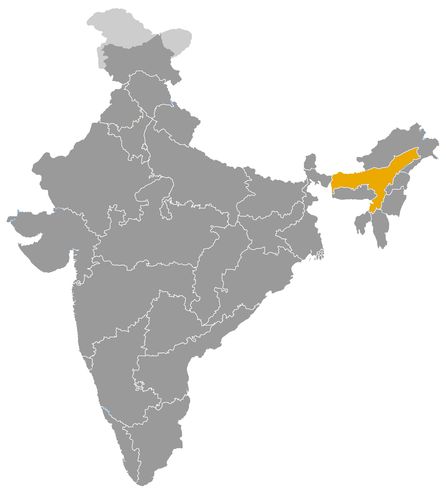
This map illustrates the maximum territory that the Ahom Dynasty had reached at its height, covering the current regions of Assam in India. Its main purpose is to provide a visual aid to understand the geographical extent of this dynasty. However, it's important to note that the contemporary borders of these regions may not necessarily coincide with the historical territories.
The Ahom Dynasty: Its Place and Role in the History of India
The emergence of a lasting kingdom in northeastern India
The Ahom dynasty occupies a unique place in Indian history as the ruling house that governed much of present-day Assam for nearly six centuries, from 1228 until the early nineteenth century. Founded by Sukaphaa, a Tai prince who migrated from the region of Mong Mao in present-day southwestern China and northern Myanmar, the kingdom developed into one of the most enduring political entities on the Indian subcontinent.
Unlike many medieval states established through rapid conquest, the Ahom kingdom expanded gradually by integrating local communities, forming political alliances and adapting to the cultural traditions of the Brahmaputra Valley. This ability to combine foreign Tai traditions with indigenous Assamese customs enabled the dynasty to create a remarkably stable and resilient state.
Throughout its history, the Ahom dynasty played an essential political, military, cultural and economic role in northeastern India, contributing significantly to the formation of Assamese identity and preserving the region's independence during periods of major imperial expansion.
Building a powerful regional state
Initially, the Ahom kingdom occupied only a limited territory in the upper Brahmaputra Valley. Over successive generations, its rulers expanded their authority by incorporating neighbouring tribal groups and absorbing smaller kingdoms. The greatest phase of expansion occurred during the reign of Suhungmung in the early sixteenth century. His military campaigns brought the Chutiya and much of the Dimasa kingdom under Ahom control, transforming the kingdom into the dominant political power of Assam.
The Ahom rulers bore the Tai title **Chao-Pha**, rendered in Assamese as **Swargadeo**, meaning "Lord of the Heavens." While maintaining their dynastic traditions, they gradually adopted elements of Indian kingship, including Hindu royal names and court rituals. This adaptation strengthened their legitimacy among the increasingly diverse population they governed.
The kingdom developed an efficient administrative system based on both hereditary offices and appointed officials. Regional governors, military commanders and high-ranking nobles supervised different parts of the realm while remaining subject to royal authority. This administrative structure proved sufficiently flexible to govern a territory inhabited by numerous ethnic and linguistic communities.
Defending northeastern India
One of the dynasty's greatest historical achievements was its successful resistance to external invasions. During the seventeenth century, the Mughal Empire attempted repeatedly to extend its authority into the Brahmaputra Valley after consolidating control over Bengal.
The resulting conflicts shaped the political history of northeastern India. Several campaigns were fought for control of western Assam, particularly around Guwahati, where strategic access to the Brahmaputra River made the region especially valuable.
The decisive moment came in 1671 at the Battle of Saraighat. Under the military leadership of Lachit Borphukan during the reign of Udayaditya Singha, the Ahom forces defeated a much larger Mughal army. Through superior knowledge of the river, effective defensive tactics and determined resistance, they prevented Mughal expansion into Assam.
The victory at Saraighat became one of the defining events in Assamese history. It preserved the independence of the Ahom kingdom and prevented Mughal political domination from extending into much of northeastern India. For this reason, the Ahom dynasty occupies a distinctive place among the regional powers that successfully resisted one of the largest empires in early modern Asia.
Economic organisation and agricultural development
The economic strength of the Ahom kingdom rested primarily on agriculture, particularly wet rice cultivation in the fertile Brahmaputra Valley. Extensive river systems, seasonal flooding and productive alluvial soils provided favourable conditions for agricultural expansion.
A distinctive feature of Ahom administration was the **paik** system, under which adult males were organised into service groups responsible for providing labour to the state. Depending on government needs, these obligations included military service, farming, road construction, irrigation works, boat building and public architecture.
Unlike economies relying primarily on monetary taxation, the Ahom state mobilised labour directly. This system enabled the kingdom to maintain a large army while simultaneously constructing extensive public infrastructure, including embankments, reservoirs, roads, palaces and temples.
Trade also flourished along the Brahmaputra and through contacts with neighbouring hill communities, Bengal, Tibet and Southeast Asia. Agricultural products, forest resources, textiles and handicrafts formed the basis of regional commerce, while the kingdom's strategic location facilitated exchanges between South and Southeast Asia.
Cultural integration and historical legacy
One of the dynasty's most significant contributions was its capacity for cultural integration. Although the founders spoke a Tai language and practised their own ancestral religion, they gradually adopted the Assamese language and increasingly embraced Hindu religious traditions, particularly Shaivism and Vaishnavism.
This process of cultural assimilation did not erase Ahom identity. Traditional priests continued to perform royal ceremonies, while elements of Tai culture remained embedded within court ritual and dynastic tradition. The resulting civilisation reflected a synthesis rather than the replacement of one culture by another.
Among the dynasty's most valuable intellectual achievements are the **Buranjis**, official court chronicles documenting political events, diplomacy, military campaigns and administrative affairs. Originally written in the Ahom language and later in Assamese, these texts constitute one of the richest historical traditions in pre-colonial India and remain indispensable sources for reconstructing the history of the region.
The Ahom rulers also left an important architectural legacy. Capitals such as Charaideo, Garhgaon, Rangpur and present-day Sivasagar preserve monuments including palaces, ceremonial buildings, temples, reservoirs and burial mounds. Structures such as Rang Ghar, Talatal Ghar and the royal necropolis at Charaideo illustrate the dynasty's sophisticated engineering and architectural achievements.
Decline and enduring importance
During the late eighteenth century, the Ahom kingdom entered a period of decline. Internal political rivalries, the prolonged Moamoria Rebellion and the weakening of the paik system reduced the effectiveness of the central government. Burmese invasions in the early nineteenth century further devastated the kingdom and accelerated its collapse.
Following the First Anglo-Burmese War, British influence expanded into Assam. Although Purandar Singha briefly regained authority over Upper Assam under British supervision, the remaining Ahom territory was annexed in 1838, bringing nearly six centuries of independent rule to an end.
Despite the disappearance of the kingdom, the Ahom dynasty remains one of the most influential political powers in the history of northeastern India. It unified much of Assam, preserved regional independence against powerful external empires, established an effective administrative system and fostered a distinctive cultural tradition that blended Tai and Indian influences. Its political institutions, historical chronicles, monuments and cultural legacy continue to occupy a central place in the historical identity of Assam and in the broader history of India.
The Geographical Expansion of the Ahom Dynasty in India
The foundation of a kingdom in the Brahmaputra Valley
The Ahom dynasty established its kingdom in 1228 when Sukaphaa, a Tai prince from Mong Mao, crossed the Patkai Hills and entered the upper Brahmaputra Valley. At its foundation, the kingdom occupied only a relatively small territory in what is now eastern Assam. Surrounded by mountains, forests and river systems, the region offered fertile agricultural land while providing natural defensive barriers that protected the emerging state.
Rather than pursuing rapid conquest, the early Ahom rulers gradually expanded their authority by forging alliances with local communities and integrating indigenous populations into their political system. This combination of diplomacy, military strength and cultural assimilation laid the foundations for one of the longest-lasting kingdoms in Indian history.
Gradual expansion across the Brahmaputra Valley
For nearly three centuries, the Ahom kingdom steadily extended its control westward along the Brahmaputra River. The valley itself became the geographical backbone of the kingdom, serving as its principal agricultural region, transportation corridor and political centre.
The most significant territorial expansion occurred during the reign of Suhungmung between 1497 and 1539. Under his leadership, the Ahom state transformed from a regional principality into the dominant political power of Assam. He conquered the Chutiya kingdom in eastern Assam and absorbed much of the Dimasa Kachari kingdom to the south. These conquests greatly increased the kingdom's territory, population and economic resources.
The enlarged kingdom controlled most of the fertile plains of upper and central Assam, enabling the Ahom rulers to strengthen agricultural production while securing important river routes and commercial networks.
A kingdom shaped by natural frontiers
The geographical position of the Ahom kingdom strongly influenced both its expansion and its diplomacy. To the north lay the foothills of the eastern Himalayas, inhabited by numerous hill communities with whom the Ahoms maintained a mixture of trade, tribute relationships and occasional military conflicts.
To the east, the Patkai Hills and the mountainous regions bordering present-day Myanmar formed a natural frontier separating Assam from the Shan states. Although these mountains limited large-scale military campaigns, they did not prevent cultural exchanges. The Ahoms themselves retained many elements of their Tai heritage while gradually adopting Assamese language and customs.
The southern frontier bordered the territories of the Dimasa Kacharis, Naga communities and other hill peoples. Relations alternated between warfare, political alliances and commercial exchanges, reflecting the strategic importance of controlling the routes linking the Brahmaputra Valley with the surrounding highlands.
The western frontier became the most politically significant. As the kingdom expanded downstream along the Brahmaputra, it came into direct contact first with the Koch kingdom and later with the Mughal Empire.
Relations with neighbouring kingdoms
Territorial expansion inevitably transformed the Ahom kingdom's relations with neighbouring states. The conquest of the Chutiya kingdom eliminated one of its principal eastern rivals while incorporating valuable agricultural lands and strategic river crossings.
The annexation of much of the Dimasa kingdom further strengthened Ahom influence over central Assam and brought the kingdom into closer contact with the hill states to the south. Rather than seeking complete domination of every neighbouring territory, the Ahoms frequently maintained buffer zones or tributary relationships that helped stabilise their frontiers.
Relations with the Koch kingdom fluctuated between rivalry and temporary accommodation. During the sixteenth century, both powers sought to dominate western Assam, creating a shifting frontier that reflected the changing balance of power in northeastern India.
These regional rivalries eventually drew the Ahom kingdom into direct confrontation with the Mughal Empire, whose expansion into Bengal brought one of Asia's greatest empires to the western borders of Assam.
Defending the western frontier
The seventeenth century marked the most important phase in the kingdom's military geography. The Brahmaputra River became both a strategic highway and a defensive barrier during repeated Mughal invasions.
Control of Guwahati proved especially important because the city occupied a narrow section of the valley where surrounding hills overlooked the river. Whoever held Guwahati effectively controlled access to central Assam.
Several campaigns were fought for possession of this region before the decisive Battle of Saraighat in 1671. Under the command of Lachit Borphukan, the Ahom navy and army defeated a much larger Mughal force attempting to advance along the Brahmaputra. The victory secured Ahom control over western Assam and effectively ended Mughal ambitions to conquer the entire valley.
This geographical success preserved the kingdom's independence for more than a century after many other Indian states had come under Mughal influence.
Administration of a diverse territory
As the kingdom expanded, the Ahom rulers developed an administrative structure capable of governing territories inhabited by numerous ethnic groups, languages and religious traditions.
The **paik** system provided labour and military service throughout the kingdom while enabling the central government to organise agriculture, public works and defence across a large geographical area. Rivers served as the principal communication routes, allowing officials, troops and supplies to move efficiently between different regions.
Successive capitals, including Charaideo, Garhgaon, Rangpur and present-day Sivasagar, were strategically located within the Brahmaputra Valley to facilitate administration and maintain effective control over the expanding kingdom.
The limits of expansion
Despite its considerable growth, the Ahom kingdom never sought to establish an empire encompassing the entire Indian subcontinent. Its ambitions remained focused primarily on controlling the Brahmaputra Valley and securing its surrounding frontiers.
The mountainous regions surrounding Assam acted both as natural barriers and as protective buffer zones. Rather than extending deep into these difficult terrains, the Ahom rulers generally preferred to maintain stable frontiers through diplomacy, limited military expeditions and tributary relationships with neighbouring communities.
During the late eighteenth century, internal unrest, particularly the Moamoria Rebellion, weakened central authority. Burmese invasions in the early nineteenth century further disrupted the kingdom's territorial control. Following the First Anglo-Burmese War, British influence expanded rapidly into Assam, and the remaining Ahom territory was finally annexed in 1838.
A lasting territorial legacy
At its greatest extent, the Ahom kingdom controlled most of the Brahmaputra Valley from eastern Assam to the region around Guwahati. Although its territory remained geographically concentrated, it represented one of the largest and most stable political entities in northeastern India for nearly six centuries.
Its territorial expansion shaped the political geography of Assam by bringing together diverse populations under a single administration while preserving the region's independence from larger imperial powers. The kingdom's frontiers, administrative centres and strategic river corridors influenced the historical development of Assam long after the end of Ahom rule, leaving a lasting imprint on the political and cultural landscape of northeastern India.
Ahom rulers bore the Tai title Chao-Pha, rendered in Assamese as Swargadeo, meaning “Lord of the Heavens”. From Suhungmung onward, several rulers also adopted a Hindu royal name. The chronology includes three interregnums between 1364 and 1397, several extremely brief reigns in the seventeenth century, the Burmese occupation beginning in 1817 and two interrupted restorations. Purandar Singha ruled again from 1833 to 1838 over a territory under British control.
- Sukaphaa (1228–1268) • A Tai prince from Mong Mao, he founded the Ahom kingdom in the Brahmaputra valley and established his capital at Charaideo.
- Suteuphaa (1268–1281) • The son and successor of Sukaphaa, he consolidated the young Ahom kingdom.
- Subinphaa (1281–1293) • He continued the organisation of the kingdom established by his predecessors.
- Sukhaangphaa (1293–1332) • His long reign was marked by territorial consolidation and conflicts with neighbouring kingdoms.
- Sukhrangphaa (1332–1364) • He ruled for more than three decades before a five-year interregnum.
- Sutuphaa (1369–1376) • A brother of Sukhrangphaa, he succeeded after the interregnum and was assassinated.
- Tyao Khamti (1380–1389) • His reign followed a second interregnum and ended with his deposition, opening another vacancy of the throne.
- Sudangphaa (1397–1407) • Also known as Bamuni Konwar, he restored the monarchy after an eight-year interregnum and introduced several Hindu influences at court.
- Sujangphaa (1407–1422) • A son of Sudangphaa, he maintained the stability of the kingdom during a reign of about fifteen years.
- Suphakphaa (1422–1439) • He continued the administrative and dynastic consolidation of the Ahom state.
- Susenphaa (1439–1488) • His reign of almost half a century provided a long period of political continuity.
- Suhenphaa (1488–1493) • His brief reign was marked by conflicts with Naga groups and ended with his assassination.
- Supimphaa (1493–1497) • He ruled for four years and was the father of Suhungmung.
- Suhungmung (1497–1539) • Known by the Hindu title Swarganarayan, he greatly expanded the kingdom at the expense of the Chutiya and Dimasa states and reformed its administration.
- Suklenmung (1539–1552) • He transferred the capital to Garhgaon, which remained a major centre of Ahom power for many years.
- Sukhaamphaa (1552–1603) • His long reign was marked by regional conflicts and the consolidation of his predecessors’ conquests.
- Susenghphaa, Pratap Singha (1603–1641) • He thoroughly reorganised the administration, created new offices and strengthened Ahom expansion westward.
- Suramphaa, Jayaditya Singha (1641–1644) • His short reign was dominated by political tensions and ended with his deposition.
- Sutingphaa (1644–1648) • Placed on the throne after his brother’s deposition, he was himself removed by the leading nobles.
- Sutamla, Jayadhwaj Singha (1648–1663) • He faced Mir Jumla’s Mughal invasion and was forced to accept the unfavourable Treaty of Ghilajharighat in 1663.
- Supangmung, Chakradhwaj Singha (1663–1670) • He rejected Mughal domination and launched the reconquest of western Assam, recovering Guwahati in 1667.
- Sunyatphaa, Udayaditya Singha (1670–1672) • His reign saw the Ahom victory at Saraighat in 1671, but he was subsequently overthrown and executed.
- Suklamphaa, Ramadhwaj Singha (1672–1674) • He ruled during a period of intense rivalry among court factions.
- Suhung (1674–1675) • Installed by the minister Debera Borbarua, he ruled for only a few weeks before being poisoned.
- Gobar Roja (1675) • An elderly member of a collateral branch, he was placed on the throne and soon deposed and executed.
- Sujinphaa (1675–1677) • His short reign unfolded under the influence of military factions and ended with his deposition.
- Sudoiphaa (1677–1679) • He attempted to free himself from the dignitaries who had raised him to the throne but was overthrown and executed.
- Sulikphaa, Ratnadhwaj Singha (1679–1681) • Still young when enthroned, he was dominated by Laluksola Borphukan and overthrown by Gadapani.
- Supaatphaa, Gadadhar Singha (1681–1696) • He ended a decade of instability, restored royal authority and permanently expelled the Mughals from Guwahati.
- Sukhrungphaa, Rudra Singha (1696–1714) • He strengthened the state, developed Rangpur and encouraged architecture, the arts and relations with neighbouring kingdoms.
- Sutanphaa, Siva Singha (1714–1744) • His reign was strongly influenced by his wives Phuleswari, Ambika and Sarbeswari, who successively exercised considerable political authority.
- Sunenphaa, Pramatta Singha (1744–1751) • A brother of Siva Singha, he continued royal building programmes and commissioned the monumental form of the Rang Ghar.
- Suremphaa, Rajeswar Singha (1751–1769) • His reign experienced cultural prosperity and military interventions in the kingdom of Manipur.
- Sunyeophaa, Lakshmi Singha (1769–1780) • The first phase of the Moamoria rebellion erupted during his reign and led to his temporary captivity in 1769–1770.
- Suhitpangphaa, Gaurinath Singha (1780–1795) • The renewed Moamoria rebellion severely weakened the kingdom and prompted the intervention of British troops.
- Suklingphaa, Kamaleswar Singha (1795–1811) • A minor at his accession, he ruled under the influence of prime minister Purnananda Burhagohain, who sought to restore the administration.
- Sudingphaa, Chandrakanta Singha (1811–1818 and 1819–1821) • Deposed after the first Burmese intervention, he was restored in 1819 before being permanently driven from power in 1821.
- Purandar Singha (1818–1819 and 1833–1838) • First installed during the Burmese crisis, he later ruled Upper Assam under British paramountcy until the annexation of his territory.
- Jogeswar Singha (1821–1824, nominal reign) • Placed on the throne by the Burmese, he exercised no effective sovereign authority during their occupation of Assam.