

 Français (France)
  Nederlands (nl-NL)
 00:00 • intro | 00:10 • Baba Muard Shah Ji Jora Ghar | 01:15 • Tomb of Muhammad Momin and Haji Jamal
Personal creation from visual material collected during my trip India • Hola Mohalla • Punjab • Himachal Pradesh (2018)
Map of places or practices in Nakodar on this site
• Use the markers to explore the content •
Nakodar: Sufi Sanctuaries and Mughal Heritage in Punjab
A Religious Landscape Shaped by Punjab’s Spiritual Traditions
Located in the Indian state of Punjab, Nakodar preserves a religious and architectural heritage reflecting centuries of cultural, spiritual, and artistic exchanges in northern India. The town is particularly known for its Sufi shrines and Mughal funerary monuments, which illustrate the historical importance of Punjab as a crossroads of religious traditions and artistic influences.
The video explores several complementary aspects of this heritage. It presents both active devotional spaces still frequented today and historic monuments whose architecture preserves traces of Mughal craftsmanship and regional decorative traditions. Together, these sites reveal the coexistence of contemporary religious practices and older forms of monumental heritage within the urban environment of Nakodar.
Baba Murad Shah Ji and the Mughal Tomb Complex
The shrine associated with Baba Murad Shah Ji occupies an important place in the religious life of the region. Visitors from different parts of Punjab and northern India continue to gather at the site during ceremonies and devotional events linked to local Sufi traditions. The spaces visible in the video show an active religious environment shaped by pilgrim circulation, prayer areas, and structures connected with contemporary devotional practices.
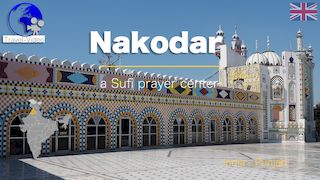
The route then moves toward the Tombs of Mohammad Momin and Hadj Jamal, a Mughal funerary complex particularly notable for its monumental architecture and polychrome ceramic decoration. Large domes, recessed arches, elevated terraces, and richly ornamented façades connect the monument with several seventeenth-century funerary structures built in historic Punjab during the Mughal period.
The complex is often described through the “Ustad-Shagird” tradition, referring to the relationship between a master and a disciple. This association contributes to the cultural identity of the monument and explains part of its continuing importance in regional memory. Today, the site is protected by the Archaeological Survey of India and remains one of the most remarkable surviving Mughal funerary ensembles in this part of Indian Punjab.
Architecture, Urban Change, and Historical Memory
The monuments presented in the video illustrate the transformation of Nakodar’s religious and urban landscape over several centuries. The Mughal tombs were probably constructed within a more open environment, while modern urban expansion progressively surrounded the complex with newer buildings and infrastructure. Despite these changes, the principal architectural volumes remain clearly visible and continue to dominate the immediate surroundings.
The ceramic decoration visible on the mausoleums forms one of the most distinctive aspects of the site. Polychrome panels, domes, and corner pavilions reflect artistic traditions that developed in Mughal Punjab through exchanges between the Indian subcontinent, Central Asia, and the Persian world.
The contrast between the active Sufi shrine and the historic funerary complex also reveals two different temporal dimensions of regional heritage: one deeply integrated into contemporary religious life, the other increasingly linked to architectural preservation and historical memory.
What the Videos on This Site Make Easier to Observe
The videos created for this site rely largely on carefully selected and animated photographs, allowing architectural details to be examined with greater precision than during a rapid visit. Slow movements within the images emphasize the proportions of the domes, the depth of the arches, and the symmetrical organization of the façades.
The transitions between wider views and close details also help clarify the relationships between the different parts of the complex. This approach makes it easier to observe ceramic ornamentation, changing light on monumental surfaces, and the gradual integration of the monuments into Nakodar’s contemporary urban setting.
A Regional Heritage Between Devotion and Preservation
Nakodar offers a particularly revealing example of the coexistence between active religious traditions and preserved Mughal heritage. Between the Sufi sanctuary still visited by pilgrims and the protected funerary monuments associated with Mohammad Momin and Hadj Jamal, the town preserves important testimonies to the cultural history of Punjab. The detailed pages linked to this video provide additional insight into the history, architecture, and symbolic role of these monuments within the region.
Links to related pages






Music:
- - YouTube video library - A Fallen Cowboy
Disclaimer: Despite its appropriateness, copyright issues prevent the use of indian traditional music in "Nakodar • Punjab, India ", hence the use of royalty-free music. Despite our careful selection, some might regret this decision, which is necessary to avoid potential lawsuits. Although difficult, this decision is the only viable solution.


