

 Français (France)
  Nederlands (nl-NL)
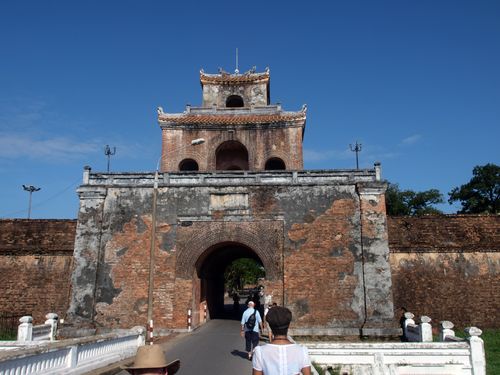
 La Cité impériale de Hué, située à Hué au Vietnam, constitue un vaste ensemble monumental qui fut le centre politique et cérémoniel du pays sous la dynastie des Nguyễn. Intégrée à un paysage urbain structuré par la rivière des Parfums, elle regroupe enceintes, palais, cours et espaces administratifs organisés selon des principes symboliques et fonctionnels. L’ensemble est reconnu pour son importance culturelle et institutionnelle et figure sur la Liste du patrimoine mondial de l’UNESCO. Aujourd’hui, la Cité impériale joue un rôle majeur dans l’identité de Hué, à la fois comme repère historique, site patrimonial ouvert au public et pôle culturel majeur du centre du Vietnam.

Hue • Forbidden City
Hue • Forbidden City

Hue • Forbidden City
Monument profile
Forbidden City
Monument categories: Citadel, Palace
Monument families: Fort, Fortifications or Citadel • Palace and Annexes
Monument genres: Military, Residential
Cultural heritage: Buddhist
Geographic location: Hue • Vietnam
Construction period: 19th century AD
This monument in Hue is inscribed on the UNESCO World Heritage List since 1993 and is part of the serial property "Complex of Hué Monuments".See the UNESCO monuments featured on this site
• Links to •
• List of videos about Hue on this site •
Hue, the mausoleum of Tu Duc • Vietnam
Hue, in the surrounding countryside • Vietnam
Hue, Celestial Lady Pagoda (Tien Mu) • Vietnam
Hue, the forbidden city • Vietnam
Historical Analysis of the Imperial City of Hué (Vietnam)
Political and Social Context of the Construction
The Imperial City of Hué was constructed in the early nineteenth century as the political and symbolic center of unified Vietnam under the Nguyễn dynasty. Its foundation is inseparable from the rise of Emperor Gia Long, who ascended the throne in 1802 after decades of civil war that had fragmented the country. The construction of a new imperial capital was both a political necessity and a statement of legitimacy. By establishing Hué as the seat of power, the Nguyễn dynasty sought to consolidate authority over a territory recently reunified after prolonged conflict between rival factions.
The choice of Hué reflected a careful balance between geography, politics, and tradition. Located in central Vietnam, the city occupied a strategic position between the northern and southern regions, allowing the emperor to govern a vast and culturally diverse realm. Socially, the creation of the Imperial City reinforced the Confucian model of governance, emphasizing hierarchy, ritual order, and centralized authority. The monument was designed not merely as a residence, but as a spatial expression of imperial ideology, where architecture and urban planning embodied the moral and political order promoted by the state.
Rivalries with former ruling families and lingering resistance movements influenced both the defensive character and the symbolic grandeur of the complex. At the same time, diplomatic relations with neighboring powers and the desire to project stability shaped its monumental scale and ceremonial functions.
Major Historical Events Affecting the Site
Throughout the nineteenth century, the Imperial City of Hué remained the administrative heart of Vietnam. However, its history was marked by repeated episodes of conflict and transformation. During the mid-nineteenth century, the increasing presence of European powers in Southeast Asia brought growing pressure on the Nguyễn dynasty. Military confrontations and treaties gradually weakened imperial authority, affecting the role and perception of the capital.
The late nineteenth century saw the city subjected to foreign intervention and occupation, which altered its political significance. Although the imperial court continued to function, real power increasingly shifted away from the emperor. These changes were accompanied by episodes of damage, looting, and neglect, particularly during periods of unrest.
In the twentieth century, the Imperial City experienced some of its most severe destruction. Armed conflicts led to extensive damage to palaces, gates, and ceremonial halls. Several structures were destroyed or heavily altered, while others fell into disuse. The end of the monarchy in the mid-twentieth century marked a decisive rupture in the site’s original function, transforming it from a living seat of power into a historical and cultural monument.
Global Context at the Time of Construction
The construction of the Imperial City of Hué took place during a period of significant global transformation. Across Asia, traditional empires were reaffirming or redefining their authority in response to internal consolidation and external pressure. Monumental capitals continued to be built or expanded as symbols of sovereignty, stability, and continuity.
At the same time, Europe was experiencing rapid political and industrial change, leading to increased global interaction and colonial expansion. While the Imperial City adhered primarily to East Asian imperial models, its construction occurred in a world increasingly shaped by global trade, diplomacy, and conflict. In this sense, the site represents one of the last major expressions of pre-modern imperial urbanism in the region, constructed just before colonial influence began to reshape political structures across Southeast Asia.
Transformations of the Monument Over Time
The Imperial City has undergone multiple transformations since its foundation. Initially conceived as a fully functional political and ceremonial center, it gradually adapted to changing circumstances. Administrative functions were reduced as political authority weakened, and certain areas were repurposed or abandoned.
Periods of decline alternated with efforts at repair and adaptation. During times of instability, maintenance was limited, leading to structural deterioration. Later, recognition of the site’s historical importance prompted restoration campaigns aimed at preserving remaining structures and reconstructing damaged elements. These interventions varied in scope and methodology, reflecting evolving attitudes toward heritage conservation.
Urban development around Hué also affected the monument. As the modern city expanded, the Imperial City became increasingly integrated into the urban fabric, shifting from a secluded political center to a focal point of historical memory within a growing city.
Contemporary Role and Cultural Importance
Today, the Imperial City of Hué holds a central place in Vietnam’s cultural and historical identity. It is widely regarded as a tangible link to the country’s imperial past and a key symbol of national heritage. The site is used primarily for cultural, educational, and commemorative purposes, hosting exhibitions, ceremonies, and public events that highlight its historical significance.
The monument also plays a role in local identity, serving as a source of pride and continuity for the city of Hué. Traditional festivals and cultural activities associated with imperial history contribute to its ongoing relevance in contemporary society. While no longer a political center, the site continues to shape perceptions of Vietnam’s past and its place within regional history.
Conservation Status and Modern Preservation Challenges
The preservation of the Imperial City presents complex challenges. Environmental factors such as humidity, seasonal flooding, and climate-related deterioration threaten the integrity of historic structures. Urban pressure, tourism, and pollution further complicate conservation efforts.
Restoration policies aim to balance historical accuracy with practical considerations, prioritizing the stabilization of surviving structures and the careful reconstruction of key elements. The site’s designation as part of the World Heritage framework has brought increased attention, funding, and international cooperation, while also imposing strict guidelines on intervention.
Despite ongoing efforts, conservation remains an evolving process. The challenge lies in preserving the monument’s historical authenticity while ensuring its accessibility and relevance in a modern urban and cultural context.
Architectural Analysis of the Imperial City of Hué
The architecture of the Imperial City of Hué represents one of the most complete and coherent expressions of imperial urban design in Southeast Asia during the early nineteenth century. Conceived as a functional, symbolic, and defensive capital, the complex integrates architectural traditions inherited from East Asia with local construction practices adapted to the environmental conditions of central Vietnam. Its design reflects both continuity with established imperial models and pragmatic innovation in response to climate, materials, and urban scale.
Technological and Architectural Innovations
One of the defining characteristics of the Imperial City lies in its integrated approach to architecture and urban planning. Rather than treating individual buildings as isolated monuments, the designers conceived the city as a unified system combining fortifications, ceremonial spaces, administrative areas, and residential compounds. This systemic design ensured structural coherence, efficient circulation, and strict spatial hierarchy.
From a technological perspective, the site demonstrates advanced knowledge of load distribution and structural balance. Large halls and ceremonial buildings rely on timber frameworks composed of carefully calibrated columns and beams, allowing wide interior spans without the use of masonry vaults. This flexibility reduced structural stress and improved resistance to ground movement and climatic variation.
Ventilation was a central concern. Buildings are arranged around open courtyards, with deep roof overhangs and covered galleries facilitating air circulation while limiting direct solar exposure. These features contributed to thermal regulation, an essential consideration in a region characterized by high humidity and seasonal heat.
Materials and Construction Methods
The choice of materials reflects both symbolic hierarchy and technical necessity. Defensive structures, including ramparts and gates, were constructed primarily from brick and stone, bonded with traditional mortars adapted to humid conditions. These materials provided durability and mass, essential for fortification and long-term stability.
Timber dominated the construction of palaces, halls, and residential buildings. Selected hardwoods were prized for their resistance to insects and moisture. Structural assemblies relied on interlocking joints rather than metal fasteners, a method that allowed buildings to flex slightly under environmental stress while maintaining overall integrity.
Roofing systems were both functional and emblematic. Fired ceramic tiles, often glazed, protected structures from heavy rainfall while signaling status through color and form. Steep roof pitches facilitated water runoff, while layered tile systems improved insulation and longevity. These roofing techniques illustrate a refined understanding of material performance under tropical conditions.
Architectural and Artistic Influences
The architectural vocabulary of the Imperial City reflects a synthesis of influences rather than direct imitation. Principles of axial symmetry, hierarchical enclosure, and ceremonial progression reveal strong links to East Asian imperial traditions. However, the implementation departs from monumental excess in favor of proportion, rhythm, and integration with the surrounding landscape.
Local artistic traditions are evident in decorative motifs and spatial articulation. Ornamentation emphasizes symbolic imagery, including flora, animals, and cosmological references, rendered in restrained but precise forms. Decorative elements are not merely aesthetic but serve to reinforce social order and ceremonial function.
Indirect foreign influences can also be detected, particularly in the design of fortifications. The geometric layout of bastions and the scale of defensive earthworks suggest familiarity with contemporary military architecture circulating in Asia at the time, adapted to local construction techniques rather than imported wholesale.
Spatial Organization and Structural Hierarchy
The Imperial City is organized through a series of concentric enclosures, each corresponding to a specific level of access and function. This spatial hierarchy governs movement and visibility, reinforcing political and ceremonial order through architectural means.
A central axis structures the complex, linking major gates, courtyards, and ceremonial halls. Along this axis, architectural scale and decoration increase progressively, culminating in the most symbolically charged spaces. Secondary buildings align symmetrically along this core, ensuring visual coherence and ease of orientation.
Courtyards play a crucial structural role, serving as transitional spaces that mediate between buildings while contributing to ventilation and natural lighting. Covered walkways connect key structures, allowing movement protected from weather while maintaining continuity of design.
Notable Architectural Elements
Several architectural components distinguish the Imperial City from other complexes of the same period. Monumental gates combine defensive mass with refined detailing, balancing strength and representational function. Elevated platforms and balustrades define ceremonial spaces, subtly controlling access and perspective.
Columns and beams exhibit precise proportional systems, ensuring both structural efficiency and visual harmony. Decorative roof ridges and gable ornaments, while restrained, convey symbolic meaning and denote building status. The absence of large-scale vaults or domes underscores reliance on timber engineering rather than masonry innovation.
Dimensions, Statistics, and Architectural Facts
The Imperial City occupies a vast enclosed area defined by extensive ramparts and surrounding moats. These defensive works serve both military and hydraulic purposes, stabilizing the ground and managing seasonal water levels. The repetition of modular building units across the complex illustrates a standardized approach to construction, facilitating maintenance and phased development.
An often-overlooked aspect is the durability of timber structures within a challenging climate. The longevity of surviving elements attests to the effectiveness of material selection, joinery techniques, and ongoing maintenance practices established during the imperial period.
International Recognition and Conservation Challenges
The architectural significance of the Imperial City contributes directly to its international recognition as a site of outstanding cultural value. Its coherent urban layout, adaptation of imperial architectural principles, and integration of environmental considerations place it among the most representative examples of pre-modern capital design in Southeast Asia.
Conservation challenges stem largely from the materials that define its character. Timber structures require continuous monitoring, while brick and stone elements face erosion from humidity and flooding. Urban expansion around Hué introduces additional pressures, necessitating careful management to preserve visual integrity and structural stability.
Current conservation strategies focus on preserving original construction techniques while accommodating contemporary requirements for accessibility and safety. The architectural integrity of the Imperial City remains central to these efforts, ensuring that its form continues to convey the technical and aesthetic ambitions of its creators.