

 Français (France)
  Nederlands (nl-NL)
 Kasthamandap is a religious monument located in Kathmandu, Nepal, and holds a significant place in the cultural and urban history of the Kathmandu Valley. Traditionally associated with the Hindu deity Gorakhnath, the structure historically functioned as a public shelter, meeting place, and ritual space. Built primarily of wood, it contributed to the identity of the city, whose name is closely linked to the monument. Kasthamandap forms part of Kathmandu Durbar Square, included in the UNESCO World Heritage listing of the Kathmandu Valley. Today, it remains an important symbol of religious tradition and historical continuity in Nepal’s capital.
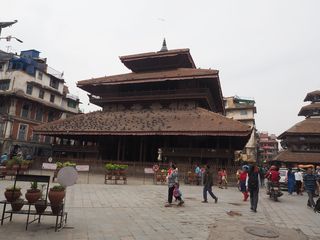
Kathmandu • Kasthamandap
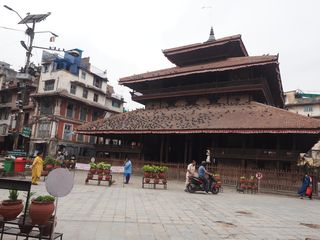
Kathmandu • Kasthamandap
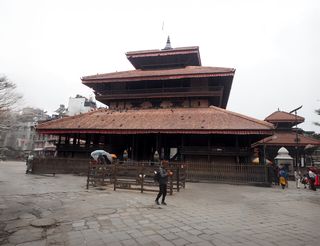
Kathmandu • Kasthamandap
Monument profile
Kasthamandap
Monument category: Hindu Temple
Monument family: Temple
Monument genre: Religious
Cultural heritage: Hindu
Geographic location: Kathmandu • Nepal
Construction period: 12th century AD
This monument in Kathmandu is inscribed on the UNESCO World Heritage List since 1979 and is part of the serial property "Kathmandu Valley".See the UNESCO monuments featured on this site
• Links to •
• List of videos about Kathmandu on this site •
Kathmandu • Great Buddhist stupas and sacred landscape
Kathmandu • Durbar Square, historic royal and religious centre
Kathmandu • Urban life, local temples and everyday spaces
Kathmandu • Pashupatinath, Hindu sanctuary on the Bagmati River
History of the Kasthamandap (Kathmandu, Nepal)
Political and social context of the construction
The Kasthamandap was erected in the early medieval period, traditionally dated to the twelfth century, at a time when the Kathmandu Valley was undergoing significant political consolidation and urban development. The valley was ruled by local dynasties that preceded the Malla kings, within a landscape marked by evolving trade networks, religious patronage, and the growing importance of urban centers. Kathmandu, then emerging as a major political and commercial hub, required public structures capable of accommodating religious, social, and administrative functions.
The construction of the Kasthamandap responded to these needs. Unlike royal temples dedicated exclusively to dynastic cults, the monument functioned as a civic-religious pavilion accessible to a broad segment of the population. Its association with the deity Gorakhnath, a figure linked to ascetic traditions and popular devotion, suggests an intention to integrate religious practice with communal life. The building embodied a form of authority rooted less in royal exclusivity than in public utility and shared ritual space.
Politically, the Kasthamandap contributed to the structuring of urban space in Kathmandu. Its location near the royal and commercial core reinforced the city’s role as a gathering point for traders, pilgrims, and local communities. By sponsoring such a monument, ruling elites demonstrated their capacity to provide infrastructure that supported both religious continuity and social cohesion.
Major historical events affecting the site
Over the centuries, the Kasthamandap was closely affected by the political transformations of the Kathmandu Valley. During the Malla period, when the valley was divided among competing city-states, the monument remained a stable civic reference point despite shifting dynastic control. While palaces and temples were often rebuilt to reflect the authority of successive rulers, the Kasthamandap retained its function as a shared urban structure rather than a dynastic emblem.
The unification of Nepal in the eighteenth century under Prithvi Narayan Shah altered the political framework of Kathmandu. As royal authority became centralized, many monuments associated with earlier regimes lost their symbolic prominence. The Kasthamandap, however, continued to serve communal and religious purposes, adapting to the new political order without losing its relevance.
Natural disasters played a decisive role in the monument’s history. Earthquakes in 1833 and 1934 caused significant damage, necessitating repairs that altered certain structural elements while preserving the overall form. The most severe impact occurred during the 2015 earthquake, which led to the complete collapse of the structure. This event marked a turning point, prompting extensive archaeological investigation and a large-scale reconstruction project.
Global context at the time of construction
The construction of the Kasthamandap occurred within a broader global context characterized by the growth of urban centers and the erection of multifunctional public buildings. In South Asia, similar developments can be observed in the construction of mandapas, caravanserais, and public halls that served religious, commercial, and social functions. These structures reflected societies in which mobility, trade, and pilgrimage played an increasing role.
Elsewhere in the world, comparable trends were evident. In medieval Europe, market halls and guild buildings emerged as focal points of urban life, while in the Islamic world, covered bazaars and civic complexes integrated commerce and religious practice. Although the architectural forms differed, these monuments shared a common purpose: to organize communal space and support expanding urban societies.
Within this global pattern, the Kasthamandap represents a regional response shaped by local materials, religious traditions, and environmental conditions. Its emphasis on openness and flexibility aligns with a widespread medieval concern for multifunctional public architecture.
Transformations and evolution of the monument
Throughout its history, the Kasthamandap underwent multiple phases of repair and adaptation. While its primary function as a public pavilion remained consistent, its immediate surroundings evolved significantly. The gradual densification of Kathmandu transformed the monument from a relatively isolated structure into an integral element of a crowded urban fabric.
Restoration campaigns following earthquakes introduced modifications intended to stabilize the building. These interventions reflected the technical knowledge of their time, sometimes incorporating new materials or construction methods while maintaining traditional forms. Such changes illustrate the ongoing negotiation between preservation and practical necessity.
Periods of political decline or transition did not result in the abandonment of the Kasthamandap. Instead, the monument continued to be reused for religious gatherings, social interactions, and as a resting place for travelers. This continuity of use contributed to its resilience and symbolic endurance.
Contemporary role and cultural significance
Today, the Kasthamandap holds a prominent place in the cultural consciousness of Kathmandu. It is widely recognized as a symbol of the city’s historical identity, reinforced by the fact that the name “Kathmandu” itself is derived from the monument. This linguistic connection underscores the building’s importance beyond its physical presence.
The reconstructed Kasthamandap serves as a site for religious observance, public gatherings, and cultural events. It embodies the continuity of communal traditions while also functioning as a reminder of the city’s vulnerability to natural disasters. For residents, it represents both heritage and resilience, linking past and present through shared space.
On a national level, the monument contributes to Nepal’s cultural narrative as an example of indigenous architectural and social traditions. Its visibility within the historic center reinforces its role as a reference point for understanding the evolution of Kathmandu.
Conservation status and modern preservation challenges
The inclusion of the Kasthamandap within the UNESCO World Heritage Site of the Kathmandu Valley has significant implications for its conservation. This status imposes strict guidelines regarding restoration methods, materials, and management practices. Following the 2015 earthquake, reconstruction efforts prioritized archaeological accuracy and traditional craftsmanship, drawing on historical documentation and material analysis.
Despite these efforts, the monument faces ongoing challenges. Seismic risk remains a constant threat, while urban pollution and heavy foot traffic affect the surrounding environment. Balancing accessibility with preservation requires careful management, particularly given the site’s continued social and religious use.
The reconstruction of the Kasthamandap has become a reference case in heritage conservation, illustrating the complexities of restoring a monument that is both historically significant and actively used. Its future preservation depends on sustained collaboration between local authorities, heritage experts, and the community.
Architecture of the Kasthamandap (Kathmandu, Nepal)
Architectural context and technological innovations
The Kasthamandap represents one of the most distinctive examples of traditional timber architecture developed in the Kathmandu Valley during the medieval period. Its construction reflects an advanced understanding of structural balance, material behavior, and environmental constraints. Unlike enclosed temple sanctuaries, the Kasthamandap was conceived as an open pavilion, requiring a design capable of combining stability with spatial openness. This architectural choice demonstrates a high degree of technical confidence among Newar builders, who relied on empirical knowledge accumulated over generations.
One of the monument’s most significant innovations lies in its post-and-beam structural system. The load of the superstructure is distributed through massive wooden columns directly anchored to a raised plinth, allowing forces to be transmitted vertically rather than laterally. This configuration reduces structural stress during seismic events, a critical consideration in the earthquake-prone Kathmandu Valley. The absence of masonry walls further minimizes the risk of catastrophic collapse by allowing controlled movement of the structure.
Ventilation and climatic adaptation were integral to the design. The open sides facilitate continuous air circulation, reducing humidity and preserving the timber elements. At the same time, the deep overhanging roof protects the interior from monsoon rains and excessive solar exposure. These features illustrate a holistic architectural approach in which structural, environmental, and functional considerations are inseparable.
Materials and construction methods
The defining material of the Kasthamandap is wood, traditionally believed to have been sourced from a single large tree, a notion that has become part of the monument’s cultural narrative. Regardless of this symbolic association, the extensive use of timber is architecturally significant. The primary structural elements consist of thick wooden pillars, beams, and struts, selected for their strength, durability, and flexibility.
Wood was particularly suited to the seismic conditions of the valley. Its natural elasticity allows it to absorb and dissipate energy during ground movement, reducing the likelihood of sudden structural failure. The builders employed sophisticated joinery techniques, such as mortise-and-tenon joints, wooden dowels, and interlocking connections, eliminating the need for metal fasteners. These methods enabled the structure to deform slightly under stress and return to its original configuration.
The plinth and base elements were constructed using brick and stone, providing a stable foundation and elevating the wooden superstructure above ground moisture. Traditional lime-based mortars were used to bond masonry components, ensuring compatibility with the surrounding materials and allowing gradual movement without cracking. The careful combination of wood, brick, and stone reflects an advanced understanding of material interaction and long-term durability.
Architectural influences and artistic expression
The architectural vocabulary of the Kasthamandap is firmly rooted in Newar traditions, yet it also reflects broader cultural exchanges within South Asia. The concept of a large, open mandapa-like structure aligns with Indian architectural models associated with assembly halls and rest pavilions. However, the execution is distinctly local, shaped by regional craftsmanship and urban practices.
Decorative elements are restrained when compared to more ornate temples of the Kathmandu Valley. Carved details appear primarily on struts, beams, and capitals, featuring geometric patterns, vegetal motifs, and symbolic figures. These carvings serve both aesthetic and structural purposes, reinforcing joints while providing visual rhythm. The relative sobriety of ornamentation underscores the monument’s civic and communal character rather than a purely ritual function.
The absence of elements such as domes, arches, or enclosed sanctuaries distinguishes the Kasthamandap from contemporaneous religious buildings influenced by other architectural traditions. Its design prioritizes horizontality and openness, reinforcing its role as a gathering space within the urban fabric.
Spatial organization and structural layout
The Kasthamandap is organized around a square plan, elevated on a stepped platform that defines its presence within the surrounding public space. This raised base establishes a clear boundary between the monument and the ground level while facilitating circulation around and beneath the structure. Access is provided from multiple sides, emphasizing inclusivity and ease of movement.
At the core of the structure stands a grid of massive wooden columns that support the roof. These pillars are arranged symmetrically, creating a modular spatial system that distributes loads evenly. The roof structure consists of layered beams and rafters, forming a gently sloping profile that directs rainwater away from the interior. The extensive eaves extend well beyond the column line, offering shelter while reinforcing the visual dominance of the roof.
Unlike enclosed temples, the Kasthamandap lacks internal partitions. This open layout allows the space to accommodate diverse functions, from religious gatherings to social assemblies. The clarity of the structural system ensures that the architecture remains legible, with each element clearly expressing its role.
Distinctive features and structural particularities
One of the most remarkable aspects of the Kasthamandap is the scale of its timber elements. The size and weight of the columns and beams testify to the logistical and technical capabilities of the builders, who were able to source, transport, and assemble large wooden components with precision. The visual impact of these elements contributes significantly to the monument’s identity.
Another distinctive feature is the complete reliance on wooden joinery for the superstructure. This approach contrasts with hybrid systems found elsewhere in the valley, where masonry and timber are more closely interwoven. The Kasthamandap thus stands as an extreme example of timber-dominated architecture within an urban context.
The building’s open configuration also represents a deliberate structural choice. By avoiding enclosed walls, the architects reduced lateral loads and improved seismic performance. This decision demonstrates a pragmatic understanding of risk management through architectural form.
Dimensions, notable data, and architectural anecdotes
While exact measurements vary across documentation, the Kasthamandap is generally recognized as one of the largest timber structures historically erected in the Kathmandu Valley. Its footprint and height are modest in comparison to multi-tiered pagoda temples, yet its expansive roof span and column grid create a monumental presence.
The belief that the structure was built using the wood of a single tree has long fascinated scholars and visitors alike. Although this claim is symbolic rather than literal, it reflects the cultural emphasis placed on unity, abundance, and craftsmanship. Such narratives contribute to the monument’s architectural mystique and underscore its exceptional status within local tradition.
International recognition and conservation challenges
The architectural significance of the Kasthamandap contributes directly to the global value of the Kathmandu Valley as a UNESCO World Heritage Site. Its design exemplifies indigenous building knowledge adapted to specific environmental and social conditions. As a result, conservation efforts emphasize the preservation of traditional materials and techniques.
The collapse of the monument during the 2015 earthquake highlighted both its vulnerability and the importance of its architectural principles. Reconstruction efforts focused on reestablishing the original structural logic, using traditional timber joinery and historically appropriate materials. These interventions aimed to restore not only the appearance but also the functional resilience of the building.
Ongoing challenges include exposure to pollution, fluctuations in humidity, and the pressures of dense urban surroundings. The long-term preservation of the Kasthamandap depends on careful monitoring of its wooden components and sustained commitment to traditional maintenance practices.
Architectural assessment
The Kasthamandap stands as a landmark of timber architecture in South Asia, embodying a refined balance between structural efficiency, environmental adaptation, and social function. Its architectural form reflects a deep understanding of materials and forces, achieved without reliance on monumental mass or elaborate ornamentation. Through its clarity of design and resilience, the Kasthamandap remains a key reference for the study of traditional architecture in the Kathmandu Valley and a testament to the enduring ingenuity of Newar builders.