

 Français (France)
  Nederlands (nl-NL)
 The Jagannath Temple is a Hindu temple located in Kathmandu, Nepal. Built in the 16th century during the Malla period, it forms part of the historic Kathmandu Durbar Square, the former royal and religious centre of the city. Dedicated to Jagannath, a form of Vishnu, the temple illustrates the close relationship between religion and political authority in medieval Kathmandu. As a component of the UNESCO World Heritage Site “Kathmandu Valley,” it represents an important element of the city’s cultural heritage and continues to function as a place of worship within the modern urban environment.


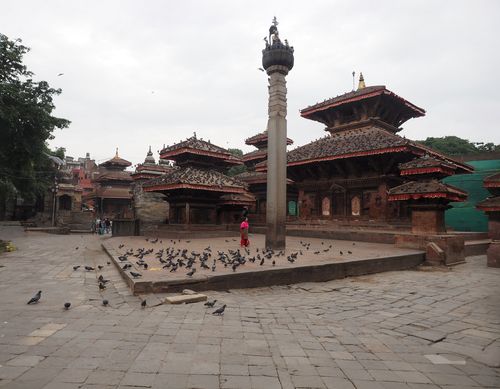
Jagannath Temple

History of the Jagannath Temple
Political and Social Context of Construction
The Jagannath Temple was constructed in the sixteenth century during the rule of the Malla dynasty, a period marked by political fragmentation and cultural vitality in the Kathmandu Valley. At that time, the valley was divided among the rival city-states of Kathmandu, Patan, and Bhaktapur, each governed by branches of the Malla family. Competition among these kingdoms extended beyond military confrontations to include the symbolic domains of religion, architecture, and ritual authority.
The foundation of the Jagannath Temple is generally attributed to King Mahendra Malla of Kathmandu, a ruler noted for his engagement with Hindu law, literature, and religious scholarship. The dedication of the temple to Jagannath, a form of Vishnu associated with cosmic preservation and moral order, reflected a deliberate political choice. By aligning royal authority with a protective and legitimizing deity, the king reinforced his role as guarantor of stability, justice, and continuity within a socially stratified urban society.
Socially, the temple emerged within a hierarchical Newar society in which religious spaces mirrored distinctions of power, caste, and function. The proximity of the temple to the royal palace complex was not incidental; it underscored the close interdependence between kingship and ritual practice. Access to specific areas of the temple was regulated, reflecting broader patterns of social organization and reinforcing the authority of royal and priestly elites.
Major Historical Events Affecting the Site
Throughout its history, the Jagannath Temple was shaped by the political upheavals that affected the Kathmandu Valley. Recurrent conflicts among the Malla kingdoms periodically destabilized the region, leading to phases of fortification, repair, and ceremonial reassertion within palace complexes. Although there is no evidence that the Jagannath Temple was the primary target of large-scale destruction, it inevitably shared in the broader impacts of warfare and political rivalry.
A decisive transformation occurred in the eighteenth century with the conquest of the Kathmandu Valley by Prithvi Narayan Shah and the incorporation of the Malla kingdoms into a unified Nepali state. This dynastic shift altered the institutional role of temples associated with former royal houses. The Jagannath Temple lost its function as a direct symbol of local sovereignty, yet it retained its religious significance and continued to serve as a place of worship within the new political framework.
Natural disasters also played a crucial role in the temple’s history. Major earthquakes in 1833, 1934, and 2015 caused extensive damage to Kathmandu Durbar Square and its monuments. The Jagannath Temple underwent successive restoration campaigns following these events, aimed at repairing structural damage while maintaining ritual continuity. These interventions, although sometimes resulting in minor alterations, ensured the survival of the monument across centuries of environmental stress.
Global Context at the Time of Construction
The construction of the Jagannath Temple coincided with a broader global trend toward monumental architecture as an expression of political and religious authority. During the sixteenth century, centralized powers across Asia, Europe, and the Middle East invested heavily in religious and palatial complexes to assert legitimacy and prestige. In the Indian subcontinent, Mughal rulers were developing expansive imperial centers, while in Europe the late Renaissance witnessed a proliferation of monuments linked to state power and ecclesiastical influence.
Within this global context, the Jagannath Temple represents a localized expression of a universal phenomenon. While firmly rooted in regional traditions and Hindu cosmology, the temple reflects the same impulse toward monumentalization and symbolic representation observed elsewhere. Its construction illustrates how the rulers of the Kathmandu Valley participated in global patterns of state formation and cultural display while maintaining a distinct architectural and religious identity.
Transformations and Evolution Over Time
Over the centuries, the Jagannath Temple experienced various transformations shaped by political change, urban development, and environmental constraints. Although its core religious function remained stable, its immediate surroundings evolved as Kathmandu Durbar Square expanded and adapted to new administrative and ceremonial needs.
Restorations following earthquakes often introduced structural reinforcements and selective repairs, reflecting changing approaches to conservation and engineering. These interventions sought to balance structural stability with respect for traditional materials and techniques. Periods of political decline, particularly after the fall of the Malla dynasty, did not lead to the abandonment of the temple but rather to a reorientation of its role toward religious practice rather than royal representation.
Urban densification around the palace complex altered the spatial perception of the temple, integrating it more closely into the daily life of the city. Despite these changes, the monument preserved its architectural coherence and symbolic resonance.
Contemporary Role and Cultural Significance
Today, the Jagannath Temple remains an active religious site and an important component of Kathmandu’s cultural landscape. It continues to host specific rituals associated with the Hindu calendar, maintaining its function as a living place of worship. Its presence within Kathmandu Durbar Square situates it at the intersection of religious devotion, historical memory, and public space.
For local communities, the temple embodies continuity with the past and serves as a tangible link to the Malla period, a formative era in the valley’s history. At the national level, it contributes to the cultural identity of Nepal by illustrating the historical depth and complexity of its religious traditions. For visitors, the temple offers insight into the organization of royal and religious life in pre-modern Kathmandu.
Current State of Conservation and Modern Challenges
The Jagannath Temple faces ongoing challenges related to preservation and urban pressure. Seismic vulnerability remains a persistent threat, compounded by pollution, heavy foot traffic, and the density of the surrounding urban environment. Wooden structural elements require continuous monitoring due to their sensitivity to humidity and biological decay.
Restoration efforts following the 2015 earthquake highlighted the complexities of heritage conservation in an active urban setting. Balancing modern engineering requirements with traditional construction methods remains a central concern. As part of the UNESCO-listed Kathmandu Valley, the temple is subject to international conservation standards, which provide both support and constraints. Coordinated management among local, national, and international authorities is essential to ensure its long-term preservation.
Historical Assessment
The Jagannath Temple stands as a significant historical monument reflecting the political ambitions, religious practices, and architectural traditions of the Malla period. Its endurance through dynastic change, natural disasters, and urban transformation underscores its resilience and cultural importance. As a component of Kathmandu’s royal and religious heritage, the temple offers valuable insight into the historical processes that shaped the Kathmandu Valley and continue to influence its cultural identity.
Architecture of the Jagannath Temple
Architectural Context and Technical Innovations
The Jagannath Temple represents a mature expression of royal Hindu architecture developed in the Kathmandu Valley during the late Malla period. Its construction reflects a refined understanding of structural balance, seismic adaptation, and urban integration, shaped by centuries of empirical knowledge accumulated by Newar craftsmen. Built within a dense palace environment and in a region of high seismic activity, the temple embodies architectural solutions specifically adapted to these constraints.
The overall design is based on a vertically articulated yet structurally conservative composition. Rather than relying on massive singular volumes, the temple employs a tiered configuration that distributes weight progressively toward the ground. This strategy reduces lateral stress during earthquakes and limits the risk of catastrophic collapse. The absence of large-span interiors and concentrated loads at higher levels further enhances the building’s structural resilience.
Environmental considerations also influenced the design. The limited number of openings, combined with deep roof overhangs, protects the structure from monsoon rains while moderating interior temperature fluctuations. These features demonstrate an architectural approach that integrates structural stability, climatic adaptation, and symbolic form.
Materials and Construction Methods
The construction of the Jagannath Temple relies on a carefully calibrated combination of locally available materials, selected for both their mechanical properties and cultural significance. Fired brick constitutes the primary material for load-bearing walls and platforms. The bricks, produced in the Kathmandu Valley, display consistent dimensions that allow for precise masonry and even load distribution. Their mass contributes to the building’s stability while providing a durable surface for architectural articulation.
Wood plays a central role in both the structural and aesthetic dimensions of the temple. Timber elements are used extensively for columns, beams, struts, roof frameworks, and door assemblies. Local hardwood species were chosen for their strength, flexibility, and resistance to decay. The structural system avoids rigid metallic fasteners; instead, it relies on traditional joinery techniques such as mortise-and-tenon connections. These joints permit controlled movement during seismic events, allowing the building to absorb energy without fracturing.
Traditional lime-based mortars bind the brick masonry while maintaining a degree of elasticity. This compatibility between brick, wood, and mortar creates a coherent structural system in which materials respond harmoniously to environmental stresses. The visible contrast between red brick surfaces and dark carved wood contributes to the temple’s visual clarity and architectural legibility.
Architectural and Artistic Influences
The architectural vocabulary of the Jagannath Temple is firmly rooted in the Newar tradition, while selectively incorporating broader influences from the Indian subcontinent. The temple’s compact plan, vertical hierarchy, and roof composition follow regional conventions developed over centuries in the Kathmandu Valley. These features distinguish it clearly from contemporaneous Islamic or Mughal architectures, which emphasize domes, arches, and axial symmetry.
Wood carving constitutes one of the temple’s most distinctive artistic elements. Struts, lintels, and doorframes are densely ornamented with representations of deities, mythological beings, and stylized vegetal motifs. These carvings are not applied decoration but integral components of the structural system, reinforcing the unity of form and function. The iconographic program reflects Hindu cosmology while adhering to stylistic conventions specific to the Newar artistic tradition.
External influences appear subtly in proportional relationships and compositional discipline rather than in overt stylistic borrowing. The temple thus illustrates a selective assimilation of broader cultural currents, filtered through local craftsmanship and religious practice.
Spatial Organization and Structural Layout
The Jagannath Temple is constructed on an elevated plinth that serves both symbolic and practical purposes. The raised base marks a transition from the civic space of the square to the sacred realm of the temple, while also protecting the structure from ground moisture and surface runoff. Access is provided by a controlled staircase that reinforces the axial approach to the shrine.
Internally, the spatial organization is compact and hierarchical. The progression from exterior platform to inner sanctum is deliberately constrained, limiting circulation and emphasizing the sanctity of the central space. This inward-focused layout reflects ritual priorities rather than congregational use, distinguishing the temple from religious structures designed for large assemblies.
The superimposed roof system is a defining feature of the temple’s architecture. Each tier is structurally independent yet visually connected, creating a stepped silhouette that balances vertical emphasis with horizontal articulation. Wide eaves shield the walls and carvings from weather exposure while visually anchoring each level. The resulting form is both structurally efficient and symbolically expressive.
Distinctive Structural Features
Among the temple’s notable characteristics is the extensive use of exposed wooden struts as both load-bearing and iconographic elements. These struts support the projecting roofs while simultaneously conveying religious imagery, exemplifying the Newar principle that structural necessity and symbolic meaning should coexist.
The walls are relatively solid, with few and carefully positioned openings. This configuration enhances structural integrity and reduces vulnerability to seismic forces. The restrained use of openings also reinforces the temple’s introverted character, emphasizing the separation between sacred interior and public exterior.
Unlike religious buildings from other traditions, the Jagannath Temple contains no domes, vaults, or towers. Its architectural identity relies instead on proportional harmony, layered roofs, and intricate surface articulation. This approach reflects a regional aesthetic that prioritizes balance and continuity over monumental scale.
Dimensions, Quantitative Data, and Notable Characteristics
While precise measurements vary among historical surveys, the Jagannath Temple is generally classified as a medium-scale structure within Kathmandu Durbar Square. Its perceived height is enhanced by the elevated plinth and the vertical stacking of roof tiers, allowing it to assert a strong visual presence despite its limited footprint.
The density of carved elements is particularly notable. Compared to larger temples, the Jagannath Temple concentrates ornamentation within a relatively small volume, creating a high level of visual complexity. This concentration reflects both the temple’s royal association and the technical virtuosity of its craftsmen.
Inscriptions carved into parts of the temple provide valuable documentation of legal and religious practices during the Malla period. These inscriptions elevate the monument’s significance beyond architecture, positioning it as a material record of governance and ritual life.
Architectural Legends and Symbolic Narratives
Traditional narratives associated with the Jagannath Temple emphasize the close relationship between the deity and the ruling monarch. According to these accounts, the temple’s design and construction were guided by divine sanction, reinforcing its status as a structure of exceptional importance. While these narratives cannot be treated as historical evidence, they illuminate the symbolic framework within which the architecture was conceived and interpreted.
Such stories underscore the perception of the temple as more than a physical shelter for a deity. Architecturally, it was understood as a manifestation of cosmic order and royal legitimacy, a concept that informed both its design principles and its ritual function.
Heritage Recognition and Conservation Challenges
The architectural significance of the Jagannath Temple contributes directly to the international recognition of Kathmandu Durbar Square as a World Heritage Site. Its inclusion within a protected ensemble imposes strict conservation requirements, particularly regarding materials, construction techniques, and visual integrity.
The primary conservation challenges stem from seismic risk, urban pollution, and environmental exposure. Wooden elements are especially vulnerable to humidity, insects, and fungal decay, necessitating continuous monitoring and preventive maintenance. Restoration campaigns conducted after recent earthquakes have aimed to reinforce structural stability while respecting traditional construction logic.
Efforts to balance modern engineering interventions with historical authenticity remain central to the temple’s long-term preservation. The dense urban context further complicates conservation, as surrounding development influences microclimatic conditions and access management.
Architectural Assessment
The Jagannath Temple stands as a refined example of late Malla-period religious architecture in the Kathmandu Valley. Its architectural value lies in the coherence of its structural system, the intelligent use of materials, and the seamless integration of ornamentation and load-bearing elements. Designed to endure in a challenging natural and urban environment, the temple illustrates the sophistication of Newar architectural knowledge.
Through its balanced proportions, intricate craftsmanship, and resilient construction, the Jagannath Temple remains a key reference for understanding the architectural traditions of historic Kathmandu. It continues to demonstrate how religious, political, and environmental considerations converged to produce an architecture that is both functional and symbolically charged.