

 Français (France)
  Nederlands (nl-NL)
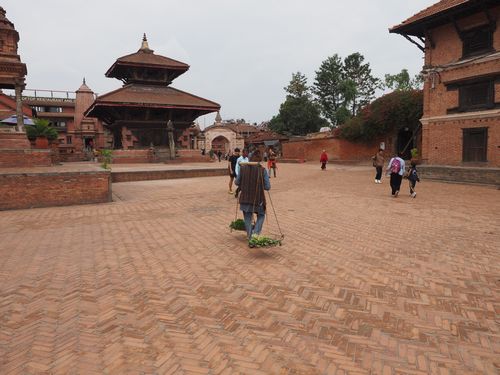
 Bhaktapur Durbar Square, also known simply as Bhaktapur Durbar Square, is a renowned royal square in Nepal located in the city of Bhaktapur. This site is famed for its impressive collection of temples and monuments, mostly from the 16th to the 18th centuries. The square is one of three Durbar Squares in the Kathmandu Valley, all of which are UNESCO World Heritage Sites. Bhaktapur Durbar Square features a distinct array of pagodas and shikhara-style temples, showcasing Newar religious art. It is also known for the Palace of Fifty-five Windows, a masterpiece of wooden architecture.

Monument profile
Durbar Square
Monument category: Set of Monuments
Monument family: Museum, remarkable architecture or group of buildings
Monument genre: Cultural or scientific
Cultural heritage: Hindu
Geographic location: Bhaktapur • Nepal
Construction period: 12th century AD
This monument in Bhaktapur is inscribed on the UNESCO World Heritage List since 1979 and is part of the serial property "Kathmandu Valley".See the UNESCO monuments featured on this site
• Links to •
• Dynasties that contributed to the construction of the monument •

• List of videos about Bhaktapur on this site •
Bhaktapur • A Journey Through Nepal’s Historic Wonder
• Sources •
Online Sources
- UNESCO World Heritage Centre. "Kathmandu Valley." https://whc.unesco.org/en/list/121/
- Kathmandu Valley Preservation Trust. "Completed Projects." https://www.asianart.com/kvpt/completed.html
- Wikipedia. "Bhaktapur Durbar Square." https://en.wikipedia.org/wiki/Bhaktapur_Durbar_Square
Books and publications
- Vaidya, Tulasī Rāma. Bhaktapur Rajdarbar. Centre for Nepal and Asian Studies, Tribhuvan University, 2002.
- Shrestha, Purushottam Lochan. Pachpanna Jhyale Darbarko Vishvarupa. Lalitkala Magazine, 22 novembre 2014.
The History of Durbar Square in Bhaktapur: A Comprehensive Analysis
Durbar Square in Bhaktapur is one of the most significant historical and architectural sites in Nepal. As a royal complex and an administrative center of the medieval Malla kingdom, it played a central role in the political, social, and religious life of the region. Today, the square stands as a symbol of Nepalese heritage, recognized as a UNESCO World Heritage Site. Its history is deeply intertwined with the evolution of Bhaktapur, shaped by political ambitions, warfare, artistic development, and continuous transformations over the centuries.
Political and Social Context of Construction
Durbar Square was constructed primarily during the reign of the Malla dynasty (12th–18th century), a period marked by rivalry among the three major city-states of the Kathmandu Valley: Kathmandu, Patan, and Bhaktapur. The kings of these city-states engaged in architectural competition, each striving to build grander palaces and temples to assert dominance and attract traders, artisans, and religious scholars.
Bhaktapur, meaning "City of Devotees," was established as the capital of the Malla kingdom in the early 12th century. King Yaksha Malla (1428–1482) played a crucial role in expanding and fortifying the city, making Durbar Square the political and religious nucleus of his domain. His successors continued embellishing the site, constructing pagoda-style temples, courtyards, and water fountains.
Strategic and Religious Motivations
The construction of Durbar Square was not merely a display of power; it also had profound religious and social implications:
- Sacralization of Kingship: The Malla rulers were regarded as divine kings (Rajgurus), believed to be earthly manifestations of Lord Vishnu. Temples dedicated to Vishnu, Shiva, and Taleju Bhawani (the royal deity) reinforced their legitimacy.
- Protection and Stability: The square’s architectural layout was designed to reflect cosmic harmony, embodying traditional Hindu and Buddhist principles to ensure the city’s prosperity.
- Urban Planning and Commerce: Positioned along key trade routes, Bhaktapur attracted merchants from Tibet and India, and Durbar Square functioned as a commercial and administrative hub.
Rivalries and Alliances
The construction of Durbar Square was influenced by political tensions within and beyond the Kathmandu Valley. The Malla kings frequently engaged in alliances and conflicts with each other, leading to intermittent wars and the need for fortifications and military architecture. In some periods, alliances with Indian and Tibetan rulers provided financial and artistic contributions to the square’s development.
Major Historical Events Shaping the Site
Over the centuries, Durbar Square has been shaped by wars, invasions, dynastic changes, and natural disasters.
The Gorkha Conquest (1769)
One of the most significant turning points in Durbar Square’s history was the conquest of Bhaktapur by Prithvi Narayan Shah in 1769. The ambitious Gorkha ruler sought to unify Nepal under his rule. Bhaktapur, weakened by internal rivalries, fell to his army. The defeat marked:
- The end of the Malla dynasty, shifting Nepal’s political center to Kathmandu.
- A decline in royal patronage, as the new Shah rulers focused on governing from Kathmandu.
- Looting and repurposing of temples and palaces, altering the square’s significance.
Destruction and Reconstruction
Durbar Square has suffered repeated damage from earthquakes, notably:
- The 1934 Earthquake, which led to the collapse of several temples and required extensive rebuilding.
- The 2015 Earthquake, one of the most devastating in Nepal’s history, which destroyed multiple structures, including the Vatsala Durga Temple and severely damaged the Palace of Fifty-Five Windows.
In response, international restoration efforts have played a crucial role in preserving and rebuilding the site.
Changes in Usage and Modifications Over the Centuries
Following the collapse of the Malla kingdom, Durbar Square gradually lost its political importance but remained a religious and cultural hub. The square underwent changes, including:
- Adaptation of palaces for administrative use, particularly under the Shah dynasty.
- Continued religious functions, with temples still being active sites of worship.
- Integration into Nepal’s tourism industry, becoming a key destination for cultural heritage.
The Global Context of its Construction
During the period of Durbar Square’s construction and expansion, similar architectural and urban developments were occurring across the world:
- In Europe (12th–17th centuries): Gothic cathedrals like Notre-Dame de Paris and city squares in Italy and Germany reflected urban prosperity and religious devotion.
- In India: The construction of Mughal palaces and forts, such as the Red Fort in Delhi, mirrored the strategic and aesthetic elements of Bhaktapur’s royal complex.
- In China and Tibet: Temples and monasteries followed intricate wooden architectural traditions, some of which influenced Newar craftsmanship.
Bhaktapur Durbar Square stands as a part of this global movement of monumental urban centers, reflecting religious, political, and artistic aspirations.
Architectural and Urban Transformations
Structural Changes Over Time
The addition of the Nyatapola Temple (1702), the tallest pagoda-style temple in Nepal, showcasing advanced earthquake-resistant techniques.
Expansion of the royal palace, incorporating the Golden Gate and the Taleju Temple complex.
Conversion of water fountains and hiti (ancient drinking water systems), reflecting changes in urban infrastructure.
Impact of Bhaktapur’s Urban Growth
As Bhaktapur grew, Durbar Square faced challenges of modernization:
Encroachment of modern buildings, threatening the visual and structural integrity of the site.
Population pressure, leading to increased commercial activity around the square.
Efforts to maintain the square’s historical character include heritage regulations preventing modern alterations within its vicinity.
Cultural Significance and Modern Role
Religious and Social Functions
Durbar Square remains an active spiritual and cultural site, hosting major festivals such as:
- Bisket Jatra: A New Year festival featuring elaborate chariot processions.
- Dashain: Nepal’s largest Hindu festival, with ceremonies held at the Taleju Temple.
These celebrations reinforce the continuity of traditions dating back to the Malla period.
Tourism and Economic Impact
Bhaktapur Durbar Square is a major tourist attraction, contributing significantly to Nepal’s economy. Entrance fees fund restoration and conservation projects, ensuring its preservation for future generations.
Current Conservation Challenges
Environmental and Structural Risks
Seismic vulnerability: Despite traditional earthquake-resistant techniques, restoration efforts are ongoing to reinforce weakened structures.
Pollution and Urbanization: Air pollution and uncontrolled urban expansion threaten the site’s materials and aesthetics.
Tourism pressure: Managing visitor flow is essential to prevent structural wear and damage.
Restoration and UNESCO Protection
Being a UNESCO World Heritage Site, Durbar Square benefits from international conservation initiatives. Current efforts focus on:
Rebuilding earthquake-damaged structures using traditional Newar craftsmanship.
Regulating urban development to maintain historical authenticity.
Despite these challenges, the site remains a symbol of Nepal’s enduring cultural identity.
Conclusion
Bhaktapur Durbar Square is more than an architectural masterpiece; it is a historical and cultural monument, embodying Nepal’s royal heritage, religious traditions, and urban evolution. While it has endured wars, earthquakes, and political upheavals, it continues to be a living legacy, connecting the past with the present and inspiring future generations.
The Architecture of Durbar Square in Bhaktapur: A Comprehensive Study
Bhaktapur Durbar Square is one of the most remarkable architectural complexes in Nepal, showcasing the ingenuity, craftsmanship, and spiritual symbolism of the Newar civilization. As a former royal palace complex, it embodies centuries of innovation in construction techniques, materials, and artistic expression. This analysis explores the technological advancements of the time, the influence of various architectural traditions, the organization of the site, and its ongoing conservation challenges.
Technological and Architectural Innovations of the Era
Bhaktapur Durbar Square was built during the reign of the Malla dynasty (12th–18th centuries), a period of architectural excellence and experimentation. The Malla rulers commissioned grand temples, palaces, and courtyards using sophisticated construction methods that demonstrated their knowledge of structural engineering and urban planning.
Earthquake-Resistant Techniques
One of the most significant innovations in Bhaktapur Durbar Square is its seismic resilience, an essential feature in a region prone to earthquakes. Several techniques were employed to mitigate damage from tremors:
- Timber Reinforcement: Wooden beams were embedded into brick and mortar structures to provide flexibility and absorb seismic shocks.
- Tiered Pagoda Design: Temples like the Nyatapola Temple, with their multiple roofs, distribute weight efficiently, reducing the impact of ground movement.
- Sloped Foundations: Buildings were constructed on slightly raised platforms with sloped foundations, preventing structural collapse due to shifting ground.
These innovations allowed many of Bhaktapur's structures to withstand centuries of natural disasters, though periodic reconstructions were necessary after major earthquakes.
Ventilation and Urban Planning
The spatial arrangement of Durbar Square reflects meticulous urban planning, ensuring airflow, temperature regulation, and functionality:
- Open Courtyards: Large open spaces facilitate cross-ventilation and provide communal gathering areas.
- Extended Roof Eaves: Projecting eaves protect façades from heavy monsoon rains while allowing natural light and air circulation.
- Strategic Building Orientation: Structures were positioned to maximize sunlight exposure while preventing excessive heat buildup.
These design elements highlight the Newars’ understanding of climate adaptation in architectural planning.
Materials and Construction Methods
Bhaktapur Durbar Square’s material palette and construction techniques reflect local craftsmanship and the availability of high-quality building materials.
Primary Materials Used
- Brick and Mortar: The predominant material, bricks were fired using traditional kilns, giving them their distinctive reddish hue. The mortar, made from clay and lime, allowed some flexibility during seismic events.
- Wood: Carved wooden elements, particularly sal wood (Shorea robusta), were extensively used in windows, doors, beams, and struts. The choice of sal wood was due to its resistance to humidity, termites, and warping.
- Stone: Limited use of stone can be seen in structures such as the Vatsala Durga Temple, which was constructed in the North Indian shikhara style using sandstone.
Construction Techniques
- Interlocking Brickwork: The bricks were laid without excessive reliance on cement, allowing flexibility during tremors.
- Wooden Peg Joints: Instead of nails, wooden pegs and interlocking joints were used in wooden structures to enhance durability and adaptability.
- Golden and Copper Gilding: Some roofs and deity statues were adorned with gilded copper sheets, signifying divine protection and royal patronage.
Architectural and Artistic Influences
Bhaktapur Durbar Square is a fusion of regional and foreign architectural styles, reflecting Nepal’s role as a crossroads of trade and cultural exchange.
Newar and Indigenous Styles
The Newar pagoda style, characterized by multi-tiered roofs, carved wooden struts, and intricate brickwork, dominates the square’s temples and palaces. Some notable features include:
- Windows with Latticed Screens (Tiki Jhya): These delicate wooden windows allowed privacy and ventilation while showcasing artistic mastery.
- Guardians and Mythological Carvings: Stone and wooden sculptures of lions, elephants, and deities protect temples from negative influences.
Foreign Influences
- Indian Influence: The shikhara style, seen in temples like Vatsala Durga Temple, is inspired by North Indian temple architecture, featuring curvilinear spires.
- Tibetan and Chinese Influence: The ornamental motifs, including cloud patterns and Buddhist iconography, indicate artistic exchanges with Tibetan monasteries.
This blend of styles demonstrates Bhaktapur’s engagement with regional architectural trends while preserving its unique identity.
Organization and Spatial Layout
Bhaktapur Durbar Square is a structured yet organic ensemble of temples, courtyards, and palaces, each serving distinct functions.
Key Structures in the Square
- Palace of Fifty-Five Windows: A royal residence built in the 17th century, featuring elaborately carved wooden windows and an expansive courtyard.
- Nyatapola Temple: A five-tiered pagoda (30 meters high), one of the tallest in Nepal, dedicated to Siddhi Lakshmi.
- Vatsala Durga Temple: A stone temple resembling North Indian architecture, destroyed in the 2015 earthquake but undergoing restoration.
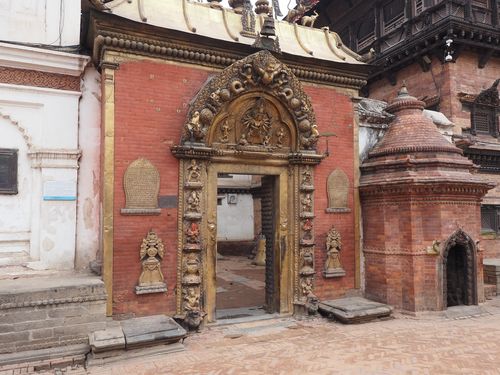
- Golden Gate (Sundhoka): An intricately gilded entrance to the palace, adorned with deities and mythical figures.
Each structure within the square follows hierarchical spatial planning, with religious and administrative buildings positioned according to their importance.
Notable Statistics and Anecdotes
The Nyatapola Temple stands at 30 meters, making it one of the tallest pagoda-style temples in Nepal.
The Palace of Fifty-Five Windows was built during King Bhupatindra Malla’s reign (1696–1722) and remains a masterpiece of Newar wood carving.
Legend states that supernatural beings assisted in building Nyatapola Temple overnight, ensuring its durability.
The Golden Gate is often regarded as one of the most beautifully crafted gates in South Asia.
These details illustrate the grandeur and mystique surrounding Bhaktapur’s architectural legacy.
International Recognition and Conservation Challenges
Global Architectural Significance
Bhaktapur Durbar Square is recognized as a UNESCO World Heritage Site, highlighting its cultural and architectural importance. It serves as a key example of traditional Nepalese urbanism, influencing conservation and restoration projects worldwide.
Current Conservation Challenges
Despite its historical value, Bhaktapur Durbar Square faces several threats:
- Earthquakes: The 2015 earthquake caused severe damage, necessitating continuous restoration efforts.
- Urbanization and Pollution: Encroachment and modernization threaten the square’s visual harmony.
- Tourism Pressure: Excessive foot traffic contributes to wear and tear, requiring careful visitor management.
Restoration and Preservation Efforts
UNESCO and local organizations work to restore earthquake-damaged structures using traditional methods.
Restrictions on modern construction help maintain the historical integrity of the square.
Revenue from tourism fees supports ongoing conservation initiatives.
While challenges remain, these efforts ensure that Bhaktapur Durbar Square continues to serve as a living heritage site for future generations.
Conclusion
Bhaktapur Durbar Square stands as a testament to Nepal’s architectural mastery, blending seismic-resistant engineering, exquisite craftsmanship, and religious symbolism. From its pagoda temples and palace courtyards to its intricate wooden carvings, the square encapsulates the artistic and urban achievements of the Malla period. Despite centuries of natural disasters and political changes, it remains a symbol of Nepalese identity, admired worldwide for its architectural ingenuity and cultural significance.
As restoration efforts continue, preserving Bhaktapur Durbar Square is not just about maintaining physical structures but safeguarding a legacy that reflects Nepal’s enduring artistic and historical spirit.