

 Français (France)
  Nederlands (nl-NL)
 The amphitheater in Amman, the capital of Jordan, is a remarkable relic from the Roman era. Built in the 2nd century, it could accommodate approximately 6,000 spectators and was used for public events, performances, and official ceremonies. Carved into a hillside, it showcases Roman architectural ingenuity and remains a prominent symbol of Jordan's heritage, drawing visitors from around the globe.

Amman • Amphitheater
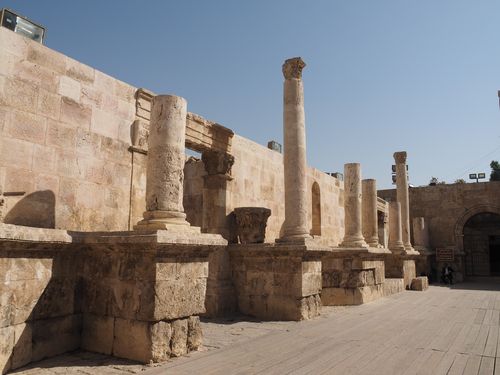
Amman • Amphitheater
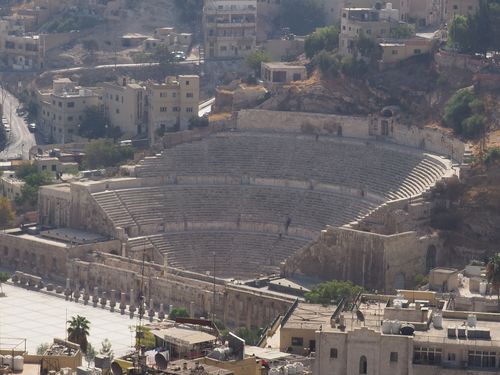
Amman • Amphitheater: seen from the citadel
Monument profile
Amphitheater
Monument categories: Ancient, Amphitheatre
Monument families: Archaeological • Monument for cultural purposes
Monument genres: Archaeological site, Cultural or scientific
Cultural heritage: Roman antiquity
Geographic location: Amman • Jordan
Construction period: 2nd century AD
• Links to •
• List of videos about Amman, Jerash, Umm Qais on this site •
Jordan • the Roman Jordan
Amman, the capital • Jordan
• References •
Wikipedia EN: Roman Theatre (Amman)
• Sources •
- UNESCO - World Heritage Report: Amman
- Encyclopædia Britannica - Amman
- History.com - Ancient Rome and its influence
- Jordan Times - Studies in Roman architecture in Amman
- Jordanian Government Archives - Amphitheater conservation efforts
Books and Publications
- "The Roman Amphitheater: From its Origins to the Colosseum" by Katherine E. Welch, published by Cambridge University Press, 2007.
- "Roman Theaters: An Architectural and Architectural Study" by Frank Sear, published by Oxford University Press, 2006.
- "Jordan: History, Culture, and Heritage" by Barbara A. Porter and Stephen Bourke, published by University of Pennsylvania Museum of Archaeology and Anthropology, 2013.
The Roman Amphitheater in Amman: Political Motives, Historical Transformations, and Modern Challenges
The Roman Amphitheater in Amman, Jordan, is a remarkable architectural achievement that embodies the political and social ambitions of the Roman Empire in the region. Built during the reign of Emperor Antoninus Pius (138–161 CE), this monument served as a centerpiece for public life in ancient Philadelphia, the city now known as Amman. Its history and transformations provide a lens through which to understand the shifting political, cultural, and social dynamics of the region over the centuries.
Political and Social Motives Behind Its Construction
The construction of the amphitheater was deeply rooted in the Roman strategy of consolidating control over their provinces. Philadelphia, as part of the Decapolis, a group of ten cities with strong Roman influence, was an important administrative and cultural hub. The amphitheater was built to serve as a venue for public gatherings, performances, and official ceremonies, symbolizing Roman authority and fostering loyalty among the local population.
By providing a grand space for entertainment and civic engagement, the amphitheater demonstrated the generosity and organizational prowess of the Roman administration. It also reinforced social hierarchies, with seating arrangements reflecting the stratified nature of Roman society, where the elite enjoyed prime viewing positions.
Historical Context and Global Comparisons
The amphitheater was constructed during the Pax Romana, a period of relative peace and stability across the Roman Empire. This era saw the proliferation of monumental architecture as a means of showcasing imperial power and unifying diverse cultures under Roman rule. Similar structures, such as the Colosseum in Rome and the theaters in Ephesus and Aspendos, were built across the empire to serve comparable purposes.
Globally, this period coincided with significant developments in other regions. In China, the Han Dynasty was flourishing, promoting trade and innovation along the Silk Road, while in the Americas, advanced civilizations such as the Maya were constructing their own monumental architecture. These parallels highlight the universal use of grand structures as symbols of power and cultural identity.
Major Transformations Over the Centuries
Over the centuries, the Roman Amphitheater in Amman experienced numerous transformations, reflecting the changing political and cultural landscape of the region. Following the decline of the Roman Empire, the amphitheater’s use diminished, and it was gradually repurposed or abandoned as new powers, including the Byzantine Empire and later Islamic caliphates, rose to prominence.
During the Islamic Golden Age, the region’s focus shifted toward new architectural styles and urban developments, leaving many Roman structures, including the amphitheater, neglected. By the Ottoman period, the amphitheater had fallen into disrepair, buried partially under debris and affected by natural erosion.
The 20th century marked a turning point for the site. With the emergence of modern Jordan, efforts to restore the amphitheater were undertaken to preserve its historical significance and reintegrate it into the cultural life of Amman. These efforts have transformed the amphitheater into a venue for cultural events, bridging its ancient purpose with contemporary uses.
Cultural Significance and Current Conservation Status
The Roman Amphitheater in Amman is not only an architectural marvel but also a symbol of the city’s enduring connection to its historical roots. With a capacity of approximately 6,000 spectators, the amphitheater showcases the ingenuity of Roman engineering, particularly in its design for optimal acoustics and audience comfort.
Restoration efforts have preserved the monument’s structural integrity and aesthetic appeal, allowing it to function as a vibrant cultural hub for modern Jordan. Events such as concerts and theatrical performances held at the site have strengthened its role as a living part of the city’s heritage.
Challenges to Preservation
Despite these efforts, the amphitheater faces significant challenges. Natural erosion, exacerbated by Amman’s semi-arid climate, threatens the longevity of the stonework. Urban development around the site creates additional pressure, as vibrations from traffic and construction activities pose risks to its stability.
Tourism, while essential for the site’s recognition and funding, also presents challenges, requiring careful management to prevent overuse and damage. Climate change introduces further uncertainties, with extreme weather patterns potentially accelerating deterioration.
Conclusion
The Roman Amphitheater in Amman stands as a testament to the ingenuity, cultural ambition, and political strategies of the Roman Empire. Its history, marked by periods of prominence, neglect, and revitalization, mirrors the dynamic transformations of the region. Today, it serves not only as a relic of the past but also as a vibrant cultural landmark that bridges ancient traditions with modern Jordanian identity. Preserving this architectural gem amid modern challenges is crucial to ensuring its legacy for future generations.
The Roman Amphitheater in Amman: Technological Mastery and Cultural Fusion in Ancient Architecture
The Roman Amphitheater in Amman, Jordan, is a remarkable example of architectural ingenuity and cultural synthesis from the Roman era. Built in the 2nd century CE during the reign of Emperor Antoninus Pius (138–161 CE), this grand structure demonstrates the advanced engineering techniques and artistic vision of its time. Its design, materials, and decorative features reflect a harmonious blend of Roman innovation and local influences, making it a cultural and historical landmark.
Materials and Construction Techniques
The amphitheater was constructed using locally sourced limestone, a durable and abundant material well-suited to the region’s climate. The limestone blocks were meticulously cut and assembled without mortar, showcasing the precision of Roman engineering.
Carved into a hillside, the amphitheater's semi-circular structure capitalized on the natural slope to provide stability and enhance acoustics. This technique not only reduced construction costs but also ensured that the audience could hear performances clearly, even from the uppermost tiers. The theater’s orientation toward the north minimized sun exposure, offering comfort to spectators during events.
Architectural Features and Cultural Fusion
The amphitheater’s layout follows the traditional Roman design, with a semi-circular cavea (seating area) divided into three horizontal sections. This arrangement reflected the Roman social hierarchy, with seating tiers assigned according to social status. The vomitoria (passageways) facilitated efficient movement of large crowds, exemplifying the practicality of Roman public architecture.
The stage area (orchestra) was adorned with ornate columns, niches, and decorative carvings that incorporated both classical Roman motifs and elements influenced by local traditions. This blend of styles illustrates the cultural integration that characterized the Roman Empire, where architectural projects often served as instruments of political and cultural unification.
Notable Statistics and Anecdotes
The amphitheater could accommodate approximately 6,000 spectators, underscoring its importance as a hub for public gatherings in ancient Philadelphia, the Roman name for Amman. Its construction was part of a broader effort to establish Philadelphia as a key city within the Decapolis, a group of cities with strong economic and cultural ties to Rome.
One particularly notable feature is the amphitheater's exceptional acoustics, achieved through its precise design and materials. A performer on the stage could project their voice to the highest seating tier without amplification, an engineering feat that continues to impress modern architects and engineers.
Recognition and UNESCO’s Role
Although the Roman Amphitheater in Amman is not independently listed as a UNESCO World Heritage Site, it is a vital part of Jordan’s cultural heritage and attracts thousands of visitors annually. Its historical significance and architectural brilliance contribute to its international recognition.
Restoration efforts in the 20th century, supported by both local authorities and international partnerships, have preserved much of the structure’s integrity. These efforts have also allowed the amphitheater to function as a venue for cultural events, bridging its ancient purpose with modern uses.
Preservation Challenges and Modern Threats
The preservation of the Roman Amphitheater faces several challenges. Natural erosion, exacerbated by Amman’s semi-arid climate, threatens the longevity of the limestone structure. Urban development around the site increases the risk of damage from vibrations and environmental pollution.
Tourism, while economically beneficial, requires careful management to prevent wear and tear on the ancient stones. Furthermore, climate change poses new threats, with extreme weather potentially accelerating the degradation of the monument.
Conclusion
The Roman Amphitheater in Amman stands as a testament to the technological innovation and cultural inclusivity of the Roman Empire. Its architecture, combining advanced engineering techniques with artistic expression, continues to captivate scholars and visitors alike. As a symbol of Amman’s rich history and its connections to the ancient world, the amphitheater remains a vital cultural landmark. Preserving this architectural treasure is essential for safeguarding its legacy and ensuring that future generations can appreciate its historical and artistic significance.