

 Français (France)
  Nederlands (nl-NL)
 San Pietro Church in Erice, Sicily, is a religious building constructed in the 14th century. Located in the town of Erice, this church is an important example of the region's religious heritage. It serves as a place of worship and stands as a symbol of the enduring Christian faith over the centuries in this part of Italy.

Erice • San Pietro church

Erice • San Pietro church
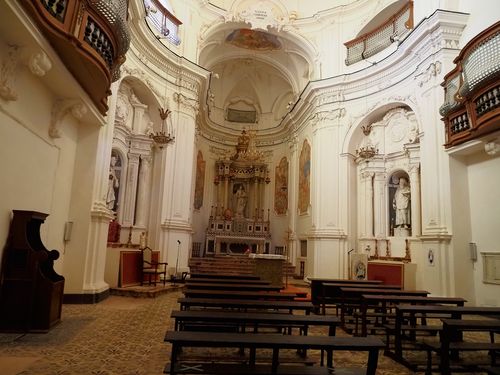
Erice • San Pietro church
Monument profile
San Pietro church
Monument category: Church
Monument family: Church, cathedral, basilica, chapel
Monument genre: Religious
Cultural heritage: Christian
Geographic location: Erice • Sicily • Italy
Construction period: 14th century AD
• Links to •
• List of videos about Erice on this site •
Erice • Streets and Churches of the Medieval City
Political and Social Motivations Behind the Construction of San Pietro Church in Erice
Historical Context and Construction Date
The San Pietro Church in Erice, Italy, was constructed in the 14th century, a period characterized by significant political and social changes in Sicily. The construction of this church was driven by both political and social motivations, reflecting the broader dynamics of the time. Sicily, during this period, was under the rule of the Aragonese crown, following the War of the Sicilian Vespers, which led to the expulsion of the Angevin forces. The Aragonese sought to consolidate their power and reinforce their influence over the island, and one of the most effective ways to achieve this was through the construction of religious edifices.
The building of San Pietro Church served multiple purposes. Politically, it was a statement of Aragonese dominance and an affirmation of their commitment to the Catholic Church, which was a crucial ally in maintaining control over the diverse population of Sicily. The church was also intended to integrate the local population into the broader socio-political framework of the Aragonese rule, fostering a sense of unity and stability in a region that had experienced centuries of conflict and change.
Socially, the church became a central place for the community, not only as a house of worship but also as a gathering place for various social activities. The construction of such a significant religious structure reinforced the Christian identity of the region, particularly in an area that had been influenced by Islamic culture during previous centuries of Muslim rule.
Major Historical Events and Their Impact on Erice
The history of San Pietro Church is closely tied to the broader historical events that shaped Erice and Sicily. The transition from Angevin to Aragonese rule in the 14th century was a critical period that influenced the construction of the church. The Aragonese rulers were keen to solidify their presence on the island, and the church played a key role in this strategy. As a symbol of Christian faith and Aragonese authority, it helped to establish a sense of order and continuity in a time of political upheaval.
Over the centuries, San Pietro Church has witnessed numerous historical events that have left their mark on the structure and its surroundings. The church survived the various conflicts that plagued Sicily, including invasions, internal rebellions, and the broader European wars that often spilled over into the Mediterranean. Each of these events contributed to the evolution of the church, both architecturally and culturally.
For instance, during the Counter-Reformation in the 16th century, the church was reinforced and modified to align with the Catholic Church's efforts to combat the spread of Protestantism. These changes included the addition of new altars, artwork, and structural modifications that reflected the changing religious and political landscape of the time.
Global Context and Comparison with Other Regions
The construction of San Pietro Church in the 14th century occurred during a period of significant global transformation. In Europe, the Christian kingdoms were engaged in the Reconquista, reclaiming territories from Muslim rule in Spain, while also participating in the Crusades in the Holy Land. The rise of powerful monarchies in France and England, alongside the decline of the Byzantine Empire, marked a period of shifting political alliances and religious fervor.
In contrast, the Ming Dynasty was consolidating power in China, leading to a period of cultural renaissance and economic growth. Meanwhile, in the Americas, the civilizations of the Aztecs and Incas were reaching their zenith, albeit isolated from the developments in Europe and Asia.
Sicily, particularly Erice, was a crossroads of these global currents. The island's strategic location made it a melting pot of cultures, with influences from Europe, North Africa, and the Middle East converging in its architecture, art, and social practices. San Pietro Church is a reflection of this unique position, blending Gothic architectural elements with local Sicilian styles and influences from previous Islamic rule.
Transformations and Cultural Influences Over the Centuries
San Pietro Church has undergone several significant transformations since its construction. Originally built in the Gothic style favored by the Aragonese, the church has been modified over the centuries to reflect the changing tastes and influences of successive rulers. During the Spanish period, Baroque elements were added, including ornate altars and elaborate frescoes, reflecting the artistic trends of the time.
These transformations were not merely aesthetic but also practical, as the church adapted to the evolving liturgical practices and the needs of the local community. The integration of different architectural styles and the continuous modifications of the church's structure highlight the dynamic nature of Sicilian culture, which has always been shaped by external influences while maintaining a distinct local identity.
Cultural Significance and Current State of Conservation
Today, San Pietro Church stands as a significant cultural landmark in Erice. It is a testament to the region's rich history and its role as a center of religious and social life. The church is relatively well-preserved, though ongoing efforts are necessary to maintain its structural integrity. The Mediterranean climate, with its extremes of humidity and temperature, poses challenges to the preservation of the building's stonework and frescoes.
Additionally, the increasing number of tourists visiting Erice adds pressure on the church's infrastructure, necessitating careful management to ensure that the site remains accessible without compromising its historical value.
Preservation Challenges and Future Strategies
Preserving San Pietro Church requires addressing several specific challenges. The effects of weathering, particularly erosion caused by wind and moisture, are constant threats to the building's stone structure. Moreover, the impact of modern tourism must be carefully managed to prevent damage to the site.
Future conservation strategies should involve the use of modern technology to monitor and maintain the church's condition while respecting traditional restoration methods. Public awareness and engagement are also crucial in ensuring that the importance of this monument is recognized and that efforts to protect it are supported by the local and international community.
Conclusion
San Pietro Church in Erice is more than just a religious building; it is a symbol of the political, social, and cultural dynamics that have shaped Sicily over the centuries. Its construction and subsequent transformations reflect the complex interplay of power, religion, and culture that characterizes the island's history. Preserving this monument is essential to maintaining a connection to the past, ensuring that future generations can continue to appreciate the unique heritage of Erice and Sicily.
Architectural Innovation and Technological Advancements in the San Pietro Church, Erice
Technological Innovations and Construction Techniques
The San Pietro Church in Erice, Sicily, constructed in the 14th century, serves as a remarkable example of the technological advancements and architectural innovations of its time. The church’s construction reflects the transition from the Romanesque to the Gothic style, a period marked by the desire to create more structurally sound and visually imposing religious edifices. The primary material used in the construction of San Pietro was locally sourced limestone, chosen for its durability and availability. This stone allowed for the creation of thick, load-bearing walls that were essential in supporting the large vaulted ceilings typical of Gothic architecture.
One of the key technological innovations of the time was the use of pointed arches, which distributed weight more efficiently than the rounded arches of earlier periods. This innovation allowed for the construction of higher ceilings and larger windows, which in turn facilitated the inclusion of stained glass that illuminated the interior with natural light. The ribbed vaults, another significant Gothic feature, were also employed, enabling the builders to create a more expansive and airy interior space that reflected the grandeur and spiritual aspirations of the era.
A Unique Blend of Regional Traditions and Foreign Influences
The architectural characteristics of San Pietro Church illustrate a unique blend of regional artistic traditions and foreign influences, a reflection of Sicily’s complex history as a crossroads of different cultures. The Gothic style, introduced by the Aragonese rulers, dominates the church’s design, particularly in the pointed arches and ribbed vaults. However, these elements are harmoniously integrated with local Sicilian styles, which include the use of intricate stone carvings and decorative motifs that draw from both Byzantine and Islamic traditions.
The church’s facade, for instance, features a combination of Gothic verticality with more horizontally aligned elements typical of Mediterranean architecture. Decorative elements, such as the geometric patterns on the doorways and the floral motifs on the capitals, exhibit influences from the Islamic art that had flourished on the island during earlier centuries of Muslim rule. This blending of styles not only highlights the adaptive nature of Sicilian architecture but also serves as a testament to the island’s historical role as a meeting point of diverse cultures.
Notable Structural Features and Layout
The layout of San Pietro Church follows the traditional basilica plan, with a central nave flanked by two aisles. The nave is covered by a barrel vault, supported by robust columns and pilasters that emphasize the verticality of the space. The church’s plan, while relatively simple, is executed with precision and attention to detail, demonstrating the advanced construction techniques of the time.
A notable aspect of the church’s design is the use of flying buttresses, which are employed to support the tall walls of the nave. These buttresses are not only functional but also add to the aesthetic appeal of the exterior, creating a rhythm of vertical lines that enhance the overall impression of height and grandeur.
An interesting anecdote related to the construction of San Pietro Church is the strategic placement of windows and doors to optimize natural lighting throughout the day. This careful consideration of light, combined with the height of the structure, creates a space that is both spiritually uplifting and architecturally impressive.
International Recognition and Conservation Efforts
While San Pietro Church is not currently listed as a UNESCO World Heritage site, it plays a significant role in the cultural and historical landscape of Erice and Sicily. The church’s unique blend of architectural styles, its historical significance, and its well-preserved state make it an important monument, attracting scholars, historians, and tourists alike.
However, the church faces several conservation challenges. The limestone, while durable, is susceptible to erosion due to the humid Mediterranean climate and the winds that sweep across the hilltop town of Erice. Additionally, the increasing flow of visitors poses a risk to the preservation of the site, necessitating careful management to balance accessibility with conservation.
Conclusion
San Pietro Church in Erice stands as a testament to the architectural innovation and cultural fusion that characterized Sicily during the 14th century. Its construction employed advanced Gothic techniques, while its design seamlessly integrates local and foreign artistic traditions. The church’s layout and decorative elements not only reflect the technological prowess of its builders but also the rich cultural tapestry of Sicily. Although not yet recognized as a UNESCO World Heritage site, San Pietro Church remains a vital part of the region’s heritage, deserving of ongoing preservation efforts to ensure its legacy endures for future generations.