

 Français (France)
  Nederlands (nl-NL)
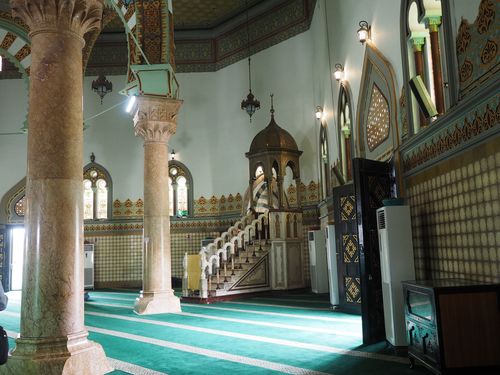
 The Raya al Mashun Mosque, located in Medan on the island of Sumatra, Indonesia, stands as one of the region’s most prominent religious landmarks. Recognizable for its monumental architectural design, it reflects both spiritual devotion and its long-standing social role in the city since its inauguration. This Muslim place of worship welcomes not only local believers but also visitors drawn by its cultural significance. The central dome, symmetrical side structures, and refined decorative elements reveal an intent to embody both faith and the prestige of a period shaped by regional political aspirations. The mosque remains an active hub for the Medan community and a cultural reference point within Sumatra’s urban fabric.


Monument profile
Raya al-Mashun Mosque
Monument category: Mosque
Monument family: Mosque, Minaret or Madrasa
Monument genre: Religious
Cultural heritage: Islamic
Geographic location: Medan, Bukit Lawang • Sumatra • Indonesia
Construction period: 20th century AD
• Links to •
• List of videos about Medan, Bukit Lawang on this site •
Indonesia • Sumatra • Medan and the orangutan sanctuary
• References •
Wikipedia EN: Grand Mosque of Medan
History of the Raya al Mashun Mosque in Medan
Political and Social Context of Construction
The Raya al Mashun Mosque, located in the city of Medan on the island of Sumatra, Indonesia, was constructed between 1906 and 1909 during a significant transitional period for the region. At the time, Medan was the capital of the Sultanate of Deli, a Malay Muslim polity that maintained a degree of autonomy under the overarching rule of the Dutch East Indies colonial administration. The mosque was commissioned by Sultan Ma’mun Al Rasyid Perkasa Alam (r. 1873–1924), a prominent ruler who sought to reinforce both religious and political authority within his realm.
The construction of this monumental mosque served multiple strategic and symbolic purposes. It was conceived as a statement of Islamic sovereignty within a multiethnic city under colonial governance, where the Malay elite, Chinese merchants, Indian laborers, and Dutch administrators coexisted, often unequally. In this context, the mosque was both a religious center and a political gesture—a way to assert the legitimacy of the Deli Sultanate in an urban landscape increasingly influenced by European culture and Christian missionary activity.
Furthermore, the mosque was part of a broader plan to restructure the civic layout of Medan, aligning key institutions—such as the sultan’s Maimun Palace and the mosque itself—along symbolic urban axes. This reinforced a model of sacred kingship, where religious and secular power emanated from the sultan. It also mirrored broader Islamic trends of the time, in which rulers across the Muslim world built prominent mosques to bolster their claims to leadership.
Key Historical Events Affecting the Site
The Raya al Mashun Mosque has stood as a stable institution through periods of regional and national upheaval. It survived the Second World War, the Japanese occupation of Indonesia (1942–1945), and the violent and complex struggle for independence (1945–1949). Despite the social and political instability surrounding these events, the mosque remained intact, continuing to serve as a place of worship and community organization.
While it was not a direct site of conflict, the mosque did experience alterations and periods of neglect. Minor damages and aging prompted several restorations, particularly in the post-independence era. In the late 20th century, a major conservation campaign sought to reverse unsympathetic modifications and restore the mosque to its original architectural integrity.
The building also evolved in its role. Beyond daily prayers and religious festivities, the mosque became a venue for political speeches, community dialogue, and interfaith gatherings. It has been a backdrop to funeral services for notable local figures and a rallying point during moments of national mourning.
Global Architectural Context at the Time of Construction
When the mosque was commissioned in the early 20th century, similar Islamic projects were being realized across the Muslim world, reflecting broader cultural and political shifts. In Egypt, Iran, and India, rulers and wealthy patrons were constructing monumental religious buildings that blended local traditions with elements borrowed from the Ottoman Empire or Moorish Spain.
This period also witnessed the emergence of “Islamic modernism,” an intellectual and aesthetic movement seeking to reconcile Islamic values with modernity. The architectural manifestation of this tendency can be observed in the blend of Middle Eastern, Indian, and European elements that define the Raya al Mashun Mosque. Its creation was part of a larger global trend in which Islamic societies responded to colonial pressure by reasserting religious and cultural identities through architecture.
The mosque’s eclectic style, merging Moorish arches, Turkish domes, Indian ornamentation, and European layout principles, was emblematic of these global dialogues. It stands as a Southeast Asian response to the architectural cosmopolitanism of the time.
Transformations and Modifications
Since its inauguration in 1909, the mosque has undergone several phases of change. While the original structure has remained mostly intact, functional updates have been introduced. These include the installation of electric lighting, a public address system, and improved ventilation—essential in the hot and humid climate of Sumatra.
The building’s interior was also adapted to accommodate more worshippers, though without compromising its structural authenticity. Some extensions, built during the mid-20th century to house additional prayer spaces or administrative functions, have been demolished or replaced with structures more in harmony with the mosque’s historical aesthetics.
In urban terms, the mosque is now surrounded by a densely built environment. Where once it stood near royal gardens and open plazas, today it is nestled among roads, schools, and residential buildings. Nonetheless, its profile—marked by a grand dome and minaret—remains a central landmark in the cityscape.
Contemporary Role and Cultural Significance
In present-day Medan, the Raya al Mashun Mosque is not only an active place of worship but also a civic monument of historical and spiritual importance. It is frequently used for Friday prayers, Ramadan celebrations, and Eid festivals, drawing large crowds. The mosque also hosts Quranic recitation competitions, public lectures, and events linked to the Islamic calendar.
For many residents, the mosque represents a tangible link to the city’s royal past and Islamic heritage. It is one of the few surviving elements of the Deli Sultanate’s urban vision and continues to shape Medan’s cultural identity. School excursions, national day parades, and religious tourism reinforce its role as both a spiritual and educational center.
Moreover, the mosque has become a symbol of intergenerational continuity. Families that have attended the mosque for generations continue to do so, preserving local religious customs and reinforcing social cohesion. It is also a key stop on heritage tourism circuits and frequently photographed for its architectural beauty.
Conservation Status and Modern Challenges
The mosque is currently maintained by a local board supported by the Indonesian Ministry of Religious Affairs and the provincial government of North Sumatra. It enjoys protected heritage status under Indonesian law and is listed as a cultural property of regional significance.
However, its preservation is not without challenges. The tropical climate poses constant threats to the masonry, wooden elements, and tiled surfaces. Heavy rains and high humidity require frequent maintenance. Urban development around the mosque also raises concerns about pollution, traffic congestion, and visual encroachment.
Increased tourist numbers have necessitated the implementation of visitor management strategies, including restricted entry times and designated prayer areas, to ensure the mosque remains a respectful space for worshippers. Restoration guidelines must now balance the needs of functionality, authenticity, and accessibility.
There is currently no UNESCO World Heritage designation for the mosque, though cultural preservation advocates have expressed interest in pursuing international recognition. Such a move would reinforce its status as an architectural and religious landmark of the Malay-Muslim world and might attract funding for more comprehensive conservation efforts.
Architectural Analysis of the Raya al Mashun Mosque in Medan
Technological and Architectural Innovations of the Period
The construction of the Raya al Mashun Mosque in the early 20th century reflects a period of growing architectural experimentation in the Dutch East Indies, marked by the fusion of traditional Islamic design with colonial and international influences. Built between 1906 and 1909 under the patronage of Sultan Ma’mun Al Rasyid Perkasa Alam, the mosque was designed to be not only a place of worship but also a monument symbolizing Islamic identity within a cosmopolitan and colonially governed city.
The project incorporated both traditional building knowledge and modern planning principles. Structural stability was a primary concern, especially considering the tropical climate and the seismic activity in Sumatra. The foundations were reinforced with a mix of limestone, brick, and concrete—an unusual approach in Indonesian mosque architecture of the time. The introduction of reinforced brick domes, supported by concealed steel elements, enabled the construction of a central dome with greater height and internal volume without compromising safety.
Ventilation was addressed through the use of elevated windows with jalousie openings, facilitating cross-ventilation and passive cooling. The building’s symmetry and axial alignment reflect an understanding of spatial hierarchy, allowing efficient flow of movement and a clear division between prayer areas, entrances, and ablution zones. These features demonstrate how Islamic religious requirements were integrated with environmental pragmatism and modern design.
Materials and Construction Techniques
The choice of materials in the Raya al Mashun Mosque reveals a confluence of aesthetic ambition and regional availability. The primary construction material was brick, locally fired and used in thick load-bearing walls. These bricks were clad with imported Italian marble on select façades, a luxurious detail signaling both wealth and a desire for visual grandeur. Interior ornamentation includes ceramic tiles, some of which were imported from Europe, and intricately carved teak wood, used particularly in the minbar and window frames.
The dome is composed of a layered system: a timber substructure supporting a sheet metal covering, topped by a decorative finial. This construction technique allowed the builders to achieve a bulbous form reminiscent of Middle Eastern domes while maintaining resistance to heavy rainfall. Traditional joinery techniques were employed in assembling the wooden components, and local craftsmen combined these methods with imported design motifs under the supervision of Dutch and Turkish architects.
The mosque also incorporated precast concrete in certain decorative elements, particularly balustrades and minaret details—an innovation at the time, which allowed for precise repetition and ease of installation. Overall, the blend of durable local materials and imported luxury finishes produced a resilient structure with lasting visual appeal.
Architectural and Artistic Influences
The architectural language of the Raya al Mashun Mosque is eclectic, reflecting multiple cultural influences. Ottoman, Moorish, Mughal, and Indo-Malay stylistic elements are all present, blended into a coherent design that marks a departure from earlier wooden or stilted mosques typical of Sumatra.
The horseshoe arches of the windows and doorways, paired with lobed arch detailing, are drawn from Andalusian and Moroccan precedents. The central dome is flanked by four smaller domes, reminiscent of Ottoman mosque compositions, while the use of symmetrical minarets refers more closely to South Asian and Middle Eastern traditions than to local Indonesian norms.
The ornamentation of the mosque emphasizes floral and geometric motifs over figural representation, in keeping with Islamic artistic conventions. The calligraphic panels along the qibla wall and above the main entrance feature Quranic verses in stylized Thuluth and Kufic scripts, which were carefully carved or inscribed by trained artisans. The interior stained glass windows add color-filtered light and borrow stylistically from Art Nouveau trends, reflecting a European influence made palatable through abstract, vegetal forms.
This synthesis of styles was intentional: it not only communicated the global reach of Islam but also reinforced the status of the mosque as a symbol of prestige for the Deli Sultanate, aligning it with global Islamic and colonial architectural dialogues.
Spatial Organization and Structural Elements
The mosque is constructed on a rectangular plan measuring approximately 60 meters by 40 meters. The main prayer hall is crowned by a central dome set atop an octagonal drum, surrounded by four smaller corner domes that anchor the building visually and structurally. A prominent feature is the axial entrance portico, framed by a monumental arch and flanked by two minarets of octagonal base and tiered balconies.
The central dome rises to a height of about 25 meters, creating a sense of grandeur within the prayer hall. The dome’s interior is embellished with ornamental plasterwork and painted medallions. The mihrab is recessed into the qibla wall, highlighted with green tile and marble detailing, and surmounted by an arch decorated with vegetal arabesques.
The mosque’s colonnaded verandas not only provide covered transition spaces but also serve a social function, accommodating overflow worshippers during large gatherings. Inside, the arrangement of rows is oriented precisely towards Mecca, and the lack of obstructive interior columns allows for a clear view of the mihrab from all points in the hall.
Noteworthy is the integration of ventilation grilles and clerestory windows, which ensure light and airflow throughout the structure. These passive strategies contribute to comfort without reliance on mechanical systems, a testament to thoughtful environmental design.
Notable Figures, Dimensions, and Anecdotes
At the time of completion in 1909, the Raya al Mashun Mosque was the largest mosque in Medan and one of the most architecturally ambitious in Sumatra. The main dome spans over 16 meters in diameter, and the total built surface exceeds 2,000 square meters. Its minarets reach approximately 40 meters, making them visible from considerable distances and enhancing the mosque’s role as a visual anchor in the urban landscape.
One anecdote associated with the mosque’s construction involves the collaboration between local craftsmen and foreign engineers. According to some reports, Turkish artisans were invited to oversee the decorative work, particularly the domes and calligraphy, lending the mosque its unmistakable Ottoman flavor. Another lesser-known detail is that the mosque was initially intended to be smaller, but Sultan Ma’mun doubled the budget mid-project to reflect the growing importance of the site within his vision for Medan.
International Recognition and Conservation Challenges
While the mosque has not yet been designated a UNESCO World Heritage site, it is considered a cultural heritage monument under Indonesian law and is protected at the provincial level. It has also been featured in regional architectural surveys and heritage tourism programs.
Conservation challenges are ongoing. The building’s location in a bustling city center exposes it to vehicle emissions, vibration, and crowd pressure. Moisture infiltration, especially during monsoon seasons, poses a risk to the plasterwork and timber elements. Restoration efforts have been undertaken periodically, most notably in the 1970s and early 2000s, with a focus on structural reinforcement and aesthetic restoration.
There is a growing awareness of the need to balance public access with preservation. The use of modern materials in some repairs has sparked debate among conservationists about the authenticity of restoration methods. Nonetheless, the mosque continues to function effectively as both a spiritual center and an architectural monument, illustrating the enduring legacy of Islamic civic architecture in Southeast Asia.