

 Français (France)
  Nederlands (nl-NL)
 The Mingun Bell is a monumental bell located in Mingun, in the Sagaing Region of Myanmar. Cast in the early nineteenth century during the reign of King Bodawpaya, it forms part of a group of royal and religious monuments established in this historic ceremonial area along the Irrawaddy River. Known for its remarkable size and ritual significance, the bell represents one of the most notable religious objects associated with Myanmar’s Buddhist heritage. It is closely connected with the wider monumental complex of Mingun and remains an important landmark for visitors exploring the historical and religious remains of this former royal region.
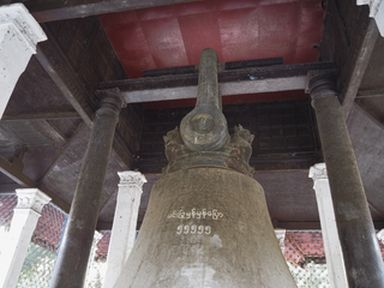
Mingun • Mingun Bell
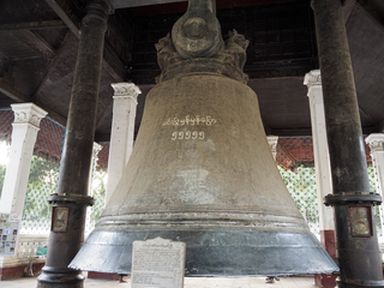
Mingun • Mingun Bell
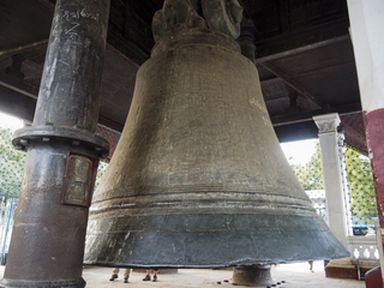
Mingun • Mingun Bell
Monument profile
Mingun Bell
Monument category: Bells and bell towers
Monument family: Royal and ceremonial monuments
Monument genre: Religious
Cultural heritage: Buddhist
Geographic location: Mingun • Myanmar
Construction period: 19th century AD
• Links to •
• List of videos about Mingun on this site •
Mingun • Pahtodawgyi Pagoda and Mingun Bell on the Irrawaddy
History of the Mingun Bell in Mingun
Political and social context of construction
The Mingun Bell, located in the village of Mingun on the western bank of the Irrawaddy River in central Myanmar, was created in the early nineteenth century during the reign of King Bodawpaya of the Konbaung dynasty. This dynasty ruled Burma from 1752 until the British annexation of the kingdom in 1885 and represented the final period of indigenous royal authority in the region. The casting of the Mingun Bell formed part of a wider program of monumental religious construction initiated by the king, whose ambitions combined religious devotion with political symbolism.
Within the traditional political culture of Burma, royal patronage of Buddhism played a central role in legitimizing the authority of the monarch. Kings frequently sponsored the construction of pagodas, monasteries, and ritual objects in order to accumulate spiritual merit and demonstrate their role as protectors of the Buddhist faith. Monumental religious projects also served to express the power and stability of the kingdom, particularly at times when rulers sought to consolidate their authority or enhance the prestige of their capital.
The Mingun Bell was commissioned as part of an ambitious religious complex at Mingun, which also included the construction of the massive Mingun Pahtodawgyi stupa. This enormous monument was intended to become one of the largest stupas in the Buddhist world. The bell was designed to accompany this monumental structure and to serve ceremonial functions associated with the religious activities of the site.
The decision to create such an enormous bell reflected both religious and political motivations. By sponsoring large-scale sacred constructions, Bodawpaya aimed to reinforce the spiritual legitimacy of his reign and to demonstrate the prosperity and technical capabilities of his kingdom. At the same time, the project symbolized the central role of the monarchy in supporting the monastic community and maintaining the religious foundations of Burmese society.
Major historical events affecting the site
The Mingun Bell was completed around 1810 after several years of preparation and casting. Weighing approximately ninety tons, it became one of the largest functioning bells ever produced. Its enormous size immediately distinguished it as a symbol of royal patronage and religious devotion.
However, the broader architectural program at Mingun encountered several difficulties. The construction of the Mingun Pahtodawgyi stupa was eventually halted before completion, partly because of the immense resources required for such an ambitious project. Economic pressures and shifting political priorities made it increasingly difficult to continue the work at the scale originally envisioned.
One of the most significant events affecting the site occurred in 1839, when a major earthquake struck central Burma. The tremor caused extensive damage to many monuments in the region, including the partially completed Mingun Pahtodawgyi. The Mingun Bell itself was affected by the earthquake but remained structurally intact, which contributed to its reputation as a remarkable feat of engineering.
During the nineteenth century Burma also faced growing pressure from the expanding British Empire in neighboring India. The Anglo-Burmese wars gradually weakened the kingdom’s political position. The final conflict in 1885 resulted in the deposition of the last Burmese king and the incorporation of the country into the British Empire. This event marked the end of the Konbaung dynasty and the transformation of the Burmese political system.
Despite these profound political changes, the Mingun Bell remained an important element of the religious and historical landscape of the region. Its presence continued to attract attention from both local communities and foreign observers.
Global context in the early nineteenth century
The creation of the Mingun Bell occurred during a period of global transformation. The early nineteenth century witnessed major political and economic changes across many regions of the world. In Europe, the aftermath of the Napoleonic Wars reshaped the political map, while industrialization began to alter patterns of production and technological development.
In many societies, rulers and governments invested in monumental construction projects as a way to assert authority and cultural identity. Religious monuments, public buildings, and infrastructure projects served as visible symbols of state power and social organization.
Across Asia, large-scale religious architecture remained a prominent expression of royal patronage. Temples, stupas, and ceremonial objects such as monumental bells played a central role in the religious life of Buddhist societies. The Mingun Bell belongs to this broader tradition of monumental religious patronage, in which rulers sought to reinforce their legitimacy through the construction of sacred structures.
Although industrial technology was beginning to influence construction methods in parts of the world, the Mingun Bell was produced using traditional metallurgical techniques. The successful casting of such a massive bronze object demonstrates the high level of craftsmanship and technical knowledge achieved by Burmese artisans during the Konbaung period.
Transformations and evolution of the monument
Over time, the site of Mingun underwent significant changes as the political and urban landscape of central Burma evolved. In the mid-nineteenth century King Mindon established a new royal capital at Mandalay, which shifted the political center of the kingdom away from earlier royal cities.
As Mandalay developed into the primary administrative and religious center of Upper Burma, the importance of Mingun gradually diminished. Nevertheless, the monumental remains of the site continued to attract visitors and pilgrims who were interested in its religious significance.
During the British colonial period the region became more accessible to travelers and administrators, many of whom documented the historical monuments of Burma. The Mingun Bell was frequently mentioned in descriptions of the country’s architectural and cultural heritage, particularly because of its extraordinary size.
In the twentieth century the growth of tourism and increased interest in cultural heritage contributed to the recognition of Mingun as an important historical site. The bell became one of the most notable attractions in the Mandalay region.
Contemporary role and cultural significance
Today the Mingun Bell is regarded as one of the most remarkable historical objects in Myanmar. It continues to function as a ceremonial bell and remains closely associated with Buddhist religious traditions.
Visitors to the site are often invited to strike the bell with a wooden mallet, producing a deep resonant sound that carries across the surrounding landscape. This act has symbolic meaning in local belief, as the sound of the bell is associated with the spread of merit and the expression of religious devotion.
The monument also plays an important role in the cultural identity of the region. As part of the wider complex of monuments at Mingun, it contributes to the historical memory of the Konbaung dynasty and to the broader narrative of Burmese royal history.
For many visitors, the bell represents both the artistic achievements and the spiritual traditions of the country. Its continued presence in the landscape reinforces the connection between historical monuments and contemporary cultural practices.
Conservation and modern preservation challenges
The preservation of the Mingun Bell presents several challenges related to environmental conditions and the management of historical sites. Although bronze is a durable material, long-term exposure to humidity and atmospheric pollutants can gradually affect its surface.
The surrounding environment also poses potential risks. The Irrawaddy River periodically experiences seasonal flooding, and seismic activity remains a factor in central Myanmar. These natural conditions require careful monitoring to ensure the long-term stability of monuments in the area.
Tourism has become an additional factor influencing the conservation of the site. The increasing number of visitors requires effective management strategies in order to protect both the monument and the surrounding archaeological landscape.
Although the Mingun Bell itself is not individually listed as a UNESCO World Heritage Site, it forms part of a broader historical region that includes several former royal capitals such as Amarapura, Inwa, and Mandalay. Together these sites represent an important chapter in the political and religious history of Myanmar.
Through its monumental scale, historical associations, and enduring ceremonial use, the Mingun Bell remains one of the most distinctive symbols of Myanmar’s royal and religious heritage.
Architecture of the Mingun Bell in Mingun
A monumental object within the architectural landscape of Mingun
The Mingun Bell, located in Mingun on the western bank of the Irrawaddy River in central Myanmar, represents one of the most remarkable examples of monumental metalwork in Southeast Asia. Although technically an object rather than a building, its scale, construction, and integration within a sacred architectural landscape allow it to be considered an important component of the monumental ensemble developed during the Konbaung dynasty.
The bell was conceived as part of the large ceremonial complex associated with the Mingun Pahtodawgyi stupa. In this context, it functioned not only as a ritual instrument but also as a structural element contributing to the spatial organization and symbolic presence of the site. Its enormous mass and carefully balanced proportions illustrate the architectural thinking behind large-scale ceremonial objects in Buddhist environments.
The Mingun Bell stands today as one of the largest functioning bronze bells ever produced. Its design demonstrates how traditional metallurgical knowledge and religious symbolism could be combined to create an object with both acoustic and monumental qualities.
Technological innovation and engineering principles
The construction of the Mingun Bell required advanced metallurgical knowledge and precise control over large-scale casting techniques. Producing a bell of this magnitude involved not only the preparation of a large quantity of molten metal but also the creation of a stable mold capable of supporting the immense weight of the bronze during the casting process.
The bell follows the general structural principles of large Asian temple bells. Its profile widens toward the base, creating a flared shape that enhances acoustic resonance. This form allows sound waves to travel efficiently through the metal body and produces the deep tonal qualities associated with ceremonial bells.
Unlike many European bells that swing from a supporting frame, the Mingun Bell remains stationary. Sound is produced when the bell is struck from the outside with a wooden beam or mallet. This design eliminates the need for mechanical movement and allows the bell to reach monumental dimensions without the structural risks associated with swinging motion.
Another important architectural aspect is the distribution of thickness throughout the bronze shell. The upper portion of the bell is slightly thicker to provide structural stability, while the lower rim is designed to optimize resonance. This balance between mass and acoustic performance demonstrates a sophisticated understanding of sound propagation and structural mechanics.
Materials and metallurgical techniques
The Mingun Bell is made of bronze, an alloy primarily composed of copper and tin. Bronze has been used for centuries in the production of bells because of its durability, resistance to corrosion, and excellent acoustic properties. When struck, bronze produces clear and sustained vibrations, making it an ideal material for ceremonial bells.
Casting a bronze bell of this scale required a complex process involving multiple stages. First, a large clay mold had to be constructed, typically using layers of clay, sand, and organic materials. The inner core defined the interior shape of the bell, while the outer mold formed the external surface.
Once the mold was prepared, molten bronze was poured into the cavity in a single controlled operation. The temperature of the metal had to be carefully maintained to prevent imperfections or fractures. After cooling, the mold was broken away to reveal the finished bell.
The success of this operation indicates a high level of metallurgical expertise among Burmese craftsmen. Producing such a large and structurally stable bronze object required precise calculations regarding metal composition, cooling rates, and structural thickness.
Artistic influences and decorative features
Although the Mingun Bell is primarily valued for its size and technical achievement, it also reflects artistic traditions associated with Buddhist religious objects in Myanmar. The exterior surface of the bell features inscriptions and decorative elements that emphasize its religious function and its association with royal patronage.
These inscriptions typically commemorate the donor and record the merit associated with the creation of the bell. In Buddhist tradition, the act of commissioning religious objects is considered a meritorious deed that contributes to spiritual merit for both the patron and the community.
The decorative program of the bell is relatively restrained compared with the elaborate ornamentation of temples or monasteries. Nevertheless, its inscriptions and symbolic markings provide an important cultural context that connects the object with Burmese artistic traditions.
The design remains largely rooted in local craftsmanship rather than reflecting external architectural influences. While monumental bells exist throughout Asia, the stylistic characteristics of the Mingun Bell correspond closely with the traditions of Burmese metalwork and religious art.
Spatial organization and architectural context
The architectural significance of the Mingun Bell becomes clearer when considered within the spatial organization of the Mingun religious complex. The bell is positioned near the base of the unfinished Mingun Pahtodawgyi stupa, forming part of a ceremonial axis that structures the site.
The bell is supported by a simple structural framework that protects it while allowing visitors to approach and strike it. This open structure ensures that the bell remains visible within the surrounding landscape and that its sound can resonate freely across the site.
The spatial relationship between the bell and the stupa contributes to the symbolic composition of the complex. The massive stupa represents the cosmic and spiritual center of the site, while the bell acts as a ceremonial instrument that reinforces the ritual atmosphere of the area.
The positioning of the bell also reflects practical considerations. Located near pathways used by visitors and pilgrims, it is easily accessible while remaining integrated into the larger architectural environment of Mingun.
Dimensions and notable characteristics
The Mingun Bell is one of the largest functioning bells ever produced. It weighs approximately ninety tons and stands about four meters high, with a diameter of more than five meters at its base. These dimensions place it among the most impressive examples of monumental bronze casting in the world.
The thickness of the bronze shell varies to maintain structural stability. Despite its enormous weight, the bell remains acoustically functional and produces a deep resonant tone when struck.
One of the remarkable features of the bell is the absence of cracks or major structural damage despite its age and exposure to environmental conditions. This durability reflects the high quality of the original casting and the resilience of bronze as a material.
Local traditions sometimes recount the extraordinary effort required to produce and transport such a massive object. Although precise historical details of the casting process remain limited, the scale of the bell suggests the involvement of numerous artisans and workers.
Architectural significance and conservation challenges
The Mingun Bell occupies a unique position within the architectural heritage of Myanmar. It demonstrates the capacity of traditional metallurgical techniques to produce monumental objects of exceptional scale while maintaining functional acoustic properties.
As part of the larger Mingun complex, the bell contributes to the international recognition of the site as a significant historical landscape associated with the Konbaung dynasty. Visitors are drawn not only by the unfinished stupa but also by the presence of the enormous bell, which has become one of the most recognizable objects in the region.
Despite its durability, the long-term preservation of the bell requires careful monitoring. Environmental factors such as humidity, temperature variation, and atmospheric pollutants can gradually affect the surface of bronze objects. In addition, the increasing number of visitors raises concerns about physical wear and accidental damage.
Conservation efforts focus on protecting the structural integrity of the bell while maintaining public access to the monument. Preservation strategies generally involve monitoring environmental conditions and ensuring that the supporting structure remains stable.
Although the Mingun Bell is not individually listed as a UNESCO World Heritage Site, it forms part of a broader historical landscape that includes several former royal capitals and monumental religious sites in central Myanmar. Within this context, the bell represents a remarkable example of the intersection between religious devotion, royal ambition, and technical expertise.
Through its monumental scale, refined design, and integration into a ceremonial architectural environment, the Mingun Bell remains one of the most striking achievements of Burmese craftsmanship during the early nineteenth century.