

 Français (France)
  Nederlands (nl-NL)
 Kanch Mandir is a Jain temple located in Indore, in the state of Madhya Pradesh, India. Built in the early twentieth century by a prominent member of the local Jain community, it remains an active place of worship and a well-known landmark in the city. Its name, meaning “Temple of Glass,” refers to the extensive use of reflective surfaces within the interior decoration. The shrine is primarily dedicated to Jain religious figures and regularly hosts rituals and devotional activities. Kanch Mandir reflects the continued presence and influence of Jain traditions in Indore’s religious and community life.


Monument profile
Kanch Mandir
Monument category: Jain temple
Monument family: Temple
Monument genre: Religious
Cultural heritage: Jain
Geographic location: Indore • Madhya Pradesh • India
Construction period: 20th century AD
• Links to •
• List of videos about Indore on this site •
Indore, economic capital • Madhya Pradesh, India
Kanch Mandir, Indore: Historical Development of a Jain Urban Shrine
Kanch Mandir, located in the old quarters of Indore in the present-day state of Madhya Pradesh, is a Jain temple constructed in the early twentieth century under the patronage of Sir Seth Hukumchand Jain, a prominent industrialist and philanthropist. Although often noted for its glass-lined interior, the monument’s historical significance lies in its relationship to the political structure of the Indore princely state, the socio-economic position of the Jain mercantile community, and the broader transformations affecting India under British paramountcy.
Political and Social Context of Construction
At the time of its construction, Indore was the capital of a princely state ruled by the Holkar dynasty, a Maratha lineage that had established authority in central India in the eighteenth century. By the late nineteenth and early twentieth centuries, the Holkar state functioned under British suzerainty, retaining internal autonomy while integrated into the colonial administrative framework. Indore had become a significant commercial and industrial center, benefiting from railway connectivity and textile production.
The Jain community, particularly the Shvetambara mercantile groups, played a major role in urban commerce. Wealth accumulation through trade and industry enabled leading families to invest in religious and civic architecture. The construction of Kanch Mandir must therefore be understood as both an act of devotion and a public affirmation of communal identity. It reflected the consolidation of Jain economic elites within the political environment of a princely state negotiating its position vis-à-vis colonial authority.
Sir Seth Hukumchand’s patronage can be interpreted within this framework of social representation. Philanthropic construction of temples, schools, and charitable institutions was a recognized means of asserting moral authority and reinforcing communal cohesion. The temple did not emerge from royal initiative but from private patronage, yet it required tacit approval and cooperation from state authorities. The Holkar rulers maintained a pragmatic relationship with merchant communities, whose financial strength contributed to the stability of the state.
There is no evidence of overt rivalry prompting the construction, yet the broader competitive environment among religious communities and mercantile families in colonial India likely encouraged architectural patronage. Monumental religious edifices served as markers of prestige, legitimacy, and continuity in a period characterized by economic modernization and administrative reform.
Historical Events and Institutional Continuity
Unlike many medieval temples in northern and central India, Kanch Mandir did not experience cycles of destruction and reconstruction linked to warfare or dynastic transitions. Its early twentieth-century foundation placed it within a relatively stable political era. The absence of military conflict in Indore during this period allowed uninterrupted religious activity.
Following Indian independence in 1947 and the integration of princely states into the Union of India, Indore became part of the newly formed state of Madhya Bharat and later Madhya Pradesh. These political transformations altered administrative frameworks but did not significantly affect the temple’s religious function. Management remained within the Jain community, ensuring continuity of ritual practice.
The site has not undergone radical changes of use. It has consistently functioned as a place of worship rather than being repurposed for secular functions. Restoration efforts have focused primarily on maintenance of interior decorative elements and structural stability rather than reconstruction after catastrophic damage.
Global Context at the Time of Construction
The early twentieth century was marked globally by industrial expansion, urban growth, and philanthropic architectural patronage. In Europe and North America, industrial magnates financed public libraries, churches, and civic buildings. In colonial India, merchant-industrial elites similarly invested in religious and charitable institutions as expressions of social responsibility and cultural continuity.
The availability of industrially produced materials, including glass and mirror panels, facilitated new decorative approaches in religious architecture. Railway networks and expanding trade circuits allowed regional centers such as Indore to access manufactured goods. Kanch Mandir thus reflects both continuity with established Jain temple traditions and adaptation to global industrial supply chains.
Simultaneously, the period witnessed religious reform movements across India. Jain communities engaged in institutional strengthening, publication of religious texts, and construction of new temples to reinforce doctrinal identity. The temple at Indore can be interpreted within this broader revivalist and consolidating trend.
Transformations and Urban Evolution
Since its construction, the urban fabric of Indore has undergone significant transformation. What was once a prominent structure within a traditional market district is now embedded in a densely developed urban environment. The growth of vehicular traffic, commercial activity, and population density has altered the temple’s spatial context.
Architectural modifications have been relatively restrained. Maintenance interventions have addressed wear to mirror surfaces, structural repairs, and improvements to visitor circulation. These adjustments have aimed to preserve original decorative integrity while accommodating increased foot traffic.
There has been no documented period of prolonged decline. However, urban pressures and environmental factors have required periodic conservation campaigns. The temple’s continued religious use has prevented abandonment, ensuring consistent community oversight.
Contemporary Role and Cultural Significance
Today, Kanch Mandir functions as an active Jain shrine and as a recognized landmark within Indore. Daily rituals, festival observances, and community gatherings sustain its religious vitality. Major Jain festivals attract devotees from within and beyond the city, reinforcing the temple’s role as a communal focal point.
Beyond its liturgical function, the temple contributes to Indore’s cultural identity. It is frequently included in local heritage itineraries and is regarded as a distinctive example of Jain devotional architecture in central India. For the Jain community, it symbolizes both spiritual commitment and historical achievement in the economic and civic spheres.
At the national level, the monument illustrates the diversity of India’s religious architectural landscape during the late colonial period. It stands as evidence of private patronage shaping urban sacred spaces during an era of political transition.
Conservation Status and Modern Challenges
Kanch Mandir is not inscribed on the UNESCO World Heritage List. Its preservation is primarily managed by the Jain trust responsible for its administration, in coordination with local authorities when necessary. The principal conservation challenges arise from environmental and urban conditions rather than structural instability.
Pollution, humidity fluctuations, and vibrations from nearby traffic can affect the durability of mirror and glass surfaces. The maintenance of reflective panels requires specialized cleaning methods to prevent deterioration. Increased tourism, though beneficial in raising awareness, necessitates visitor management to avoid accidental damage.
Urban encroachment limits the possibility of establishing protective buffer zones. Nevertheless, community engagement has been central to sustaining the temple’s condition. Conservation policies emphasize preventive maintenance rather than large-scale reconstruction.
Conclusion
The history of Kanch Mandir is inseparable from the socio-economic ascent of Jain merchant elites in Indore during the late princely and colonial period. Constructed in a politically stable yet transitional era, the temple embodies a synthesis of devotional purpose, civic representation, and adaptation to modern material culture. Its continuity of use, relative freedom from conflict-related destruction, and sustained community stewardship distinguish it from many earlier Indian religious monuments. As both a functioning shrine and a cultural landmark, Kanch Mandir continues to reflect the historical interplay between religious identity, economic power, and urban transformation in central India.
Architectural Analysis of Kanch Mandir, Indore
Kanch Mandir in Indore represents a distinctive phase in early twentieth-century Jain temple architecture in central India. While its exterior massing follows established regional patterns, its interior constitutes a comprehensive decorative program based on glass and mirror inlay applied to nearly every visible surface. The building integrates traditional load-bearing construction with industrially produced materials, resulting in a structure that is conventional in structural logic yet innovative in surface articulation. Its architectural significance lies in this deliberate synthesis of established Jain spatial typology and modern decorative technology.
Technological and Architectural Innovations
The temple is constructed primarily using load-bearing brick masonry bonded with lime mortar, a standard structural system in Indore during the late nineteenth and early twentieth centuries. Thick masonry walls provide compressive strength and ensure thermal stability in a climate characterized by high summer temperatures and seasonal humidity. The structural system relies on vertical piers and masonry partitions supporting horizontal slabs and beams, distributing loads in a straightforward manner without visible steel framing in the principal worship hall.
The principal innovation is not structural but material and decorative. The interior surfaces—walls, columns, ceilings, railings, and even sculptural backdrops—are covered with mirror panels and glass mosaics. These elements were not merely affixed as surface embellishments but were integrated into a carefully prepared substrate. Lime plaster was applied in multiple layers, leveled to a precise plane, and polished before mirror fragments were set into it using adhesive compounds adapted to local climatic conditions. The alignment of mirrored tesserae into geometric and figurative compositions required meticulous craftsmanship.
The ceiling demonstrates a compartmentalized design with framed panels filled by mirror inlay. Each panel is bordered by linear moldings that conceal the joints between structural slabs and decorative overlays. This technique protects the reflective surfaces from structural movement while maintaining visual continuity.
Ventilation and environmental control were addressed through traditional passive strategies. High-level openings and screened apertures allow cross-ventilation while limiting direct dust ingress. The thick masonry envelope moderates internal temperature, protecting both worshippers and delicate decorative surfaces from extreme fluctuations. The building’s compact footprint within a dense urban block further shields it from excessive solar exposure on multiple sides.
Materials and Construction Methods
Brick masonry forms the structural core, selected for availability, cost efficiency, and compatibility with lime mortar technology. Lime mortar was preferred over cement during the original construction period due to its flexibility and breathability, which reduce cracking under thermal stress. The combination enhances durability in a region subject to seasonal moisture variation.
Stone, likely sourced regionally, is employed for plinths, staircases, and threshold elements. These components endure heavy foot traffic and require high compressive resistance. The sanctum’s sculptural icons are carved in white marble, chosen for its symbolic purity and capacity for fine detailing.
The defining material—glass and mirror—was industrially manufactured and transported through expanding railway networks. Sheets were cut into small geometric shapes or panels before installation. The reflective surfaces amplify available light, reducing reliance on large window openings. This design decision maintains structural integrity while generating luminous interior effects.
Adhesion methods required adaptation. Mirror segments were embedded into a prepared plaster matrix, with careful spacing to prevent cracking caused by expansion and contraction. The durability of these surfaces depends on the continued integrity of the underlying plaster substrate.
The integration of thousands of mirrored elements demanded precise sequencing of construction phases. Structural completion preceded decorative application, ensuring that settlement had stabilized before fragile inlays were installed.
Architectural and Artistic Influences
The spatial organization follows established Jain temple typology. A progression leads from the entrance stair to a principal assembly hall and onward to the sanctum housing images of Tirthankaras. This hierarchical layout reinforces ritual movement and visual focus.
Decorative strategies draw upon multiple traditions. Mirror inlay has precedents in North Indian palace architecture, notably in mirror chambers associated with Rajput and Mughal courts. In those contexts, mirrors functioned as displays of luxury. In Kanch Mandir, the technique is adapted to a devotional environment, transforming courtly ornament into a sacred aesthetic language.
The geometric motifs—floral rosettes, star patterns, and repetitive grids—align with Jain visual traditions emphasizing order and symmetry. Figurative depictions embedded within mirror frames illustrate religious narratives and iconographic themes. These compositions reflect both regional artistic vocabulary and broader subcontinental decorative conventions.
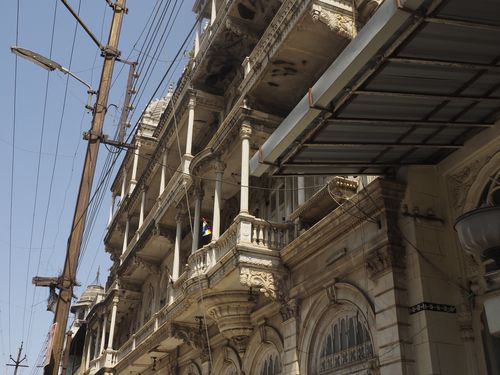
Externally, the building remains restrained. The façade presents rectilinear volumes punctuated by regular openings. There are no towering shikharas dominating the skyline; instead, the temple conforms to the scale of surrounding structures. This measured exterior contrasts with the elaborate interior, emphasizing the experiential transformation upon entry.
Spatial Organization and Structural Features
The temple rises across multiple levels within a constrained urban parcel. Access is gained via a staircase leading to the primary worship hall. The hall functions as a congregational space with an unobstructed central zone framed by columns. The load-bearing piers are relatively slender but sufficient due to short spans between supports.
The sanctum occupies the axial terminus of the hall. It is slightly elevated and demarcated by decorative railings. Marble idols are positioned symmetrically, backed by mirrored panels that multiply their visual presence. The interplay between white marble and reflective surfaces creates a layered spatial depth.
Upper levels accommodate subsidiary shrines or galleries. The vertical circulation is compact, reflecting limited site dimensions. Balustrades are integrated into the decorative scheme, ensuring aesthetic continuity.
Structural distinctions lie in the extensive use of surface articulation without compromising load-bearing clarity. Unlike temples featuring heavy stone carving as structural expression, here the ornament is largely superimposed upon a plain structural shell. This separation of structure and decoration allowed precise decorative execution without structural complexity.
Quantitative Characteristics and Notable Aspects
While not monumental in footprint compared to large Jain complexes in western India, the temple’s interior density of decoration is exceptional. Thousands of mirror fragments cover the interior envelope. The uniformity of application creates a continuous reflective field rather than isolated decorative panels.
The building occupies a compact urban plot, maximizing vertical development rather than horizontal spread. The absence of expansive courtyards distinguishes it from rural temple complexes.
One frequently noted feature is the immersive optical effect generated by layered reflections. Light from oil lamps and electric fixtures multiplies across mirrored planes, producing a dynamic visual environment disproportionate to the building’s modest dimensions.
There are no widely documented construction legends; however, the temple’s comprehensive mirror application has earned it the popular designation “Glass Temple,” underscoring its distinctive identity within the city.
Conservation and Architectural Significance
The architectural character of Kanch Mandir presents specific conservation challenges. Mirror and glass elements are vulnerable to vibration, humidity, and mechanical impact. In a densely trafficked urban setting, vibrations from vehicles can stress plaster bonds. Regular maintenance is essential to prevent detachment.
Cleaning requires non-abrasive techniques to avoid surface scratching. Environmental pollutants may accumulate on reflective surfaces, diminishing clarity. Climate control relies on passive ventilation rather than mechanical systems, preserving the building’s original environmental strategy.
The temple does not hold UNESCO World Heritage status. Preservation is managed by the Jain trust overseeing its administration. Architectural significance arises from its rare adaptation of mirror inlay as a comprehensive devotional environment in central India.
In architectural terms, Kanch Mandir demonstrates how early twentieth-century Jain patrons employed traditional spatial forms while embracing industrial materials. Its structural framework adheres to established regional building practice, yet its interior constitutes a radical reimagining of surface treatment. The building exemplifies a transitional moment when local craftsmanship intersected with global material circulation. The result is an architecture that is structurally conservative but visually transformative, distinguished by the integration of reflective material into every architectural plane.