Français (France)
  Nederlands (nl-NL)
 Cappadocian rural traditions reflect how local communities adapted to the specific conditions of central Anatolia. They combine farming, livestock raising, water management, crop storage, and village-based social organization. In this region shaped by volcanic landscapes, inhabitants developed practices linked to the careful use of local resources and the protection of agricultural production. Skills passed down through generations include cultivation methods, food preservation, and maintenance of rural spaces. These traditions still contribute today to the cultural identity of Cappadocia and help explain the long relationship between people and their inhabited landscapes.
Cappadocia • Cappadocian Rural Traditions
Cappadocia • Cappadocian Rural Traditions
Cappadocia • Cappadocian Rural Traditions
Tradition profile
Cappadocian Rural Traditions
Tradition category: Traditional agriculture
Tradition family: Traditional practices and lifestyle
Tradition genre: Agricultural and rural traditions
Geographic location: Cappadocia • Turkey
• Links to •
• List of videos about Cappadocia on this site •
Cappadoce • Göreme, valleys and cave villages Turkey
Historical Development of Cappadocian Rural Traditions
Origins in Environment, Society and Settlement
Cappadocian rural traditions emerged from the interaction between human communities and the volcanic landscape of central Anatolia. Soft tuff stone, carved easily yet structurally stable when dry, allowed villages to create storage rooms, shelters, dovecotes and agricultural facilities directly in the rock. These customs did not appear as a single cultural system at one moment, but as a long accumulation of practical responses to climate, geography and changing political authority.
The region’s continental climate, with cold winters and dry summers, required careful food preservation and seasonal planning. Rural households depended on cereals, vineyards, orchards, livestock and later potatoes. Communities therefore developed underground storage chambers, rock-cut barns and controlled ventilation spaces. These were not only technical solutions but part of daily social organization.
Political powers that ruled Cappadocia—Roman, Byzantine, Seljuk, Ottoman and later Turkish—generally tolerated or encouraged productive rural systems that secured taxation, food supply and local stability. Village notables, religious institutions and landholding elites often supervised land use and irrigation, while peasant families preserved technical knowledge through custom.
Pigeon Houses and Agricultural Economy
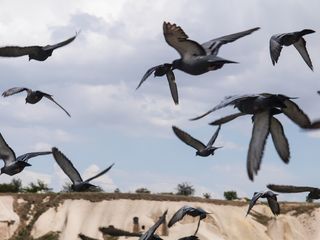
One of the most distinctive Cappadocian traditions was the construction of pigeon houses, or dovecotes, carved into cliffs and valley walls. Their principal purpose was agricultural rather than ornamental. Pigeon droppings were highly valued fertilizer, especially for vineyards and gardens cultivated in soils that required enrichment.
Many dovecotes were painted or whitewashed around the entrances to attract birds. Their façades sometimes carried geometric motifs, inscriptions or symbolic decoration. Interior compartments were designed to maximize nesting space while protecting birds from predators. Families periodically collected guano and transported it to cultivated fields.
This practice likely expanded significantly during the late Byzantine and Ottoman periods, when viticulture and horticulture remained economically important. Similar uses of pigeons existed in Persia, Egypt and parts of the Mediterranean world, but Cappadocia is unusual for the scale of rock-cut installations integrated into volcanic landscapes.
Pigeon keeping also had symbolic dimensions. Birds could represent blessing, fertility or peace in local imagination, linking practical farming with broader cultural meanings.
Storage Traditions and the Rise of Potato Cellars
Another major rural tradition was underground storage. Natural insulation in rock-cut chambers kept temperatures relatively stable, making them ideal for preserving grain, dried fruit, wine and vegetables. Families relied on such spaces to survive winter shortages and market fluctuations.
In the modern period, especially from the nineteenth century onward, potatoes became increasingly significant in Anatolian agriculture. Cappadocia’s cool underground spaces proved exceptionally suitable for potato storage. Existing caves and newly excavated chambers were adapted for large-scale use, sometimes serving commercial rather than purely domestic purposes.
The spread of potato storage reflects changing agricultural economies under late Ottoman reforms and later the Turkish Republic, when transport networks and national markets expanded. What had once been village subsistence infrastructure gradually entered wider commercial circuits.
Comparable underground storage traditions existed elsewhere, such as root cellars in northern Europe, but Cappadocia differed in the extent to which entire volcanic landscapes could be converted into storage systems.
Dynastic Change, Modernization and Social Transformation
Successive political changes influenced rural traditions without always replacing them. Under Byzantine rule, monastic estates and village communities shaped local agricultural organization. Under Seljuk and later Ottoman authority, taxation systems, land tenure and caravan trade redirected production patterns but often preserved existing village practices.
The twentieth century brought deeper transformation. Population exchanges between Greece and Turkey in the 1920s altered the demographic composition of many Cappadocian settlements, interrupting some inherited customs while preserving others through newly settled Muslim communities. Mechanized agriculture, chemical fertilizers and modern warehouses reduced dependence on traditional dovecotes and cave storage.
Urban migration after the mid-twentieth century weakened intergenerational transmission. Many younger residents left villages for Ankara, Istanbul or overseas employment. Some pigeon houses were abandoned, and older farming rhythms declined.
At the same time, tourism reinvented rural traditions. Features once seen as ordinary agricultural infrastructure became heritage assets. Visitors increasingly valued dovecotes, cave cellars and village landscapes as expressions of authenticity.
Global Context and Comparative Perspective
Cappadocian rural traditions belong to a broader global history of pre-industrial adaptation to demanding environments. Across the world, communities created vernacular systems using local materials: terrace farming in the Andes, underground granaries in North Africa, cave settlements in China, and dovecote agriculture in Iran and Egypt.
What distinguishes Cappadocia is the fusion of several functions in one geological setting: habitation, worship, storage, fertilizer production and animal keeping within carved volcanic terrain. While many regions had one of these elements, few combined them so completely.
The modern heritage revaluation of such traditions also mirrors international trends seen since the twentieth century, when vernacular landscapes came to be studied not merely as backward survivals but as sophisticated ecological knowledge systems.
Present Role, Cultural Meaning and Preservation Challenges
Today Cappadocian rural traditions remain important markers of regional identity. They appear in tourism imagery, local museum narratives and cultural promotion. Restored dovecotes, vineyards, traditional food production and cave-based storage all contribute to the distinctiveness of the region.
Some practices continue in modified form. Underground storage is still used commercially in certain sectors. Viticulture survives, and local households maintain gardens and seasonal preservation methods. Festivals and village markets may indirectly preserve older agricultural rhythms.
However, preservation faces serious challenges. Urbanization, standardized farming methods, loss of artisanal skills and generational change threaten living continuity. There is also a risk of transforming traditions into decorative folklore detached from their original economic purpose.
Public authorities, local associations and heritage initiatives increasingly support restoration of rural structures and documentation of traditional knowledge. Although these customs are not individually inscribed as UNESCO intangible heritage, they benefit from the international visibility of Cappadocia as a protected cultural landscape.
The long-term future of Cappadocian rural traditions depends less on static conservation than on their continued usefulness. When adapted to modern agriculture, sustainable tourism and local pride, they remain living traditions rather than museum remnants.
Characteristics of Cappadocian Rural Traditions
Origins and Historical Context
Cappadocian rural traditions developed in central Anatolia through a long interaction between farming communities and a distinctive volcanic environment. Soft tuff stone, harsh winters, dry summers and irregular rainfall encouraged practical systems of storage, soil improvement and seasonal cooperation. These traditions were not created by a single authority or religious reform, but emerged gradually from village life under successive political regimes including Byzantine, Seljuk, Ottoman and modern Turkish rule.
Their original function was economic and social. Rural households needed to preserve food, fertilize fields, protect harvests and organize labour across the agricultural calendar. In many settlements, the family rather than the state was the principal unit of production. Religious institutions, village elders and local landholders sometimes influenced land use, but most techniques were maintained through customary practice.
Within the wider history of Cappadocia, these traditions belong to a region known for adaptation to rock landscapes. Just as people created cave dwellings and underground refuges, they also transformed the terrain into agricultural infrastructure.
Constituent Practices and Technical Knowledge
Among the best-known elements are rock-cut pigeon houses, underground storage chambers and seasonal farming routines. Pigeon houses were carved into valley walls or cliff faces to attract birds whose droppings were collected as fertilizer, especially for vineyards and gardens. Entrances were often whitened or painted to draw pigeons, and interior niches were arranged for nesting.
Underground chambers served as natural refrigerators before mechanical cooling. They were used for grain, dried fruit, wine and later potatoes. Stable temperatures and low light helped preserve produce for months. In some areas, large cave networks were adapted for commercial storage.
Agricultural work followed seasonal sequences: pruning vines, sowing cereals, harvesting fruit, drying produce, collecting pigeon manure and preparing winter reserves. Roles were often distributed by age and gender. Men might handle excavation, transport and field labour, while women frequently managed food processing, storage, household gardens and domestic animals. Children learned through participation rather than formal instruction.
Specific knowledge transmitted across generations included reading weather patterns, choosing suitable cave humidity, identifying fertile soils, maintaining dovecotes and timing harvest cycles.
Symbolism and Cultural Meanings
Although highly practical, these traditions also carried symbolic value. Pigeons were associated in many cultures with fertility, blessing and peace. In Cappadocia, their usefulness in agriculture reinforced the idea that nature could be an ally when properly managed.
Storage caves symbolized prudence and continuity. A well-filled cellar represented security, family honour and readiness for winter. Bread ovens, shared meals and preserved foods often expressed hospitality and household competence.
Colour and decoration could also matter. Some dovecote façades displayed painted motifs, geometric signs or white lime coatings. These served practical purposes but also marked care, ownership and local identity.
Variants existed between valleys and villages. Some communities emphasized vineyards, others cereals, orchards or livestock. As a result, traditions reflected local ecology as much as common regional culture.
Evolution and External Influences
Over centuries, Cappadocian rural traditions adapted to changing political and economic systems. Byzantine monastic estates may have influenced vineyard management and irrigation. Under Seljuk and Ottoman rule, taxation, caravan trade and regional markets altered production priorities while preserving many village techniques.
From the nineteenth century onward, expanding transport links introduced new crops and broader markets. Potatoes became increasingly important, and old caves found new commercial uses. In the twentieth century, chemical fertilizers reduced dependence on pigeon manure, while modern warehouses challenged traditional storage.
Urban migration weakened transmission, especially after the 1950s. Many younger residents left villages, and some practices survived only partially. Tourism later revived interest in rural heritage, sometimes preserving structures but detaching them from their original economic role.
Comparable traditions can be found elsewhere: dovecotes in Iran and Egypt, root cellars in northern Europe, cave granaries in North Africa. Cappadocia remains distinctive because so many functions were integrated into carved volcanic terrain.
Social Organization and Community Role
These traditions structured community life. Seasonal labour often required neighbourly cooperation, reciprocal assistance and collective timing. Harvests, grape pressing and winter preparation were moments of intense social interaction.
Older generations held authority through experience, while younger members supplied labour. Women frequently acted as guardians of food knowledge, preservation techniques and household continuity. Such divisions varied by village and period, but the family economy remained central.
Traditional practices also intersected with festivals and religious calendars. Communal meals after harvests, market gatherings and holiday preparations reinforced local cohesion. Rural identity was therefore expressed not only through work, but through shared rhythms of life.
Notable Facts and Local Memory
Thousands of pigeon houses still survive across parts of Cappadocia, though many are no longer active. Some valleys display dense concentrations of decorated façades cut high into the rock.
Large underground stores continue to be used in some areas for agricultural products, especially potatoes. Their scale demonstrates how vernacular techniques could remain economically relevant into the modern era.
Local stories often claim that the best vineyards depended on carefully managed pigeon manure, while families sometimes measured prosperity by the quality of their stores before winter.
Recognition and Preservation Challenges
Today these traditions are recognized as part of Cappadocia’s broader cultural landscape, internationally known through the UNESCO-listed Göreme and surrounding rock sites. While the monumental churches and geological formations receive more attention, rural practices are increasingly valued as intangible heritage.
Main threats include urbanization, industrial farming, abandonment of villages and declining intergenerational transmission. Tourism can preserve appearances while simplifying real traditions into folklore.
Local initiatives now support restoration of dovecotes, promotion of regional foods, traditional viticulture and documentation of oral knowledge. The future of Cappadocian rural traditions depends on combining heritage value with living usefulness. If they remain connected to local economy and community pride, they can continue as active cultural practices rather than static relics.
 Links to the main sections of the site