Français (France)
  Nederlands (nl-NL)
 The village school of Ranjeet Nagar Shahabad reflects the importance of local education in rural India. Such institutions play a central role in daily life by giving children access to basic learning, reading, writing and early scientific knowledge. They also serve as places of social interaction for families within the community. Often modest in their physical setting, these schools contribute to local social progress. They illustrate long-term efforts to expand access to education in the Indian countryside and to improve opportunities for younger generations through regular schooling and community support.
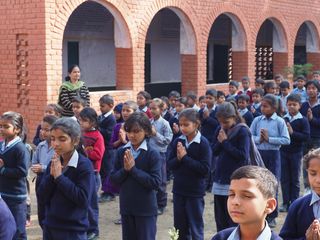
Ranjeet Nagar Shahabad • Village school in Haryana
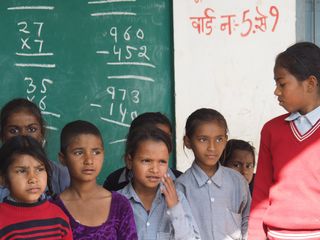
Ranjeet Nagar Shahabad • Village school in Haryana
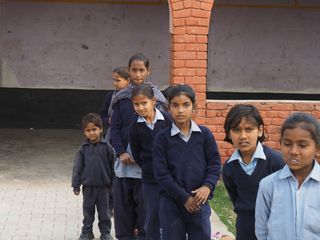
Ranjeet Nagar Shahabad • Village school in Haryana
Village school in Haryana
Village Schooling in Haryana: Historical Development and Social Role
Origins of Rural Education
Village schooling in Haryana forms part of a long Indian tradition in which learning was historically transmitted through family networks, religious institutions, local teachers and community settings. Before the expansion of modern public education, literacy and formal instruction were unevenly distributed, often linked to occupation, caste, wealth or access to urban centres. In rural northern India, many children learned practical skills within the household while only a smaller number received sustained academic training.
During the nineteenth and early twentieth centuries, colonial administrations introduced wider systems of formal schooling. These remained limited in many villages, where infrastructure, funding and teacher availability were often insufficient. Even so, the idea of a permanent school building serving a rural population gradually became established.
Expansion after Independence
A major transformation came after Indian independence in 1947. Education was increasingly regarded as essential for national development, citizenship and economic progress. In what later became the state of Haryana in 1966, successive governments invested in village schools, teacher recruitment and access to primary education.
Rural schools became one of the most visible signs of state presence in the countryside. They provided structured learning in reading, writing, mathematics and languages while connecting villages to broader administrative and social systems. Over time, many settlements that once depended on distant schools gained local educational facilities.
Social Meaning within Village Communities
A village school in places such as Ranjeet Nagar Shahabad is more than an academic institution. It often serves as a shared civic space where children from different family backgrounds meet daily. In regions shaped by agriculture, the school represents continuity between traditional village life and modern aspirations.
Families commonly view education as a path toward social mobility, stable employment and wider opportunities beyond farming or manual labour. For girls in particular, expanded schooling has carried important implications for literacy, autonomy and participation in public life.
Schools also help standardise civic practices through national holidays, assemblies, health campaigns and community meetings. Their influence therefore extends beyond the classroom.
Change over Time
Village education in Haryana has evolved significantly in recent decades. Enrolment levels have risen, female participation has improved and awareness of compulsory education has expanded. Midday meal programmes, textbook distribution and scholarship schemes have encouraged attendance, especially among lower-income households.
At the same time, expectations have changed. Parents increasingly seek English instruction, digital familiarity and examination success. This has created new pressure on rural schools to modernise teaching methods and facilities.
Migration, mechanisation of agriculture and changing employment patterns have also altered the relationship between school and village economy. Education is now often linked to careers outside the immediate rural environment.
Present Importance
Today, village schools remain central to everyday life in much of Haryana. They structure children’s routines, sustain literacy gains and offer one of the first formal contacts with public institutions. In smaller settlements, the school may be among the most important shared buildings.
Its role is especially significant where private alternatives are distant or costly. Public rural schools continue to support broad access to basic education and social inclusion.
Transmission and Contemporary Challenges
Current challenges include uneven resources, teacher shortages in some areas, classroom overcrowding, infrastructure maintenance and the gap between urban and rural opportunities. Digital education has opened new possibilities but also exposed inequalities in connectivity and equipment.
Despite these constraints, the village school remains a durable institution. It reflects the long transformation of rural India from locally bounded communities toward a society increasingly shaped by literacy, mobility and formal education.
Daily Functioning of a Village School in Haryana
General Routine
A village school in Ranjeet Nagar Shahabad usually follows a structured daily timetable beginning in the morning. Pupils arrive on foot, by bicycle or with family members from nearby streets and surrounding rural areas. Before classes start, students often gather in the courtyard or an open space for attendance, announcements, short exercises or collective recitations.
Lessons are then divided into periods according to age groups and subjects. The school day normally combines literacy, mathematics, languages, environmental studies and basic social sciences. Breaks separate the sessions and allow movement, rest and informal interaction.
Buildings and Learning Spaces
The school environment is generally practical in design. Buildings often include rectangular classrooms arranged around a courtyard or beside an open playground. Walls may display painted alphabets, numbers, maps, moral messages or educational illustrations intended for constant visual learning.
Large doors and windows help circulation of air and daylight, especially during hot seasons. Floors may be cement, tile or simple finished surfaces. Some classrooms contain ceiling fans, storage cupboards and notice boards. Outdoor areas are used for assemblies, games and overflow activities.
Furniture and Teaching Materials
Observable classroom equipment commonly includes desks, benches, blackboards or whiteboards, notebooks and textbooks. In lower grades, some children may sit on mats or low benches depending on local resources. Teachers frequently use chalk, charts, flashcards and handwritten examples.
School bags, water bottles, lunch containers and exercise books form part of everyday student life. Where facilities have improved, computers, televisions or digital devices may supplement traditional tools.
Participants and Roles
The principal participants are pupils, teachers, administrative staff and occasionally visiting parents or local officials. Teachers direct lessons, maintain discipline, correct written work and supervise movement between classes. Older students may help organise lines, distribute materials or guide younger children.
Boys and girls usually attend together. Uniforms or standardised clothing are common, often consisting of shirts, trousers, skirts or salwar-style garments in selected colours. Uniform dress reduces visible social differences and reinforces school identity.
Gestures and Learning Practices
Many teaching methods remain highly visible and interactive. Students repeat words aloud, read in groups, copy sentences from the board and answer questions one by one. Memorisation exercises, multiplication tables and handwriting practice are frequent components of the day.
Teachers move between rows, inspect notebooks and give immediate corrections. Group recitation creates a recognisable sound environment found in many South Asian schools. Written discipline and orderly posture are often emphasised alongside academic progress.
Soundscape and Atmosphere
The atmosphere combines concentration with regular bursts of collective activity. One may hear recited lessons, bells, teacher instructions, children speaking in Hindi, English or local speech forms, and playground voices during breaks. The pace changes throughout the day, from quiet writing periods to animated outdoor intervals.
Distinctive Features of a Rural Haryana School
What distinguishes a village school in Haryana is its close relationship with surrounding rural life. Agricultural fields, local roads and family networks lie only a short distance away. Seasonal weather, harvest periods and village events can influence attendance patterns and daily rhythms.
The school therefore functions not only as a place of instruction, but also as a visible meeting point between traditional rural society and the expanding educational system of modern India.
 Links to the main sections of the site