Français (France)
  Nederlands (nl-NL)
 Octopus fishing and drying are traditional practices commonly found along the coasts of Rodrigues. This activity is based on artisanal octopus capture, integrated into the island’s sustainable livelihood systems. The octopuses are dried naturally outdoors on structures adapted to tropical conditions. This method preserves the product for future consumption or local trade. Octopus fishing supports the island’s economy and reflects the importance of marine resources in Rodrigues’ social and food organization. The skills are still actively passed down within coastal communities, where they remain a vital part of the island’s cultural identity.

Port Mathurin • Octopus fishing and drying

Port Mathurin • Octopus fishing and drying
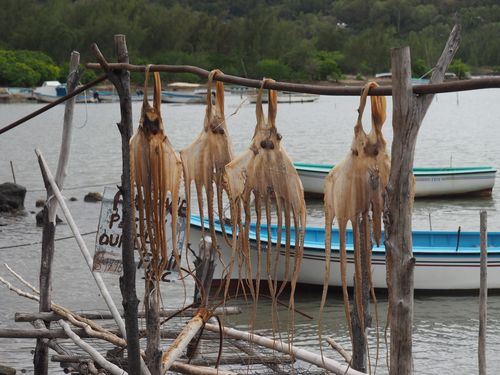
Port Mathurin • Octopus fishing and drying
Tradition profile
Octopus fishing and drying
Tradition category: Traditional fishing
Tradition family: Crafts and professions
Tradition genre: Trade and Local Creativity
Geographic location: Port Mathurin, Saint Gabriel, Camp Pintade • Rodrigues • Mauritius
• Links to •
• List of videos about Port Mathurin on this site •
Rodrigues, the runaway ibex • Rodrigues, Mauritius
Rodrigues • Indian Ocean island
Octopus Fishing and Drying in Rodrigues: Traditions, Transformations, and Contemporary Challenges
Social and Political Origins of the Practice
Octopus fishing and drying on Rodrigues Island find their roots in the subsistence needs of island communities. This practice did not emerge from a formal political decision but rather from a social dynamic where food self-sufficiency was vital. From the French colonial period (1735–1809), and even more under British administration (1810–1968), Rodrigues remained marginalized compared to the main island of Mauritius. This isolation fostered community-based economic systems focused on coastal fishing and subsistence agriculture.
Foot fishing, particularly suited to the wide coral flats exposed at low tide, gradually became institutionalized as a means to secure local protein supplies without the need for heavy infrastructure or sophisticated vessels.
Emergence and Historical Evolution
The structured practice of octopus fishing and drying appears to have become well-established by the 19th century. Following the abolition of slavery in 1835 in Mauritius and Rodrigues, social reorganization took place: communities of former slaves, often deprived of access to the best agricultural lands, increasingly turned to fishing. This context strengthened the intergenerational transmission of techniques adapted to the demanding coastal environment.
In the 20th century, especially after Mauritius’ independence in 1968, Rodrigues experienced attempts at economic modernization. However, artisanal fishing, including octopus fishing, remained essential both for subsistence and as a modest source of income through local markets.
Global Context and Comparisons
Globally, artisanal coastal fishing has long been a response to the food security challenges of poor island or coastal societies. In Rodrigues, this tradition is similar to practices observed in Polynesia, the Seychelles, Madagascar, and parts of coastal Africa, where foot fishing and natural drying of marine products allow preservation without advanced technology.
Unlike other regions where the introduction of motorized equipment disrupted traditional fishing methods from the 20th century onwards, Rodrigues has remained faithful to techniques that respect the rhythms of the tides and biological cycles.
Transformations and External Influences
Over time, octopus fishing has undergone progressive transformations, mainly linked to:
• the structuring of local markets,
• increasing environmental regulations to preserve marine stocks,
• the influence of modernization, albeit limited, in drying equipment.
Internal social dynamics, notably the recognition of the important role of women in this activity (they make up a large part of the foot-fishers), have also marked the evolution of the practice.
External cultural influences, such as the development of tourism and coral reef protection policies, have begun to redefine the role of this tradition in the local economy.
Current Cultural Importance and Contemporary Challenges
Today, octopus fishing and drying remain a key element of Rodrigues’ identity. They embody an intimate relationship between the inhabitants and their marine environment and represent a living know-how transmitted within families.
However, several major challenges threaten this tradition:
• occasional overexploitation of marine resources,
• the effects of climate change on coral ecosystems,
• competition from modern economic activities,
• and the progressive disinterest of younger generations for trades perceived as arduous and undervalued.
The preservation of this practice now depends on community initiatives, raising awareness of the value of living heritage, and adaptation to contemporary ecological constraints.
Octopus Fishing and Drying in Rodrigues: Island Innovation, Symbolism, and Cultural Dynamics
Social and Cultural Innovation at the Time of Emergence
Octopus fishing and drying in Rodrigues represent more than just a means of subsistence: they reflect a social and cultural innovation adapted to the constraints of an isolated island. At the time of their emergence, probably consolidated in the 19th century after the abolition of slavery, local communities developed a system of marine resource management based on collective effort, respect for natural cycles, and ecological adaptation. This informal organization, involving both men and women fishing on extensive coral flats, offers a model of early sustainable community-based economy.
The systematic use of simple structures to dry octopuses outdoors also demonstrates vernacular engineering adapted to tropical conditions: rational use of sunlight, management of ambient humidity, and optimization of natural resources.
Objects, Rituals, and Values Expressed by the Tradition
Although octopus fishing is not framed by spectacular religious rituals, it incorporates strong collective practices. Fishing departures often follow informal community-based patterns: inhabitants gather in small groups based on tidal schedules, respecting unwritten fishing territories passed down orally through generations.
The tools used—sticks for probing holes, rustic knives, simple nets—show a functional and respectful relationship with the marine environment. Collective drying practices, with octopuses suspended on makeshift racks or stretched between trees, become a visual symbol of island identity and a testament to shared labor.
These customs reflect the values of mutual aid, humility before nature, patience, and resilience, which are key characteristics of traditional Rodriguan society.
Blend of Local Customs and External Influences
Rodrigues’ tradition of octopus drying illustrates a subtle blend:
• African heritage, brought by ancestors familiar with coastal fishing and drying techniques,
• European influences, indirectly introduced by French and British colonial practices, especially concerning local markets,
• and adaptations specific to Rodrigues, shaped by the island’s isolation and coral environment.
This cultural syncretism appears in the tools, in resource management methods, and in the enduring cultural centrality of octopus fishing today.
Anecdotes and International Impact
It is traditionally said in Rodrigues that a “good octopus season” foretells a prosperous year for the community. Some families pass down the “best fishing spots” as valuable family heirlooms.
Statistically, octopus fishing can account for up to 30% of family income in coastal areas during the dry season.
So far, Rodrigues’ octopus fishing and drying have not been inscribed on the UNESCO Intangible Cultural Heritage lists. However, such recognition would enhance local pride, support marine ecosystem protection, and draw international attention beneficial to safeguarding this practice against modern threats like climate change or rapid modernization.
 Links to the main sections of the site