Français (France)
  Nederlands (nl-NL)
 00:00 • intro | 00:41 • a team of oxen in Rajasthan | 03:17 • a school in in Tarpal in Rajasthan | 06:16 • Tarpal, a village in Rajasthan | 08:11 • Shahabad, a village in Haryana | 08:57 • Shahabad, school | 12:54 • Bodhgaya, Bihar, a school | 15:12 • a village near Bodhgaya
Personal creation from visual material collected during my trip India • Rajasthan and Varanasi (2015)
Map of places or practices in Raipura Brahman on this site
• Use the markers to explore the content •
Rural India Across Rajasthan, Haryana and Bihar
Everyday Landscapes Beyond the Famous Monuments
This video explores several regions of northern India through scenes of daily life in the countryside of Rajasthan, Haryana and Bihar. Rather than focusing on palaces, temples or major urban landmarks, it turns attention toward another form of heritage: agricultural landscapes, village communities, schools and long-established working practices. These rural environments have played a central role in the history of the Indian subcontinent, where farming settlements, seasonal rhythms and local institutions shaped social life for centuries.
The journey moves through contrasting settings. Rajasthan is often associated with drier terrain and the need to manage scarce water resources. Haryana, in the plains northwest of Delhi, is known for productive agriculture and irrigated farmland. Bihar, farther east, belongs to one of the most densely populated rural regions of India and preserves a deep historical continuity of village life. Together, these locations offer a broader understanding of India beyond its best-known monuments.
Villages, Schools and Traditional Rural Work
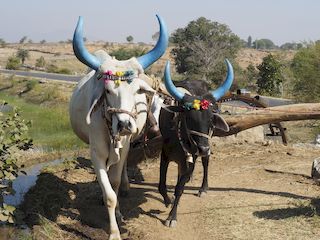
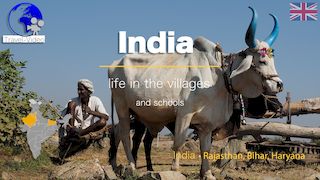
One of the most memorable scenes shows a bullock cart or working oxen in Rajasthan. Animal traction has long been part of Indian rural economies, used for transport, ploughing and water-lifting systems. Even where tractors and motorized tools are now common, older methods sometimes remain practical and economically useful. Such images reveal the coexistence of different technological eras within the same countryside.
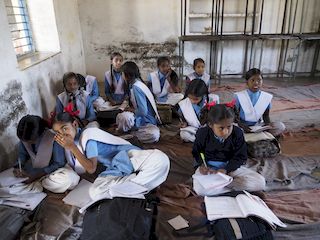
The schools shown in Rajasthan, Haryana and Bihar add another important dimension. Rural education has been one of modern India’s major social priorities since independence in 1947. School buildings, classrooms and children’s daily routines reflect efforts to widen literacy, improve opportunities and reduce social inequality. In many villages, the local school is not only a place of learning but also a symbol of aspiration and gradual change.
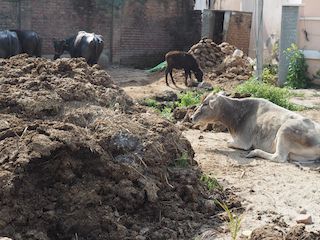
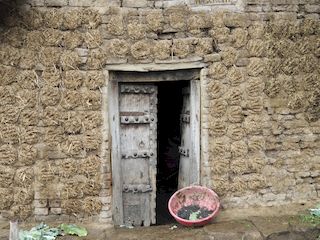
The villages of Samwas in Rajasthan, Shahabad in Haryana and the settlements near Bodhgaya in Bihar illustrate varied forms of rural habitation. Houses grouped along lanes, courtyards, open working spaces and nearby fields create compact communities where domestic life, agriculture and social interaction remain closely linked.
Historical and Cultural Background
For much of Indian history, the village was the essential social and economic unit. Under ancient kingdoms, regional dynasties, the Mughal Empire and later British colonial rule, rural settlements functioned as centres of cultivation, taxation and local administration. After independence, land reform, road building, mechanization and population growth transformed many regions, though older patterns often survived alongside newer ones.
Water management has been especially important in drier areas such as parts of Rajasthan. Wells, reservoirs and traditional lifting devices made cultivation possible in demanding climates. One example is the Persian wheel, also known locally as the rahat, a mechanical system that helped raise groundwater for irrigation. Related pages on this site provide further insight into such practical traditions.
Haryana became a separate state in 1966 and benefited strongly from the Green Revolution, which increased agricultural productivity through irrigation, improved seeds and new farming methods. Bihar, although marked by economic challenges, remains rich in agricultural life and historical memory. The area around Bodhgaya adds further significance, as this town is one of the world’s major Buddhist pilgrimage centres.
What the Videos on This Site Make Especially Clear
Travel-video.info often builds its productions from carefully selected photographs animated through smooth movement and transitions. This approach is particularly effective for rural subjects. It allows viewers to examine tools, animals, building materials, street layouts and human gestures with greater calm than fast-moving footage sometimes permits.
The visual rhythm also helps comparisons between regions. Differences in terrain, architecture and atmosphere between Rajasthan, Haryana and Bihar become easier to perceive. Step by step, the viewer gains a clearer understanding of how landscapes influence ways of living and working.
A Broader View of India
By showing schools, villages and agricultural scenes, this video presents an India that is less publicized but deeply important. It reveals the continuity of rural societies adapting to change while preserving long-standing habits and practical knowledge. For those wishing to continue the journey, the related pages on this site offer deeper background on traditional technologies and regional culture.
Links to related pages
Audio Commentary Transcript
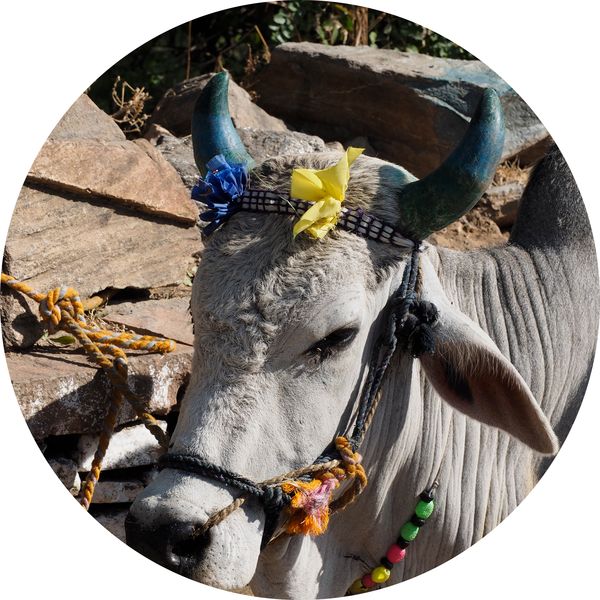
A team of oxen with horns painted blue and carrying bells and pompoms busy turning a wheeled well (Persian wheel or saqja) is a godsend on the roads of Rajasthan.
But India is not only made of palaces and cows. There are also schools. We visited a few. And yes, the atmosphere there is a little different from that of our Western schools.
We also walked through different villages in Rajasthan, Haryana and Bihar. The villagers gave us a warm welcome each time, even if they were a little surprised to see a few tourists arrive.
Images and videos of some villages in Rajasthan, Haryana and Bihar, school visits, field work and daily life in the Indian countryside
Music:
- - YouTube video library - Butterflies in Love
- - YouTube video library - Clouds
- - YouTube video library - Dance for Wind Trio
- - YouTube video library - Done Running
- - YouTube video library - Evil March, (© Evil March by Kevin MacLeod is licensed under a Creative Commons Attribution 4.0 license. https://creativecommons.org/licenses/by/4.0/
- Source: http://incompetech.com/music/royalty-free/index.html?isrc=USUAN1100727
- Artist: http://incompetech.com/)
- - YouTube video library - Fall of the Solar King, (© Fall of the Solar King by Twin Musicom is licensed under a Creative Commons Attribution 4.0 license. https://creativecommons.org/licenses/by/4.0/
- Artist: http://www.twinmusicom.org/)
Disclaimer: Despite its appropriateness, copyright issues prevent the use of indian traditional music in "India, scenes of life in the countryside • Rajasthan, Haryana, Bihar, India ", hence the use of royalty-free music. Despite our careful selection, some might regret this decision, which is necessary to avoid potential lawsuits. Although difficult, this decision is the only viable solution.