Français (France)
  Nederlands (nl-NL)
 The rural school of Tarpal, in the state of Rajasthan, represents an important part of local community life. Like many village schools in India, it provides basic education while contributing to the social structure of the settlement. These institutions often welcome children from the surrounding area and play a significant role in literacy, social mobility, and the transmission of modern knowledge. They may also serve as gathering places for civic or educational activities. Through their daily operation, they reflect ongoing efforts to expand access to education in rural parts of India.
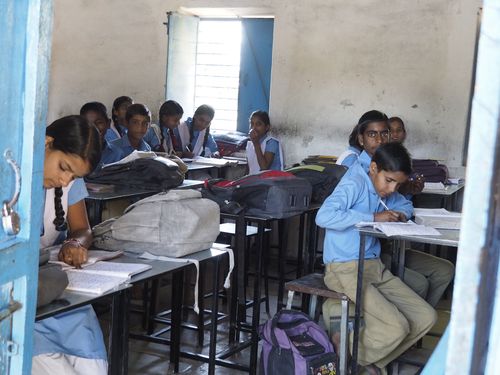
Tarpal • Rural school in Rajasthan
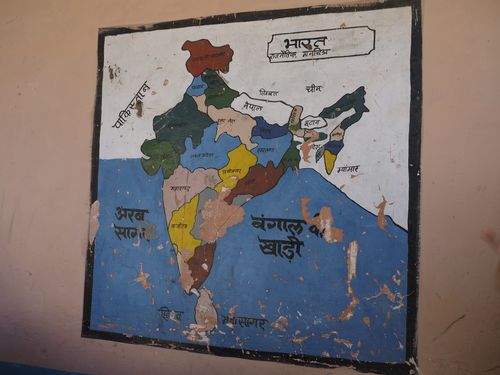
Tarpal • Rural school in Rajasthan
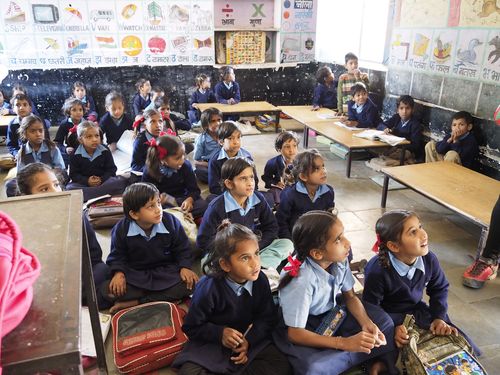
Tarpal • Rural school in Rajasthan
Rural school in Rajasthan
Rural Schooling in Tarpal, Rajasthan
Origins of Village Education
Rural schooling in places such as Tarpal belongs to a long process through which education gradually moved from limited informal instruction to organized public access. In older village society, learning often took place within the family, through caste occupations, religious institutions, or local tutors who transmitted literacy, arithmetic and customary knowledge to a restricted number of children, most often boys.
During the nineteenth century, under princely states and British colonial administration, more formal schools began to appear in parts of Rajasthan. Their distribution remained uneven, especially in sparsely populated or economically modest rural zones. Many villages continued to rely on traditional learning patterns rather than permanent institutions.
Expansion after Independence
A major transformation followed Indian independence in 1947. Education became a central instrument of nation-building, social mobility and administrative modernization. State authorities expanded the primary school network, including in remote villages. The objective was not only literacy, but also the integration of rural populations into a common civic framework.
In Rajasthan, where settlements can be dispersed and environmental conditions demanding, the creation of village schools required sustained public investment. Buildings, teacher appointments and textbook distribution became part of broader development policies. Schools such as the one in Tarpal represent this post-independence effort to bring regular education within reach of rural families.
Social and Community Role
Village schools rapidly acquired functions extending beyond classroom teaching. They became places where children from different households met daily, where girls increasingly gained access to education, and where state programmes could be implemented. Public health campaigns, census work, elections and awareness initiatives often used school premises or staff support.
For many families, schooling also marked a shift in expectations. Literacy and numeracy opened possibilities beyond agricultural labour alone. Education became linked to salaried employment, migration opportunities and access to public services.
Phases of Change
The history of rural schools has not been linear. Teacher shortages, absenteeism, limited infrastructure and irregular attendance have affected many regions at different times. Economic pressures sometimes required children to assist households or seasonal work, reducing continuity in education.
From the late twentieth century onward, renewed policies strengthened enrolment. Midday meal schemes, free textbooks, campaigns for girls’ education and constitutional recognition of education as a right helped increase attendance. Roads, transport and communication networks also improved access in many villages.
Present Importance
Today, a rural school in Tarpal remains a key public institution. It provides foundational education, introduces digital tools where available, and connects children to wider linguistic and administrative systems. It often serves as one of the most visible symbols of state presence in village life.
The school also preserves an important social rhythm: daily gathering, intergenerational contact and shared civic experience. In communities undergoing economic and demographic change, this continuity retains significant value.
Transmission and Contemporary Challenges
Current challenges include maintaining teaching quality, ensuring regular staffing, reducing dropout rates and adapting learning to changing expectations. Digital inequality between urban and rural areas remains a concern, as does the balance between local languages and wider educational requirements.
At the same time, rural schools continue to transmit more than academic content. They pass on habits of cooperation, public participation and social aspiration. In villages such as Tarpal, the school remains both an educational space and a cornerstone of community development.
Daily Life and Practices of a Rural School in Tarpal
General Organization of the School Day
A rural school in Tarpal typically follows a structured daily rhythm adapted to local conditions. Pupils arrive in the morning on foot, by bicycle, or accompanied by family members. Before classes begin, children often gather in the courtyard or open assembly space. Attendance is checked, announcements may be made, and the day starts collectively.
Lessons are divided into periods covering subjects such as reading, writing, mathematics, environmental studies and basic sciences. In multi-grade settings, one teacher may supervise pupils of different ages within the same classroom, alternating exercises and explanations between groups.
Buildings and Educational Spaces
The visible layout usually consists of a modest compound with one or several classrooms arranged around an open yard. Rooms are rectangular, ventilated through doors and windows, and equipped with blackboards or whiteboards. Walls may display alphabets, numbers, maps, health messages or educational charts.
The courtyard plays an important role. It functions as an assembly area, recreation zone and overflow teaching space when weather permits. Boundary walls or fences help define the school grounds. A flagpole, water point, storage room or kitchen area for meal preparation may also be present.
Objects, Materials and Classroom Tools
The school environment includes benches, desks, floor mats or simple seating arrangements depending on resources. Teachers use chalk, registers, notebooks, textbooks and wall charts. Pupils commonly carry schoolbags containing exercise books, pencils, pens and slates in some contexts.
Uniforms may be worn, though styles vary. Many children appear in coordinated clothing prescribed by state or local policy, while others wear practical everyday garments suited to village life and climate.
Gestures and Learning Practices
Observable teaching methods often combine oral repetition, copying from the board, group recitation and written exercises. Pupils may read aloud together, answer questions in turn, or solve arithmetic problems before the class. Memorization remains important, especially for foundational literacy and multiplication tables.
Teachers frequently move between rows, check notebooks individually and reorganize mixed-age groups according to task level. Peer assistance is common, with older pupils helping younger ones complete exercises or understand instructions.
Sounds, Expressions and Social Atmosphere
The soundscape of a rural school is distinctive: collective recitation, teacher instructions, children answering in chorus, footsteps in the courtyard and informal conversation during breaks. Bells, hand signals or verbal calls may mark transitions between periods.
Morning greetings, respectful forms of address and shared routines reinforce discipline and social cohesion. During recess, the atmosphere shifts quickly to games, running and lively exchanges.
Meals and Shared Services
Where school meal programmes operate, midday food distribution becomes a visible part of the day. Children queue with plates or containers, meals are served in order, and eating often takes place in shaded open areas or classrooms. This routine supports attendance while adding a communal dimension to schooling.
What Distinguishes the Rural Setting
A village school such as the one in Tarpal differs from many urban institutions through its close relationship with surrounding community life. Agricultural seasons, festivals, weather conditions and family responsibilities can influence attendance patterns and daily schedules.
The school is not only a place of instruction. It is also a meeting point where education, village rhythms and public life intersect in a practical and highly visible manner.
 Links to the main sections of the site