Français (France)
  Nederlands (nl-NL)
 The tradition of the rope dancer, widely performed across Rajasthan, India, is a captivating art form blending agility, balance, and creativity. Often linked to local Roma-like communities, this performance is typically carried out by young girls gracefully moving on a taut rope, accompanied by traditional live music. Props like colorful umbrellas or metal pots add a distinctive flair to this ancient practice.
This art form reflects both the artistic expression and resilience of marginalized communities and remains a vital part of the region's cultural identity, enchanting audiences in public spaces and markets.
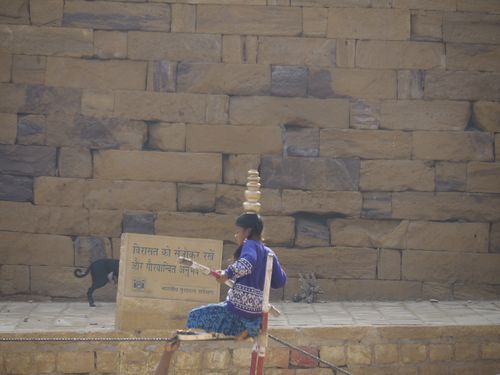
Jaisalmer • Rope dancer
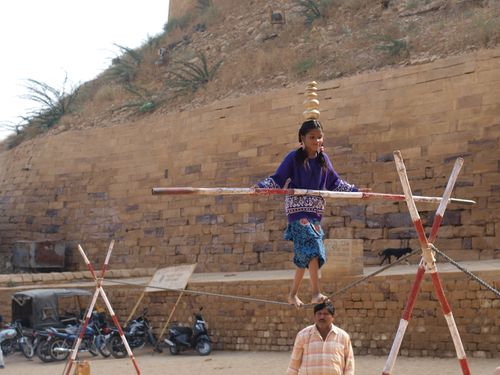
Jaisalmer • Rope dancer

Jaisalmer • Rope dancer
Tradition profile
Rope dancer
Tradition category: Tightrope Walker
Tradition family: Acrobatics and Aerial Performances
Tradition genre: Performing arts
Geographic location: Jaisalmer • Rajasthan • India
• Links to •
• List of videos about Jaisalmer on this site •
Jaisalmer, the Golden City • Rajasthan, India
Balancing Tradition and Change: The Social and Political Foundations of the Rope Dancer Tradition in Rajasthan
Social and Political Motivations Behind the Tradition's Emergence
The tradition of the rope dancer, widely practiced across Rajasthan, including Jaisalmer, is deeply rooted in the social and political structures of its time. Emerging from marginalized nomadic communities such as the Nat or Kalbeliya, this art form served as both a means of livelihood and a form of social inclusion. These communities, often relegated to the peripheries of society, used performance arts like rope dancing to integrate themselves into broader societal frameworks.
Politically, the rope dancer tradition flourished in a feudal system dominated by Rajput kingdoms. Performances were frequently organized during royal celebrations or public gatherings, not only as a form of entertainment but also as a demonstration of the ruler’s patronage of arts and culture. This reinforced the social contract between the ruling elite and the nomadic performers, allowing the latter to maintain a presence within these hierarchical societies.
Historical Timeline and Major Influences
The origins of the rope dancer tradition are difficult to pinpoint precisely, but its practice can be traced back several centuries, likely during the height of the Rajput dynasties (12th to 18th centuries). These dynasties placed a significant emphasis on cultural grandeur, fostering an environment where art and performance flourished.
The arrival of British colonial rule in the 19th century marked a turning point. The colonial administration's restructuring of social and economic systems marginalized traditional performers further, as industrialization and Western entertainment gained prominence. However, the tradition persisted in rural fairs and festivals, which became safe havens for preserving this unique art form.
Global Context and Comparisons
At the time of its emergence, similar performance traditions were thriving in other parts of the world. For instance, acrobatic troupes in China and tightrope walkers in medieval Europe shared common themes of skill, risk, and spectacle. However, unlike their counterparts in more urbanized settings, Rajasthan’s rope dancers remained deeply tied to rural communities and were often embedded in local cultural and religious festivals.
The rope dancer tradition reflects a unique blend of regional customs and external influences. Rajasthan’s position on historic trade routes brought cultural exchanges from Central Asia and Persia, evident in the use of vibrant costumes and props that bear similarities to other nomadic performance styles.
Transformations Over the Centuries
Over the centuries, the rope dancer tradition has undergone significant transformations. Originally a community-centered practice, it evolved into a more commercialized form of entertainment, particularly with the rise of tourism in the 20th century. Modern audiences, especially international visitors, have brought renewed attention to the art, but this has also led to changes in its presentation. What was once a community ritual now often caters to tourist expectations, sometimes at the cost of authenticity.
These changes also mirror shifts in power dynamics. As Rajasthan transitioned from feudal rule to a modern democratic state, the patronage of traditional arts diminished. Without consistent support, many rope dancer families faced economic hardships, prompting them to adapt their performances for new audiences in urban and tourist-centric settings.
Cultural Significance and Current Status
Today, the rope dancer tradition continues to hold cultural importance, though its prevalence has declined. It remains a staple at rural fairs and in tourist hubs like Jaipur and Jodhpur, where performers attract crowds with their daring feats and colorful presentations. However, its role has shifted from being a community-integrated tradition to a largely commercial enterprise.
Efforts to preserve the tradition include featuring it in cultural festivals and programs aimed at safeguarding intangible heritage. Despite these initiatives, the lack of formal recognition—such as inclusion in UNESCO's lists of intangible cultural heritage—limits broader awareness and support.
Challenges to Preservation
The tradition faces significant modern challenges, including declining interest among younger generations, economic instability, and competition from modern entertainment. Additionally, performers often work under precarious conditions with little institutional support. Without adequate measures, such as financial aid, education programs, and heritage recognition, this unique art form risks further decline.
Conclusion
The rope dancer tradition of Rajasthan is a testament to the resilience and creativity of marginalized communities. Its journey from a socially integrative art form to a tourist attraction reflects broader social, political, and cultural shifts over centuries. While it continues to captivate audiences, its future depends on proactive preservation efforts that balance authenticity with adaptation to contemporary realities. By ensuring its survival, this tradition can continue to serve as a bridge between Rajasthan’s rich past and its dynamic present.
The Rope Dancer Tradition of Rajasthan: A Symbol of Social and Cultural Ingenuity
Innovation in Social and Cultural Context
The rope dancer tradition, widely associated with Rajasthan, including regions like Jaisalmer, serves as a striking example of social and cultural innovation in its time. Emerging from the marginalized nomadic communities, such as the Nat and Kalbeliya, this practice functioned as both a livelihood strategy and a medium for social integration. In a rigidly hierarchical society, the rope dancers found a way to position themselves as entertainers who were indispensable at fairs, festivals, and royal gatherings.
The innovation lay in their ability to transform simple acrobatics into a profound artistic expression that combined physical skill, storytelling, and symbolic gestures. This allowed the performers to carve a space for themselves in a society that often relegated them to the fringes, showcasing the resilience and adaptability of these communities.
Rituals, Objects, and Symbolism Reflecting Societal Grandeur
The rope dancer tradition is rich with rituals and symbolic elements that reflect the grandeur and values of the Rajput society to which it belongs. Performers often adorned themselves with brightly colored costumes and intricate jewelry, signifying the vibrancy of Rajasthan’s cultural tapestry. Props such as metallic pots balanced on the head or parasols used during performances were not just decorative but carried deeper meanings. The pots symbolized balance and resourcefulness in daily life, while the parasols represented protection and grace under pressure.
The act itself—walking a tightrope, often high above the ground—can be seen as a metaphor for navigating life’s challenges with courage and poise, values deeply rooted in the cultural ethos of Rajasthan. The live musical accompaniment, typically played on instruments like the dholak and sarangi, added a rhythmic and emotional depth to the performance, creating a multisensory experience for the audience.
A Unique Blend of Regional Customs and External Influences
The rope dancer tradition embodies a unique synthesis of local and external influences. Rajasthan’s position as a crossroads of trade routes exposed it to diverse cultural interactions. Elements of Persian acrobatics and Central Asian nomadic artistry are evident in the tradition, blended seamlessly with local customs. This fusion not only enriched the art form but also allowed it to resonate with audiences beyond regional boundaries.
The communal aspect of the performances, often held during village fairs and religious festivals, ties the tradition to local cultural and spiritual practices. At the same time, the elaborate costumes and acrobatic skills hint at the broader influence of the traveling performers who once traversed Central and South Asia.
Noteworthy Practices and Anecdotes
A remarkable aspect of this tradition is the early training of young girls, who begin practicing the art of tightrope walking at an age as young as five or six. One of the most iconic feats involves balancing multiple pots on their heads while gracefully traversing the rope, a spectacle that never fails to awe the audience.
An interesting anecdote comes from the annual Pushkar Fair, where rope dancers have become a highlight attraction, drawing thousands of visitors. Their performances are not just acts of entertainment but are seen as a tribute to the endurance and creativity of Rajasthan’s nomadic communities.
Recognition and UNESCO Impact
Although the rope dancer tradition is a cherished part of Rajasthan’s cultural landscape, it has yet to receive formal recognition on UNESCO’s list of intangible cultural heritage. Such recognition could significantly boost efforts to preserve the tradition, bringing global attention to its artistry and historical significance. This, in turn, could lead to funding opportunities, improved conditions for performers, and heightened awareness among younger generations.
Recognition would also strengthen its position as a symbol of Rajasthan’s cultural identity on the international stage, attracting cultural tourists and fostering a deeper appreciation for the state’s heritage.
Challenges and Preservation
The rope dancer tradition faces numerous challenges today, including diminishing interest among younger generations, economic instability, and competition from modern forms of entertainment. Many performers continue to live in precarious conditions, struggling to sustain their families through this art alone. The lack of institutional support and policies aimed at safeguarding intangible heritage further exacerbates the risk of decline.
Efforts to address these challenges include featuring rope dancers at cultural festivals, organizing workshops to pass on skills to the next generation, and integrating the tradition into broader tourism and heritage initiatives. However, these measures require consistent support and recognition at both national and international levels.
Conclusion
The rope dancer tradition of Rajasthan is a testament to the social and cultural ingenuity of its creators. Through its symbolic rituals, skillful performances, and vibrant aesthetics, it reflects the resilience and adaptability of the communities that developed it. While modern challenges threaten its survival, with adequate recognition and support, this tradition has the potential to continue inspiring audiences worldwide as a living representation of Rajasthan’s rich cultural heritage.
 Links to the main sections of the site