Français (France)
  Nederlands (nl-NL)
 Eagle hunting, practiced in the Issyk-Kul region of Kyrgyzstan, is an ancient tradition rooted in the nomadic heritage of Central Asia. It involves the careful training of the golden eagle, a trusted companion used to hunt animals such as foxes and hares. Beyond its practical function, the practice reflects a deep connection between humans and nature, and the transmission of specialized knowledge from one generation to the next. Today, eagle hunting stands as a powerful symbol of Kyrgyz identity and an enduring expression of intangible cultural heritage, frequently showcased in festivals and cultural events that help preserve this centuries-old art.
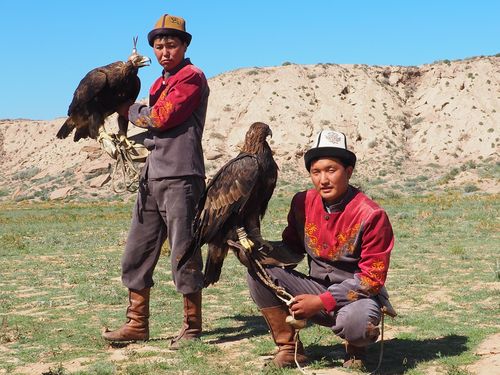
lac Issyk-Kul • Eagle Hunting
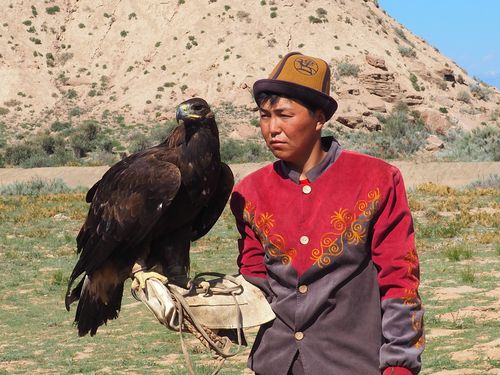
lac Issyk-Kul • Eagle Hunting
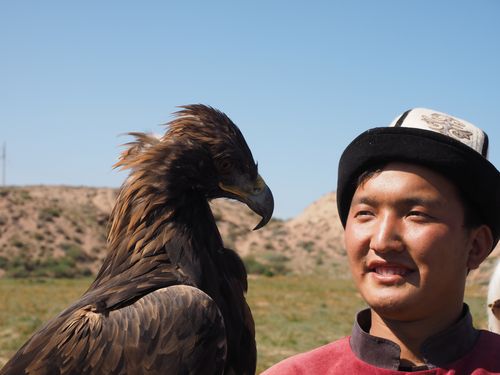
lac Issyk-Kul • Eagle Hunting
Eagle Hunting
The History of the Eagle Hunting Tradition in Kyrgyzstan
Political and Social Context of Emergence
The tradition of eagle hunting, known as berkutchi in Kyrgyz culture, is one of the oldest surviving practices of Central Asia, deeply rooted in the nomadic way of life. Its origins can be traced back over two thousand years, to a time when the peoples of the Central Asian steppes relied on a profound understanding of nature for survival. In the harsh environment of the Tian Shan Mountains and the Issyk-Kul region, where winters were long and game was scarce, hunting with trained raptors emerged as both a practical necessity and a cultural expression.
The socio-political framework of the early nomads encouraged the development of this tradition. Tribal confederations such as the Göktürks, Uighurs, and later the Kyrgyz khanates organized their societies around pastoralism, warfare, and seasonal migration. Hunting played a dual role: it provided food and materials (fur, leather) but also reinforced social hierarchy. Mastery of the eagle symbolized authority and self-control — qualities associated with leadership. Chieftains and warriors used hunting displays to affirm their prestige, while the transmission of falconry techniques within families ensured continuity of knowledge and cohesion among clans.
Religious and philosophical dimensions also shaped the emergence of eagle hunting. Pre-Islamic beliefs, dominated by shamanic cosmology, regarded the eagle as a celestial messenger capable of linking the earthly and spiritual realms. When Islam spread through Central Asia between the 8th and 12th centuries, these cosmological interpretations were not erased but absorbed, giving the practice a syncretic character. The berkutchi became both a craftsman and a mediator, embodying harmony between man and nature — a principle central to the Kyrgyz worldview.
Major Historical Developments
During the Mongol Empire (13th century), eagle hunting spread widely across Eurasia. The Mongols institutionalized it as both an elite pastime and a military training tool. As their empire fragmented, various Turkic-speaking groups, including the Kyrgyz, preserved and localized the custom, integrating it into their pastoral lifestyle.
Under the Russian Empire in the 19th century, eagle hunting faced transformation rather than suppression. While Russian administrators often considered it an exotic curiosity, they recognized its social function and even encouraged its demonstration in ethnographic exhibitions. However, colonization also disrupted the economic foundations of nomadic life. Sedentarization and new land-use policies reduced hunting grounds and limited the resources necessary to maintain raptors.
The Soviet period brought both repression and revival. During the collectivization campaigns of the 1930s, traditional practices were discouraged as remnants of “feudal” culture. Yet, from the 1960s onward, the Soviet authorities began to valorize eagle hunting as part of the republic’s “folk heritage,” promoting it in cultural festivals and tourism propaganda. This ambivalent approach — at once folkloric and administrative — allowed the practice to survive in a symbolic form, even as its practical function disappeared.
After Kyrgyzstan’s independence in 1991, eagle hunting re-emerged as a national emblem. It became a means of reaffirming continuity with the pre-Soviet past and asserting a distinct cultural identity within the post-Soviet landscape. In the Issyk-Kul region, local communities revived the art under both state patronage and the initiative of private masters. These berkutchis are now considered custodians of intangible heritage, preserving an ancestral art that links present-day Kyrgyzstan to its nomadic roots.
Global Context and Cultural Parallels
At the time of its emergence, eagle hunting belonged to a broader constellation of human-animal partnerships observable in ancient civilizations. Similar practices existed among the Scythians of the Black Sea steppes, the Persians, and even in medieval Europe, where falconry became the privilege of aristocracy. However, the Kyrgyz variant differs in both environment and meaning.
In Europe and the Middle East, falconry was confined to the courtly class and relied on sedentary estates. In contrast, Central Asian eagle hunting developed within mobile societies, where every element — from the horse to the hunting bird — had to adapt to constant movement. The Kyrgyz practice thus reflects a nomadic logic of adaptability and resilience. Moreover, while European falconry emphasized hierarchy and display, the Kyrgyz berkutchi cultivated an ethic of reciprocity. The relationship between hunter and eagle was framed not as domination but as partnership, governed by ritual respect and mutual dependence.
Transformations and Adaptations
Over the centuries, the eagle hunting tradition has continually evolved in response to social and technological change. Once essential for subsistence, it gradually became a marker of identity and artistry. In the Soviet era, mechanization and agriculture reduced the need for hunting, yet paradoxically preserved it as a cultural performance.
In contemporary Kyrgyzstan, the practice has taken on new forms. Annual festivals such as those held near Issyk-Kul bring together dozens of berkutchis from across Central Asia. These gatherings include competitions for speed, precision, and technique, as well as exhibitions of traditional equipment — leather gauntlets, embroidered tunics, and hand-carved perches. Modern materials, such as synthetic straps, occasionally replace older ones, but the aesthetic and ritual dimensions remain intact.
Nevertheless, the shift from subsistence to spectacle raises questions about authenticity. Younger generations sometimes approach eagle hunting as a tourist attraction or athletic discipline rather than a spiritual tradition. This reinterpretation, while ensuring visibility, also risks detaching the practice from its ecological and symbolic roots.
The Role of the Tradition Today
In today’s Kyrgyz society, eagle hunting represents a bridge between the past and the present. It functions not merely as a sport or performance but as a living narrative of continuity. For rural communities in Issyk-Kul, the berkutchi embodies values of endurance, self-discipline, and loyalty. Training a golden eagle demands years of commitment — capturing a juvenile bird, taming it with care, teaching it to hunt, and ultimately releasing it after a decade of companionship.
This cycle of bonding and separation serves as a metaphor for the Kyrgyz relationship with the natural world: dominion tempered by respect. The hunter’s attire, songs, and rituals reaffirm community solidarity. Women, who historically played supportive roles in the preparation of costumes and equipment, are now increasingly visible participants, reflecting the broader social transformation of Kyrgyz society.
For the state, eagle hunting functions as a cultural ambassador. It features prominently in tourism campaigns, international fairs, and national festivals such as Nomad Games. Through these representations, the tradition not only strengthens local identity but also projects an image of Kyrgyzstan as a guardian of authentic nomadic heritage.
Preservation and Contemporary Challenges
The inclusion of eagle hunting on UNESCO’s Representative List of the Intangible Cultural Heritage of Humanity in 2010 (through a multinational Central Asian nomination) marked a turning point. It provided institutional recognition and encouraged preservation initiatives. Yet, the tradition faces significant threats. Environmental degradation, urban migration, and the scarcity of golden eagles in the wild have constrained its practice. The knowledge once passed orally from father to son risks fragmentation as younger generations migrate to cities or pursue different livelihoods.
To counter these trends, cultural organizations and local NGOs have established apprenticeship programs and educational workshops. In Issyk-Kul, training centers combine ecological conservation with cultural education, emphasizing the ethical treatment of raptors and the importance of sustainable hunting practices. Documentation projects — films, exhibitions, and oral histories — seek to preserve both the material and immaterial aspects of the art.
Conclusion
The eagle hunting tradition of Kyrgyzstan is more than a vestige of nomadic history; it is a living expression of harmony between human ingenuity and the natural world. Born in the steppes and sustained in the mountains of Issyk-Kul, it has endured political upheavals, modernization, and globalization without losing its essence. Today, the berkutchi stands as both a guardian of ancestral wisdom and a participant in a modern cultural dialogue. The endurance of this art demonstrates that traditions, when rooted in deep ethical and ecological awareness, can adapt and thrive while preserving the spirit of their origins.
The Characteristics of the Eagle Hunting Tradition in Kyrgyzstan
Origin and Context of Emergence
The tradition of eagle hunting in the Issyk-Kul region of Kyrgyzstan, known locally as berkutchi, is one of the most enduring expressions of nomadic culture in Central Asia. Its origins are rooted in the ancient Turkic and Mongol pastoral societies that thrived on the vast steppes and mountain ranges of the region. These societies depended on their close relationship with nature and animals for survival, developing techniques that combined practicality, spirituality, and symbolism.
In the early centuries of its emergence, eagle hunting was primarily a means of subsistence. Harsh winters and limited resources compelled nomadic peoples to rely on trained raptors for hunting hares, foxes, and occasionally wolves. Yet, beyond its functional purpose, the practice reflected a broader cosmological worldview. Influenced by shamanic beliefs, the eagle was seen as a divine messenger, a link between the human and celestial realms. The taming of such a powerful creature symbolized mastery over the natural world, but also harmony with it — a balance that lay at the core of the nomadic ethos.
Socially, the berkutchi occupied a respected position within the community. Training and maintaining an eagle required discipline, patience, and years of apprenticeship. It was both a family heritage and a marker of social prestige. Historically, hunting gatherings were also communal events that reinforced tribal bonds, celebrated successful hunts, and transmitted collective knowledge across generations.
Elements and Practices
Eagle hunting is an intricate art that involves specific rituals, gestures, and equipment. The process begins with the selection of the bird. Female golden eagles (Aquila chrysaetos) are preferred for their size, strength, and loyalty. The capture, often of a juvenile bird from the wild, is followed by a delicate period of taming, which may last several months. During this phase, the eagle becomes accustomed to human presence, feeding schedules, and commands.
A berkutchi’s attire and tools are as symbolic as they are functional. The heavy leather glove (baldak) protects the hunter’s arm from the eagle’s talons, while the hood (tomaga) keeps the bird calm until released. A thick belt, saddle strap, and perch (tugun) accompany the hunter during expeditions. These items are traditionally handmade, decorated with regional motifs that indicate clan identity and aesthetic sensibility.
The hunt itself follows a precise sequence: preparation, release, pursuit, and retrieval. Once the eagle spots its prey from a distance, it dives at astonishing speed, guided by instinct and training. Upon capture, the hunter follows on horseback to reclaim both the prey and the bird. The cooperation between human and raptor is a central element of the tradition, embodying mutual trust rather than dominance. Music, chants, and verbal cues often accompany the event, reinforcing the ritualized nature of the activity.
Symbolism and Meanings
The eagle holds a profound place in Kyrgyz cosmology. Representing the spirit of the sky (Kök Tengri), it is revered as a symbol of freedom, vigilance, and divine vision. In the context of the hunt, it serves as both a physical partner and a spiritual guide. The act of releasing the eagle signifies the projection of human will into nature, while its return to the hunter’s arm represents reconciliation between strength and obedience, wilderness and culture.
Each gesture of the berkutchi carries symbolic weight. Covering the eagle’s eyes before the hunt reflects the control of passion and aggression; uncovering them at the right moment represents enlightenment and readiness. The garments and ornaments of the hunters often feature the eagle motif, underlining its role as an ancestral totem.
In local storytelling, the eagle embodies loyalty and sacrifice. Legends recount bonds so strong that when a master dies, his eagle refuses to eat or fly again. Such narratives underscore the moral dimensions of the tradition — discipline, courage, and respect for the natural world — values deeply embedded in the Kyrgyz cultural identity.
Evolution and External Influences
Over time, eagle hunting has evolved under the influence of shifting political and social structures. During the Russian imperial period, it was observed and occasionally encouraged as a symbol of exoticism and regional identity. The Soviet era, however, imposed new constraints. The collectivization of pastoral lands reduced traditional hunting grounds, and the practice declined as an economic necessity. Yet, it survived as a cultural emblem, promoted in state-sponsored folk festivals as part of the “ethnographic heritage” of the Kyrgyz people.
In the post-Soviet period, the tradition experienced a resurgence. The collapse of central control and the search for cultural authenticity after independence in 1991 led to a renewed pride in nomadic heritage. The Issyk-Kul region, with its open landscapes and strong communal memory, became a focal point for revival efforts. The practice also adapted to contemporary conditions, integrating tourism and public demonstrations without entirely losing its ceremonial dimension.
Parallels exist with other cultures of Eurasia, such as Kazakh, Mongol, and even Persian communities, where falconry and eagle hunting represent similar human-animal partnerships. Yet, the Kyrgyz form distinguishes itself by its scale and intensity, as well as by the deep spiritual connection that continues to define the relationship between hunter and bird.
Social Organization and Community Impact
Within Kyrgyz society, eagle hunting is more than an individual pursuit; it is a communal institution. The berkutchi acts as both practitioner and educator, often training young apprentices who assist in feeding, cleaning, and caring for the birds. These apprenticeships transmit not only technical knowledge but also moral teachings — patience, respect, and harmony with the environment.
Festivals and competitions, particularly those held around Issyk-Kul, play a vital role in maintaining the practice’s visibility. Such events are accompanied by other traditional activities — horse games, storytelling, and music — creating a holistic expression of Kyrgyz nomadic culture. The presence of women in recent years, once limited to supportive roles, is growing, reflecting broader social changes within the country.
The practice also reinforces intergenerational cohesion. Elder hunters, often considered cultural guardians, are revered figures whose expertise and life stories are central to communal memory. Through their guidance, the art of eagle hunting continues to serve as a living school of ethics, endurance, and respect.
Statistics, Anecdotes, and Legends
Today, fewer than two hundred active berkutchis remain in Kyrgyzstan, with a significant concentration in the Issyk-Kul and Naryn regions. Each maintains close bonds with one or two trained eagles, usually releasing the bird into the wild after eight to ten years of companionship — a gesture signifying gratitude and renewal.
One of the most famous stories tells of an eagle that returned to its trainer’s home long after being set free, circling above the yurt as if to acknowledge their shared past. Such anecdotes encapsulate the emotional depth of the human-animal connection at the heart of this tradition.
Recognition and Preservation
In recognition of its historical and cultural significance, eagle hunting was inscribed on UNESCO’s Representative List of the Intangible Cultural Heritage of Humanity in 2010, as part of a multinational Central Asian nomination. This inclusion has bolstered preservation initiatives, including training programs for youth and ecological protection projects for golden eagles.
Despite these efforts, challenges persist. Habitat loss, urbanization, and the declining interest of younger generations threaten the continuity of the practice. Conservationists and cultural institutions are collaborating to ensure ethical bird handling, sustainable hunting, and environmental awareness. Schools in Issyk-Kul have introduced educational modules on traditional heritage, while local NGOs organize intergenerational workshops to document oral histories and techniques.
Conclusion
Eagle hunting in Kyrgyzstan represents more than a survival skill; it is a synthesis of art, spirituality, and identity. In the mountains of Issyk-Kul, it continues to express the enduring relationship between humanity and the natural world — one founded on respect, partnership, and reverence. Through adaptation and resilience, this tradition has transcended centuries of change, remaining a living testament to the cultural vitality of the Kyrgyz people and their unbroken dialogue with the spirit of the eagle.
 Links to the main sections of the site