Français (France)
  Nederlands (nl-NL)
 This rural school near Bodhgaya, located in Sujata in the Indian state of Rajasthan, represents a practical aspect of everyday life in village areas. This type of institution plays a central role in providing children with access to education and basic knowledge. It also serves as a meeting place for families, teachers, and the local community. Rural schools often reflect regional social priorities such as literacy, equal opportunity, and preparation of younger generations for working life. They illustrate the importance of education in local development.
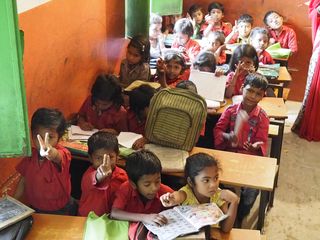
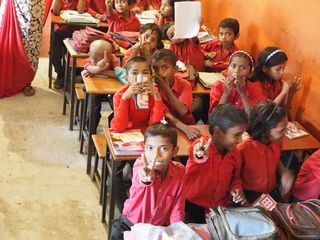
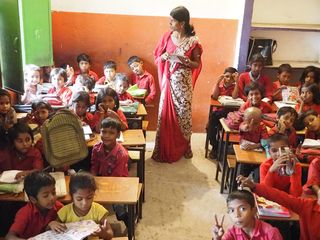
Rural school near Bodhgaya
Rural School near Bodhgaya: Educational Tradition and Historical Development
Origins of Local Schooling
The rural school near Bodhgaya, in the area of Sujata, belongs to a long Indian tradition of village-based learning. Before the spread of modern public education, instruction in many rural communities depended on families, local teachers, religious institutions, or small informal teaching spaces. Children were introduced to reading, elementary arithmetic, moral codes, practical knowledge, and skills useful for agricultural life.
In such environments, access to learning was often shaped by social status, available resources, and the willingness of the community to support instruction. Villages connected to pilgrimage routes or active market networks could benefit from wider cultural exchanges.
Development under Modern Systems
During the colonial period, British authorities gradually introduced a more formal school structure in many parts of India. Primary schools, standardized curricula, and administrative supervision expanded over time. However, rural districts often remained less equipped than urban centres, with shortages of buildings, trained staff, and regular attendance.
After Indian independence in 1947, education became a central priority of national development. Governments sought to widen access to primary schooling through village schools, teacher recruitment, and public investment. Rural institutions such as the school near Bodhgaya became part of a broader effort to reduce illiteracy and strengthen social mobility.
Social and Community Significance
A rural school is more than a teaching facility. It often functions as a shared civic space where children, parents, teachers, and local authorities interact. In many villages, the school represents one of the most visible public institutions and a symbol of collective progress.
Schools also support public health campaigns, literacy initiatives, civic awareness, and the participation of girls in education. Their presence can influence demographic choices, employment expectations, and the relationship between younger generations and the wider economy.
Transformations over Time
From the late twentieth century onward, Indian rural education underwent major reforms. Midday meal programmes, free textbooks, scholarship schemes, and enrolment drives helped increase attendance. Greater attention was also given to female education and disadvantaged communities.
At the same time, schools faced changing expectations. Families increasingly viewed education not only as basic instruction but as a path toward secondary studies, professional employment, and migration opportunities.
Present Importance
Today, the rural school near Bodhgaya illustrates the continuing role of local education in areas where village life remains important. It helps connect traditional rural society with modern administrative, economic, and technological systems.
Its relevance extends beyond children alone, as educated households often gain better access to services, information, and institutional support.
Transmission and Contemporary Challenges
Current challenges include teacher retention, classroom quality, digital access, infrastructure maintenance, and continuity between primary and secondary education. Seasonal labour patterns and household poverty may still affect attendance.
Despite these constraints, the rural school remains a key instrument of long-term development. It embodies the principle that education should be available within everyday community life, including in smaller and less urbanised settlements.
Daily Functioning of a Rural School near Bodhgaya
General Layout and Physical Setting
The rural school at Sujata is typically organised in a practical manner suited to local resources and climate. Buildings are often single-storey structures arranged around an open courtyard used for assembly, recreation, and group activities. Classrooms contain basic furniture such as benches, desks, storage shelves, and wall-mounted blackboards or whiteboards. Some rooms may serve several age groups depending on enrolment and staffing.
The surrounding grounds can include shaded areas, a hand pump or water point, sanitation blocks, and open spaces used for games or outdoor lessons.
Daily Sequence of Activities
The school day usually begins with the gradual arrival of pupils on foot or by bicycle from nearby homes. A morning gathering may take place in the courtyard, where students line up by class, listen to announcements, and participate in a short collective exercise such as a song, pledge, or attendance check.
Lessons then proceed in scheduled periods. Core subjects generally include reading, writing, mathematics, language instruction, environmental studies, and civic education. In smaller schools, one teacher may supervise several levels at the same time, alternating between groups.
Materials and Teaching Practices
Visible classroom materials are often simple and functional: notebooks, textbooks, pencils, slates, charts, maps, and chalk. The board remains a central teaching tool. Teachers commonly rely on oral repetition, question-and-answer exchanges, copying exercises, and group recitation.
Students may be invited individually to write on the board, read aloud, or solve arithmetic problems in front of the class. Where digital equipment exists, it is often limited and shared among several pupils.
Participants and Their Roles
The main participants are students, teachers, and support staff responsible for maintenance or meal preparation. A head teacher or principal may coordinate administration, attendance records, and contact with families.
Parents are present during enrolment periods, meetings, celebrations, or discussions concerning progress. In village settings, the school often maintains direct links with the wider community.
Shared Spaces and School Life
The courtyard plays an important role in everyday activity. It serves for breaks, physical exercise, ceremonies, and informal interaction between classes. Trees or covered verandas may provide shade during hot periods and become temporary learning spaces.
Where midday meal programmes operate, food distribution forms a structured part of the day. Students gather in designated areas, and the meal supports attendance and regular school participation.
Distinctive Features
This type of rural school is marked by its adaptability. Timetables, attendance levels, and use of space may vary according to seasons, agricultural work, or local events. Resources can be modest, yet the institution performs several visible functions at once: education, childcare, social discipline, and community organisation.
Its most notable characteristic is the close relationship between school life and village life, where learning takes place within the daily rhythm of the surrounding settlement.
 Links to the main sections of the site