Français (France)
  Nederlands (nl-NL)
 The Bukit Lawang Orangutan Reserve, located on the Indonesian island of Sumatra, forms part of the Gunung Leuser National Park, an area known for its rich biodiversity. Established in 1973 as a rehabilitation center for formerly captive orangutans, it has since developed into a conservation and research initiative. The reserve plays a vital role in protecting endangered wild populations and raising public awareness of ecological challenges. Bukit Lawang remains a model for the balance between wildlife preservation and responsibly managed ecotourism.
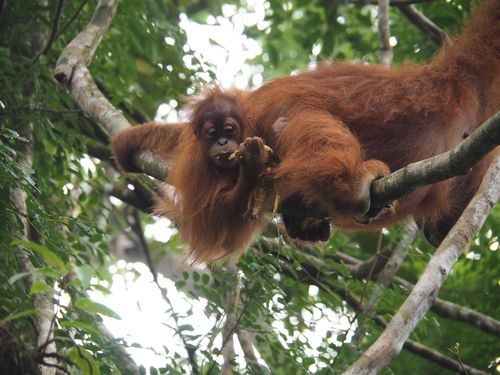
Bukit Lawang • Bukit Lawang's Orangutan Sanctuary

Bukit Lawang • Bukit Lawang's Orangutan Sanctuary

Bukit Lawang • Bukit Lawang's Orangutan Sanctuary
Natural site profile
Bukit Lawang's Orangutan Sanctuary
Natural site category: Natural reserve
Natural site family: Animals and nature reserves
Natural site genre: Fauna
Geographic location: Bukit Lawang • Sumatra • Indonesia
This natural site in Bukit Lawang is inscribed on the UNESCO World Heritage List since 2004 and is part of the serial property "Tropical Rainforest Heritage of Sumatra".See the UNESCO natural sites featured on this site
• Links to •
• List of videos about Medan, Bukit Lawang on this site •
Indonesia • Sumatra • Medan and the orangutan sanctuary
Bukit Lawang: Politics, Ecology, and the Making of an Environmental Heritage Site
Origins and Context
The Bukit Lawang Orangutan Reserve, near Medan in northern Sumatra, was founded in 1973 as Indonesia began responding to the global rise of environmental awareness. The project emerged in the wake of the 1972 Stockholm Conference, which established the environment as an international policy concern. Supported by the World Wildlife Fund (WWF) and the Indonesian Forestry Department, Bukit Lawang was created to rehabilitate captive orangutans and release them into the adjacent rainforest of Gunung Leuser National Park, one of the last strongholds of tropical biodiversity in Southeast Asia.
At the time, Indonesia was expanding its agricultural frontier, and deforestation was accelerating. Under President Suharto, conservation was also a political statement: it showed that the country could participate in international cooperation while promoting an image of modernization. Establishing a center dedicated to one of Asia’s most iconic primates served both scientific and diplomatic purposes.
Political and Cultural Motivations
During the 1970s, the Suharto government sought legitimacy through global partnerships, including environmental projects. Bukit Lawang became a symbol of national responsibility and a showcase for Indonesia’s capacity to align economic development with ecological protection.
Culturally, the orangutan—its name meaning “person of the forest” in Malay—embodied a moral link between humans and nature. Promoting its conservation offered a narrative that blended science and spirituality, appealing both to local traditions and to international environmental values. This combination made Bukit Lawang one of the first conservation sites in Indonesia to unite ecological, political, and cultural goals.
Economic Role and Local Development
By the 1980s, Bukit Lawang had evolved from a rehabilitation station into an engine of regional development. Authorities promoted ecotourism as a tool to reduce poverty and deforestation. The site attracted travelers eager to observe orangutans in the wild, providing alternative income for local communities once reliant on palm oil and rubber plantations.
Infrastructure was built to accommodate visitors, and training programs turned residents into guides, rangers, and guesthouse owners. This participatory approach generated significant income—more than 50,000 visitors per year by the early 1990s—and inspired similar initiatives across Sumatra. Ecotourism became a model of conservation economics, demonstrating that protecting forests could also sustain livelihoods.
However, dependency on tourism introduced new fragilities. Economic downturns and natural disasters exposed the limits of a system tied to external demand. Nonetheless, the combination of preservation and revenue generation became a defining feature of Bukit Lawang’s identity.
The 2003 Flood: A Turning Point
On November 2, 2003, a devastating flash flood struck the Bahorok River valley, destroying most of Bukit Lawang’s infrastructure and killing more than 200 people. Investigations revealed that illegal logging upstream had destabilized the soil, worsening the disaster.
The tragedy reshaped both local and national attitudes toward environmental management. It demonstrated that ecological degradation could have direct human consequences. In response, the government launched reforestation and river management programs, supported by the World Bank and conservation NGOs. These initiatives shifted the focus from mere rehabilitation of wildlife to broader ecosystem restoration, linking forest integrity to community safety.
Decentralization and Community Involvement
After Suharto’s fall in 1998, Indonesia’s decentralization reforms gave provincial and district authorities greater control over natural resource management. In Bukit Lawang, this led to a more community-based approach. Village committees were formed to help manage tourism, combat poaching, and oversee forest monitoring.
Educational programs raised awareness of sustainable practices, and income from ecotourism was partly reinvested in conservation. This participatory framework reduced conflicts between locals and park authorities and helped integrate the reserve into regional development planning. The approach reflected a global shift toward inclusive conservation, aligning local well-being with ecological protection.
UNESCO Recognition and Global Integration
A year after the flood, a major milestone reinforced the site’s visibility. In 2004, Gunung Leuser National Park, which encompasses Bukit Lawang, was designated a component of the Tropical Rainforest Heritage of Sumatra, a UNESCO World Heritage Site. This inscription acknowledged the park’s outstanding biodiversity and its role in maintaining ecological processes vital to Southeast Asia.
While Bukit Lawang is not listed separately, its inclusion within Gunung Leuser brought international recognition and financial support. New conservation measures were implemented: visitor quotas, restricted observation zones, and habitat monitoring. These helped stabilize orangutan populations and limit the ecological footprint of tourism. The UNESCO status also positioned the region as a research hub for tropical ecology, drawing universities and environmental organizations into long-term partnerships.
Transformation and Comparative Perspective
Bukit Lawang’s evolution mirrors broader global trends in conservation. Like the Virunga or Kibale reserves in Africa, it shows how endangered primates can become catalysts for sustainable development. Yet its challenges are distinctive. Sumatra’s dense population and extensive agricultural frontier demand constant negotiation between land use and wildlife protection. The reserve’s success lies in maintaining this fragile balance rather than excluding human activity entirely.
Over time, Bukit Lawang has become a multi-functional conservation space—simultaneously a rehabilitation center, ecotourism site, and educational platform. This transformation from a technical project into a living socio-ecological system illustrates Indonesia’s broader environmental transition: from centralized control to shared stewardship.
Current Conditions and Challenges
Today, the Sumatran orangutan population numbers about 14,000 individuals, a modest but stable figure thanks to long-term protection efforts. Within the Bukit Lawang area, roughly 300 orangutans live semi-wild in regenerated forest. Ongoing reforestation has restored more than 3,000 hectares since 2005, improving habitat connectivity.
However, the site remains under pressure. Deforestation, illegal logging, and palm oil expansion continue in peripheral areas, threatening habitat corridors. Climate change intensifies rainfall variability, increasing the risk of floods and landslides. Conservation authorities are responding through adaptive management, combining scientific monitoring with local ecological knowledge. Projects to establish biological corridors between Bukit Lawang and Ketambe are underway, aiming to ensure genetic exchange among orangutan populations.
Legacy and Symbolism
Fifty years after its foundation, Bukit Lawang embodies Indonesia’s evolving relationship with nature. It represents a synthesis of politics, science, and community engagement, where conservation and development coexist. The reserve’s story—marked by disaster, recovery, and innovation—illustrates how environmental stewardship can reshape both landscapes and societies.
As part of the UNESCO World Heritage network, Bukit Lawang serves as a global reference for tropical conservation. It stands as a reminder that preserving biodiversity is not only about protecting species but also about fostering cooperation and resilience among people. Its enduring success lies in its dual identity: a refuge for the orangutan and a living example of how environmental heritage can sustain the future of local communities.
Bukit Lawang: A Natural Laboratory of Tropical Ecology and Geological Evolution
Geological Setting and Landscape Formation
The Bukit Lawang Orangutan Reserve, in northern Sumatra, Indonesia, lies within the Gunung Leuser National Park, one of Southeast Asia’s richest ecological zones. The region sits on the Sumatran Fault, where the Indo-Australian and Eurasian plates collide, creating a landscape of continuous geological change. Over millions of years, volcanic activity, uplift, and erosion have produced a complex topography of ridges, valleys, and alluvial plains.
Soils enriched by volcanic minerals sustain dense rainforests, while the Bahorok River shapes the terrain through erosion and sedimentation. The surrounding limestone hills, carved by tropical rainfall, form intricate karst systems with caves and underground streams that regulate groundwater and store carbon. This combination of tectonic instability and biological productivity makes Bukit Lawang a vivid example of how geology and life evolve together in tropical environments.
Biodiversity and Evolutionary Significance
Bukit Lawang lies within the Sundaic biogeographical region, a transition zone between continental Asia and the Indonesian archipelago. During the Ice Age, fluctuating sea levels periodically linked Sumatra to the mainland, enabling species exchange and diversification. The result is an exceptional level of biodiversity: the broader Gunung Leuser ecosystem hosts more than 4 000 plant species and 700 animal species, including many that are endemic.
The reserve’s most emblematic resident is the Sumatran orangutan (Pongo abelii), found nowhere else on Earth. Around 14 000 individuals remain, including some 300 semi-wild orangutans in Bukit Lawang’s forests. Long-term studies have documented sophisticated tool use, nest building, and social learning, proving remarkable cognitive adaptability. The forest canopy, rising up to 60 meters, shelters other primates such as gibbons and macaques, along with hornbills, civets, and clouded leopards. This multi-layered structure creates a vertical continuum of habitats—a hallmark of ancient tropical ecosystems.
Ecological Processes and Forest Dynamics
The rainforest around Bukit Lawang exemplifies the self-regulating mechanisms of tropical ecosystems. Organic matter decomposes within weeks, releasing nutrients that sustain rapid regrowth. The constant cycle of decay and renewal maintains soil fertility and structural stability.
Equally vital are the ecological relationships linking species: fruit trees depend on bats and birds for seed dispersal, while countless insects ensure pollination. Scientists have identified over a hundred such mutualistic networks, demonstrating how biodiversity supports its own persistence. These interconnections also explain the forest’s resilience: even after localized disturbances, natural regeneration restores balance without human intervention.
Karst and River Systems as Ecological Engines
The limestone formations surrounding Bukit Lawang date back more than 20 million years. Rainwater has sculpted caves and sinkholes that channel surface water into subterranean rivers, which emerge as clear springs feeding the Bahorok River. These karst systems act as natural water filters, moderating floods and maintaining water purity for both wildlife and local communities.
Inside the caves thrive specialized invertebrates and large bat colonies crucial for pest control and seed dispersal. Such formations illustrate how geological evolution underpins biological diversity: the same processes that carved the rock also created habitats that sustain complex ecosystems.
Local and Global Environmental Influences
Although Bukit Lawang’s ecological processes are ancient, they now interact with global environmental change. The region’s annual rainfall—up to 4 000 millimetres—is increasingly irregular, and extreme weather events have become more frequent. The catastrophic 2003 flood, caused by torrential rains and aggravated by upstream deforestation, destroyed large parts of the village and killed over 200 people.
This disaster triggered major restoration efforts, including reforestation of more than 3 000 hectares and stricter watershed management. It also highlighted the link between forest integrity and human safety. Since then, local authorities and NGOs have promoted sustainable tourism and community involvement, showing that ecological stability depends as much on social cooperation as on scientific management.
Scientific Recognition and UNESCO Designation
In 2004, Bukit Lawang became part of a global conservation network when Gunung Leuser National Park was included in the Tropical Rainforest Heritage of Sumatra, a UNESCO World Heritage Site. The designation recognized three key values:
- Representation of intact tropical rainforest ecosystems;
- Ongoing ecological and evolutionary processes;
- Exceptional biodiversity, including endangered species such as orangutans and Sumatran tigers.
UNESCO’s recognition strengthened monitoring programs, anti-poaching patrols, and environmental education. The site now serves as an open-air laboratory where scientists study rainforest dynamics, climate resilience, and species adaptation. The status also increased global awareness, turning Bukit Lawang into one of Indonesia’s most studied and visited conservation areas.
Comparative Insights and Conservation Model
Bukit Lawang’s integrated approach to conservation parallels that of Costa Rica’s cloud forests or Uganda’s Kibale National Park, where research, tourism, and community participation coexist. What distinguishes Bukit Lawang is its proximity to dense human settlements: rather than isolating wildlife from people, it seeks coexistence. Local residents work as guides, forest stewards, and educators, directly benefiting from the protection of the landscape. This partnership has become a cornerstone of inclusive conservation, aligning ecological integrity with social development.
The reserve’s success has inspired similar projects across Sumatra, proving that conservation need not exclude human presence. Instead, sustainable livelihoods and biodiversity protection can reinforce each other when managed through transparent governance and shared responsibility.
Present Condition and Future Challenges
Today, Bukit Lawang remains a vital refuge for the Sumatran orangutan and countless other species. Forest cover continues to recover, and biological corridors link once-isolated populations. Yet challenges persist: illegal logging, palm-oil expansion, and habitat fragmentation threaten long-term stability. Climate change further amplifies flood risks and alters flowering cycles, disrupting the delicate timing of pollination and fruiting.
Conservationists respond with adaptive management, combining satellite monitoring, genetic studies, and local ecological knowledge. These innovations ensure that decisions are data-driven while remaining rooted in community experience. The reserve’s ability to integrate modern science with traditional stewardship is now seen as a model for tropical conservation worldwide.
A Symbol of Resilience and Coexistence
Half a century after its creation, Bukit Lawang stands as both a sanctuary for wildlife and a testament to human responsibility. Its geological heritage, biological richness, and social dimension converge into a living symbol of ecological resilience. Inclusion in the UNESCO network has reinforced its global significance, while local participation secures its everyday survival.
More than a protected forest, Bukit Lawang embodies a vision of coexistence between people and nature—one that transforms the challenges of tropical conservation into opportunities for renewal. In this meeting of tectonic power, biological diversity, and cultural engagement, the reserve offers a powerful reminder that Earth’s most vibrant ecosystems endure when science, community, and policy evolve together.
 Links to the main sections of the site