

 Français (France)
  Nederlands (nl-NL)
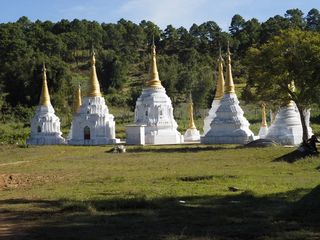
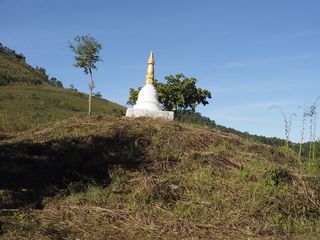
 The rural stupas visible in the countryside near Kalaw illustrate the presence of Buddhism within the agricultural landscapes of Myanmar. Distributed along paths, near villages or among cultivated fields, these small religious structures contribute to the spiritual organization of the rural environment. Their dimensions, forms and locations vary according to local communities and regional religious practices. Together, they create a characteristic Buddhist landscape of rural Myanmar, where agricultural spaces and religious structures remain closely connected in the daily life of local inhabitants.

Monument profile
Rural stupas and Buddhist landscapes
Monument category: Stupa
Monument family: Pagoda or stupa
Monument genre: Religious
Geographic location: the countryside near Kalaw • Myanmar
Construction period: Unknown era
• Links to •
• List of videos about the countryside near Kalaw on this site •
Walk in the Burmese countryside • Myanmar
Development of Rural Stupas in the Countryside near Kalaw
Spread of Buddhism in the Shan Highlands
The rural stupas scattered through the countryside around Kalaw reflect the gradual establishment of Theravāda Buddhism in the upland regions of eastern Myanmar. The Kalaw area, located within Shan State, historically formed a contact zone between Burmese populations, Shan communities and various hill groups. The spread of Buddhist practices was accompanied by the construction of small religious monuments intended to structure the rural landscape and provide places of devotion for local villagers.
Unlike major royal religious complexes sponsored directly by Burmese dynasties, the stupas of this region appear to have been built progressively through local patronage. Village communities, monasteries and individual donors likely played a central role in their construction and maintenance. Their multiplication across agricultural zones illustrates the close relationship between Buddhism, village organization and daily rural life.
Religious Functions and Rural Symbolism
The stupas visible near Kalaw primarily fulfilled religious and symbolic functions. Some served as local devotional monuments associated with village paths, cultivated fields or small settlement boundaries. Others were linked to modest monastic compounds or meditation areas established outside urban centers.
Their presence within agricultural landscapes also reflects the integration of Buddhist beliefs into farming activities and seasonal rural routines. Offerings and periodic maintenance carried out by local inhabitants continue to reinforce the religious significance of these structures. Several stupas likely underwent repeated reconstruction phases due to climatic deterioration and the fragility of rural building materials.
The diversity of forms and dimensions suggests multiple construction periods that remain difficult to date precisely because inscriptions and written documentation are generally absent. Certain structures may originate from the late Konbaung period or from the nineteenth and twentieth centuries, while others appear to be more recent additions created by local communities.
Transformations and Contemporary Preservation
During the twentieth century, economic change and the modernization of transportation networks altered the environment surrounding many rural stupas. Expanding agricultural activity, road construction and the growth of villages sometimes isolated older monuments or led to partial rebuilding using modern materials such as cement and industrial paint.
Despite these changes, the stupas remain integrated into the everyday visual landscape of the countryside around Kalaw. Their preservation often depends on local collective initiatives rather than centralized heritage programs. Many structures continue to receive new layers of plaster, repainting or decorative additions, gradually transforming their original appearance while maintaining their religious function.
Today, these rural stupas remain important cultural and spiritual markers that illustrate the continuity of Buddhist practices within the agricultural regions of Myanmar.
Global Historical Context
The development of many rural stupas in the Burmese countryside between the eighteenth and twentieth centuries coincided with the expansion of European colonial influence across Asia. During the nineteenth century, Burma progressively came under British control following the Anglo-Burmese wars. At the same time, Theravāda Buddhist institutions continued to expand throughout mainland Southeast Asia, while rural transport networks and agricultural economies underwent major transformations across the region.
Spatial Organization of Rural Stupas near Kalaw
Integration into the Agricultural Landscape
The rural stupas visible in the countryside surrounding Kalaw are directly integrated into the agricultural and mountainous environment of Shan State. The structures frequently occupy small elevations, roadside clearings, village entrances or cultivated slopes overlooking fields and footpaths. Their positioning creates a dispersed religious landscape in which Buddhist monuments remain continuously visible within everyday rural activities.
Unlike large monastic compounds enclosed within planned religious precincts, these stupas generally appear as isolated structures or small groups distributed irregularly across the terrain. Some stand beside narrow dirt roads linking villages and agricultural zones, while others are placed near trees, terraces or resting areas used by local inhabitants. Their modest scale allows them to blend into the surrounding landscape without dominating it visually.
The spatial relationship between stupas and cultivated land remains particularly significant. Agricultural paths often pass directly beside the monuments, reinforcing their role as spiritual markers embedded within daily circulation routes.
Structural Forms and Architectural Composition
The stupas around Kalaw display relatively simple architectural compositions compared to monumental Burmese pagodas. Most structures are organized around compact bases supporting cylindrical, bell-shaped or conical upper bodies. Several monuments include stepped platforms elevating the sacred structure slightly above ground level.
Vertical proportions remain important despite the modest dimensions of the buildings. Upper sections frequently terminate in narrow finials inspired by the hti umbrellas characteristic of Burmese Buddhist architecture, although simplified in rural examples. Some stupas incorporate small decorative spires or metal poles extending from the summit.
Architectural uniformity is limited. Certain structures possess rounded profiles softened by repeated plastering, while others display more geometric forms resulting from modern reconstruction techniques. Older stupas occasionally show asymmetrical surfaces caused by erosion, repairs or successive layers of coating applied over long periods.
Secondary architectural elements sometimes surround the main structures. Small altars, offering platforms, miniature shrines or poles carrying religious flags contribute to the ceremonial organization of the immediate space around the stupas.
Materials and Construction Techniques
Construction methods visible in the rural stupas near Kalaw rely primarily on locally accessible materials and relatively simple building techniques. Many structures appear to contain brick or masonry cores covered with lime plaster or painted cement coatings. Repeated repairs are often visible through uneven surface textures and multiple layers of whitewash.
White remains the dominant visible color on most monuments, occasionally combined with gold-painted decorative details on upper sections or finials. Red, green or ochre bands sometimes appear around platforms and lower sections, although decoration generally remains restrained compared to urban religious complexes.
Modern restoration campaigns have introduced reinforced concrete, industrial paints and metal elements into many structures. Cement platforms and contemporary paving are common around stupas that continue to receive regular local maintenance. Construction emphasizes durability and ease of repair rather than elaborate ornamentation.
Climatic conditions strongly affect the appearance of the monuments. Heavy seasonal rains, humidity and vegetation growth contribute to surface cracking, plaster erosion and discoloration, particularly on isolated stupas exposed directly to the elements.
Transformations and Preservation of the Buddhist Landscape
Architectural transformations continue to alter the appearance of many rural stupas in the Kalaw region. Older surfaces are frequently replaced by new cement coatings, while decorative additions such as painted ornaments, tiled bases or metal railings are introduced during community restoration projects.
Despite these interventions, the overall spatial organization of the Buddhist landscape remains largely preserved. The stupas continue to function as visual reference points distributed across agricultural areas and village surroundings. Their relatively small dimensions maintain continuity between religious architecture, cultivated land and the mountainous environment.
The resulting landscape forms a dispersed network of Buddhist structures integrated into rural circulation routes and farming zones, illustrating the close relationship between religious practice and the everyday organization of the countryside near Kalaw.