

 Français (France)
  Nederlands (nl-NL)
 Dera Baba Murad Shah Ji, located in Nakodar in the Indian state of Punjab, is an important pilgrimage site linked to Sufi traditions and popular spiritual practices of northern India. The shrine welcomes visitors from different religious backgrounds, including Sikhs, Hindus, and Muslims, who come to pay respect to Baba Murad Shah. The site is widely known for its atmosphere of collective devotion and for the religious gatherings held throughout the year. Dera Baba Murad Shah Ji also occupies a significant place in Punjabi popular culture through devotional music, ceremonies, and spiritual events regularly associated with the sanctuary and its large community of followers.
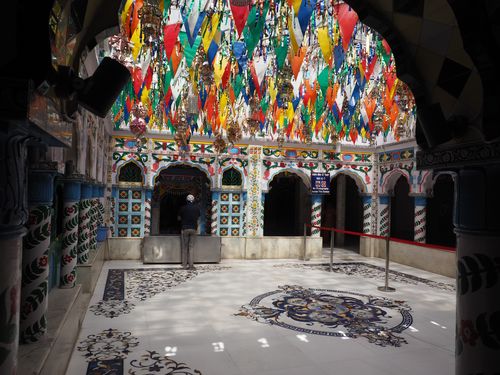
Nakodar • Dera Baba Murad Shah Ji
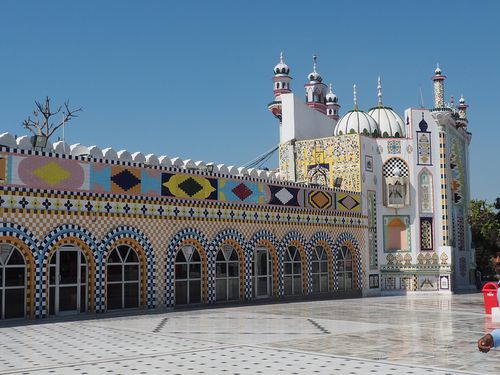
Nakodar • Dera Baba Murad Shah Ji
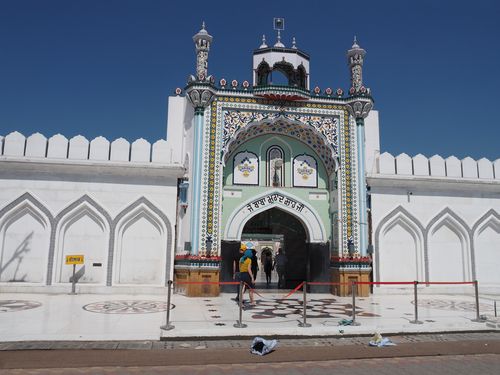
Nakodar • Dera Baba Murad Shah Ji
Monument profile
Dera Baba Murad Shah Ji
Monument categories: Pilgrimage site, Mausoleum
Monument families: Pilgrimage site or memorial • Tomb, Necropolis, Mausoleum or Cenotaph
Monument genres: Religious, Funerary
Cultural heritage: Islamic
Geographic location: Nakodar • Punjab • India
Construction period: 20th century AD
• Links to •
• This monument illustrates the following theme •
Architecture • Mausoleums : Muslim Mausoleums
• List of videos about Nakodar on this site •
Nakodar • Punjab, India
• Sources •
Books and Publications
- Singh, K. (2005). The Sacred Sites of Punjab. New Delhi: Heritage Publishers.
- Sharma, R. (2010). Architectural Marvels of India. Mumbai: India Book House.
The Dera Baba Murad Shah Ji in Nakodar: Development of a Sufi Shrine in Punjab
Establishment of the Shrine and the Figure of Baba Murad Shah
Dera Baba Murad Shah Ji is located in Nakodar, in the Jalandhar district of the Indian state of Punjab. The shrine is associated with Baba Murad Shah, a Sufi figure generally linked to the nineteenth century. Historical documentation concerning his early life remains limited, and much of his reputation was transmitted through oral traditions, devotional narratives, and regional religious memory rather than through formal written records.
The shrine developed around the burial place of Baba Murad Shah, which gradually became a center of pilgrimage and spiritual devotion. The term “dera” refers to a religious establishment or community associated with a spiritual guide and his followers. In Nakodar, the site evolved into a recognized regional center connected to popular Sufi practices. Its religious influence extended beyond Muslim communities and attracted Sikh and Hindu devotees who participated in shared devotional traditions characteristic of parts of Punjab.
Nakodar’s position within regional commercial and transportation networks contributed to the spread of the shrine’s reputation. Pilgrims, traders, and travelers visiting the town played an important role in expanding awareness of the site throughout Punjab and later among Punjabi communities abroad.
Expansion During the Twentieth Century
The importance of Dera Baba Murad Shah Ji increased significantly during the twentieth century. The Partition of British India in 1947 altered the religious geography of Punjab, with several major Sufi shrines becoming part of Pakistan. Within Indian Punjab, some remaining shrines acquired greater symbolic and devotional importance, including the shrine at Nakodar.
The site became known for its sustained interfaith character. Sikh, Hindu, and Muslim visitors continued to attend ceremonies and devotional gatherings at the shrine. This continuity contributed to the development of the Dera as both a religious center and a cultural landmark within Indian Punjab.
As the number of pilgrims increased, the administration of the shrine became more organized. Families associated with the management of the site supervised religious activities, maintenance, and the reception of visitors. Donations from devotees supported the expansion of the complex and financed the construction of additional facilities intended to accommodate large gatherings during annual religious events.
The shrine’s growing prominence also transformed Nakodar into an important destination for regional pilgrimage. Religious festivals linked to Baba Murad Shah attracted visitors from different parts of Punjab and neighboring states, reinforcing the shrine’s economic and social significance within the town.
Devotional Music and Cultural Influence
Dera Baba Murad Shah Ji became particularly associated with devotional music traditions in Punjab. Musical gatherings and religious performances played a central role in the life of the shrine and contributed to its popularity among broader audiences. Performances inspired by qawwali and other regional devotional forms became closely connected to the identity of the site.
During the late twentieth century, the shrine acquired visibility within Punjabi popular culture. Singers, performers, and figures from the Punjabi film industry participated in events associated with the Dera or referred to the shrine in musical productions. This cultural exposure strengthened the symbolic importance of the site beyond its immediate religious role.
The shrine also developed strong links with the Punjabi diaspora. Visitors from the United Kingdom, Canada, and other countries with significant Punjabi communities regularly travel to Nakodar to participate in religious ceremonies or fulfill devotional commitments associated with Baba Murad Shah.
Present-Day Role and Preservation
Today, Dera Baba Murad Shah Ji remains one of the best-known Sufi pilgrimage sites in Indian Punjab. The shrine continues to function as an active religious center where devotional practices, musical ceremonies, and communal gatherings take place throughout the year. Large annual celebrations require extensive logistical organization and continuous maintenance of the complex.
Architectural additions and renovations have been carried out over several decades in response to increasing visitor numbers. New reception areas, circulation spaces, and covered structures were integrated into the site while preserving the central importance of the mausoleum associated with Baba Murad Shah. Regular restoration and maintenance work remain necessary because of the constant flow of pilgrims and the intensive use of the complex.
International Historical Context
The principal development phase of the shrine during the nineteenth century took place after the annexation of Punjab by the British Empire in 1849. During the same period, the Ottoman Empire was implementing the Tanzimat reforms. Industrial expansion and railway construction were transforming Europe and North America. In the United States, the mid-nineteenth century was marked by the Civil War.
Architectural Layout and Devotional Spaces of Dera Baba Murad Shah Ji in Nakodar
Site Organization and General Spatial Configuration
Dera Baba Murad Shah Ji occupies an extensive religious complex within the urban fabric of Nakodar in the Indian state of Punjab. The shrine developed progressively around the tomb associated with Baba Murad Shah and expanded through successive additions rather than through the execution of a single architectural plan. The present configuration combines courtyards, covered halls, circulation corridors, and devotional spaces arranged around the central mausoleum.
The principal entrance opens onto a broad forecourt functioning as a transitional area between the surrounding streets and the religious core of the complex. This open space accommodates the movement of large numbers of pilgrims during religious festivals and musical gatherings. Several secondary access points connect adjacent structures and service areas to the main circulation routes. The organization of the site emphasizes continuous movement around the shrine rather than a rigidly symmetrical or axial layout.
The central mausoleum forms the architectural and symbolic focus of the complex. Buildings associated with devotional ceremonies, visitor accommodation, and musical performances are distributed around this nucleus. The spatial arrangement reflects gradual expansion driven by increasing pilgrimage activity. As visitor numbers grew, additional structures were integrated into the existing complex, resulting in a dense architectural ensemble composed of interconnected spaces with differing dimensions and construction phases.
Open courtyards remain essential elements of the site. They provide gathering areas for ceremonies while also regulating circulation during periods of high attendance. Covered passages linking the various parts of the complex create sheltered movement routes and reinforce the visual continuity between the principal structures.
Mausoleum Structure and Religious Interiors
The mausoleum associated with Baba Murad Shah constitutes the central devotional space of the complex. The structure is crowned by a prominent dome visible from several areas of Nakodar. This dome acts as the principal vertical element within the architectural composition and serves as a visual marker identifying the location of the shrine.
The interior of the mausoleum is organized around the tomb chamber. Circulation routes are arranged to allow pilgrims to move continuously around the sacred space during periods of intense visitation. The interior dimensions remain relatively compact compared to the larger external gathering areas, emphasizing the devotional function of the tomb chamber itself while transferring large assemblies to surrounding halls and courtyards.
Arched openings define the principal entrances and transitional spaces within the mausoleum. These arches are generally simple in structural form but enriched through decorative treatments. Metal railings and ornamental barriers regulate access around the tomb while maintaining visual openness inside the chamber. Reflective surfaces and decorative lighting contribute strongly to the visual atmosphere of the interior spaces.
Several halls adjacent to the mausoleum are designed to accommodate devotional music performances and collective ceremonies. These spaces contain broad floor areas with relatively limited internal structural obstruction, allowing large groups of participants to gather. Their architectural arrangement prioritizes acoustics, visibility, and crowd movement rather than highly segmented interior organization.
The shrine complex also includes elevated platforms, stairways, and secondary devotional structures integrated into the circulation network surrounding the central tomb. These additions reinforce the layered spatial organization created through decades of expansion and renovation.
Materials, Decorative Treatments, and Construction Techniques
The present appearance of Dera Baba Murad Shah Ji is largely the result of modern construction campaigns employing reinforced concrete as the principal structural material. Concrete frames support domes, roofs, galleries, and large covered halls. The use of reinforced concrete enabled the expansion of the complex while accommodating increasing visitor capacity and the addition of broad interior spaces.
Marble and polished stone are widely used for floors, staircases, wall cladding, and parts of the façade surfaces. The reflective quality of these materials contributes to the bright visual character of the shrine interiors. Polished marble also facilitates maintenance in areas subjected to heavy daily use by pilgrims.
Ceramic tiles and decorative surface panels cover many sections of the walls and ceilings. Floral motifs, geometric compositions, and religious inscriptions appear throughout the complex. Mirror work and reflective decorative elements are particularly visible in interior ceilings and ornamental wall sections. These surfaces interact strongly with artificial lighting, especially during evening ceremonies and religious festivals.
Metalwork forms another significant component of the architectural decoration. Railings, gates, grilles, and ornamental frames employ polished metallic finishes that reinforce the visual prominence of entrances and sacred areas. Certain decorative elements incorporate gilded or metallic surfaces intended to create strong luminous effects under artificial illumination.
The dome structures employ relatively lightweight construction methods combined with decorative external coatings. Painted finishes and reflective materials emphasize the visibility of the domes and upper architectural sections. Artificial lighting plays a substantial architectural role across the entire complex, transforming façades, domes, and decorative surfaces into highly illuminated focal points after dark.
Architectural Expansion and Contemporary Preservation
The architectural evolution of Dera Baba Murad Shah Ji reflects continuous adaptation to increasing pilgrimage activity during the twentieth and twenty-first centuries. New halls, circulation areas, covered waiting spaces, and auxiliary facilities were progressively integrated into the existing shrine. These additions expanded the scale of the complex while preserving the central role of the mausoleum.
The resulting architectural composition combines structures from different construction phases. Older sections survive within a substantially enlarged environment characterized by varied materials, decorative programs, and spatial proportions. Certain earlier architectural elements are partially concealed within later expansions, while newer buildings dominate the visual identity of the present complex.
Recent modifications have focused heavily on visitor management. Wider circulation corridors, enlarged courtyards, and additional covered spaces help regulate the movement of large crowds during annual ceremonies. Practical requirements associated with pilgrimage activity have therefore influenced the architectural organization as strongly as devotional considerations.
Maintenance and preservation efforts primarily concern surface restoration and structural upkeep of heavily used areas. Decorative finishes, polished flooring, lighting systems, and ornamental surfaces require frequent renovation because of constant exposure to large numbers of visitors. Conservation work generally prioritizes maintaining the visual intensity and ceremonial appearance of the shrine rather than preserving an earlier architectural state.