

 Français (France)
  Nederlands (nl-NL)
 The Raya Mandapa of Mahabalipuram belongs to the broader monumental ensemble that made this Tamil Nadu site famous in the history of Indian art. Located among rock-cut shrines and sculpted monuments of the former port city, it reflects the diversity of sacred forms represented at Mahabalipuram. The term mandapa generally refers to a pillared hall or ceremonial space, and this monument contributes to the understanding of a landscape shaped by stone carving and royal patronage. Raya Mandapa is valued for its place within the archaeological complex and for the insight it offers into regional artistic development.


Monument profile
Raya Mandapa
Monument categories: Hindu Temple, Rock Sanctuary
Monument families: Temple • Rock Sanctuary and Monumental Bas-reliefs
Monument genres: Religious
Cultural heritage: Hindu
Geographic location: Mahabalipuram • Tamil Nadu • India
Construction period: 16th century AD
This monument in Mahabalipuram is inscribed on the UNESCO World Heritage List since 1984 and is part of the serial property "Group of Monuments at Mahabalipuram".See the UNESCO monuments featured on this site
• Links to •
• Dynasties that contributed to the construction of the monument •

• This monument illustrates the following theme •
Architecture • Rock-cut monuments : Rock-cut temples and caves in India
• List of videos about Mahabalipuram on this site •
Mahabalipuram, excavated temples • Tamil Nadu, India
Raya Mandapa of Mahabalipuram: Rock-Cut Shrine of the Pallava Programme
Creation of the Monument under the Pallavas
Raya Mandapa belongs to the group of rock-cut monuments at Mahabalipuram, the major coastal centre developed under the Pallava dynasty in present-day Tamil Nadu. Its creation is generally placed in the seventh century or early eighth century, when Pallava rulers sponsored an ambitious programme of cave shrines, monolithic temples and sculpted reliefs.
The monument was produced in a context where Mahabalipuram functioned as both a port and a prestigious royal site. By commissioning shrines directly carved into granite outcrops, the Pallavas demonstrated technical skill, religious patronage and dynastic authority. Raya Mandapa formed part of this wider visual statement, in which architecture and sculpture were used to enhance the status of the ruling power.
Its location among several neighbouring sanctuaries suggests that the site was conceived as a coordinated monumental landscape rather than as isolated buildings.
Religious Role and Architectural Phase
Like other mandapas at Mahabalipuram, Raya Mandapa was probably intended as a sacred hall associated with devotional practice, ritual gathering or the housing of divine imagery. The term mandapa commonly refers to a pillared hall connected with temple worship.
Historically, monuments of this type are important because they represent a transitional stage in South Indian architecture. Rock-cut halls such as Raya Mandapa belong to a phase in which sacred spaces were excavated directly into living stone. They precede or accompany the development of freestanding monolithic shrines and later structural temples built from assembled masonry.
Raya Mandapa therefore preserves evidence of experimentation in both spatial design and religious architecture during the Pallava period.
Decline of Original Use and Rediscovery
As Pallava political power declined and regional centres shifted elsewhere, Mahabalipuram gradually lost the role it had held during its most active monumental phase. Some shrines remained locally known, while others appear to have had reduced ritual use. Raya Mandapa likely entered this second category, surviving more as an inherited sacred monument than as a major active institution.
During the colonial period, renewed scholarly and antiquarian interest in Mahabalipuram led to surveys, documentation and growing recognition of the site’s artistic importance. Raya Mandapa was then re-evaluated not only as an old shrine but also as part of a significant corpus of early medieval Indian art.
Later conservation measures focused on clearing, protecting and managing the monument within the archaeological zone.
Heritage Status and Present Significance
Raya Mandapa forms part of the ensemble inscribed in 1984 on the UNESCO World Heritage List under the official name Group of Monuments at Mahabalipuram. This designation recognizes the collective value of the site’s cave shrines, relief sculptures, monolithic temples and structural monuments.
Today the monument is valued for its documentary importance in the history of Indian temple architecture. Preservation concerns include weathering of sculpted surfaces, moisture, visitor impact and gradual erosion of the granite.
Raya Mandapa remains significant as evidence of how sacred space, sculpture and rock-cut engineering were combined by Pallava craftsmen.
Global Historical Context
In the seventh century, when Raya Mandapa was probably created, the Tang dynasty ruled China. The Byzantine Empire remained a major power around Constantinople. Early Islamic caliphates were expanding across the Middle East and beyond. In western Europe, post-Roman kingdoms were consolidating. These developments were contemporary with Pallava artistic patronage on the southeast coast of India.
Rock-Cut Layout and Sculptural Composition of Raya Mandapa at Mahabalipuram
Position within the Granite Landscape
Raya Mandapa belongs to the rocky monumental zone of Mahabalipuram, where several sanctuaries were excavated directly into granite outcrops. Its architecture depends entirely on the natural stone mass from which it was formed. Rather than being assembled from blocks, the monument was created by removing material from an existing rock surface. This process determined the dimensions, spatial arrangement and decorative possibilities of the shrine.
The mandapa occupies a position integrated into the terrain, on slightly raised or gently sloping ground similar to other monuments in the area. Access is frontal, through an open façade that creates a clear transition between the bright exterior and the shaded excavated interior.
The visual effect of the monument relies on the contrast between untreated natural rock and carefully finished architectural surfaces. Irregular portions of the surrounding granite may remain visible, while the carved zones present straight lines, ordered volumes and controlled symmetry.
Façade, Columns and Spatial Order
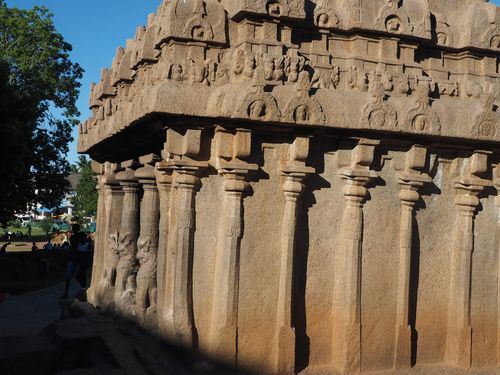
The front of Raya Mandapa follows the standard principle of an open rock-cut hall. A row of columns or pillars creates an intermediate zone comparable to a portico. These supports were not added separately but left in place during excavation and then shaped into architectural forms.
Pallava columns often combine a defined base, a relatively plain shaft and a simplified capital. Some examples in Mahabalipuram include zoomorphic bases or stylized lions, and Raya Mandapa belongs to this broader design vocabulary. Even when ornament is restrained, the columns organize the façade through a regular rhythm of voids and solids.
Behind the front row lies a rectangular hall of moderate depth, cut parallel to the façade. This arrangement allows the interior to be understood immediately upon entry. The hall likely functioned as a transitional sacred space, a restricted gathering area or a zone preceding inner devotional imagery.
The geometric clarity of the plan contrasts with the richer potential treatment of walls and carved details.
Interior Sculpture and Surface Treatment
The internal walls of Raya Mandapa may contain niches, relief panels or iconographic compositions. In monuments of this type, the rock serves simultaneously as structural body and sculptural support. Decoration is therefore inseparable from the architecture itself.
Flat wall surfaces provide suitable settings for divine figures, guardians or narrative scenes. Recessed niches create secondary focal points and establish hierarchy within the hall. Where several carved elements are present, they guide the eye from entrance to side walls and toward the rear zone of the shrine.
Ceilings are generally plain, sometimes levelled to correct the natural irregularity of the granite. This restraint increases visual emphasis on columns, wall panels and entrances rather than overhead ornament.
Natural light plays a major role in the interior experience. Illumination enters primarily from the open façade and gradually diminishes toward the rear. This progression from exterior brightness to partial shadow reinforces the sacred atmosphere of the space.
Excavation Techniques and Structural Logic
Raya Mandapa resulted from a reverse construction process when compared with masonry buildings. Craftsmen first established the outer façade and support lines, then progressively removed the unwanted stone behind them. Any major cutting error would have affected the whole composition, requiring careful planning from the outset.
Mahabalipuram granite is hard and durable, demanding methodical workmanship. Surfaces may preserve traces of tooling or later refinements used to regularize planes and profiles. Column spacing, ceiling height and hall depth remained dependent on the stability of the retained rock mass.
This method also explains dimensional limits. The span between supports, the thickness of pillars and the depth of excavation had to remain compatible with structural security.
Conservation and Present Reading
Like other coastal rock-cut monuments at Mahabalipuram, Raya Mandapa is exposed to erosion, seasonal humidity and visitor wear. Sculpted surfaces are especially vulnerable to gradual loss of detail.
Today the monument is best understood as an architecture of subtraction: columns, chamber and ornament emerge from a single granite body. Its architectural significance lies in the fusion of natural landscape, sacred function and the technical discipline of Pallava stone carving.