

 Français (France)
  Nederlands (nl-NL)
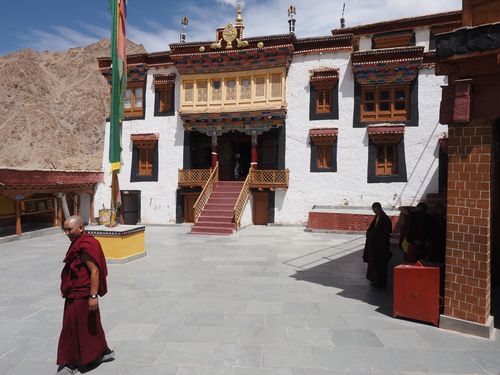
 Likir Gompa is a significant monastery in Ladakh, recognised for its religious and cultural importance within Tibetan Buddhism. Located in the Leh region, it functions as an active monastic centre where daily life, religious training, and ceremonies structure the year. The site houses a stable monastic community and attracts visitors drawn to its ritual spaces, open surroundings, and symbolic representations. Likir Gompa remains a living institution, reflecting the continuity of Buddhist practices and the enduring influence of Buddhism on Ladakh’s contemporary cultural identity.


Monument profile
Likir Gompa
Monument category: Monastery
Monument family: Monastery
Monument genre: Religious
Cultural heritage: Buddhist
Geographic location: Likir • Ladakh • India
Construction period: 11th century AD
• Links to •
• List of videos about Likir on this site •
Likir Gompa • Ceremony, monks and Buddhist paintings
History of Likir Gompa in Likir, India
Likir Gompa, located northwest of Leh in the Ladakh region, stands among the oldest and most culturally influential monastic foundations of Himalayan Buddhism. Its historical trajectory mirrors the religious transformations, political dynamics and cultural negotiations that shaped western Tibet and trans-Himalayan societies from the eleventh century onward. The monastery’s evolution illustrates the strategic function assumed by monastic institutions in governance, education and diplomacy, as well as their resilience amid shifting geopolitical landscapes.
Origins, Political Context and Founding Ambitions
Tradition situates the establishment of Likir Gompa in the eleventh century, an era characterised by what historians describe as the “second diffusion” of Tibetan Buddhism. In Ladakh, kings sought spiritual partnerships to legitimise their rule and assert cohesion within a fragmented tribal society. Patronage of monastic foundations was a recognised instrument of authority: by endowing monasteries, rulers both articulated piety and demonstrated their capacity to protect and regulate Buddhist practice.
Likir’s foundation therefore responded to a dual purpose. It strengthened royal authority and provided a stable doctrinal centre aligned with reformist movements emanating from Tibet. The construction of the monastery also corresponded to strategic concerns: it facilitated indirect control over agrarian valleys, safeguarded trade routes and acted as a symbolic expression of territorial stewardship. Religious leaders involved in its development were valuable political actors, mediating between elites and rural communities while helping to institutionalise Gelug ideologies.
Institutional Development and Religious Change
Over time, Likir Gompa became a significant centre of the Gelug school. Its growth was fostered by trans-Tibetan intellectual exchanges, cross-border religious networks and increasing integration of Ladakh into broader political spaces. Monastic life focused on liturgical recitation, scriptural study and novice training, gradually shaping Likir into an educational institution with hierarchical organisation and ritual discipline.
At its apex between the sixteenth and seventeenth centuries, the monastery benefited from land grants and material privileges bestowed by Ladakhi monarchs. The strengthening of Gelug orthodoxy brought administrative reforms and doctrinal consistency. Artistic influences flowed from Central Tibet, as did teachers and texts that helped shape the ritual culture of Likir. Contests with rival Buddhist schools, although significant, were mediated through integration of new ritual forms and architectural expansion.
Conflict, Upheaval and Reconstruction
Throughout its history, the monastery faced disruptions resulting from external conflicts. The political influence of Kashmir, the ambitions of neighbouring Himalayan kingdoms and Mongol interventions periodically destabilised the region. While Likir was geographically removed from direct invasion routes, changing alliances altered its patronage networks and caused intermittent phases of decline.
The seventeenth century brought renewed royal attention, resulting in restoration works intended to reassert monastic authority within Ladakh. The monastery became an actor in regional diplomacy, particularly in exchanges with central Tibet. This era also saw modifications of internal design, expansion of ceremonial spaces and reaffirmation of monastic hierarchy.
Likir within Global Monumental Trends
The ascendance of Likir Gompa coincided with global patterns of religious institutionalisation. Across Europe, monasteries occupied comparable functions, serving as repositories of knowledge, educational centres and expressions of elite patronage. In Asia, monumental Islamic shrines and expanding Buddhist monastic networks echoed similar architectural and spiritual ambitions.
Likir’s development reflects this broader tendency toward monumental expression as a means of projecting ideological continuity. Like medieval abbeys, the monastery embodied both spiritual authority and socio-political influence. Its educational orientation parallels the intellectual role played by monastic universities elsewhere, underscoring the central place of scriptural learning in sustaining cultural transmission.
Transformations, Adaptation and Change
The nineteenth and twentieth centuries brought major shifts in Likir’s internal organisation. With the fall of local monarchies and the rise of Dogra and later British administration, monastic institutions lost traditional financial bases. Likir adapted by restructuring its economy, intensifying agricultural self-reliance and seeking support from emerging regional authorities. The closure of Himalayan borders reduced its interaction with Tibet, limiting scholarly circulation yet prompting renewed investment in local training.
The twentieth century saw substantial renovation, including reinforcement of aging structures and installation of large religious statues, most notably that of Maitreya. Restoration campaigns revived damaged frescoes and stabilised building foundations. Educational reforms reorganised scriptural study and redefined novice curricula to preserve ritual competence in changing circumstances.
Contemporary Role and Cultural Significance
Today, Likir Gompa remains an active monastery inhabited by monks engaged in doctrine, ritual and sacred music. It functions simultaneously as a spiritual institution, a cultural symbol and a social centre. Seasonal festivals draw inhabitants from neighbouring valleys, sustaining collective memory and ensuring community participation in monastic ritual.
The monastery also contributes to Ladakhi identity. For local populations, it represents continuity of belief despite economic migration and political modernisation. The presence of resident monks, ceremonial rhythms and ongoing training in liturgy reinforce cultural cohesion. The site attracts pilgrims, scholars and tourists, who perceive it as an embodiment of Ladakhi religious heritage.
Conservation, Heritage and Challenges Ahead
Likir faces a variety of preservation challenges. Its high-altitude location exposes structures to climatic extremes: freeze-thaw cycles erode traditional mortars, seasonal wind affects roofs, and seismic vibrations threaten historic walls. Increasing tourism introduces demands for controlled access, conservation planning and mediation between sacred use and visitor experience.
Local conservation initiatives, supported by heritage organisations, aim to maintain traditional construction techniques while reinforcing vulnerable sections. Restoration focuses on wall paintings, prayer halls and roof systems. While not inscribed as a World Heritage Site, the monastery benefits from national heritage recognition and regional safeguarding programmes that promote technical training and community stewardship.
Conclusion
The history of Likir Gompa encapsulates broader patterns shaping Himalayan Buddhism. Born from political aspiration and doctrinal reform, it matured into a hub of learning and ritual practice, negotiated upheaval through adaptation and now survives as a dynamic repository of Ladakhi heritage. Its resilience illustrates the enduring interplay between spiritual authority, social organisation and regional identity, making it an instructive case for understanding the past and present of monastic institutions across the trans-Himalayan world.
Architecture of Likir Gompa in Likir, India
Likir Gompa, set on a rocky spur above the surrounding valley, is a characteristic example of Ladakhi monastic architecture, combining practical adaptation to a harsh mountain environment with the liturgical and symbolic needs of Tibetan Buddhism. Its built fabric has grown in stages over several centuries, resulting in a compact, terraced complex where structural pragmatism, ritual hierarchy and landscape all interact closely.
Site, layout and architectural concept
The defining feature of Likir’s architecture is its relationship to the terrain. The monastery is not laid out on a regular geometric plan but follows the contours of the hillside. Buildings are arranged on successive terraces, linked by stairways, narrow lanes and small courtyards. This stepped organisation allows the complex to occupy a relatively small footprint while providing the range of spaces required for monastic life: living quarters, storage, kitchens, assembly halls, chapels and service areas.
The higher levels are reserved for the most important ritual spaces: the main assembly hall, subsidiary temples and chapels, and the areas where sacred images and manuscripts are kept. Lower levels accommodate cells for monks, domestic functions and storage. This vertical hierarchy translates the symbolic ascent from everyday life towards the more sacred zones of prayer and contemplation.
From a distance, Likir appears as a cluster of white cubic volumes, punctuated by darker window bands and topped by flat earth roofs and small rooftop structures. The overall impression is that of a dense village anchored to the slope, with the monastery’s most prominent halls and the modern Maitreya statue reinforcing its visual dominance in the landscape.
Structural solutions and adaptation to climate
Technically, the architecture at Likir reflects a long tradition of building in seismic, high-altitude conditions with limited resources. The lowest parts of the complex rely on massive stone retaining walls that stabilise the terraces and anchor the structures into the rock. Above these foundations, load-bearing walls in stone and earth support the upper stories and roofs.
Structural stability is achieved through the combination of wall thickness, compact massing and relatively small spans. Roofs are supported by closely spaced timber beams carried on rows of wooden columns in the larger halls. The proportions of these elements are designed to distribute loads efficiently and to tolerate slight movements caused by temperature variation, minor seismic events and differential settlement.
The climate of Ladakh—strong solar radiation, low humidity, large diurnal temperature ranges and seasonal snow—has shaped many architectural choices. Thick walls in stone and earth act as thermal buffers, moderating interior temperatures. Small, deeply set windows reduce heat loss and minimise glare while still providing controlled daylight. Flat roofs with layers of branches and earth offer insulation and can be easily repaired after winter damage.
Ventilation is handled largely through simple means: the arrangement of openings in opposite walls, the use of internal courtyards that create air wells, and the slight permeability of traditional construction. These strategies produce a relatively stable interior climate without mechanical systems, an essential quality for preserving paintings, manuscripts and wooden elements.
Materials and building techniques
The material palette at Likir is typical of rural Ladakh, composed almost entirely of locally available resources. Stone from nearby outcrops is used for foundations, terrace walls and the lower portions of buildings. Above, walls are often raised in mud brick or rammed earth, applied over stone bases. This combination provides both robustness and insulation while keeping construction processes simple and labour-intensive rather than capital-intensive.
Timber—mainly poplar and willow—serves for beams, rafters, columns, window and door frames, and decorative elements. Given the scarcity of wood at high altitude, its use is concentrated where structurally or symbolically necessary. Roofs are composed of timber beams covered with smaller branches and then thick layers of packed earth. Regular maintenance is required to repair erosion caused by meltwater and rain.
Wall surfaces are finished with mud or lime-based plasters and then whitewashed, creating the characteristic bright volumes visible from afar. In key ritual spaces, interior surfaces receive additional layers of fine plaster to serve as a ground for paintings. Pigments derived from minerals and plants are applied in fresco or secco techniques to create wall paintings with a distinctive, saturated chromatic range.
Stylistic and artistic influences
Stylistically, Likir Gompa belongs to the wider family of Tibetan Buddhist monasteries but incorporates local Ladakhi variations. The basic volumetry—stacked rectangular blocks, flat roofs, small windows—and the colour scheme of white walls, dark window bands and ochre or red cornices are shared across the region. These features emphasise horizontality and solidity, making the structures visually rooted in the mountain.
Inside, the main assembly hall and chapels are richly decorated with paintings, sculpted elements and ritual objects. Iconography follows Tibetan Buddhist canons: large images of Buddhas and bodhisattvas, depictions of protective deities, narrative cycles and mandalas. Stylistic details, such as the rendering of faces, drapery and ornamental borders, reveal a mix of influences from Central Tibetan schools, regional Ladakhi workshops and later restorations.
Carved and painted wooden elements—capitals, door and window frames, ceiling beams—add another layer of artistic expression. Their motifs range from simple geometric patterns to complex floral and mythical designs, aligning Likir with a broader trans-Himalayan repertoire while also reflecting the hand of local artisans.
Spatial organisation and internal structure
The internal layout at Likir is conditioned by the hillside yet follows a recognisable monastic logic. The main entrance leads into lower courtyards and circulation paths that distribute residents and visitors towards different functional zones. As one moves upwards, circulation narrows and becomes more controlled, reflecting increasing ritual importance.
The principal assembly hall (du khang) is typically a large, nearly square or rectangular space, structured by rows of timber columns that divide the floor into bays. Raised platforms along the walls support statues, altars and storage for ritual implements and manuscripts, while the central area is reserved for monastic seating during ceremonies. Adjacent chapels, accessible from the main hall or from small corridors, house specialised images, relics or protective deities.
Upper roofs act as both technical surfaces and social spaces. They serve for drying produce, carrying out maintenance, observing the surroundings and, occasionally, hosting ritual activities. From these upper levels, the more recent monumental image of Maitreya visually extends the monastery’s presence beyond its immediate footprint, establishing a vertical axis between the built ensemble and the open sky.
Distinctive features, anecdotes and perception
Although not the largest monastery in Ladakh, Likir stands out for its clear, compact silhouette and for the way its volumes step down the slope in a coherent composition. The contrast between the austere, almost fortress-like exterior and the richly decorated interiors echoes a broader Himalayan architectural theme: the idea that sacred richness is contained and protected within an apparently simple envelope.
Maintenance practices, such as the recurrent re-plastering and whitewashing of façades or the periodic rebuilding of roofs after harsh winters, form part of the living architectural culture of Likir. These repeated interventions mean that the monastery’s appearance is the product of continuous adjustment rather than a single, fixed design.
Conservation issues and architectural significance
The architectural significance of Likir Gompa lies in its exemplary adaptation to environment and function. It demonstrates how a monastic institution can integrate liturgical, residential and storage needs into a single, compact fabric, with minimal reliance on imported technology and materials. At the same time, this very reliance on traditional earth, stone and timber construction makes the complex vulnerable.
Climate change, changing precipitation patterns and increased visitor numbers accentuate existing vulnerabilities: erosion of earthen roofs and walls, deterioration of plasters and paintings, structural stress on older masonry and timber. Conservation initiatives therefore focus on strengthening traditional techniques—training craftsmen in earth construction, careful repair of wall paintings, improving drainage and roof detailing—rather than replacing them with incompatible materials.
In this sense, the architecture of Likir Gompa is not simply a backdrop for religious life but a dynamic system that must continuously be maintained, interpreted and adapted. Its value is inseparable from its setting, its construction methods and the monastic community that inhabits and cares for it, making it a key reference for understanding the built heritage of Ladakh and the wider Himalayan world.