

 Français (France)
  Nederlands (nl-NL)
 The Durga Temple and local devotional worship site in Nalagarh represents a neighborhood Hindu sanctuary associated with everyday religious practices in Himachal Pradesh. Temples of this type play an important role in community life by serving as places for prayer, local gatherings, and ceremonies connected to the Hindu religious calendar. The sanctuary is dedicated to Durga, a widely revered goddess in northern India known for her protective role and association with divine power and spiritual strength. Religious activities surrounding the temple mainly reflect local devotional practices based on regular worship, offerings, and small-scale community participation.
Monument profile
Durga Temple and Local Worship
Monument category: Hindu Temple
Monument family: Temple
Monument genre: Religious
Cultural heritage: Hindu
Geographic location: Nalagarh • Himachal Pradesh • India
Construction period: 20th century AD
• Links to •
• List of videos about Nalagarh on this site •
Nalagarh, an ordinary town • Himachal Pradesh, India
Durga Temple and Neighborhood Religious Practices in Nalagarh
Establishment of the Local Sanctuary
The Durga Temple in Nalagarh belongs to the category of small neighborhood Hindu sanctuaries that expanded in many urban areas of northern India during the twentieth century. The visible structures appear to result mainly from relatively recent construction phases and gradual community-led modifications rather than from a single historical foundation campaign. The layout of the site, centered on an open courtyard surrounded by modest devotional spaces, indicates a temple designed primarily for regular local worship rather than for regional pilgrimage activity.
The coexistence of shrines associated with Durga and Shiva reflects the practical organization of many local religious spaces in Himachal Pradesh, where multiple forms of worship are maintained within the same enclosure. The sanctuary appears to have served residents of the surrounding neighborhood through daily rituals, offerings, and small-scale ceremonies linked to the Hindu religious calendar.
Development During the Twentieth Century
The expansion of Nalagarh during the twentieth century contributed to the creation of local devotional structures associated with residential communities and commercial neighborhoods. Temples of this scale were often supported by local families, merchants, or informal religious groups rather than by royal patronage or major institutional sponsorship.
Architectural elements visible today suggest incremental development over several decades. The use of modern materials, painted surfaces, and practical construction methods indicates repeated renovation campaigns rather than the preservation of an earlier monumental structure. Different sections of the complex may have been added progressively as the needs of the local community evolved.
The temple’s open spaces and modest gathering areas also suggest a strong communal function. In addition to worship activities, such sites commonly supported neighborhood religious meetings, seasonal observances, and collective ceremonies involving nearby residents.
Religious Use and Contemporary Role
The temple continues to function as an active center for local Hindu devotional practices. Ritual activities associated with Durga worship, Shiva offerings, and household religious observances remain central to the use of the sanctuary. The scale of the complex indicates a temple intended for frequent daily visits rather than large ceremonial gatherings.
The site also reflects the continuity of neighborhood-based religious organization in smaller urban centers of northern India. Community maintenance appears to play an important role in the preservation of the sanctuary, particularly through repainting campaigns, repairs, and the upkeep of ritual installations used during worship.
Because the temple remains integrated into ordinary residential life, its historical evolution is closely connected to the changing social structure of the surrounding neighborhood rather than to major political or institutional developments.
Global Historical Context
The principal development phase of the temple appears to belong to the twentieth century, a period marked in India by rapid urban growth following independence in 1947. During the same decades, many expanding urban neighborhoods around the world saw the construction of small community religious buildings serving local populations. The increased use of concrete and industrial materials in modest religious architecture also became widespread across South Asia during this period.
Architectural Organization of the Durga Temple and Neighborhood Worship Spaces in Nalagarh
Site Layout and Spatial Configuration
The Durga Temple in Nalagarh is organized around a compact open courtyard serving as the main circulation and gathering area of the complex. The courtyard connects several modest devotional structures arranged without strict axial symmetry, suggesting gradual expansion rather than a single architectural program. The layout reflects the practical requirements of a neighborhood religious site intended for regular daily use.
The complex occupies a limited urban plot integrated into the surrounding residential environment. Its low-rise structures and open circulation areas indicate adaptation to dense local conditions rather than ceremonial monumentality. The relationship between interior shrines and exterior communal spaces remains fluid, with little separation between ritual and circulation zones.
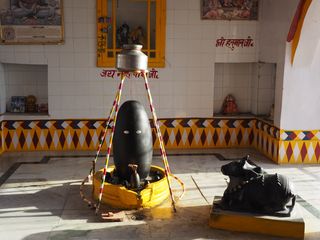
Several religious functions coexist within the enclosure. In addition to the shrine dedicated to Durga, the site contains a Shiva-related worship area centered on a lingam installation. The presence of multiple devotional spaces within the same courtyard reinforces the multifunctional character of the sanctuary.
Construction Methods and Structural Components
The visible structures are mainly built with reinforced concrete, masonry, cement render, and modern paving materials. Walls and columns use practical construction techniques favoring durability and ease of maintenance rather than elaborate craftsmanship. The structural system relies on thick load-bearing walls and covered spaces supported by square or slightly rounded pillars.
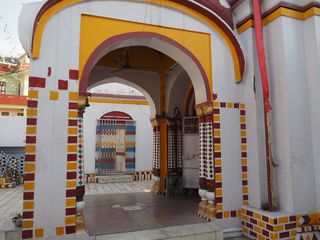
Portico sections incorporate shallow arches integrated into painted masonry façades. Their modest proportions correspond to the limited scale of the complex. Roofing systems are mostly concealed behind parapets and upper wall treatments, creating a compact horizontal appearance.
Floor surfaces consist primarily of stone slabs or ceramic tiling arranged in geometric patterns. The paving extends across circulation and ritual areas, creating visual continuity throughout the courtyard. The materials visible today suggest repeated renovation phases and continuous maintenance.
Ritual Structures and Functional Arrangement
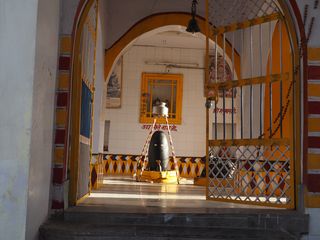
The Shiva shrine forms one of the most distinctive ritual areas of the complex. The lingam is installed within a circular yoni basin intended to collect ritual liquids used during worship. Above it, a suspended metal vessel allows the continuous dripping of water or milk during devotional rites. This installation concentrates ritual activity around the central shrine.
The Durga-related structures are simpler in layout, with enclosed devotional rooms opening directly onto the courtyard. Access remains low and direct, allowing worshippers to move easily between ritual areas. The absence of strong architectural separation between sacred and communal zones reflects the practical role of the temple as a neighborhood religious space used for frequent visits rather than formal pilgrimage activity.
Open sections of the complex accommodate small gatherings, devotional singing, and ritual preparation. The flexible organization of the courtyard allows adaptation to varying attendance levels during ceremonies and religious festivals.
Decorative Treatment and Surface Design
One of the most visible features of the complex is the extensive use of painted geometric decoration. Walls, columns, arches, and parapets display alternating bands of red, yellow, green, blue, and white applied directly onto cement-rendered surfaces. These painted motifs provide most of the visual identity of the sanctuary and compensate for the limited use of carved ornamentation.
Columns feature simplified molded bases and capitals emphasized mainly through painted detailing. Stair edges, parapets, and lower wall sections are similarly highlighted through contrasting color patterns. Decorative treatment relies largely on periodic repainting rather than permanent architectural carving.
Small sculptural figures placed near entrances and stairways serve as symbolic markers rather than elaborate decorative programs. The repeated repainting of surfaces reflects the importance of community maintenance in preserving the visual appearance of the sanctuary and its ritual spaces.