

 Français (France)
  Nederlands (nl-NL)
 Of Hindu tradition, (with additional Islamic and Christian influence), the Zamorins of Calicut dynasty ruled for approximately 686 years, ± between 1120 and 1806 over all or part of South India, during the Medieval Period and the Colonial Period.
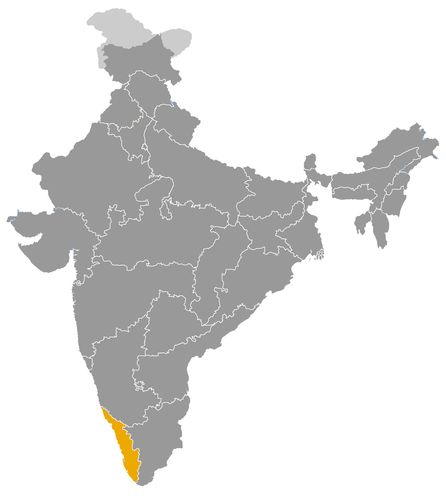
This map illustrates the maximum territory that the Zamorins of Calicut Dynasty had reached at its height, covering the current regions of Kerala in India. Its main purpose is to provide a visual aid to understand the geographical extent of this dynasty. However, it's important to note that the contemporary borders of these regions may not necessarily coincide with the historical territories.
The Zamorins of Calicut and Their Role in the History of India
A Maritime Dynasty at the Centre of the Malabar Coast
The Zamorins of Calicut, known in Malayalam tradition as the Samoothiri, were the hereditary rulers of Calicut, today Kozhikode, on the Malabar Coast of Kerala. Their importance in Indian history does not rest on the creation of a vast land empire, but on their control of one of the most influential ports of the Indian Ocean world. From the medieval period to the early modern age, Calicut became a major commercial centre linking India with Arabia, Persia, East Africa, Southeast Asia and, later, Europe.
The Zamorins emerged from the Nediyiruppu Swaroopam, a ruling house that gradually shifted its political centre toward the coast. By controlling Calicut, they gained access to maritime trade networks that brought wealth, diplomatic influence and cultural diversity. Their power illustrates the importance of coastal kingdoms in Indian history, alongside the better-known inland empires of the Deccan and North India.
Political Authority in a Fragmented Kerala Landscape
The political environment of medieval Kerala was highly fragmented. Authority was divided among royal houses, temple institutions, aristocratic lineages, military groups and merchant communities. In this context, the Zamorins built their power through a combination of warfare, diplomacy, ritual status and commercial control.
They expanded their influence over Calicut and neighbouring regions, while also asserting authority over important coastal centres such as Ponnani. Their rule depended less on a rigid centralized administration than on layered relationships with local chiefs, merchants and religious institutions. This flexible political structure allowed them to operate effectively in a region where direct territorial control was often limited.
The Zamorins were frequent rivals of other Kerala powers, especially Cochin and Cannanore. Their conflict with Cochin became particularly important after the arrival of the Portuguese, who supported Cochin as a counterweight to Calicut. These rivalries show how local politics and international commerce became closely connected on the Malabar Coast.
Calicut as a Hub of Indian Ocean Commerce
The economic strength of the Zamorins was rooted in Calicut’s position as a major port. The Malabar Coast was famous for pepper, but other goods also passed through its markets, including ginger, cardamom, timber, coconut products, textiles and luxury items. Calicut attracted merchants from many regions because it offered access to valuable commodities and functioned as a relatively open commercial centre.
The Zamorins did not necessarily control all production directly. Their strength lay in regulating trade conditions, protecting merchant communities, collecting port duties and maintaining political stability around the harbour. This gave them considerable influence without requiring a large territorial empire.
Muslim merchant communities played a central role in Calicut’s prosperity. They connected the port to long-established networks across the Arabian Sea and the wider Indian Ocean. The Zamorins’ ability to work with these communities was one of the foundations of their economic and diplomatic success.
The Encounter with the Portuguese
The arrival of Vasco da Gama at Calicut in 1498 marked a major turning point in the history of the Zamorins and of India’s maritime world. The Portuguese sought to redirect and control the spice trade through armed shipping, fortified settlements and monopolistic practices. This directly challenged the older commercial order of Calicut, which had depended on the participation of diverse merchant groups.
Relations between the Zamorins and the Portuguese quickly deteriorated. The Portuguese allied themselves with Cochin, while Calicut resisted attempts to impose foreign control over trade. The Zamorins supported naval resistance, especially through the Marakkar commanders, who became prominent figures in the struggle against Portuguese maritime power.
This conflict made Calicut one of the first major Indian centres of resistance to European expansion on the western coast. Although the Portuguese never fully destroyed Calicut’s importance, their arrival transformed the balance of power in the region and weakened the older system of Indian Ocean trade.
Cultural Patronage and Cosmopolitan Society
The cultural significance of the Zamorins was closely connected to the cosmopolitan character of Calicut. The city hosted Hindu, Muslim, Jain, Christian and foreign merchant communities. This diversity did not remove the social hierarchies of Kerala, but it gave Calicut a distinctive urban and maritime culture.
The Zamorin court supported religious and artistic traditions rooted in Kerala society. Temples, ritual institutions, Sanskrit learning and Malayalam cultural expression all formed part of the courtly environment. The tradition of Krishnanattam, associated with the cultural world of Calicut, reflects the importance of royal patronage in the performing arts of Kerala.
At the same time, the port environment brought foreign influences, languages and commercial practices into daily life. Calicut became a place where local traditions and global contacts met. This made the Zamorins important not only as rulers, but also as patrons of a society shaped by maritime exchange.
Economic Power without a Large Land Empire
The Zamorins demonstrate that political importance in Indian history did not always depend on territorial scale. Their kingdom was smaller than many inland states, but its control over maritime exchange gave it considerable influence. Port revenues, customs duties, merchant alliances and access to the spice trade gave Calicut a strategic role in regional and international politics.
This economic model also shaped the limits of Zamorin power. Because the kingdom depended heavily on coastal trade and alliances with merchants, it was vulnerable to disruption by naval warfare, European fortifications and changing trade routes. The Portuguese, Dutch and later British presence gradually reduced the autonomy of Calicut’s commercial system.
Decline under Mysore and British Expansion
In the eighteenth century, the expansion of Mysore under Haidar Ali and Tipu Sultan deeply affected the Malabar Coast. Calicut came under Mysorean pressure, and the Zamorins lost much of their effective political sovereignty. After the Anglo-Mysore conflicts, British influence replaced Mysorean control, and Malabar was incorporated into the colonial order.
The Zamorins retained social and ceremonial prestige, but their role as independent rulers came to an end. Their decline reflects the broader transformation of India’s coastal polities under the combined pressure of regional military states and European colonial expansion.
A Lasting Maritime Legacy in Indian History
The Zamorins of Calicut hold an essential place in Indian history as rulers of one of the great ports of the medieval and early modern Indian Ocean. Their political role was regional, but their economic and cultural significance was international.
By making Calicut a centre of maritime commerce, sustaining relations with merchant communities and resisting Portuguese monopolistic ambitions, the Zamorins shaped the history of the Malabar Coast and the wider Indian Ocean world. Their legacy shows that India’s past was formed not only by empires of the land, but also by coastal kingdoms whose ports connected the subcontinent to global trade, diplomacy and cultural exchange.
The Geographic Expansion of the Zamorins of Calicut in India
A Coastal Power Centred on Calicut
The Zamorins of Calicut, known in Malayalam as the Samoothiri, ruled one of the most influential coastal polities of medieval and early modern India. Their principal centre was Calicut, now Kozhikode, on the Malabar Coast of present-day Kerala. Unlike many dynasties of the Deccan or North India, the Zamorins did not build a vast inland empire. Their strength came from controlling a compact but strategically important maritime region, whose ports connected South India with the wider Indian Ocean world.
The territorial base of the Zamorins developed from the Nediyiruppu Swaroopam, an aristocratic house originally associated with the inland region of Eranad. Their rise was closely linked to a shift from an inland power base toward the coast. By gaining control of Calicut, they secured access to maritime trade, customs revenues and networks of merchants from Arabia, Persia, East Africa, Southeast Asia and other parts of India.
The Formation of a Territorial Core in Northern Kerala
The earliest territorial expansion of the Zamorins took place in northern Kerala, especially between the inland districts of Eranad and the coast around Calicut. This movement toward the sea was decisive. It allowed the rulers of Nediyiruppu to transform themselves from regional chiefs into maritime rulers with influence beyond their direct lands.
Their core territory included Calicut and neighbouring areas in the northern Malabar region. They also exercised influence over nearby settlements, markets, agrarian zones and routes connecting the interior with the coast. These routes were essential because pepper, cardamom, ginger, timber and forest products moved from the inland hills and plains toward the ports.
The power of the Zamorins therefore depended on both land and sea. Inland territories supplied products and revenue, while coastal ports provided access to international commerce. This combination gave Calicut a stronger position than its relatively limited territorial size might suggest.
Control of Ports and Commercial Corridors
The geographic expansion of the Zamorins was not based only on continuous territorial annexation. It was also based on the control of ports, river mouths, market centres and commercial corridors. Ponnani, south of Calicut, became one of the most important places within their sphere of influence. It was closely connected with Muslim merchant communities and played a major role in the maritime networks of the Malabar Coast.
The Zamorins sought to dominate the commercial geography of the central Malabar Coast. Their authority could be direct in some areas and indirect in others, through alliances, tribute, ritual status or the recognition of local chiefs. This flexible system reflected the political structure of Kerala, where power was often divided among royal houses, noble lineages, temple authorities and merchant groups.
Because the Zamorins controlled key points rather than a uniformly administered territory, their kingdom was geographically complex. It included a strong coastal centre, inland dependencies and zones of influence that could change according to military success, trade relations and political alliances.
Rivalry with Cochin and the Southern Malabar Coast
The expansion of the Zamorins brought them into frequent conflict with Cochin, one of the principal rival powers of Kerala. Cochin controlled a port that competed with Calicut for the spice trade and for access to foreign merchants. The Zamorins repeatedly attempted to extend their influence southward, while Cochin sought to preserve its independence.
This rivalry became more intense after the arrival of the Portuguese at the end of the fifteenth century. The Portuguese allied themselves with Cochin in order to weaken Calicut and gain control over the spice trade. As a result, a regional conflict between two Kerala powers became part of a larger struggle involving European maritime expansion.
The Zamorins’ southern ambitions were therefore limited by both local resistance and foreign intervention. Their relations with Cochin show how geography, commerce and diplomacy were inseparable on the Malabar Coast.
Northern Relations with Cannanore and Other Coastal Powers
To the north, the Zamorins had to deal with Cannanore, another important coastal kingdom. Cannanore had its own maritime connections and its own relationships with foreign merchants. The balance between Calicut and Cannanore was shaped by competition over trade, alliances with local chiefs and the changing presence of European powers.
The Zamorins did not completely dominate the northern Malabar Coast, but they remained one of its most powerful actors. Their influence extended through commercial prestige, naval activity and diplomatic ties. This made Calicut a central reference point in the political geography of the region, even where direct rule was absent.
Other local polities and aristocratic houses also limited Zamorin expansion. The Kerala landscape was politically fragmented, and successful rule required negotiation as much as conquest. The Zamorins expanded by integrating local elites, controlling strategic routes and asserting ritual and commercial superiority.
Maritime Conflict with the Portuguese
The arrival of Vasco da Gama at Calicut in 1498 transformed the territorial and maritime position of the Zamorins. The Portuguese wanted to impose a controlled and militarized system of trade, supported by fleets and fortifications. This directly challenged Calicut’s older commercial order, which depended on openness to many merchant communities.
The Zamorins resisted Portuguese pressure and defended their maritime sphere with the help of Muslim naval leaders, especially the Marakkars. Conflicts around Calicut, Cochin, Chaliyam and other coastal points show that the struggle was not only political but geographical. Whoever controlled the ports and sea routes controlled access to the spice trade.
Portuguese forts and alliances weakened Zamorin influence in some areas, but Calicut remained an important centre of resistance. The conflict reshaped the map of power along the Malabar Coast.
Pressure from Mysore and the End of Independent Rule
In the eighteenth century, the expansion of Mysore under Haidar Ali and Tipu Sultan changed the political geography of Malabar. Mysorean forces entered the region, and the Zamorins lost much of their effective authority. Calicut was drawn into a larger South Indian military struggle involving Mysore, Travancore and the British.
After the Anglo-Mysore wars, British power replaced Mysorean control. The Malabar Coast was incorporated into the colonial system, and the Zamorins retained mainly social and ceremonial prestige rather than independent sovereignty.
A Maritime Territory with Wide Influence
The geographic expansion of the Zamorins of Calicut was distinctive because it was coastal, commercial and network-based. Their direct territory was centred on Calicut and parts of northern and central Malabar, but their influence extended through ports, merchants, naval alliances and control of trade routes.
Their position shaped relations with Cochin, Cannanore, Venad, Mysore, the Portuguese, the Dutch and the British. The Zamorins demonstrate that a relatively compact coastal kingdom could play a major role in Indian history when it controlled strategic access to the Indian Ocean. Their territorial history is therefore best understood not as the growth of a large inland empire, but as the rise of a maritime power whose ports linked Kerala to the wider world.
The title Zamorin, or Samoothiri, refers to the hereditary rulers of Calicut, descended from the Nediyiruppu Swaroopam. Succession followed the matrilineal system, and the sources do not always preserve the personal names of the rulers. This chronology therefore presents named or historically identifiable Zamorins, with dates that are often indicative.
First house of the Zamorins of Calicut
- Mana Vikrama Manikkan (c. 1124 CE) • Traditional founder of the ruling house of Calicut, he is associated with the early assertion of Nediyiruppu power.
- Unnamed Zamorin (uncertain period, before the 14th century CE) • This ruler is traditionally associated with the foundation or development of the city of Calicut.
- Rama Varma Kulashekhara (c. 1339 to 1347 CE) • He ruled when Calicut was already an important port on the Malabar Coast.
- Raja Raja Varma (c. 1402 to 1410 CE) • His reign corresponds to a period of intense commercial activity with Indian Ocean networks.
- Unnamed Zamorin (c. 1442 to 1450 CE) • He ruled during the visits of foreign travellers who recorded the commercial importance of Calicut.
- Mana Vikrama the Great (c. 1466 to 1474 CE) • He strengthened Calicut’s prestige before the direct arrival of the Portuguese on the Malabar Coast.
- Mana Veda (c. 1474 to 1482 CE) • He maintained the kingdom’s authority during a period of maritime prosperity.
- Manavikraman Raja of Mankurussi (c. 1495 to 1500 CE) • He was the Zamorin when Vasco da Gama arrived at Calicut in 1498.
- Unnamed Zamorin (c. 1500 to 1513 CE) • His reign was marked by the first lasting tensions with the Portuguese and by conflicts around Cochin.
- Unnamed Zamorin (c. 1513 to 1522 CE) • He concluded a treaty with the Portuguese and allowed the establishment of a Portuguese fort at Calicut.
- Unnamed Zamorin (c. 1522 to 1529 CE) • He is associated with the expulsion of the Portuguese from Calicut.
- Unnamed Zamorin (c. 1529 to 1531 CE) • His reign corresponds to the construction of the Portuguese fort at Chaliyam.
- Unnamed Zamorin (c. 1531 to 1540 CE) • He continued conflicts with the Portuguese amid maritime rivalry on the Malabar Coast.
- Unnamed Zamorin (c. 1540 to 1548 CE) • He concluded a treaty with the Portuguese while preserving Calicut’s commercial interests.
- Unnamed Zamorin (c. 1548 to 1560 CE) • His reign was marked by dynastic adoptions and continued fighting with the Portuguese.
- Vira Raya (c. 1560 to 1562 CE) • He ruled briefly during a period of tension with European powers.
- Mana Vikrama (c. 1572 to 1574 CE) • He is associated with the expulsion of the Portuguese from Chaliyam.
- Unnamed Zamorin (c. 1574 to 1578 CE) • He continued campaigns against the Portuguese on the Malabar Coast.
- Unnamed Zamorin (c. 1578 to 1588 CE) • He allowed a Portuguese commercial presence at Ponnani in a changing diplomatic context.
- Unnamed Zamorin (c. 1588 to 1597 CE) • His reign saw the Portuguese settlement at Calicut in the late 16th century.
- Unnamed Zamorin (c. 1597 to 1599 CE) • He faced tensions with the Marakkars, former naval allies of Calicut.
- Unnamed Zamorin (c. 1599 to 1604 CE) • He took part in the capture of the Marakkar stronghold, an important event in Calicut’s maritime politics.
- Unnamed Zamorin (c. 1604 to 1617 CE) • He dealt with the Dutch and the English while maintaining regional rivalry with Cannanore.
- Mana Vikrama (c. 1617 to 1627 CE) • He ruled during growing European competition on the western coast of India.
- Unnamed Zamorin (c. 1627 to 1630 CE) • His short reign belongs to a phase of dynastic transition.
- Unnamed Zamorin (c. 1630 to 1637 CE) • He maintained the continuity of Calicut’s power amid commercial rivalries.
- Mana Vikrama Saktan Tampuran (c. 1637 to 1648 CE) • He was linked to a period of cultural patronage and the Krishnanatakam tradition.
- Tiruvonam Tirunal (c. 1648 to 1655 CE) • He ruled during a relatively stable phase of the first house.
- Mana Veda (c. 1655 to 1658 CE) • He is traditionally associated with the composition of the Krishnanatakam.
- Asvati Tirunal (c. 1658 to 1662 CE) • His reign coincided with the expulsion of the Portuguese from Kodungallur.
- Puratam Tirunal (c. 1662 to 1666 CE) • He ruled when the Portuguese also lost Cochin.
- Unnamed Zamorin (c. 1666 to 1668 CE) • He was confronted with conflicts against the Dutch.
- Unnamed Zamorin (c. 1668 to 1671 CE) • His reign is associated with the symbolic destruction of the Cheraman Sword.
- Uttrattati Tirunal (c. 1671 to 1684 CE) • He ceded Chetwai to the Dutch, reflecting growing European pressure.
- Bharani Tirunal Mana Vikrama (c. 1684 to 1705 CE) • He strongly resisted the Dutch and patronized two Mamankam celebrations.
- Nileswaram Tirunal (c. 1705 to 1711 CE) • His reign was marked by adoptions from Nileshwaram.
- Vira Raya (c. 1711 to 1729 CE) • He ruled during the Dutch War of the early 18th century.
- Mana Vikrama (c. 1729 to 1741 CE) • Last Zamorin of the first house, he preceded the branch created through the Nileshwaram adoptions.
Second house of the Zamorins and the end of political sovereignty
- Zamorin of Kilakke Kovilakam (c. 1741 to 1746 CE) • First ruler of the second house, he belonged to the lineage adopted from Nileshwaram.
- Zamorin of Putiya Kovilakam (c. 1746 to 1758 CE) • His reign was marked by a renewed war against the Dutch.
- Zamorin of Kilakke Kovilakam (c. 1758 to 1766 CE) • He faced Travancore and the invasion of Mysore before Calicut was annexed by Haidar Ali.
- Zamorin of Putiya Kovilakam (c. 1766 to 1788 CE, reduced authority) • He retained dynastic status during the period of Mysorean domination over Malabar.
- Kerala Varma Vikrama (c. 1788 to 1798 CE, reduced authority) • His rule coincided with the transition from Mysorean domination to British influence after the Treaty of Seringapatam.
- Krishna Varma (c. 1798 to 1806 CE) • Last Zamorin to exercise residual political authority, he accepted the 1806 agreement with the British East India Company.