

 Français (France)
  Nederlands (nl-NL)
 Of Hindu tradition, (with additional Buddhist influence), the Varman dynasty ruled for approximately 300 years, ± between 350 and 650 over all or part of East India, during the Ancient Period and the Classical Period.
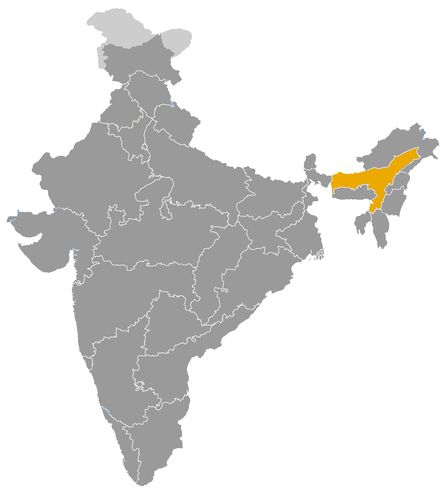
This map illustrates the maximum territory that the Varman Dynasty had reached at its height, covering the current regions of Assam and Meghalaya in India. Its main purpose is to provide a visual aid to understand the geographical extent of this dynasty. However, it's important to note that the contemporary borders of these regions may not necessarily coincide with the historical territories.
The Varman Dynasty and Its Role in the History of India
A Foundational Power in Ancient Kamarupa
The Varman dynasty occupies a significant place in the history of ancient India as the first historically documented ruling house of Kamarupa, a kingdom located in the northeastern part of the subcontinent. Its core territory corresponded largely to present day Assam, especially the Brahmaputra valley, but its influence also reached neighbouring regions connected to Bengal, the Himalayan foothills and eastern frontier zones. The dynasty emerged around the fourth century CE and remained politically important until the seventh century.
The Varmans are especially important because they gave Kamarupa a stable dynastic framework and integrated northeastern India more clearly into the political and cultural world of the subcontinent. Before their rise, the region was known through earlier traditions and scattered references, but under the Varmans it became a recognized kingdom with diplomatic relations, royal inscriptions, religious patronage and a defined political identity.
Political Consolidation in the Brahmaputra Valley
The founder of the dynasty is traditionally identified as Pushyavarman. His rule probably developed during a period when the Gupta Empire was expanding its influence across northern India. The Varmans did not create an empire comparable to the Guptas, but they established a durable regional monarchy in a strategically important area.
Their main achievement was the consolidation of Kamarupa around the Brahmaputra valley. This region was fertile, but also geographically complex, with river plains, forests, hills and frontier communities. Establishing authority there required more than military power. It depended on alliances with local elites, control of agricultural zones and command over river routes.
Later rulers such as Bhutivarman, Sthitavarman and Bhaskaravarman strengthened royal authority and expanded the prestige of the dynasty. Under their rule, Kamarupa became one of the major political forces of northeastern India. The kingdom was no longer a marginal frontier territory, but an active participant in the political balance between the eastern Gangetic plain, Bengal and the Himalayan borderlands.
Relations with the Gupta World and Northern India
The Varman dynasty developed in a political environment shaped by the prestige of the Gupta Empire. The earliest Varman rulers appear to have positioned themselves within this wider order, while maintaining effective local autonomy. This relationship illustrates a common feature of early Indian politics: regional kingdoms could acknowledge the cultural or symbolic authority of a larger imperial power without losing their own sovereignty.
The connection with northern India became especially visible under Bhaskaravarman, the most famous ruler of the dynasty. He formed a close alliance with Harsha of Kanauj, one of the leading rulers of seventh century northern India. This alliance elevated the status of Kamarupa and placed it within the major diplomatic networks of the time.
For Harsha, Kamarupa was a valuable eastern partner. For Bhaskaravarman, the alliance provided recognition, security and access to a broader political world. The Varman kingdom thus acted as a bridge between the Gangetic heartland and the northeastern frontier.
Cultural Integration through Sanskrit and Brahmanical Traditions
The cultural role of the Varman dynasty was particularly important in the integration of Assam into the Sanskritic and Brahmanical traditions of ancient India. Their inscriptions and genealogical claims show that the rulers sought legitimacy through ideas widely recognized across the subcontinent, including royal ancestry, religious merit, land donation and the protection of dharma.
This process did not simply erase local traditions. Rather, the Varmans adapted broader Indian political and religious models to the specific context of Kamarupa. The region had its own social structures, local cults and ethnic diversity. Varman rule helped create a synthesis between regional identities and pan Indian forms of kingship.
Sanskrit served as an important language of prestige and administration. It connected the court of Kamarupa with intellectual and religious currents circulating through northern and eastern India. Through this cultural policy, the Varmans helped establish patterns of royal representation that continued under later dynasties of Assam.
Religious Patronage and the Legitimacy of Kingship
The Varman rulers are generally associated with Brahmanical Hindu traditions, although the religious landscape of Kamarupa was diverse. Royal patronage probably supported temples, learned Brahmins and ritual specialists who helped strengthen the ideological foundations of monarchy.
Land grants were an important instrument in this process. By granting land to Brahmins and religious beneficiaries, the kings encouraged agricultural development, extended administrative influence and linked local society to royal authority. These donations also reinforced the idea of the king as a protector of religious order and social hierarchy.
This model was common in many regions of early medieval India, but in Kamarupa it had particular importance because it helped incorporate frontier and semi frontier zones into a more organized political structure.
Economic Foundations of Varman Power
The economic strength of the Varman kingdom rested primarily on agriculture, riverine communication and control over regional resources. The Brahmaputra valley offered fertile lands, but its environment required adaptation to floods, forests and shifting settlement patterns. Royal authority depended on the ability to organize cultivation and secure access to productive zones.
The kingdom’s location also gave it commercial advantages. Kamarupa stood between Bengal, the Himalayan foothills and eastern regions beyond the Brahmaputra valley. This position allowed the movement of agricultural goods, forest products, animals, metals and luxury items. Control over routes and river corridors increased the political value of the kingdom.
The Varman economy was therefore not isolated. It was linked to wider exchange networks, even if these were less urbanized than those of the Gangetic plain or western India.
A Lasting Legacy in Northeastern Indian History
The Varman dynasty’s greatest historical role was the creation of a durable political and cultural framework for ancient Assam. It transformed Kamarupa into a recognized kingdom, connected it with northern Indian diplomacy and gave its rulers a prestigious dynastic identity.
Their legacy continued after the fall of the dynasty. Later ruling houses of Kamarupa inherited a territorial framework, a royal ideology and a regional political identity shaped in large part by the Varmans. For this reason, the dynasty holds a central place in the history of northeastern India and in the broader development of regional kingdoms across the Indian subcontinent.
The Geographic Expansion of the Varman Dynasty in India
A Kingdom Anchored in the Brahmaputra Valley
The Varman dynasty was the first major historically documented ruling house of Kamarupa, an ancient kingdom in northeastern India. Its core territory lay in the Brahmaputra valley, corresponding largely to present day Assam. From this strategic riverine region, the Varmans gradually extended their authority over neighbouring plains, frontier zones, hill margins and areas connected to Bengal and the eastern Himalayan foothills.
The dynasty emerged around the fourth century CE, a period during which regional kingdoms were forming around the edges of the Gupta political world. Kamarupa was geographically distant from the main centres of the Gangetic plain, yet it was not isolated. Its position gave it control over routes linking northern India, Bengal, the Himalayan borderlands and the eastern regions beyond the Brahmaputra valley. This geography shaped both the territorial ambitions of the Varman rulers and their relations with neighbouring powers.
Early Consolidation around Western and Central Kamarupa
The founder of the dynasty is traditionally identified as Pushyavarman, who probably ruled in the fourth century CE. The earliest phase of Varman power seems to have been concentrated in western and central Kamarupa. These areas included fertile parts of the Brahmaputra valley and zones that connected Assam with northern Bengal and the wider political world of northern India.
The first Varman rulers likely did not control a clearly bounded state in the modern sense. Their authority was probably stronger in settled agricultural zones and more indirect in forested or upland regions. Power depended on the ability to dominate river routes, command local chiefs, secure agricultural production and establish dynastic legitimacy.
This early consolidation was crucial. By strengthening their position in the Brahmaputra valley, the Varmans created the territorial basis for a durable kingdom. They also made Kamarupa visible to larger political formations, especially the Gupta Empire, whose prestige influenced much of northern India during the same period.
Expansion toward Davaka and the Eastern Brahmaputra Region
One of the important directions of Varman expansion was toward Davaka, an ancient region generally associated with central Assam or a neighbouring area between Kamarupa and more eastern territories. Davaka appears in early historical traditions as a distinct political zone, and its relationship with Kamarupa was important for the growth of Varman authority.
The incorporation or domination of Davaka allowed the Varmans to extend their influence deeper into the Brahmaputra valley. This expansion strengthened their control over agricultural land, river passages and zones of contact with communities farther east. It also helped transform Kamarupa from a western Assamese kingdom into a larger regional power.
The eastern frontier, however, was difficult to control directly. The landscape included forests, hills and diverse local societies. Varman authority in these regions probably combined direct rule in some areas with tributary relations, alliances and symbolic recognition in others. This flexible pattern of rule was common in early Indian polities, especially in frontier regions where fixed borders were less important than networks of loyalty and influence.
Western Routes and Relations with Bengal
The western side of Kamarupa was equally important. It connected the kingdom to Bengal, the lower Ganges region and the main political networks of northern India. Control of western routes allowed the Varmans to participate in trade, diplomacy and military affairs beyond the Brahmaputra valley.
Relations with Bengal and neighbouring eastern Indian powers were likely complex. Depending on the period, the Varmans may have faced rivalry, negotiated alliances or competed for influence over border regions. The territories between Kamarupa and Bengal were valuable because they controlled access between the northeast and the Gangetic world.
This western orientation gave Kamarupa strategic significance. It was not merely a remote frontier kingdom, but a political actor positioned between the eastern Gangetic plain and the northeastern highlands. The Varmans’ control of these corridors increased their diplomatic value and sometimes made them useful partners for more powerful rulers.
Himalayan and Hill Frontiers as Zones of Indirect Influence
The northern and northeastern margins of the Varman realm bordered Himalayan foothills and hill regions inhabited by diverse communities. These areas were important for access to forest products, animals, metals and upland trade networks. They also formed defensive and cultural frontiers between the Brahmaputra valley and the trans-Himalayan world.
The Varmans probably did not administer these regions in the same way as the agricultural plains. Their influence was likely exercised through local intermediaries, ritual claims, tribute relations and political alliances. This created a layered frontier system in which royal authority was real but uneven.
Such frontier relations shaped the character of Kamarupa as a kingdom. Its rulers needed to integrate populations and landscapes that differed considerably from the settled river valley. This helped produce a political culture that combined Sanskritic kingship with regional traditions and local power structures.
Territorial High Point under Bhaskaravarman
The reign of Bhaskaravarman in the seventh century represents the political high point of the dynasty. By this time, Kamarupa had become a recognized power in northern and eastern India. Bhaskaravarman formed a major alliance with Harsha of Kanauj, one of the most influential rulers of the period.
This alliance was closely linked to geography. For Harsha, Kamarupa offered a strategic partner on the eastern edge of the northern Indian political sphere. For Bhaskaravarman, the alliance brought prestige, security and recognition from a major imperial court. It also strengthened Kamarupa’s position against rival powers in Bengal and neighbouring regions.
Under Bhaskaravarman, Varman authority probably covered much of the Brahmaputra valley and extended influence toward eastern Bengal, hill frontiers and neighbouring regional powers. The kingdom’s strength lay not only in territorial control, but also in its command of corridors between several cultural and political zones.
A Political Geography Built on Corridors and Networks
The geographic expansion of the Varman dynasty was not the expansion of a state with fixed modern borders. It was a gradual enlargement of authority over river valleys, agrarian settlements, frontier regions and strategic routes. The heartland was the Brahmaputra valley, while the outer zones were controlled through varying degrees of military presence, alliance, tribute and symbolic sovereignty.
This territorial pattern strongly influenced relations with neighbouring dynasties. To the west, it encouraged diplomacy and rivalry with Bengal, the Gupta world and later northern Indian powers. To the east and north, it required flexible relations with local communities and frontier regions. Through this expansion, the Varmans transformed Kamarupa into a durable kingdom and made northeastern India an active participant in the political history of the subcontinent.
The Varman dynasty ruled the kingdom of Kamarupa in northeastern India, mainly in the region of present-day Assam. The reign dates are indicative and may vary according to historical reconstructions, especially for the earliest rulers known through genealogical traditions and later inscriptions.
- Pushyavarman (c. 350 to 374 CE) • Historical founder of the dynasty, he established Varman rule in Kamarupa during the wider period of Gupta expansion.
- Samudravarman (c. 374 to 398 CE) • He continued the consolidation of the kingdom and appears to have maintained political relations with powers in northern India.
- Balavarman (c. 398 to 422 CE) • His reign belongs to the gradual stabilization of Varman authority in the Brahmaputra valley.
- Kalyanavarman (c. 422 to 446 CE) • He is associated with a phase of expansion, especially toward Davaka, an important region between Kamarupa and neighbouring territories.
- Ganapativarman (c. 446 to 470 CE) • He ruled during a period of dynastic continuity and stronger regional control.
- Mahendravarman (c. 470 to 494 CE) • He probably extended Varman influence toward more eastern areas of the kingdom.
- Narayanavarman (c. 494 to 518 CE) • His reign belongs to a phase of consolidation after earlier territorial expansion.
- Bhutivarman (c. 518 to 542 CE) • He strengthened royal authority and dynastic prestige amid regional rivalries.
- Chandramukhavarman (c. 542 to 566 CE) • He ruled after Bhutivarman and maintained the political continuity of the Varman line.
- Sthitavarman (c. 566 to 590 CE) • He is associated with a revival of Kamarupa’s power and victories against western adversaries.
- Susthitavarman (c. 590 to 595 CE) • His reign was brief and preceded a rapid succession within the dynasty.
- Supratishthitavarman (c. 595 to 600 CE) • He ruled shortly before the accession of Bhaskaravarman, the last great Varman ruler.
- Bhaskaravarman (c. 600 to 650 CE) • Last major king of the dynasty, he made Kamarupa a recognized power and became an ally of Harsha of Kanauj.