

 Français (France)
  Nederlands (nl-NL)
 The Cathedral of Seville ranks among the most significant religious monuments in Andalusia and is one of the largest Christian buildings worldwide. Constructed after the Reconquest, it reflects the determination of ecclesiastical and civic authorities to provide the city with a structure that matched its rising commercial and cultural importance. The building incorporates several construction phases, resulting in a distinctive identity that plays a prominent role in the city’s religious and public life. Today, the cathedral stands as a landmark of international heritage, attracting steady visitor numbers while remaining an active centre of worship.
The Cathedral
History of Seville Cathedral
Seville Cathedral, officially known as the Cathedral of Saint Mary of the See, is one of the most ambitious monumental projects undertaken in medieval and early modern Europe. Constructed on the site of the former Almohad Great Mosque, the cathedral embodies centuries of political upheaval, artistic transformation and civic ambition. Its evolution reflects the shifting religious and social dynamics of Andalusia after the Christian conquest, as well as broader global currents that shaped architectural and cultural developments across the Mediterranean and Europe.
Political and Social Context of the Construction
The origins of the cathedral lie in the conquest of Seville by Ferdinand III in 1248, a decisive event in the Reconquista. The Almohad mosque, still largely intact, was immediately consecrated as a Christian cathedral and used with minimal alterations for more than a century. Its minaret, later known as the Giralda, became a bell tower, symbolising both continuity and rupture with the city’s Islamic past.
By the early fifteenth century, however, the mosque-cathedral no longer reflected the aspirations of the increasingly influential ecclesiastical hierarchy and civic elites. Seville had grown into one of Castile’s most prosperous cities thanks to its river port, its textile and trade industries, and its administrative importance. The chapter sought an edifice that would reflect this prominence and serve as a powerful statement of Christian authority. The famous phrase attributed to the canons — “Let us build a church so magnificent that future generations will think us mad” — captures the ambitious spirit underlying the project.
Political rivalries among noble families, the desire to compete with other episcopal centres such as Toledo or Burgos, and the support of the Crown all played roles in the decision to replace the mosque with a vast Gothic cathedral. The project symbolised the consolidation of Christian rule, the integration of Seville into the Castilian kingdom and the desire to inscribe the city among Europe’s great religious capitals.
Major Historical Events
Construction began in 1401 and continued for over a century, punctuated by interruptions due to epidemics, economic crises and political instability. The initial Gothic phase focused on erecting the immense nave, the choir and the side chapels, all conceived on a scale unprecedented in Iberia. This phase consolidated the foundations of a structure meant to surpass its predecessors in height and spatial richness.
The devastating Lisbon earthquake of 1755 had a significant impact on the cathedral. While the main Gothic structure resisted collapse, several parts suffered damage, prompting reinforcement efforts and modifications in a Baroque idiom, particularly in decorative and structural repairs. Earlier, the city’s golden age in the sixteenth century, fuelled by trade with the Americas, had financed chapels, altarpieces and extensions, demonstrating how global commerce supported local monumentalism.
Changes in dynasties — from the Trastámaras to the Catholic Monarchs and then the Habsburgs — influenced the pace and direction of construction. The arrival of the Casa de la Contratación, which administered trade with the New World, transformed Seville into a crucial node of empire, attracting wealth, skilled artisans and new artistic influences.
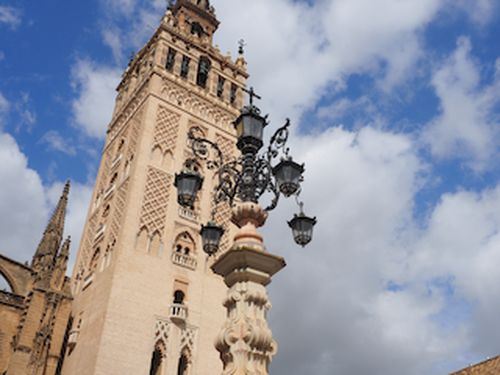
Over the centuries, the cathedral underwent multiple transformations: new chapels for confraternities, additions linked to evolving liturgical practices after the Council of Trent, and the installation of artworks by leading Spanish and Flemish artists. The Giralda was altered in the late sixteenth century with the addition of a Renaissance lantern topped by the Giraldillo, turning the tower into a fusion of Islamic foundations and Christian triumphal symbolism.
Throughout wars, political upheavals and social changes, the cathedral retained its role as a centre of authority. During the Napoleonic occupation, some artworks were removed or threatened, though the building escaped large-scale destruction. In the twentieth century, conflicts such as the Spanish Civil War prompted preventive conservation, though the cathedral remained structurally intact.
Global Context and Monumental Dynamics
Seville Cathedral was erected during a period of widespread monumental construction in Europe. While Gothic cathedrals had flourished in France, Germany and England, Spain maintained a strong attachment to the style even as Renaissance ideas spread. The decision to build a fully Gothic structure in the early fifteenth century, when the Renaissance was already emerging in Italy, attests to the persistence of local traditions and the political value of architectural grandeur rooted in medieval forms.
The cathedral’s construction parallels broader transnational exchanges: artistic imports from Flanders and Italy; the influence of Islamic aesthetics inherited from centuries of coexistence; and financial support fuelled indirectly by colonial expansion. The edifice thus stands at the intersection of Mediterranean cultural exchange, Christian liturgical evolution and early globalisation.
Transformations and Changing Uses
Beyond its initial Gothic conception, the cathedral has continually adapted. Chapels were refitted to house important burials or confraternity altars. Baroque additions enriched spaces with sculpted retables, dynamic façades and elaborate furnishings. Renaissance interventions, particularly in sacristies and some portals, introduced classical orders and proportions.
The Giralda’s evolution is emblematic of these layered transformations. Originally a twelfth-century minaret with a system of ramps allowing ascent on horseback, it became a Christian bell tower and later a hybrid architectural monument combining Almohad engineering with Renaissance and Baroque crowns.
Urban evolution also shaped the cathedral’s environment. Medieval street patterns gradually opened to create plazas that offered better visibility of the monument. In the nineteenth and twentieth centuries, urban modernisation altered circulation routes and intensified the area’s civic and touristic activity.
Contemporary Role and Cultural Importance
Today, Seville Cathedral is a central symbol of Andalusian identity. It remains an active religious centre, especially during Holy Week, when processions and ceremonies attract large crowds and reinforce the monument’s spiritual significance. The cathedral is also a museum of Spanish art and craftsmanship, containing works by Murillo, Goya, Pedro de Campaña and numerous sculptors, painters and artisans whose creations span several centuries.
Its role as a cultural landmark extends beyond its architectural and artistic importance. It is a key economic driver through tourism and appears frequently in literature, cinema, music and visual arts. The cathedral functions as a memory site linking Islamic, Christian and global histories, and reflects the composite identity of Seville.
Its inscription by UNESCO as part of the World Heritage ensemble that includes the Alcázar and the Archivo de Indias emphasises its international significance and ensures the application of rigorous conservation policies.
Conservation Status and Modern Challenges
Preserving a monument of such scale and complexity presents considerable challenges. The cathedral’s stone surfaces — limestone and sandstone — suffer from urban pollution, biological growth and weathering. Variations in humidity and temperature affect wooden elements, while metallic components risk corrosion.
Tourism, while essential to the local economy, accelerates wear on pavements, chapels and artworks. Vibrations from traffic and nearby urban activity can pose long-term structural risks. Conservation teams employ advanced diagnostic tools, including laser scanning, material analysis and structural monitoring, to document and mitigate deterioration.
Restoration efforts focus on cleaning façades, reinforcing vaults, conserving altarpieces and ensuring the stability of the Giralda. Coordination between ecclesiastical authorities, heritage specialists and civil institutions is crucial to maintaining the monument’s integrity.
Conclusion
Seville Cathedral encapsulates centuries of political ambition, artistic innovation and cultural dialogue. From its origins as a mosque to its transformation into a Gothic and later multi-stylistic Christian monument, it mirrors the history of Andalusia — a region shaped by conquest, coexistence and global exchange. Its vast scale, symbolic power and continued religious function make it one of Europe’s most significant cathedrals and a lasting testament to the social and artistic forces that shaped the medieval and early modern world.
Architecture of Seville Cathedral
Seville Cathedral, dedicated to Saint Mary of the See, is one of the largest Gothic churches in the world and a key example of how medieval engineering, regional traditions and later artistic currents were combined into a single monumental ensemble. Built from the early fifteenth century onwards on the site of the former Almohad Great Mosque, it preserves traces of its Islamic predecessor while asserting a new Christian identity through its scale, structure and decorative programme. Its architecture is the result of several centuries of building campaigns, adjustments and restorations, each leaving a distinct imprint on the fabric of the monument.
Technological and architectural innovations
When the project was launched at the beginning of the fifteenth century, Gothic building technology was already highly developed. The master masons of Seville took advantage of this maturity to push dimensions to an exceptional degree. The design uses a sophisticated system of pointed arches, rib vaults and flying buttresses to cover an enormous internal volume while maintaining stability. The height of the central nave and the breadth of the five-aisled plan required careful calculation of loads and thrusts, reflected in the massive piers and the intricate pattern of ribs.
The vaulting exhibits a variety of patterns, from simple quadripartite divisions to more complex star and net vaults. These systems not only have a structural function, distributing weight toward the supports, but also shape the visual rhythm of the interior. The builders refined the geometry of the ribs to achieve a balance between structural efficiency and aesthetic effect, a hallmark of late Gothic design.
Ventilation and lighting were also addressed through architectural means. High clerestory windows, filled with stained glass, admit filtered daylight that softens the vast interior, while the great overall height allows warm air to rise, fostering a more temperate environment in the hot Andalusian climate. The combination of substantial wall thickness, deep openings and tall volumes reveals an awareness of environmental conditions and an adaptation of northern Gothic principles to southern realities.
At the urban scale, the cathedral’s mass was integrated into the dense medieval fabric by preserving the basic orientation and footprint of the former mosque, yet expanding its vertical and horizontal presence. The building was conceived as a dominant volume, visible above the surrounding roofs and structuring the network of streets and plazas around it.
Materials and construction methods
The primary material of the cathedral is stone, mainly limestone and sandstone quarried in the region. These stones were chosen for their resistance and relative ease of carving, essential for the elaborate portals, tracery and sculptural details that characterise the façades and interior. Harder varieties were reserved for zones subject to greater mechanical stress, such as piers, arches and the lower parts of walls.
Timber plays a crucial role in the roof structures, floors of upper galleries and many fittings. The trussed roofs are designed to distribute loads efficiently while allowing slight movement, an important feature in an area where minor seismic events are not unknown. In the interior, carved wood appears in choir stalls, pulpits and decorative screens, reflecting the high level of craftsmanship and, in some cases, the persistence of Mudéjar woodworking traditions.
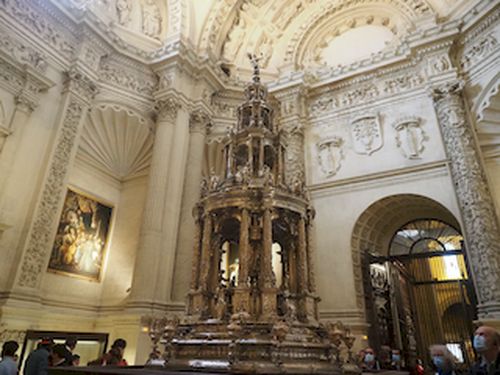
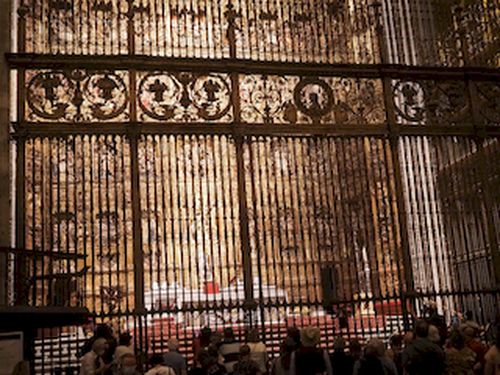
Metal is used for structural reinforcements, railings, grilles and the mechanical components of the bells. Wrought-iron screens separate certain liturgical spaces and chapels, combining functional enclosure with intricate decorative patterns. Bronze and other metals are employed in doors, fittings and the Giraldillo, the large bronze figure crowning the Giralda tower.
Building such a vast structure required well-organised construction techniques. Modular scaffolding, reusable lifting devices and standardised stone-cutting procedures enabled a relatively continuous progression of the works, despite interruptions caused by external events. The precision of the masonry and the regularity of the joints demonstrate the effectiveness of this construction organisation.
Architectural and artistic influences
Although Seville Cathedral is fundamentally a Gothic structure, its architecture reflects a complex mixture of influences. The spatial conception of the interior—very wide, with five naves and a high central vessel—is related to Iberian interpretations of Gothic, where breadth and monumental scale often predominate over extreme verticality. French and English cathedrals provided models for structural solutions, but they were adapted to local liturgical needs and climatic conditions.
The most striking example of layered influence is the Giralda. Originally the minaret of the twelfth-century Almohad mosque, it was retained and transformed into a bell tower. Its internal system of ramps, broad enough for horsemen to ascend, represents a sophisticated piece of Islamic engineering, while the addition of a Renaissance lantern and the Giraldillo in the sixteenth century gives the tower a new Christian symbolic and formal identity. The juxtaposition of Almohad masonry and classical elements makes the Giralda one of the most distinctive towers in Europe.
Renaissance and Baroque interventions are visible in sacristies, chapels, façades and interior furnishings. Classical orders, pediments and balanced proportions appear in some portals and annexes, while Baroque altarpieces, pulpits and sculptural ensembles enrich the visual density of the interior. Imported works and styles from Flanders and Italy, as well as local Andalusian traditions, contributed to a highly diversified but coherent artistic environment anchored in the overarching Gothic structure.
Organisation and spatial structure
The cathedral’s plan is organised around five longitudinal naves, intersected by a relatively shallow transept. The central nave, considerably higher than the others, serves as the main processional axis and visual focus. The side aisles house a series of chapels that run along the length of the building, each with its own patronage, iconography and artistic programme.
The choir occupies a central position beneath some of the highest vaults, enclosed by elaborately carved wooden stalls and separated from the surrounding space by sculpted screens. This arrangement reflects post-medieval liturgical practice in Spain, placing the clergy and choral functions at the heart of the building rather than directly in front of the high altar, as in many northern cathedrals.
Radiating chapels around the chevet, lateral chapels along the aisles, sacristies and chapter rooms create a complex network of spaces, each adapted to specific uses: private devotion, burials of important figures, confraternity activities and administrative functions. The sacristy and treasury rooms, often decorated in Renaissance style, underscore the administrative and ceremonial role of the cathedral as an institution.
Dimensions, statistics and notable anecdotes
Seville Cathedral is approximately 135 metres long and around 100 metres wide, with internal vaults rising to more than 40 metres in height. These dimensions make it one of the largest Gothic churches in the world by volume. The Giralda, including its later additions, reaches more than 100 metres, dominating the skyline of the historic centre.
The high altar is backed by a massive carved and gilded retable that covers an entire wall, composed of numerous panels illustrating scenes from the life of Christ and the Virgin. This retable is often cited as one of the most extensive and complex in Europe, reflecting both artistic ambition and the financial resources available during Seville’s golden age.
A well-known anecdote describes the determination of the cathedral chapter to surpass all existing churches in grandeur, encapsulated in the statement that they aimed to build a church so large that those who saw it would think them mad. Whether or not this phrase was actually spoken as recorded, it effectively summarises the mindset behind the project.
International recognition and conservation issues
Architecturally, Seville Cathedral is significant because it embodies the culmination of Gothic building in the Iberian Peninsula, layered with Renaissance and Baroque additions and integrated with a major example of Islamic architecture in the Giralda. Its scale, structural sophistication and artistic richness make it a reference point for the study of late medieval and early modern ecclesiastical architecture.
Today, the building faces numerous conservation challenges linked to its materials and urban context. Stone surfaces are affected by air pollution, biological growth and the natural effects of weathering. Wooden structures must be protected against humidity, insect activity and climatic fluctuations. Metal elements are vulnerable to corrosion. The heavy flow of visitors, essential to the cathedral’s economic sustainability, accelerates wear on floors, steps and fittings.
Restoration programmes focus on consolidating vaults, reinforcing structural elements where necessary, cleaning and protecting façades and sculptures, and conserving interior artworks. Modern diagnostic techniques, such as laser scanning, structural monitoring and laboratory analysis of materials, support these efforts and inform decisions about interventions.
Seville Cathedral thus stands not only as a masterpiece of Gothic architecture but also as a living monument, continuously negotiated between historical authenticity, liturgical function, cultural representation and the practical demands of preservation in a dense, dynamic urban environment.