

 Français (France)
  Nederlands (nl-NL)
 The church of Camp Pintade is a place of worship located in the village of Camp Pintade on Rodrigues Island, part of the Republic of Mauritius. It represents an important landmark in the social and religious organization of this island community. The building plays a central role in collective practices, particularly during liturgical celebrations and local gatherings. Through its presence, it reflects the significance of religion in daily life on Rodrigues and contributes to shaping social interactions within the village, in connection with widely practiced Christian traditions in the region.

Camp Pintade • Church of Camp Pintade
Camp Pintade • Church of Camp Pintade

Camp Pintade • Church of Camp Pintade
Monument profile
Church of Camp Pintade
Monument category: Church
Monument family: Church, cathedral, basilica, chapel
Monument genre: Religious
Cultural heritage: Christian
Geographic location: Camp Pintade • Rodrigues • Mauritius
Construction period: 21th century AD
• Links to •
• List of videos about Port Mathurin on this site •
Rodrigues, the runaway ibex • Rodrigues, Mauritius
Rodrigues • Indian Ocean island
History of the Church of Camp Pintade
Context of foundation
The Church of Camp Pintade, also known as the Chapel of Saint John the Evangelist, was built in 2012 to meet the spiritual needs of a growing population in the localities of Baie Topaze and Camp Pintade, on Rodrigues Island. This development is part of a recent phase of territorial planning on Rodrigues, characterized by the intention to bring places of worship closer to residents and to strengthen parish life at a local level.
The chapel belongs to the Saint-Esprit parish and falls under the Apostolic Vicariate of Rodrigues, the ecclesiastical structure that organizes and oversees religious life on the island. Its creation does not follow a missionary logic, as was the case during colonial periods, but rather responds to the pastoral support of a community already largely structured around the Christian faith.
From the outset, the management of the church was entrusted to a local committee composed of faithful members from various parish movements. This participatory organization reflects a common model in Rodrigues, where communities play an active role in managing collective facilities. It also demonstrates a clear intention to anchor the building sustainably in the daily life of residents by encouraging their direct involvement in its functioning.
Establishment and structuring of religious life
Since its opening, the Church of Camp Pintade has gradually integrated into the rhythm of local religious life. The weekly celebration of Mass, generally held on Saturday afternoon, constitutes a central moment of gathering for residents of the area. In addition, regular times of prayer and adoration are organized on a monthly basis.
The functioning of the chapel relies on close coordination between the clergy and members of the local committee. The latter meets periodically to ensure maintenance of the building, preparation of celebrations, and management of associated activities. This organization allows for continuity in the use of the site while adapting its functioning to local realities.
The church also plays a role in accompanying major stages of life for residents, particularly through baptisms, weddings, and funeral ceremonies. It is thus part of a cycle of religious practices that structure social life and reinforce community bonds.
Recent evolution and adaptation to local needs
As a recent structure, the Church of Camp Pintade has not undergone major transformations linked to historical or political changes. Its evolution is instead characterized by gradual adjustments aimed at improving its functioning and reception capacity.
Regular maintenance of the building is a priority for the community, particularly due to the climatic conditions specific to Rodrigues, such as humidity and winds. Adaptations may be carried out to reinforce the durability of the structure or to facilitate its use during gatherings.
The development of the village and demographic changes also influence attendance at the chapel. Nevertheless, it retains a scale that remains adapted to its environment, in direct relation to the needs of local residents.
Role in memory and local identity
Despite its recent construction, the Church of Camp Pintade already occupies an important place in the collective memory of the area. It serves as a reference point for residents and a place where significant moments of community life take shape.
Its role extends beyond strictly religious functions. It operates as a space for gathering and exchange, contributing to social cohesion in an insular environment where close relationships are essential. The active participation of residents in its management reinforces this sense of collective ownership.
The church also reflects the vitality of Christianity on Rodrigues, where religious practices remain deeply rooted in everyday life. It is part of a network of places of worship distributed across the island, each playing a similar role within its respective community.
Contemporary challenges and perspectives
The challenges associated with the Church of Camp Pintade mainly concern its long-term sustainability and its adaptation to future community developments. The maintenance of the building depends on the commitment of residents and their ability to ensure regular upkeep.
The environmental conditions of Rodrigues require constant vigilance, particularly regarding the effects of climate. However, the use of modern construction techniques offers greater resistance than that of older buildings.
The church is not subject to international heritage classification, but it belongs to a form of living heritage. Its value lies primarily in its daily use and in the role it plays in structuring the social life of the village.
Thus, the history of the Church of Camp Pintade illustrates a contemporary dynamic in which places of worship continue to evolve according to the needs of local communities, while maintaining their essential function of gathering, transmission, and cohesion.
Architecture of the Church of Camp Pintade in Rodrigues
A contemporary architecture based on form and climate
The Church of Camp Pintade stands out through a contemporary architectural approach characterized by a strong formal exploration, which remains uncommon among religious buildings on Rodrigues Island. Built in 2012, it does not belong to an older monumental tradition but rather to a modern approach in which the form of the building becomes the central element of its identity.
The most striking feature is its roof, which adopts a curved and asymmetrical silhouette, evoking a shell, a sail, or a structure inspired by natural forms. This geometry is not purely aesthetic: it also responds to local climatic constraints, particularly prevailing winds and heavy rainfall. The pronounced slope allows rapid water drainage, while the enveloping shape protects the lateral walls.
This approach reflects an architecture adapted to an insular context, where functionality and resistance to natural conditions take precedence over monumentality.
Materials and construction techniques
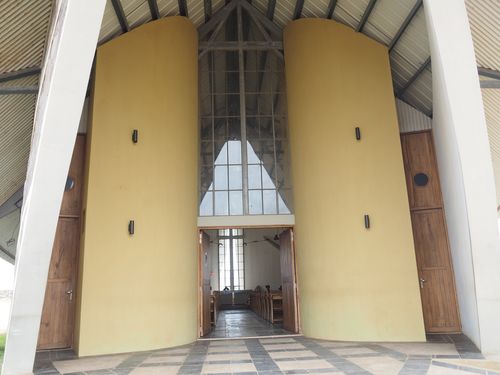
The building is based on a combination of modern and local materials. The main structure consists of a concrete and metal framework, ensuring the stability of the whole. This framework remains visible, particularly through the inclined load-bearing elements that follow the curvature of the building and contribute to its visual expression.
The lateral walls incorporate masonry made of local stone, likely basalt, which visually anchors the church in its environment. This choice creates a contrast with the smooth surfaces of the structural elements and reinforces landscape integration.
The roof is composed of lightweight metal sheets fixed onto an exposed framework. This type of covering is common in tropical regions due to its lightness and resistance to weather conditions. It also makes it possible to span large areas without requiring massive structural systems.
Architectural influences and aesthetic expression
The church does not directly adopt the traditional codes of European religious architecture. Instead, it aligns with a contemporary trend in which religious buildings adopt abstract and symbolic forms.
The roof, as the dominant element, can be interpreted as a reference to protection or shelter, while also reflecting adaptation to the open landscapes of Rodrigues. The absence of elaborate ornamental decoration reinforces this interpretation: the identity of the building relies on its lines and volumes rather than on decorative elements.
The bell tower, separated from the main building and reduced to a simple metal structure topped with a cross, also illustrates this simplification. It fulfills a symbolic function without attempting to compete with the main composition.
Spatial organization and interior structure
The interior of the church reflects the external logic: a single, open, and clearly legible space. The nave is organized longitudinally, with rows of wooden benches oriented toward the altar. This classical arrangement is adapted to a simplified architectural framework.
The roof structure is visible from the inside, with an exposed metal framework that follows the curvature of the roof. This structural transparency contributes to the identity of the space by highlighting load-bearing elements rather than concealing them.
Natural light plays an important role. A vertical opening located behind the altar creates a luminous focal point, while lateral strip windows allow for an even distribution of light. This combination enhances the clarity of the space and creates a restrained atmosphere.
Natural ventilation is ensured through these openings, in accordance with local climatic conditions. The absence of visible technical devices confirms a design based on passive principles.
Notable features and singularities
The main singularity of the church lies in its overall form, which is unusual for a religious building of this scale. The curvature of the roof, combined with an asymmetrical structure, creates a silhouette that is immediately identifiable within the landscape.
The inclined load-bearing elements, visible on the façade, play a dual role: structural and aesthetic. They reinforce the dynamic character of the building and emphasize its sense of movement.
The integration into the site is also noteworthy. The church is set on a slight elevation and surrounded by a low stone wall that defines the space without completely enclosing it. This open relationship with the landscape corresponds to the scale of the village and its environment.
Recognition and conservation issues
The Church of Camp Pintade does not fall within the category of traditional monumental heritage, but it presents local architectural interest due to its contemporary design. It illustrates an evolution of religious forms in an insular context, where technical and environmental constraints directly influence design.
Conservation issues are mainly related to the materials used. The metal roofing and exposed structure require regular maintenance, particularly in an environment subject to humidity and sea winds. Concrete and stone elements must also be monitored to prevent climate-related deterioration.
As a recent building, the church is not confronted with major restoration challenges but rather with issues of maintenance and durability. Its value lies primarily in its use and in the quality of its architectural design.