

 Français (France)
  Nederlands (nl-NL)
 Saint Gabriel Cathedral is a major religious building located in the village of Saint Gabriel on Rodrigues Island, a dependency of the Republic of Mauritius. It serves as one of the principal centers of Catholic worship on the island and plays a key role in local religious organization. The building is closely linked to community life, hosting services, ceremonies, and important gatherings within the liturgical calendar. Through its institutional significance and regular use, the cathedral functions as a central landmark for residents, reflecting the presence and role of Catholicism in contemporary Rodriguan society.
Monument profile
St. Gabriel Cathedral
Monument category: Church
Monument family: Church, cathedral, basilica, chapel
Monument genre: Religious
Cultural heritage: Christian
Geographic location: Saint Gabriel • Rodrigues • Mauritius
Construction period: 20th century AD
• Links to •
• List of videos about Port Mathurin on this site •
Rodrigues, the runaway ibex • Rodrigues, Mauritius
Rodrigues • Indian Ocean island
Saint Gabriel Cathedral in Rodrigues: construction and role within local society
Construction context and organization of the project
Saint Gabriel Cathedral, located in the village of Saint Gabriel on Rodrigues Island, was built between 1936 and 1939. Its construction took place within a context of consolidation of Catholic presence on the island, which was then under British colonial administration but strongly structured by Mauritian Catholic institutions.
The decision to build a large-scale place of worship responded to population growth and to the need for a central religious space. The construction process relied heavily on local participation. Materials were sourced from different parts of the island and transported manually, reflecting a collective effort that directly linked the building to the community.
Commissioning and continuity of use
The consecration of the cathedral in 1939 marked the completion of the construction phase. From that date, the building has been used continuously as the main Catholic place of worship on Rodrigues. Its parish function has not undergone significant change, indicating a stable and uninterrupted use.
The absence of functional transformation distinguishes the building from other comparable structures. The cathedral has retained its original purpose without interruption, reinforcing its central role in the religious organization of the island.
Religious and social function
Saint Gabriel Cathedral serves as a central institution within the religious life of Rodrigues. It hosts major liturgical celebrations and functions as a reference point for ecclesiastical authority on the island.
Beyond its liturgical role, the building has also served as a gathering place for collective events, particularly before the island obtained administrative autonomy in 2002. This extended use highlights its importance in local social organization without altering its primary religious function.
Restoration and current condition
The cathedral has undergone periodic restoration work aimed at preserving its structure against local climatic conditions. These interventions have primarily concerned the roof and exterior finishes, which are exposed to degradation caused by tropical weather and cyclones.
These works have not altered the building’s overall configuration. Conservation efforts focus on maintaining original characteristics while ensuring long-term durability. The current condition reflects this continuity, with a preserved structure and ongoing use.
Global historical context
The construction of the cathedral in the 1930s coincides with a period marked by the global economic crisis and political transformations in Europe. At the same time, colonial territories experienced the development of structured administrative and religious institutions. Maritime networks facilitated the circulation of materials and institutional models, enabling construction projects in remote island environments.
Saint Gabriel Cathedral in Rodrigues: spatial organization and construction features
Site placement and plan organization
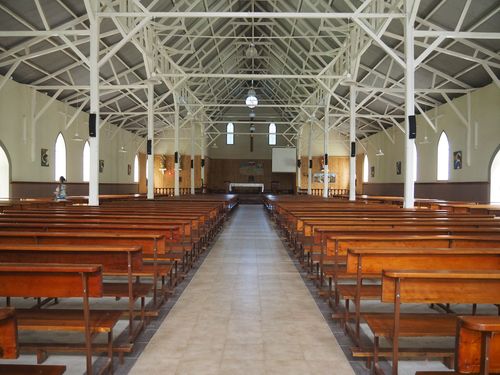
Saint Gabriel Cathedral is located within the village of the same name, on an open site that allows clear visibility of the building. The structure follows a simple longitudinal plan, organized along a central axis connecting the entrance to the chancel. This linear configuration defines both the external form and the internal circulation.
The building presents itself as a single, unified volume, without extensive annexes. The absence of developed peripheral structures reinforces the clarity of the main nave. The surrounding open space allows functional extension during large gatherings without requiring additional architectural elements.
Construction techniques and materials
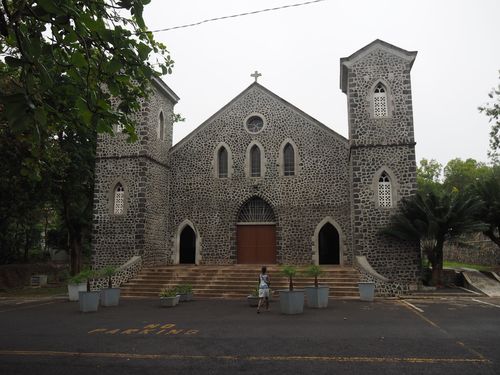
The structure is based on load-bearing masonry walls constructed from locally sourced materials. Volcanic stone combined with coral mortar forms a solid envelope capable of withstanding local climatic conditions. The thickness of the walls contributes to structural stability and thermal regulation.
The roof structure is made of timber and supports a pitched roof designed for efficient rainwater drainage. Construction techniques reflect local resource availability and the community-based nature of the project. The combination of materials and methods emphasizes durability and practical execution.
Interior spatial organization
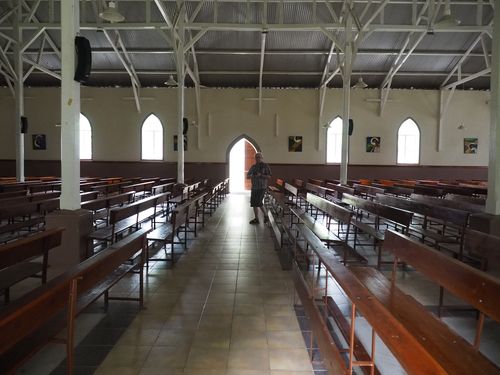
The interior is dominated by a wide single nave designed to accommodate a large congregation. This configuration allows direct visibility toward the altar, positioned along the main axis. The chancel forms the focal point without complex spatial separation.
Openings along the lateral walls are arranged regularly, ensuring even distribution of natural light. The absence of aisles or developed side chapels simplifies circulation and reinforces spatial continuity. The interior organization prioritizes clarity and functional use.
Architectural elements and formal expression
The main façade is symmetrically organized around a central entrance. The composition emphasizes vertical alignment and structural clarity. A bell tower, either integrated into or attached to the façade, provides a dominant vertical reference within the surrounding landscape.
Exterior surfaces remain restrained, with limited ornamentation. Openings are evenly spaced along the side elevations, creating a consistent rhythm. Simplified neoclassical elements appear in the symmetry and geometric clarity of the volumes.
The overall massing reflects a simple hierarchy, with the main nave dominating the composition. Variations in roof height correspond directly to internal spatial organization.
Modifications and architectural preservation
Interventions have primarily focused on maintaining exposed elements such as the roof and external finishes. These works respond to deterioration caused by tropical weather conditions, particularly cyclones.
Restorations have not altered the original architectural configuration. Conservation efforts aim to preserve original materials and construction techniques. This approach ensures structural continuity while maintaining the building’s long-term stability.