

 Français (France)
  Nederlands (nl-NL)
 The Pak Ou Caves, located in Ban Pak Ou in Laos, are a long-established Buddhist pilgrimage site. They hold an exceptional collection of Buddha statues placed there over generations by monks and lay worshippers. The site reflects enduring religious practice and a strong symbolic meaning shared by local communities and visitors. Reached by boat along the Mekong River, the caves are part of traditional circuits of devotion and continue to attract travellers seeking insight into Lao culture. Their significance lies in the link between landscape, spirituality and identity, making them an important reference within the country’s living heritage.


Monument profile
Pak Ou Caves
Monument categories: Pagoda, Rock Sanctuary
Monument families: Rock Sanctuary and Monumental Bas-reliefs • Pagoda or stupa
Monument genres: Religious
Cultural heritage: Buddhist
Geographic location: Ban Pak Ou • Laos
Construction period: 16th century AD
• Links to •
• List of videos about Ban Pak Ou on this site •
Pak Ou caves, Ban Pak Ou • Tham Ting and Tham Theung caves • Laos
History of the Pak Ou Caves, Ban Pak Ou, Laos
The Pak Ou Caves, positioned where the Mekong meets the Ou River, constitute one of Laos’ most enduring sacred landscapes. Their development from natural cavities into revered sanctuaries reflects the complex interplay between religion, monarchy, community practices and territorial identity. Far from being static formations, they represent a layered historical archive that mirrors political shifts, regional conflicts and evolving devotional patterns across several centuries.
Early Sacred Significance and Royal Appropriation
The caves are believed to have held ritual significance long before written records. Communities living along the river associated such places with spirits tied to water, fertility and ancestral power. When the Kingdom of Lan Xang consolidated during the fifteenth and sixteenth centuries, rulers sought sites capable of expressing their legitimacy and shaping shared devotion. The Pak Ou Caves offered a natural focus already imbued with symbolic value, making them an ideal location for royal patronage.
By promoting the placement of Buddha images inside the caves, kings not only affirmed their Buddhist credentials but also integrated pre-existing beliefs into a state-oriented cosmology. This sacralisation aligned religious practice with political authority: the caves became visible statements of the monarchy’s ability to protect and sanctify the land.
Political Context, Alliances and Identity
Lan Xang’s rulers managed a territory marked by diverse ethnic groups and rival political centres in Siam, Vietnam and Burma. Religious landscapes acted as sites of negotiation and allegiance. The choice to support Pak Ou as an official pilgrimage site reflected broader state strategies of unification and symbolic control.
The Mekong was a communication artery linking alliances, trade routes and spheres of political influence. Processions to Pak Ou by royal and monastic groups functioned as demonstrations of presence in contested space. Pilgrimage rituals echoed those in neighbouring kingdoms where monarchs also tied their legitimacy to Buddhist patronage. Pak Ou therefore illustrates how architecture and natural features were mobilised in geopolitical theatres.
Dynastic Change and Enduring Sanctity
The fragmentation of Lan Xang in the eighteenth century did not diminish the site’s importance. Local princely houses, Siamese authorities and later colonial administrators all recognised the symbolic capital of the caves. Rather than dismantling the sanctuary, successive powers incorporated it within their own frameworks of prestige and religious obligation.
During the nineteenth century, foreign observers encountered the caves and described them as repositories of Buddhist imagery. While their accounts introduced Pak Ou to external audiences, internal ritual dynamics continued. Offerings persisted, and images accumulated as visual proof of historical continuity.
Twentieth Century Upheavals and Transformation
The twentieth century brought wars, revolutions and ideological realignments. The conflict in Indochina and the establishment of a socialist state in 1975 altered the relationship between institutional religion and government. Yet Pak Ou survived as a tolerated and later valued heritage site. Its significance as an expression of Lao identity encouraged authorities to preserve its ritual function rather than suppress it.
This period also marks increasing tourist interest. The caves shifted from a purely devotional centre to a dual-status space: a pilgrimage site and a cultural attraction. Monks, villagers and officials navigated the new demands imposed by foreign visitation, balancing reverence with exhibition.
Context Within Global Monumental Traditions
The transformation of a natural cavern into a ritual monument aligns with broader patterns found across Asia. From Myanmar and Thailand to Sri Lanka and India, caves were appropriated by Buddhist communities as enclosed sanctuaries or meditation spaces. Pak Ou participates in this lineage, yet differs by its cumulative mode of construction: rather than carved reliefs or frescoes, its significance lies in thousands of deposited statues, each a trace of individual or institutional devotion.
More universally, Pak Ou exemplifies a type of memorial architecture where human intervention uses space rather than mass. This approach parallels developments in medieval Christian shrines, Islamic cave sanctuaries or Tibetan hermitages, demonstrating a global phenomenon of sacred natural architecture.
Physical Alterations and Shifts in Use
Over time, the caves underwent minimal but targeted modifications. Stairs were repaired or widened, balustrades were added to secure steep approaches, and platforms were adapted to support statues and ritual practices. These interventions reflected the need to stabilise the terrain while preserving the caves’ natural integrity.
Periods of reduced maintenance corresponded with political turmoil, but the site generally avoided decline due to continuous community engagement. In recent decades, new issues emerged: organising statue deposits, preventing overcrowding of votive niches and reconfiguring circulation for safety. Today, subtle management efforts aim to retain the sanctity of space without fossilising its living nature.
Cultural Role and Contemporary Identity
Pak Ou remains deeply integrated in Lao religious life. Families and monks visit during the Lao New Year or other ceremonial times to offer statues, candles and prayers. These acts contribute to an ever-expanding sacred landscape, reinforcing the idea of Pak Ou as a living reliquary.
Beyond faith, the caves function as emblematic markers of national identity. They embody themes central to Lao cultural narratives: Buddhism, river geography, ritual continuity and kingship memory. The pilgrimage journey by river amplifies their iconic value, framing them as places where nature and devotion converge.
For international visitors, Pak Ou has become one of the most recognisable heritage attractions in northern Laos. The site’s visibility, supported indirectly by Luang Prabang’s World Heritage status, reinforces its symbolic worth.
Conservation Challenges and Management
Preserving Pak Ou involves balancing multiple pressures. Environmental threats include fluctuating humidity, mineral erosion, candle soot and wax accumulation. Tourism intensifies physical wear on staircases, platforms and delicate statues. The riverbank, periodically affected by hydrological changes, complicates access and stability.
Local religious authorities and government agencies implement maintenance measures: controlled cleaning, selective repositioning of statues and reinforcement of access structures. Formal protection initiatives recognise the caves’ cultural significance, yet their integration into a living ritual system complicates any attempt to freeze them in time. Conservation thus requires respect for ongoing devotional practices while limiting damage from overuse.
Conclusion
The Pak Ou Caves illustrate how architecture and history merge in places shaped more by ritual than construction. Their evolution reflects regional politics, religious patronage and community practice. Over centuries, they accumulated the material evidence of thousands of individual acts of devotion, becoming a monumental yet intangible archive of Lao culture. Today, their survival demands a delicate equilibrium between sacred function, heritage preservation and visitor expectations. In this sense, Pak Ou continues to grow, not through new stonework, but through acts of remembrance that sustain its meaning.
Architecture of the Pak Ou Caves: shaping sanctity within stone
The Pak Ou Caves at Ban Pak Ou illustrate an unusual form of sacred architecture in which human intervention organises rather than replaces nature. Instead of erecting a monumental complex, generations of monks, pilgrims and artisans adapted limestone cavities into a structured sanctuary. The physical construction is discreet, but the layering of access ways, platforms, balustrades and countless statues produces a distinctive architectural identity in which the caves themselves are the main envelope.
Spatial organisation and circulation
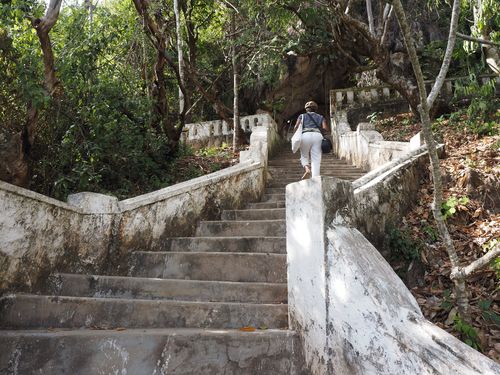
The ensemble is structured around two principal spaces: the lower cave, Tham Ting, and the upper cave, Tham Theung. Access begins at a riverside landing, where boats moor before visitors ascend via a broad stairway carved into or built against the cliff. This stairway acts as the main architectural gesture, linking the river to the ritual zone through terraces that provide both rest points and orientation.
Tham Ting functions as a threshold interior: daylight penetrates the chamber, and circulation is guided by masonry bases, benches and natural ledges adapted to hold statues. The upper cave lies higher and deeper inside the rock. Reached by a narrower, steeper stairway, it offers a darker, more meditative setting where clusters of images occupy recesses around uneven rock surfaces. The ascent thus reinforces a symbolic progression: from public entry ritual to intimate contemplation.
Materials and construction techniques
Pak Ou’s primary “material” is its natural limestone mass. Human additions are mostly limited to masonry steps, retaining walls, platforms and statue plinths. Builders relied on readily available materials such as fired bricks, river stones, lime mortar and timber. Their restrained use reflects both availability and an understanding of environmental challenges, including humidity, unstable terrain and fluctuating water levels.
Stairs typically consist of brick or stone treads bonded by lime mortar. Platforms are either carved from the bedrock or filled and retained by low walls. Wooden elements appear in rails, offertory tables and small installations, but they seldom dominate the space. Whitewashed surfaces provide visual clarity and durable, breathable protection.
These modest construction techniques demonstrate pragmatic knowledge: flexible materials allow constant adjustment, surfaces tolerate moisture, and repairs can be carried out with local skills. Pak Ou architecture thus exemplifies maintenance-based building rather than once-for-all construction.
Adaptation to environment, stability and ventilation
Because the caves are pre-existing voids, architectural innovation lies in environmental management. The main staircase was positioned to resist seasonal flooding and remain serviceable under wet conditions. Slight tread inclinations limit pooling, and parapets improve safety.
Inside, limestone vaults provide structural stability. Human intervention concentrates on the interface between ritual objects and natural surfaces. Masonry plinths elevate statues above damp ground, while retaining edges limit erosion or slipping. Ventilation remains largely natural: the lower cave’s opening and cracks within the rock allow airflow that mitigates condensation. Light follows the same principle—daylight illuminates areas near the entrance, while deeper zones use candlelight, shaping an intimate, layered atmosphere.
Artistic and stylistic influences
Although the caves are not monumental buildings, their architecture is inseparable from their artistic content. Thousands of Buddha statues, deposited over centuries, form a cumulative decorative system. These statues reflect a mix of influences: Lao proportions, Siamese stylistic gestures, occasional Khmer echoes and traces of Burmese or Vietnamese aesthetics. The range of iconographic postures—standing blessing figures, meditating seated Buddhas and smaller devotional pieces—creates a sculptural tapestry that substitutes for carved ornamentation.
Spatial organisation also resonates with Southeast Asian cave sanctuaries. The progression from illuminated antechamber to dim inner domain parallels ritual architecture elsewhere in the region, though Pak Ou relies on the density of objects rather than wall-carving or fresco cycles. Its decoration emerges through repetition rather than monumentality, emphasising collective devotion rather than elite artistry.
Distinctive structural and sensory features
Several aspects distinguish Pak Ou from similar sites. First is its direct river approach: the cliffs and cave openings present themselves immediately, giving the stairway an axial processional meaning akin to access routes to hilltop stupas. Second is the extraordinary density of statuary in relatively modest volumes, transforming limited space into a field of sculptural presence.
Third is the dual-cave organisation. Tham Ting serves as a public arena with greater visibility and open light, while Tham Theung, darker and more confined, functions as a contemplative chamber. This hierarchy is expressed without imposing built forms; the transition itself becomes architectural.
Sound, scent and shadow contribute to architectural experience. Candle smoke darkens ceilings, incense leaves fragrance, and dripwater shapes rock forms. These sensory layers subtly form part of the architectural character, revealing how use, rather than masonry, shapes the caves.
Dimensions, numbers and anecdotes
Exact measurements vary, but the lower cave stretches tens of metres into the cliff, while the upper cave reaches deeper, with higher, irregular ceilings. The number of Buddha statues—commonly counted in the thousands—is one of the site’s most notable attributes. These range from miniature wooden figures to larger images near human size.
A frequently mentioned tradition claims some statues were donated by Lan Xang rulers or local nobles, linking the site architecturally to royal patronage. Families and villages also return repeatedly to place new images, making the caves a visible chronicle of devotion embedded in the architecture.
Evolution, recognition and conservation challenges
Although modest in structure, the architecture of Pak Ou is central to its heritage value. It embodies a Southeast Asian model where sacred space emerges from environmental adaptation. Its position within the cultural landscape of Luang Prabang strengthens its international importance.
Conservation concerns stem from materials and location. Limestone is vulnerable to water damage; brick and mortar erode under heavy footfall; timber suffers from insect decay. Tourism exerts pressure on steps, platforms and delicate statuary. Candle smoke, wax deposits and incense fumes accumulate, requiring continuous cleaning. Hydrological changes along the Mekong threaten access points.
Recent management strategies focus on stabilising access structures, regulating visitor flows and reorganising statue displays to avoid overcrowding. Repairs are subtle to preserve the layered character of the space. The challenge is to protect a living sanctuary without freezing it, acknowledging that its architecture evolves in response to use.
Conclusion
The Pak Ou Caves represent an architectural paradigm where sanctity grows outward from nature rather than being imposed upon it. Their significance lies not in monumental construction but in incremental shaping—stairs adjusted, platforms stabilised, statues added. This evolving architecture reveals deep knowledge of environment, ritual movement and symbolic value. Pak Ou is therefore a sanctuary continually built through acts of devotion, in which architecture is less a finished object than a process sustained across generations.