

 Français (France)
  Nederlands (nl-NL)
 TThe Baba Ramdev Temple, located in Ramdevra in the state of Rajasthan, is one of the major devotional sites of northwestern India. Dedicated to Baba Ramdevji, a spiritual figure revered by several communities, it receives large numbers of pilgrims throughout the year. The site plays an important role in regional religious life and also serves as a social and cultural landmark. Its influence extends well beyond Rajasthan because of the strong devotion associated with the shrine. Today, the temple remains an active centre of gathering, prayer, and shared memory.

Ramdevra • Baba Ramdev Temple
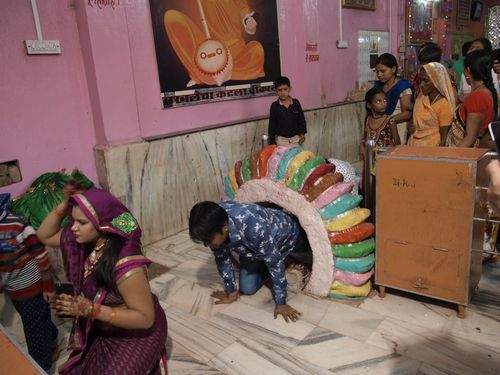
Ramdevra • Baba Ramdev Temple
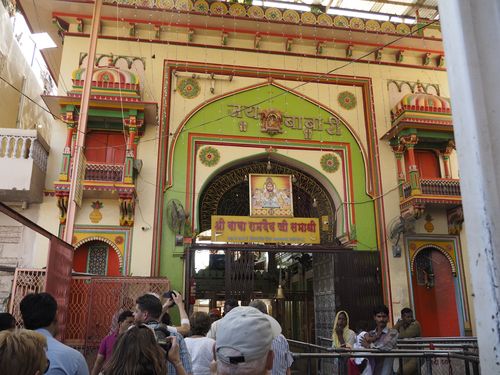
Ramdevra • Baba Ramdev Temple
Monument profile
Baba Ramdev Temple
Monument category: Hindu Temple
Monument family: Temple
Monument genre: Religious
Cultural heritage: Hindu
Geographic location: Ramdevra • Rajasthan • India
Construction period: 14th century AD
• Links to •
• List of videos about Ramdevra on this site •
Ramdevra, Baba Ramdev temple • Rajasthan, India
Baba Ramdev Temple at Ramdevra: History of a Major Pilgrimage Shrine
Origins of the Sacred Site and Memory of Baba Ramdevji
The Baba Ramdev Temple at Ramdevra is dedicated to Baba Ramdevji, a revered folk saint of Rajasthan generally placed in the fourteenth or fifteenth century. Regional traditions describe him as a Rajput noble or local leader remembered for justice, compassion, and protection of ordinary people. Over time, his reputation extended far beyond his lifetime, transforming him into one of the most widely venerated devotional figures of western India.
The shrine developed around the place associated with his samadhi, understood as the memorial linked to his final spiritual departure. After his death, devotees began visiting Ramdevra to honour his memory, seek blessings, and commemorate miracles attributed to him. The settlement, formerly known in some traditions as Runicha, gradually acquired sacred status through this continuing devotion.
Unlike temples founded by royal decree as formal dynastic monuments, the Baba Ramdev Temple emerged from collective pilgrimage practice. Its earliest form was likely modest, centred on a memorial enclosure rather than a monumental structure.
Gradual Expansion of the Temple Complex
As the cult of Baba Ramdevji spread, the original shrine was enlarged in successive phases. Additional courts, gateways, prayer halls, circulation corridors, and service areas were created to accommodate rising numbers of visitors. The present complex therefore reflects cumulative growth rather than a single planned construction campaign.
Donations from merchants, local patrons, landed families, and pilgrims played an important role in these expansions. The temple’s fame reached regions beyond Rajasthan, including Gujarat and parts of central India, increasing long-distance pilgrimage and the need for improved facilities.
By the modern period, Ramdevra had become a pilgrimage town organized around the temple. Streets, markets, lodging houses, and seasonal commercial activity developed in direct relationship to the shrine. The monument thus shaped not only religious practice but also the spatial and economic life of the settlement.
Religious Function and Social Importance
The temple occupies a distinctive place in Rajasthan because Baba Ramdevji is honoured across social boundaries. He is widely regarded as a protector of the poor, travellers, and those seeking justice or healing. This broad appeal helped create a pilgrimage culture open to many communities.
The annual fair held in memory of Baba Ramdevji became the central event in the shrine’s calendar. During this gathering, large numbers of pilgrims arrive for prayers, offerings, devotional singing, and ceremonial visits to the sacred core of the complex. The fair also supports trade, temporary markets, transport services, and regional exchange networks.
Daily worship continues throughout the year. Many visitors come to fulfil vows, express gratitude, or request assistance in personal matters. This uninterrupted devotional use distinguishes the temple from monuments preserved mainly as archaeological sites.
Modern Alterations, Preservation and Present Status
During the nineteenth, twentieth, and twenty-first centuries, the temple underwent repeated modifications intended to manage increasing pilgrimage numbers. Entrances were widened, waiting systems introduced, circulation routes reorganized, and covered areas added to protect visitors from sun and heat.
Conservation concerns differ from those of abandoned monuments. The principal challenge is maintaining a living sacred site while preserving older built elements integrated into the modern complex. Floors, steps, railings, and access zones experience constant wear because of heavy daily use.
Administrative management now involves balancing ritual continuity, public safety, sanitation, crowd control, and architectural maintenance. The temple is not inscribed on the UNESCO World Heritage List.
Global Historical Context
At the time when devotion to Baba Ramdevji was taking shape, northern India was marked by regional sultanates and shifting political authority. In Europe, the later Middle Ages saw expanding urban trade and stronger centralized kingdoms. Ming China governed a major imperial state. Across the Islamic world, commercial and cultural networks linked Central Asia, Persia, and the Middle East.
Continuing Historical Significance
Today the Baba Ramdev Temple remains one of Rajasthan’s most important popular pilgrimage centres. Its historical significance lies in the enduring transformation of a saint’s memorial into a major sacred complex sustained by centuries of continuous devotion, expansion, and social relevance.
Spatial Organization and Pilgrimage Architecture of the Baba Ramdev Temple at Ramdevra
Site Placement and Overall Layout
The Baba Ramdev Temple stands at Ramdevra in western Rajasthan within a settlement whose urban form is closely tied to pilgrimage movement. The complex occupies a central and visually dominant position, with roads, market streets, lodging areas, and open gathering zones oriented toward its entrances. Rather than functioning as an isolated monument, the temple acts as the architectural core of the town.
Its layout reflects gradual enlargement over time. Instead of a single symmetrical master plan, the complex is composed of successive courts, gateways, covered corridors, queue zones, prayer areas, and service sectors added in response to increasing numbers of visitors. This cumulative growth gives the site a layered spatial character in which older sacred nuclei coexist with later circulation infrastructure.
The compound emphasizes horizontal spread more than vertical monumentality. Broad enclosures, open forecourts, and extended approach routes are more significant than towering structures. This arrangement suits a major pilgrimage centre where the management of movement is architecturally as important as symbolic form.
Materials, Construction Systems and Climate Response
The temple combines traditional masonry with modern interventions. Older sections use stone, brick, lime-based plaster, and heavy wall construction suited to Rajasthan’s dry climate. Thick masonry moderates heat gain, while durable mineral surfaces withstand dust, wind, and intense sunlight.
Later additions employ reinforced concrete, steel framing, tiled finishes, and prefabricated roofing where wider spans or faster construction were required. These materials are especially visible in waiting halls, covered queue routes, and utility zones serving large seasonal crowds.
Surface treatment often favours pale colours or reflective finishes that reduce solar absorption and improve brightness. Floors are typically hard-wearing stone or tile capable of enduring constant foot traffic. Drainage and washability are important practical concerns because the complex must remain operational during periods of intense use.
Roofing systems vary according to function. Sacred chambers may retain more traditional enclosed volumes, while outer gathering areas frequently use lighter canopies or shed-like coverings designed for shade rather than monumentality. This mixture of structural systems illustrates the temple’s evolution from devotional shrine to high-capacity pilgrimage complex.
Movement Sequence and Hierarchy of Sacred Space
One of the most distinctive architectural features of the Baba Ramdev Temple is its management of pilgrim circulation. Visitors do not enter directly into the most sacred zone. Instead, movement is organized through progressive thresholds: outer access points, transitional courts, covered passageways, regulated queue lines, and finally the inner sanctified area associated with Baba Ramdevji’s memorial core.
This staged sequence creates both order and symbolic intensification. Public space at the perimeter is relatively open and social, allowing assembly, rest, and orientation. As one advances inward, circulation becomes narrower, more directed, and more ritualized.
Courtyards function as pressure-release spaces within the system. They absorb crowds, permit temporary pauses, and distribute movement toward multiple secondary routes. Covered corridors protect pilgrims from heat while maintaining directional flow.
The central sacred chamber or immediate shrine zone is comparatively concentrated in scale. Its architectural power lies less in large dimensions than in controlled access, density of devotion, and spatial centrality within the broader complex. This contrast between expansive outer areas and compressed inner focus is fundamental to the temple’s planning logic.
Formal Elements, Visual Language and Devotional Ornament
The temple’s architecture is primarily functional-devotional rather than sculpturally monumental. Entrance gates, domed kiosks, smaller shrine towers, parapets, and marked thresholds visually identify sacred zones. These elements provide recognisable religious form without requiring a unified historic style across the entire complex.
Decorative treatment includes painted surfaces, sacred symbols, inscriptions, framed images, polished metal elements, and donated objects integrated into the architecture. Ornament often accumulates through use rather than through a single original programme. This gives many spaces a lived devotional character shaped by continuous offerings and renewal.
Colour is significant. White, cream, saffron, red, and metallic accents are common because they remain visible under strong desert light and communicate ceremonial presence. Interior areas may combine polished stone, tile cladding, railings, and fabric hangings, producing an environment where architecture and ritual furnishing overlap.
The visual hierarchy usually privileges gateways, sanctum approaches, and focal worship points. Secondary service areas remain plainer, allowing visitors to read the importance of spaces through finish quality and symbolic density.
Alterations, Maintenance and Architectural Continuity
The temple has undergone repeated modifications to meet modern pilgrimage demands. Expanded entrances, crowd-control barriers, paved circulation zones, additional shade structures, lighting systems, and sanitation facilities have been introduced without suspending the shrine’s religious role.
As a result, the monument presents visible layers of time: historic sacred core, incremental masonry additions, and contemporary service architecture. Its significance lies partly in this adaptive continuity rather than in stylistic purity.
Conservation challenges arise from constant use more than abandonment. Floors wear smooth, steps erode, railings require replacement, and exposed surfaces need regular repair. Architectural preservation therefore depends on ongoing maintenance embedded within daily operation.
Today the Baba Ramdev Temple can be understood as a dynamic pilgrimage architecture in which sacred focus, crowd logistics, climatic adaptation, and cumulative building history are combined into a single functioning religious complex.