

 Français (France)
  Nederlands (nl-NL)
 The Manakula Vinayagar Temple is a Hindu shrine dedicated to the deity Ganesha, located in Pondicherry in the Indian state of Tamil Nadu. It is among the most visited places of worship in the city and plays a significant role in local religious life. Devotees gather there daily to offer prayers and participate in rituals associated with the deity. The temple reflects the continuity of Hindu devotional traditions in a city shaped by both South Indian culture and a colonial past. Today it remains an important religious landmark and a recognized spiritual site for residents and visitors alike.
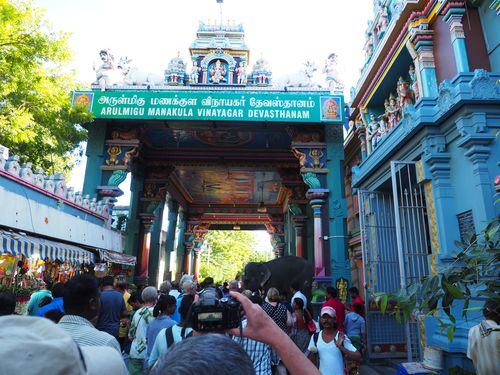
Pondicherry • Manakula Vinayagar Temple

Pondicherry • Manakula Vinayagar Temple

Pondicherry • Manakula Vinayagar Temple
Monument profile
Manakula Vinayagar Temple
Monument categories: Hindu Temple, Dravidian temple
Monument family: Temple
Monument genre: Religious
Cultural heritage: Hindu
Geographic location: Pondicherry • Tamil Nadu • India
Construction period: 18th century AD
• Links to •
• List of videos about Pondicherry on this site •
Pondicherry, a former French trading post • Tamil Nadu, India
History of the Manakula Vinayagar Temple in Pondicherry
Foundation and early religious presence
The Manakula Vinayagar Temple is a Hindu sanctuary dedicated to the god Ganesha, located in the historic urban area of Pondicherry in the Indian state of Tamil Nadu. Historical evidence indicates that the temple already existed before the consolidation of European colonial settlements along the Coromandel Coast during the seventeenth century. The name of the temple derives from the Tamil expression “Manal Kulam,” meaning “sand pond,” referring to a water depression or reservoir that once existed near the site before the coastal landscape was modified by urban development.
The presence of a shrine dedicated to Ganesha in this part of the settlement reflects the importance of local devotional practices that predated the colonial city. The temple served as a place of worship for the surrounding Tamil population, who maintained religious activities associated with the deity traditionally invoked at the beginning of rituals and undertakings. The sanctuary appears to have been sustained through local patronage and community involvement rather than by a single royal foundation.
The temple during the French colonial period
During the late seventeenth and eighteenth centuries Pondicherry developed into the principal administrative and commercial center of French colonial power in India. As the European quarter expanded and urban planning reshaped the coastal settlement, the Manakula Vinayagar Temple stood close to areas increasingly occupied by colonial institutions and residences.
Historical accounts and local traditions indicate that the presence of the temple occasionally generated tensions between colonial authorities and the Hindu population. The sanctuary occupied a location that some administrators considered incompatible with the planned layout of the European district. Several narratives describe attempts to remove or relocate the image of Ganesha from the temple site. According to these accounts, the statue was repeatedly returned to the shrine after attempts to displace it, reinforcing the perception of the temple as a symbol of religious continuity.
Over time the colonial administration adopted a more pragmatic approach toward local religious institutions. The temple continued to function as a place of worship within a city characterized by the coexistence of European administrative structures and traditional South Indian religious practices.
Expansion and transformations in the nineteenth and twentieth centuries
During the nineteenth and twentieth centuries the Manakula Vinayagar Temple underwent several phases of expansion and architectural modification. Increasing numbers of devotees visiting the shrine led to the enlargement of the complex and the addition of new structures within the temple enclosure. Donations from local communities played a central role in supporting these developments and maintaining the ritual activities associated with the sanctuary.
The temple gradually became one of the most prominent centers of Ganesha worship in Pondicherry. Religious festivals dedicated to the deity attracted large gatherings of worshippers and processional ceremonies were organized in the surrounding streets. These events reinforced the temple’s role in the religious life of the city and contributed to its growing prominence within the urban landscape.
Following the integration of Pondicherry into the Republic of India in the mid-twentieth century, the temple continued to operate as an active religious institution. Administrative and religious bodies assumed responsibility for the management and maintenance of the complex, ensuring the continuity of ritual practices and the preservation of the site.
Contemporary role and preservation
Today the Manakula Vinayagar Temple remains one of the most frequented Hindu temples in Pondicherry. Daily worship rituals, offerings and ceremonial activities continue to structure the life of the sanctuary. The temple functions both as a devotional center for the local population and as a significant religious landmark within the city.
The site is also visited by travelers interested in the cultural and religious traditions of South India. Maintenance efforts focus on preserving the temple structures, safeguarding the sacred images and supporting the regular cycle of rituals that sustain the temple’s religious significance. Continuous use and community involvement contribute to the preservation of the temple as an active place of worship within the historic fabric of Pondicherry.
Global historical context
When the temple is documented in the seventeenth century, European trading companies were establishing coastal settlements across the Indian Ocean region. France and Britain were expanding their colonial presence in Asia. In China the Qing dynasty was consolidating imperial authority. The Ottoman Empire remained a major political power in the eastern Mediterranean and Middle East.
Architecture of the Manakula Vinayagar Temple in Pondicherry
Urban setting and spatial organization
The Manakula Vinayagar Temple stands within the historic urban core of Pondicherry, in the coastal district shaped by the colonial city plan established during the French administration. The temple occupies a compact plot within a dense urban grid composed of narrow streets, residential buildings and small commercial structures. This environment has influenced the spatial organization of the complex, which develops internally rather than across a wide horizontal compound.
The temple complex is enclosed by perimeter walls that separate the sacred precinct from the surrounding city. The main entrance opens directly onto the street and forms the principal transition between urban space and the ritual domain of the sanctuary. Movement through the complex follows a linear progression from the gateway toward the principal shrine, structured through a sequence of courtyards and covered circulation corridors.
A central axis organizes the internal layout of the temple. Visitors entering through the gateway pass through a transitional hall before reaching the principal courtyard. Secondary shrines and auxiliary structures are arranged around this space, forming an architectural ensemble that accommodates ritual circulation. The spatial hierarchy directs movement progressively toward the inner sanctum housing the principal deity.
Entrance tower and external elevation
The most visible architectural element from the surrounding streets is the entrance tower, or gopuram, marking the main gateway of the temple. Rising above the surrounding buildings, it functions as a visual landmark within the urban landscape of Pondicherry. The structure follows the pyramidal profile typical of South Indian temple gateways, composed of several stacked tiers that decrease in size toward the summit.
The lower portion of the tower is built with thick masonry walls forming a stable base for the upper tiers. Above this base, horizontal cornices divide the façade into successive decorative registers. Each level contains niches filled with sculptural representations of deities, mythological figures and symbolic motifs drawn from Hindu iconography.
These sculptural compositions are primarily executed in stucco applied over masonry frameworks. The figures are coated with brightly colored pigments that create a polychrome surface visible from the surrounding streets. The central opening of the gopuram forms a vaulted passageway that allows access into the temple enclosure while supporting the mass of the superstructure above.
Main shrine and internal spatial configuration
At the center of the complex stands the principal sanctuary dedicated to the deity Ganesh, locally called Vinayagar. This structure forms the architectural and ritual core of the temple. The sanctuary, known as the garbhagriha, is a compact chamber constructed with thick masonry walls. Its interior is intentionally dim, creating an environment suited to the installation of the cult image and the performance of ritual offerings.
Above the sanctum rises the vimana, a tower marking the position of the principal shrine within the complex. Smaller than the entrance gopuram, the vimana follows a similar pyramidal composition composed of stacked architectural tiers decorated with sculptural niches and ornamental elements. This superstructure reinforces the vertical emphasis of the sacred core.
Circulation corridors surrounding the sanctuary allow ritual circumambulation. These passageways enable devotees to move around the shrine according to prescribed devotional paths while maintaining orientation toward the sacred center. The corridors are defined by rows of structural columns supporting the roof of the surrounding galleries.
Several subsidiary shrines dedicated to other deities are arranged around the main courtyard. Each includes its own sanctum and decorative elements while remaining integrated into the overall organization of the temple compound.
Construction materials and decorative program
The primary structural components of the temple are built with stone and brick masonry. Lower architectural elements, including the sanctuary walls and column bases, are constructed with stone blocks that provide stability and resistance to structural stress. Upper elements such as superstructures and sculptural frameworks are typically made with brick cores covered by plaster or stucco.
Decorative sculpture forms an essential part of the temple’s architectural expression. Reliefs representing divine figures, mythological creatures and ornamental motifs cover large portions of the exterior surfaces. These sculptural elements are integrated into niches, cornices and projecting architectural surfaces.
The interior galleries display carved stone columns that structure the surrounding corridors. Many columns feature sculpted capitals and decorative bands with geometric or floral motifs. Some include figurative imagery associated with Hindu mythology, contributing to the visual articulation of the interior spaces.
Polychrome painting also plays a role in the decorative program. Painted surfaces and colored sculptures emphasize architectural forms and highlight the iconographic compositions embedded within the structure.
Architectural modifications and conservation
The present configuration of the Manakula Vinayagar Temple reflects several phases of architectural modification carried out to accommodate the growing number of devotees and evolving ritual practices. Additions within the temple compound include secondary shrines, covered halls and service structures used for ceremonial activities.
Maintenance work has focused particularly on preserving sculptural decorations and painted surfaces exposed to coastal climatic conditions, including humidity and saline air. Periodic restoration campaigns renew the polychrome finishes applied to sculptural elements of the entrance tower and other architectural features.
Structural maintenance also involves stabilization of masonry walls and reinforcement of roofing elements above the surrounding galleries. These interventions aim to preserve the functional integrity of the temple while maintaining its established architectural appearance.
Continuous use of the sanctuary for daily worship contributes to the regular upkeep of the complex. Ritual activity combined with conservation work supports the preservation of the architectural structures and decorative elements that define the present form of the Manakula Vinayagar Temple within the historic urban environment of Pondicherry.