

 Français (France)
  Nederlands (nl-NL)
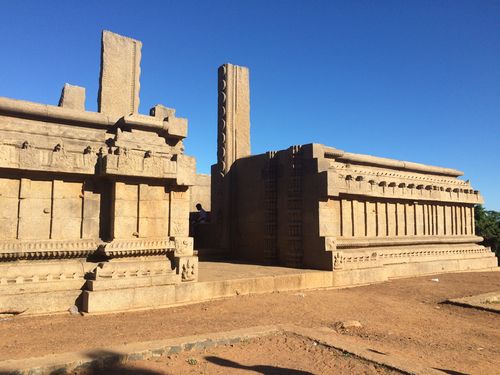
 The Symmetric Building in Mahabalipuram is part of the monumental remains associated with the large archaeological complex developed under the Pallava dynasty on India’s southeastern coast. The monument is notable for its balanced layout and regular composition, features that inspired its modern designation. Located in a region known for its rock-cut temples, monolithic shrines and sculpted reliefs, it reflects the architectural experimentation carried out in Mahabalipuram during the 7th and 8th centuries. Today, the site contributes to the cultural and archaeological identity of Mahabalipuram, which is internationally recognised for the importance of its Pallava monumental heritage.

Mahabalipuram • Symmetric Building

Mahabalipuram • Symmetric Building
Mahabalipuram • Symmetric Building
Monument profile
Symmetric Building
Monument category: Hindu Temple
Monument family: Temple
Monument genre: Religious
Cultural heritage: Hindu
Geographic location: Mahabalipuram • Tamil Nadu • India
Construction period: 7th century AD
This monument in Mahabalipuram is inscribed on the UNESCO World Heritage List since 1984 and is part of the serial property "Group of Monuments at Mahabalipuram".See the UNESCO monuments featured on this site
• Links to •
• Dynasties that contributed to the construction of the monument •

• List of videos about Mahabalipuram on this site •
Mahabalipuram, excavated temples • Tamil Nadu, India
Development and Historical Context of the Symmetric Building at Mahabalipuram
Construction during the Pallava Period
The monument identified today as the “Symmetric Building” belongs to the monumental ensemble created at Mahabalipuram during the Pallava period, mainly between the seventh and eighth centuries CE. Although its original historical designation is uncertain, the structure shares architectural characteristics with other Pallava monuments commissioned under rulers such as Narasimhavarman I and Rajasimha. Its balanced composition and carefully organised plan reflect the experimentation that characterised Pallava architectural production during this period.
The building was constructed within a coastal urban and ceremonial environment that combined structural temples, rock-cut shrines and sculptural monuments. Mahabalipuram functioned both as a royal centre and as an active maritime settlement connected to commercial routes across the Bay of Bengal. The concentration of monuments in the area suggests deliberate royal patronage intended to reinforce political authority and religious legitimacy through monumental stone architecture.
The monument’s symmetrical organisation indicates that visual order and spatial balance formed essential aspects of its conception. This emphasis on geometric regularity corresponds to broader Pallava interests in architectural planning and formal coherence visible throughout the site.
Religious Function and Use
The precise ritual function of the Symmetric Building remains insufficiently documented. Its placement within the sacred landscape of Mahabalipuram nevertheless strongly suggests a religious or ceremonial purpose associated with Hindu worship. The structure may have served as a subsidiary shrine, ritual pavilion or architectural component connected to nearby temple activities.
Its relatively compact dimensions indicate a controlled devotional space rather than a large congregational monument. Unlike later South Indian temple complexes expanded through multiple dynastic phases, the building appears to preserve a more unified architectural conception linked to a single principal construction phase.
The monument also reflects the transitional nature of Pallava architecture during the seventh century. Builders at Mahabalipuram explored different structural forms while moving gradually from excavated rock-cut sanctuaries toward fully structural temples assembled from dressed stone blocks. The Symmetric Building forms part of this broader experimental phase in South Indian temple development.
Historical Evolution and Conservation
After the decline of Pallava political power, Mahabalipuram gradually lost its importance as an active royal capital. Many monuments nevertheless continued to survive because of their religious significance, durable granite construction and integration into local cultural traditions. The Symmetric Building appears to have undergone relatively limited later modification compared to some larger temple complexes in South India.
Centuries of exposure to coastal conditions progressively affected parts of the structure. Humidity, salt carried by sea winds and seasonal climatic variations contributed to the erosion of certain carved surfaces and architectural details. Despite this deterioration, the monument retains much of its original spatial organisation and geometric clarity.
Archaeological documentation and conservation work became more systematic during the colonial and post-colonial periods. Preservation measures have generally focused on stabilising existing structures and limiting environmental damage rather than reconstructing missing elements. The monument is today protected as part of the UNESCO World Heritage Site designated in 1984 under the official title “Group of Monuments at Mahabalipuram.” This inscription recognised the importance of the site for the history of early South Indian architecture and sculpture.
The Symmetric Building now forms part of the wider archaeological landscape visited for its contribution to Pallava artistic and architectural development.
Chronological Context
The principal construction phase of the Symmetric Building took place during the seventh or early eighth century CE. During the same period, the Tang dynasty ruled China, early Islamic caliphates expanded across the Middle East, and important maritime kingdoms developed in Southeast Asia. In Europe, early medieval kingdoms emerged after the fragmentation of western Roman authority. These contemporaneous developments formed part of the wider political and commercial networks connected indirectly to the Indian Ocean world.
Spatial Composition and Stone Architecture of the Symmetric Building at Mahabalipuram
Integration into the Rocky Landscape
The Symmetric Building occupies a granite zone within the archaeological landscape of Mahabalipuram. Its placement on relatively level rocky ground allows the monument to maintain strong geometric regularity despite the uneven natural environment. The structure forms part of a broader ensemble in which carved monuments and exposed stone surfaces remain visually connected.
Its orientation appears carefully planned in relation to circulation routes and neighbouring monuments. The symmetrical composition is immediately visible from the frontal approach, showing that visual balance formed a major architectural objective. Unlike deeply recessed cave sanctuaries, this monument presents a more open and externally legible arrangement in which the relationship between façade and interior spaces remains clearly readable.
Granite strongly influenced both the structure and appearance of the building. The hardness of the stone limited extremely delicate carving but provided substantial mechanical stability. Surviving surfaces still preserve sharp transitions between walls, supports and sculpted areas despite centuries of exposure to coastal climatic conditions.
The open terrain surrounding the monument further reinforces the perception of symmetry by allowing unobstructed views of the architectural alignment.
Façade Organisation and Structural Elements
The façade follows a controlled axial composition organised around repeated supports and evenly spaced openings. Columns and pilasters divide the elevation into balanced sections without excessive decorative density. The architectural effect depends more on proportional order than on monumental scale.
The columns display characteristics associated with early Pallava stone architecture. Their shafts remain compact and relatively simple, while the capitals preserve restrained forms adapted to granite carving. Decorative treatment is limited, allowing the structural framework to dominate visually. Broad bases reinforce the impression of stability.
Horizontal alignment plays a major role in the monument’s appearance. Architectural emphasis extends across the width of the façade rather than concentrating vertically. Unlike later Dravidian temples dominated by towers and monumental gateways, the composition here relies on measured repetition, shadow contrasts and the interaction between carved and untreated stone surfaces.
The granite still preserves visible traces of carving techniques. Some surfaces were carefully smoothed, while others retain slight irregularities linked to the natural texture of the stone and to different stages of the excavation process. These variations reveal aspects of Pallava workmanship without disturbing the monument’s overall symmetry.
Interior Layout and Spatial Balance
The internal organisation reflects the same concern for proportional equilibrium visible on the exterior. Spaces are arranged according to a regular plan in which circulation areas and shrine zones maintain clear relationships. The monument relies less on complex spatial sequences than on controlled transitions between open and enclosed volumes.
The principal hall functions as the central organising space. Its moderate dimensions create a contained architectural atmosphere rather than a monumental ceremonial environment. Because the structure remains closely associated with the granite mass, walls and ceilings preserve a strong sense of material continuity.
Entrances and openings are integrated directly into the walls without strongly projecting frames. This restraint contributes to the coherence of the interior and avoids decorative fragmentation. Spatial organisation therefore depends mainly on alignment and proportional balance rather than dramatic variation between different zones.
Ceilings remain comparatively flat and geometrically regular, indicating careful planning during construction. Structural supports inside the monument are limited because the granite itself provides sufficient stability. The relatively open interior thus results from controlled excavation and weight distribution rather than technical complexity.
The proportions of the chambers also shape the perception of sculptural decoration. Reliefs and carved figures remain integrated into the architectural framework instead of dominating it completely, reinforcing the unity between structure and ornamentation.
Decorative Treatment and Sculptural Integration
The decorative programme remains closely connected to the architectural structure. Reliefs, recessed surfaces and sculptural elements are distributed selectively in order to preserve the clarity of the symmetrical composition. Ornamentation never overwhelms the architectural framework.
The sculptural treatment demonstrates careful control of depth and projection. Figures emerge gradually from the stone surface while remaining visually connected to the surrounding walls. This approach preserves structural continuity and strengthens the integration between iconography and architecture.
Pilasters, niches and recessed areas create subtle variations in light and shadow across the building. These effects are especially visible on the façade, where sunlight interacting with carved stone reinforces the geometric organisation of the monument. Visual rhythm therefore depends on both physical symmetry and contrasts between illuminated and shaded surfaces.
The restrained decorative density also improves the readability of the architectural plan. Empty surfaces help define proportions and direct attention toward the principal sculptural zones.
Preservation and Architectural Condition
The preservation of the Symmetric Building depends largely on the durability of its granite construction. Structural stability remains strong despite prolonged exposure to humidity, salt-laden air and seasonal climatic variations along the Coromandel Coast.
Erosion has nevertheless affected certain exterior surfaces and finer decorative details. Areas exposed directly to wind and moisture show gradual softening of carved contours. Conservation measures focus mainly on limiting environmental deterioration and reducing visitor impact.
Modern preservation policies generally avoid large-scale reconstruction. Conservation efforts instead prioritise maintaining the readability of the original architectural forms while stabilising vulnerable surfaces and preserving the monument’s historical material integrity.