

 Français (France)
  Nederlands (nl-NL)
 The Church of Saint Cajetan is a Catholic monument located in Goa, in the Indian state of Goa. It belongs to the religious heritage established during the Portuguese period and reflects the lasting presence of European ecclesiastical institutions in the region. Associated with religious orders active during the colonial era, the church illustrates Goa’s historical role as a spiritual and administrative center in Asia. Today, it stands as an important cultural landmark and forms part of the broader historical ensemble that represents religious and institutional exchanges between Europe and the Indian subcontinent.
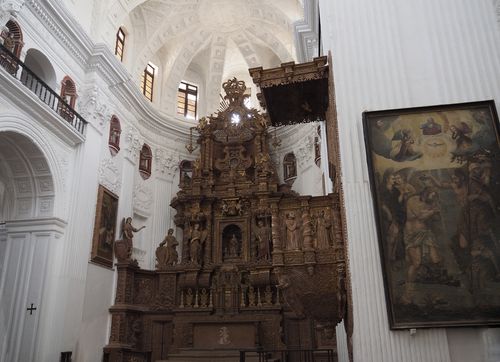
Goa • Church of St. Cajetan
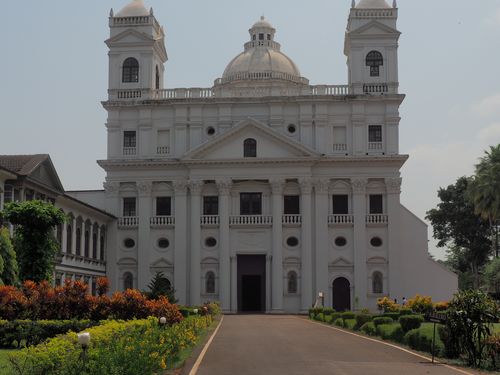
Goa • Church of St. Cajetan
Goa • Church of St. Cajetan
Monument profile
Church of St. Cajetan
Monument category: Church
Monument family: Church, cathedral, basilica, chapel
Monument genre: Religious
Cultural heritage: Christian
Geographic location: Goa • Goa • India
Construction period: 17th century AD
This monument in Goa is inscribed on the UNESCO World Heritage List since 1986 and is part of the serial property "Churches and Convents of Goa".See the UNESCO monuments featured on this site
• Links to •
• List of videos about Old Goa City, Panaji, Chandor, Candolim on this site •
Goa • A piece of Portugal in India
History of the Church of Saint Cajetan, Goa
The Church of Saint Cajetan in Old Goa, in the Indian state of Goa, stands as a major testament to the religious, political, and institutional ambitions of the Portuguese empire in Asia during the seventeenth century. Built by the Theatine order, the church reflects the dynamics of Catholic reform, imperial consolidation, and urban transformation within the former capital of the Estado da Índia. Its history illustrates the intersection of missionary enterprise, colonial governance, and global religious networks in the early modern period.
Political and Social Context of Construction
The church was erected during a period when Old Goa remained one of the principal administrative and ecclesiastical centers of the Portuguese empire in Asia. Following the conquest of Goa in 1510, the city became the headquarters of Portuguese authority in the Indian Ocean. By the mid-seventeenth century, although Portuguese maritime dominance faced increasing challenges from Dutch and English competitors, Goa continued to function as a symbolic and institutional capital.
The arrival of the Theatines must be understood within the broader framework of the Catholic Reformation. Founded in Italy in the early sixteenth century, the Theatine order emphasized clerical reform, spiritual discipline, and the strengthening of ecclesiastical structures. Their establishment in Goa was encouraged by colonial authorities who sought to reinforce Catholic orthodoxy and revitalize religious life in a colony confronted by both external threats and internal administrative difficulties.
The Portuguese Crown exercised patronage rights over ecclesiastical affairs through the Padroado system. The construction of a monumental church dedicated to Saint Cajetan reflected both spiritual and political ambitions. It affirmed Goa’s role as a Catholic stronghold in Asia and reinforced the legitimacy of Portuguese rule. Monumental religious architecture served not merely devotional purposes but also symbolized imperial permanence.
Socially, the church functioned as a focal point for both European settlers and local converts. It contributed to the structuring of colonial society through liturgical services, education, and clerical training. The Theatines played a role in shaping moral and institutional discipline within the Catholic community, thereby strengthening the ideological cohesion of the colony.
Major Historical Developments
The church was completed during a period of geopolitical instability in the Indian Ocean. Although Old Goa did not suffer direct large-scale destruction during this era, Portuguese maritime decline affected financial resources and administrative capacity. Nevertheless, the Church of Saint Cajetan continued to operate as an active religious institution.
In the eighteenth century, reforms implemented by the Portuguese Crown under the Marquis of Pombal altered the organization of religious orders throughout the empire. While the Theatines were not expelled in the manner of the Jesuits, increased state oversight affected ecclesiastical administration. These reforms influenced the management and economic sustainability of religious establishments in Goa.
The gradual decline of Old Goa as a densely populated capital, largely due to recurring epidemics and environmental challenges, significantly reshaped the urban context of the church. Administrative functions progressively shifted to Panaji, leading to demographic contraction in Old Goa. Portions of conventual and religious complexes were repurposed or fell into partial disuse. The Church of Saint Cajetan, however, retained its structural and symbolic presence.
The annexation of Goa by India in 1961 marked a decisive transformation in sovereignty. Portuguese colonial rule ended, and the church entered a new legal and political framework within the Republic of India. Despite this transition, the building continued to serve religious and cultural functions, illustrating continuity across regimes.
Global Context of Construction
The construction of the Church of Saint Cajetan occurred within a global movement of Catholic expansion. In the seventeenth century, European powers erected monumental churches in the Americas, Africa, and Asia as instruments of evangelization and imperial representation. The architectural inspiration for the church drew upon Roman models associated with the Counter-Reformation, reflecting the transcontinental circulation of architectural ideas.
Old Goa was often described as the “Rome of the East,” hosting numerous religious orders and serving as a hub for missionary activity extending to Japan, China, and Southeast Asia. The Church of Saint Cajetan formed part of this broader ecclesiastical network. Its establishment symbolized the integration of Goa into a global Catholic infrastructure that linked Europe and Asia.
Transformations Over Time
Over the centuries, the church underwent maintenance and restoration campaigns necessitated by climatic conditions. Humidity and monsoon exposure required periodic structural reinforcement and surface repairs. These interventions sought to preserve the integrity of the building without fundamentally altering its original configuration.
The decline of Old Goa in the eighteenth century altered the surrounding urban landscape. As population density decreased, the church’s role shifted from being embedded within a vibrant administrative capital to functioning within a more sparsely inhabited historical precinct.
In the twentieth century, heritage awareness intensified. Conservation initiatives emphasized structural stabilization and the preservation of interior artworks. This phase marked a transition from purely religious functionality to a combined religious and heritage-oriented role.
Contemporary Role and Cultural Significance
Today, the Church of Saint Cajetan stands as a prominent monument within Old Goa’s historic ensemble. It remains a place of worship while also attracting scholars and visitors interested in colonial and religious history. For the Catholic community of Goa, the church embodies continuity with early modern missionary traditions and represents an enduring spiritual landmark.
The monument contributes to broader reflections on colonial heritage in India. It illustrates the complexities of cultural interaction, institutional transplantation, and architectural symbolism during the early modern period.
Conservation and World Heritage Status
The Church of Saint Cajetan forms part of the UNESCO World Heritage Site designated as the Churches and Convents of Goa. This recognition affirms its outstanding universal value as an example of the dissemination of European religious architecture in Asia.
Conservation challenges include humidity-related deterioration, biological growth on masonry surfaces, and the pressures associated with tourism. Restoration policies emphasize material compatibility, structural integrity, and the retention of historical authenticity.
Balancing accessibility and preservation remains central to site management. Continued monitoring and maintenance are necessary to ensure long-term stability.
Conclusion
The history of the Church of Saint Cajetan encapsulates the ambitions of a Catholic empire seeking to assert religious authority in Asia. Constructed in a context of imperial competition and ecclesiastical reform, it survived political transitions, urban decline, and environmental challenges. Today, as part of a UNESCO-recognized heritage ensemble, it stands as a significant witness to the global circulation of religious institutions and architectural forms during the early modern era.
Architectural Analysis of the Church of Saint Cajetan, Goa
The Church of Saint Cajetan in Old Goa represents one of the most direct architectural transpositions of Roman Counter-Reformation models into the Indian subcontinent. Constructed in the seventeenth century by the Theatine order, the building reflects both doctrinal clarity and monumental ambition. Its design draws explicit inspiration from Italian ecclesiastical architecture while incorporating technical adaptations required by local materials and climatic conditions. The result is a structurally coherent and symbolically charged monument within the former capital of the Portuguese Estado da Índia.
Architectural Concept and Structural Innovation
The church is conceived on a Latin cross plan, with a longitudinal nave intersected by a pronounced transept and crowned by a central dome. This typology aligns with post-Tridentine architectural theory, which emphasized axial clarity and the visual primacy of the high altar. The uninterrupted progression from the entrance to the sanctuary reinforces liturgical focus and spatial hierarchy.
The most distinctive structural element is the hemispherical dome positioned above the crossing. Resting on a circular drum articulated by openings, the dome provides both illumination and vertical emphasis. The weight of the masonry dome is transferred to robust piers and thick perimeter walls, ensuring stability. The adoption of this centralized vertical feature reflects advanced knowledge of Renaissance and early Baroque structural principles.
The nave is covered by a barrel vault reinforced with transverse arches. These arches channel lateral thrusts toward the massive side walls and internal buttressing system. Compared with Gothic rib vaulting, this approach simplifies construction while maintaining structural integrity. The reliance on masonry mass, rather than complex skeletal systems, reflects both European precedent and pragmatic adaptation.
Ventilation and climatic responsiveness are integral to the design. Windows placed in the drum of the dome admit light while promoting vertical air movement. Lateral openings along the nave encourage cross-ventilation. The considerable interior height enhances passive cooling, while the elevated plinth protects the foundations from monsoon water infiltration. These features demonstrate the integration of climatic considerations into a fundamentally European architectural scheme.
Materials and Construction Techniques
The primary construction material is laterite, a porous, iron-rich stone abundantly available in Goa. Its relative softness when quarried allows for efficient shaping, while exposure to air hardens its surface. The use of laterite enabled large-scale masonry construction with regional resources, reducing dependency on imported stone.
Structural joints were bonded using lime mortar, chosen for its compatibility with laterite and its capacity to regulate moisture. Lime-based plaster coatings provided additional protection to exterior surfaces. The façade’s light-colored finish enhances durability while emphasizing the architectural articulation of pilasters and cornices.
The dome’s masonry required careful engineering to ensure even load distribution. Internal reinforcement techniques, combined with precise curvature, contribute to its longevity. Timber elements, particularly in roof frameworks and secondary structures, supplement the masonry system without compromising structural balance.
Interior decorative components, including altarpieces and carved elements, were executed primarily in wood. Mortise-and-tenon joinery and layered gilding techniques reflect the transmission of European craft knowledge to local artisans. The integration of stone structure and wooden ornamentation creates a cohesive architectural environment.
Stylistic Influences and Artistic Synthesis
The façade composition reflects late Renaissance and early Baroque influences derived from Italian ecclesiastical architecture. Its symmetrical organization, vertical pilasters, and tiered elevation recall Roman prototypes associated with the Counter-Reformation. The articulation into horizontal registers produces visual order and monumentality.
Unlike some other Goan churches characterized by more restrained façades, Saint Cajetan’s elevation projects a classical monumentality grounded in proportional harmony. The triangular pediment crowning the central bay reinforces axial emphasis.
The interior decoration aligns with Baroque sensibilities, particularly in the treatment of the high altar and subsidiary chapels. Carved retables display dynamic ornamentation, including spiral columns and layered iconographic panels. While stylistically European in conception, the execution incorporates regional carving traditions and floral motifs, demonstrating a localized reinterpretation of imported forms.
Spatial Organization and Internal Configuration
The nave extends through several bays articulated by engaged pilasters and transverse arches. Side chapels are recessed into the thickness of the structural walls, creating devotional niches without disrupting the central axis. This configuration preserves structural solidity while accommodating liturgical plurality.
The transept arms are proportioned to maintain balance with the longitudinal axis. The crossing beneath the dome becomes the architectural focal point, visually anchoring the entire interior composition. Light filtering through the drum windows accentuates this vertical emphasis.
The chancel is elevated and clearly distinguished from the nave. Its spatial definition reinforces liturgical hierarchy. The cumulative effect of axial alignment, centralized dome, and articulated chapels generates a coherent spatial narrative rooted in Counter-Reformation principles.
Distinctive Architectural Features
One of the church’s defining characteristics is the dome itself, among the earliest and most explicit adaptations of Italian Renaissance dome construction in Goa. Its scale and prominence distinguish the building from other contemporary religious structures in the region.
The façade’s classical vocabulary further differentiates it. The disciplined arrangement of orders and the absence of excessive ornamentation emphasize proportion rather than decoration. This restraint contrasts with the richer interior, producing a deliberate duality between external sobriety and internal elaboration.
The integration of the church within a conventual complex also shapes its architectural identity. Cloistered spaces and ancillary buildings complement the principal sanctuary, reinforcing its institutional function.
Dimensions and Notable Data
The nave measures approximately fifty meters in length, creating a substantial interior volume. The dome rises prominently above the crossing, contributing to the skyline of Old Goa. Proportional relationships between width, height, and length adhere to Renaissance harmonic principles.
The structural thickness of the walls, often exceeding one meter, enhances stability and thermal insulation. The careful calibration of dimensions reflects adherence to European theoretical models adapted to local execution.
International Recognition and Conservation
The Church of Saint Cajetan forms part of the UNESCO World Heritage ensemble designated as the Churches and Convents of Goa. Its architectural significance lies in demonstrating the transmission of Italian Counter-Reformation forms into South Asia.
Conservation challenges include humidity-induced erosion of laterite masonry and deterioration of wooden decorative elements. Restoration programs prioritize compatible materials and structural monitoring. The maintenance of the dome and roof systems is particularly crucial in mitigating water infiltration.
Tourism generates additional preservation concerns, requiring careful management to protect interior finishes. Conservation strategies aim to balance public accessibility with long-term stability.
Architectural Significance
The Church of Saint Cajetan exemplifies the architectural ambitions of the Theatine order and the Portuguese empire in Asia. Its Latin cross plan, centralized dome, and classical façade articulate a direct lineage from Roman ecclesiastical architecture while demonstrating pragmatic adaptation to Goan conditions.
Through its structural clarity, climatic responsiveness, and stylistic synthesis, the church stands as a pivotal monument in the architectural history of South Asia. It embodies the global circulation of design principles during the seventeenth century and remains a key reference for understanding the interaction between European architectural theory and local building practice in colonial contexts.