

 Français (France)
  Nederlands (nl-NL)
 The Basilica of the Infant Jesus is a Catholic church located in Goa, in the Indian state of Goa. It is one of the region’s prominent places of worship and attracts numerous visitors each year. The basilica is closely associated with devotion to the Infant Jesus and plays a significant role in local religious life. Regular liturgical services and major Christian celebrations are held there, drawing both residents and pilgrims. Owing to its spiritual importance and steady attendance, the church is also regarded as a key cultural and tourist landmark within Goa.
Monument profile
Basilica of Bom Jesus
Monument category: Basilica
Monument family: Church, cathedral, basilica, chapel
Monument genre: Religious
Cultural heritage: Christian
Geographic location: Goa • Goa • India
Construction period: 17th century AD
This monument in Goa is inscribed on the UNESCO World Heritage List since 1986 and is part of the serial property "Churches and Convents of Goa".See the UNESCO monuments featured on this site
• Links to •
• List of videos about Old Goa City, Panaji, Chandor, Candolim on this site •
Goa • A piece of Portugal in India
History of the Basilica of the Infant Jesus in Goa
The Basilica of Bom Jesus, commonly referred to as the Basilica of the Infant Jesus, stands in Old Goa, within the Indian state of Goa. Constructed between 1594 and 1605 and consecrated in 1605, the church emerged at the height of Portuguese imperial power in Asia. Its foundation must be understood within the political, religious, and global transformations that shaped the early modern world, particularly the consolidation of the Portuguese Estado da Índia and the Catholic Counter-Reformation.
Political and Social Context of Construction
Goa was conquered by Afonso de Albuquerque in 1510 and rapidly developed into the capital of Portuguese Asia. By the late sixteenth century, the city had become a major administrative, commercial, and ecclesiastical center linking Europe, Africa, and Asia. The construction of monumental churches formed part of a deliberate strategy to affirm Portuguese sovereignty and embed Catholicism within colonial society.
The Basilica of Bom Jesus was closely associated with the Society of Jesus. The Jesuits had arrived in Goa in 1542, most famously with Francis Xavier, whose missionary activities extended across the Indian Ocean and into East Asia. After his death in 1552, his body was brought to Goa in 1553. The decision to construct a grand church for the Jesuit order reflected both spiritual and political ambitions: to institutionalize missionary authority, to project imperial prestige, and to reinforce Goa’s role as the ecclesiastical capital of Asia.
The broader European context was defined by the Catholic Reformation following the Council of Trent. The Portuguese Crown, in alliance with the papacy, promoted doctrinal clarity, missionary expansion, and architectural patronage as tools of religious consolidation. The basilica therefore functioned not merely as a parish church but as a symbol of Catholic orthodoxy in a region marked by religious plurality and increasing competition from Protestant maritime powers such as the Dutch and the English.
Major Historical Events and Institutional Transformations
During the seventeenth century, Goa faced mounting challenges. Dutch naval incursions threatened Portuguese trade networks, and the gradual shift of commercial routes diminished the city’s economic vitality. Although the basilica itself was not destroyed or severely damaged in military conflict, it existed within a declining urban environment. Epidemics and demographic shifts led to the partial abandonment of Old Goa in favor of healthier coastal settlements.
In 1624, the relics of Francis Xavier were enshrined within the basilica in an elaborate tomb, elevating the church to a major pilgrimage site. The public exposition of the relics, held periodically from the seventeenth century onward, reinforced the basilica’s international religious significance.
The suppression of the Jesuit order in Portuguese territories in 1759 marked a critical institutional shift. The Jesuits were expelled from Goa, and their properties were confiscated by the Crown. The basilica subsequently came under different ecclesiastical administration, reflecting broader Enlightenment-era reforms within the Portuguese Empire. Despite these disruptions, the building retained its liturgical function.
The nineteenth century introduced further changes. Liberal reforms in Portugal led to the secularization of many religious institutions. Meanwhile, Old Goa had largely declined as an urban center, with Panaji emerging as the new capital. The basilica survived this transformation, though the surrounding cityscape contracted dramatically.
In 1961, the annexation of Goa by the Republic of India ended Portuguese rule. The political transition altered the administrative framework governing religious properties but did not diminish the basilica’s status as an active Catholic church. Instead, it became an integral part of India’s pluralistic cultural landscape.
Global Context of Monumental Construction
The basilica’s construction coincided with an era of intense global architectural patronage linked to European overseas expansion. In Spanish America, cathedrals were being erected in Mexico City and Lima. In Rome, major churches such as St. Peter’s Basilica symbolized renewed Catholic authority. Portuguese Asia likewise developed monumental religious complexes in Goa, Cochin, and Macau.
The Basilica of Bom Jesus thus formed part of a transcontinental network of ecclesiastical architecture that embodied the spiritual and geopolitical ambitions of early modern Catholicism. It signified not only missionary zeal but also the integration of Goa into a worldwide imperial system.
Transformations Over the Centuries
Although structurally stable, the basilica underwent various modifications and restorations. Environmental factors, particularly humidity and monsoon exposure, necessitated periodic maintenance. The relics of Francis Xavier were transferred into a marble mausoleum in 1698, crafted in Italy and shipped to Goa, illustrating continued transnational connections.
As Old Goa’s population declined in the eighteenth and nineteenth centuries, the basilica became increasingly isolated within a landscape of partially abandoned convents and churches. Its survival owed much to its status as a pilgrimage site and to sustained devotional practices.
Twentieth-century conservation efforts intensified after Indian independence. Archaeological and heritage authorities initiated structural stabilization, façade cleaning, and preservation of interior artworks. These interventions sought to balance continued religious use with heritage protection.
Contemporary Role and Cultural Significance
Today, the basilica remains an active center of worship and pilgrimage. The exposition of the relics of Francis Xavier, held approximately every ten years, attracts large numbers of visitors from India and abroad. The event holds significant religious, cultural, and economic importance for Goa.
Within the broader Indian context, the basilica represents the historical presence of Christianity and the enduring legacy of Portuguese colonialism. It contributes to Goa’s distinct regional identity, which blends Indian and Lusophone cultural elements. The church is also a focal point of tourism, forming part of a broader heritage circuit that includes multiple early modern religious structures.
Conservation Status and Modern Challenges
The Basilica of Bom Jesus forms part of the “Churches and Convents of Goa,” inscribed on the World Heritage List by UNESCO in 1986. This designation recognizes the ensemble as an outstanding example of the interchange of European and Asian architectural and religious traditions.
World Heritage status imposes obligations concerning conservation, monitoring, and visitor management. The principal challenges include environmental degradation due to humidity, biological growth on stone surfaces, pollution, and the physical impact of large crowds during pilgrimage events.
Conservation policies aim to preserve original materials while ensuring structural integrity. Restoration campaigns are conducted under archaeological supervision, and efforts are made to control urban development in the surrounding area to protect the historic landscape.
Conclusion
The Basilica of Bom Jesus embodies the intersection of imperial ambition, missionary enterprise, and global cultural exchange. Constructed at the height of Portuguese power in Asia, it survived institutional suppression, urban decline, and political transformation. Its historical trajectory reflects the broader evolution of Goa from colonial capital to Indian state, while its continuing religious function and international recognition underscore its enduring significance.
Architectural Analysis of the Basilica of the Infant Jesus (Basilica of Bom Jesus), Goa
The Basilica of Bom Jesus in Old Goa represents one of the most accomplished examples of early modern Catholic architecture in Asia. Constructed between 1594 and 1605, the church embodies the technical, artistic, and spatial principles associated with late sixteenth-century Portuguese religious architecture, while integrating regional materials and responding to the climatic conditions of coastal western India. Its architectural form reflects both Counter-Reformation ideals and the logistical realities of building in a colonial context.
Architectural Conception and Structural Innovation
The basilica follows a longitudinal plan typical of Jesuit churches influenced by the Roman model of Il Gesù. The structure consists of a single wide nave terminating in a deep chancel, with lateral chapels opening off the main aisle. The absence of a projecting transept and the clarity of axial alignment reinforce liturgical visibility and acoustical efficiency, consistent with post-Tridentine architectural prescriptions emphasizing preaching and congregational focus.
The engineering approach demonstrates a rational adaptation of European masonry traditions to tropical conditions. Load-bearing walls of considerable thickness ensure structural stability while compensating for the absence of flying buttresses. The mass of the walls distributes vertical loads evenly and provides resistance against seasonal humidity fluctuations and monsoon exposure. Arched openings and barrel vaulting elements further stabilize the structure by transferring weight laterally into the supporting masonry.
Ventilation and climatic adaptation are integral to the design. High clerestory openings, combined with strategically positioned windows along the nave, facilitate cross-ventilation. The vertical height of the interior volume allows warm air to rise, mitigating interior heat accumulation. These solutions reflect both European architectural logic and empirical adaptation to Goa’s humid maritime environment.
Materials and Construction Techniques
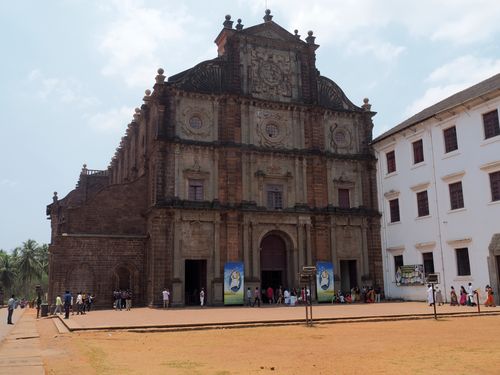
The primary construction material is laterite, a locally abundant iron-rich stone that is easily quarried and cut when freshly extracted but hardens upon exposure to air. Laterite’s thermal properties provide durability in a tropical climate, while its reddish hue contributes to the basilica’s distinctive exterior appearance. The decision to leave the façade unplastered exposes the structural material, creating a monumental yet austere surface treatment.
Basalt and granite were employed selectively for structural reinforcements, decorative details, and plinth elements requiring additional durability. Lime mortar served as the binding agent, ensuring cohesion between stone blocks and allowing flexibility under minor structural stress.
Interior finishes relied extensively on timber. The principal altarpiece, carved and gilded in wood, exemplifies advanced woodworking techniques transmitted from Iberian workshops and executed by trained artisans in Goa. The integration of imported marble for the tomb of Saint Francis Xavier required sophisticated logistical coordination, as components were transported by sea and assembled on site.
Construction proceeded in phases, reflecting both funding patterns and the availability of skilled labor. The church’s completion in just over a decade indicates efficient organization and the presence of experienced master builders familiar with Iberian construction systems.
Stylistic Influences and Artistic Synthesis
The façade articulates three superimposed tiers framed by classical orders—Doric at the base, Ionic above, and Corinthian at the upper level. This hierarchical progression reflects Renaissance architectural theory as codified in European treatises. The façade’s vertical rhythm is reinforced by pilasters and entablatures that structure the elevation into clearly defined segments.
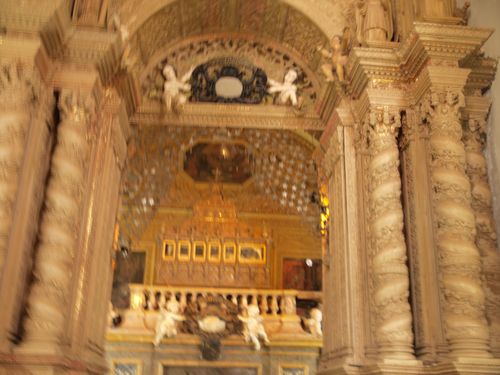
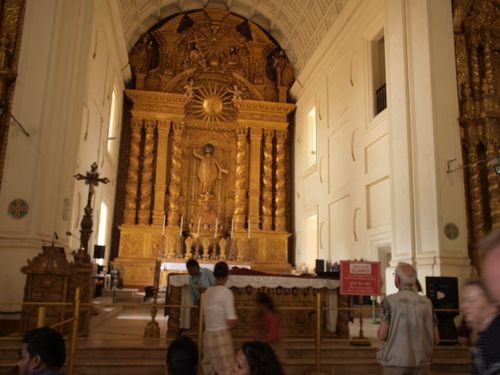
Although fundamentally Mannerist in composition, the interior decorative program anticipates Baroque sensibilities. The gilded retable of the high altar, rising dramatically toward the ceiling, exemplifies vertical emphasis and ornamental richness associated with seventeenth-century Iberian ecclesiastical art. Twisted columns, sculptural reliefs, and iconographic layering contribute to a visually immersive sacred environment.
Local artistic participation is evident in certain ornamental motifs and carving techniques. Floral elements and surface treatments reveal subtle adaptation to Indian craftsmanship traditions, creating a synthesis rather than a replication of European models. This hybridization underscores the basilica’s role as a cultural interface between Portuguese and Goan artisans.
Spatial Organization and Liturgical Configuration
The church measures approximately 55 meters in length and 16 meters in width, proportions that produce a balanced yet imposing interior. The nave’s breadth ensures unobstructed sightlines to the sanctuary. Lateral chapels embedded within the thick side walls provide secondary devotional spaces without disrupting the overall unity of the interior.
The sanctuary is elevated by a series of steps, enhancing hierarchical distinction. The main altar, dedicated to the Infant Jesus, is framed by a monumental retable reaching nearly the full height of the chancel wall. The tabernacle occupies a central axial position, reinforcing theological emphasis on Eucharistic presence.
The mausoleum of Saint Francis Xavier, installed in the north transept-like extension, constitutes an architectural focal point. Designed in marble with intricate relief panels, the structure combines Italian craftsmanship with local assembly. Its elevated position allows ceremonial processions during periodic expositions of the relics.
Notably, the church originally featured two towers; only one remains visible today. This asymmetry contributes to the basilica’s distinctive silhouette. The exterior remains relatively restrained compared to the opulence of the interior, a deliberate contrast enhancing the dramatic effect upon entry.
Technological and Urban Considerations
The basilica’s orientation aligns with prevailing urban axes of Old Goa, integrating the church within a broader ecclesiastical complex. Its placement reflects urban planning principles common to Portuguese colonial cities, where major churches anchored civic and administrative spaces.
Drainage systems incorporated into the plinth and foundation mitigate monsoon water infiltration. Slight elevation above ground level protects interior spaces from flooding. The structural simplicity of the nave minimizes maintenance complexity and enhances long-term resilience.
Compared to contemporary cathedrals in Europe, the basilica avoids elaborate structural experimentation, favoring proven masonry techniques. This conservatism reflects the practical constraints of colonial construction, where reliability outweighed architectural risk.
Dimensions, Features, and Notable Facts
The façade rises approximately 20 meters, establishing visual dominance within the surrounding landscape of Old Goa. The gilded altarpiece is among the largest of its kind in India, and the marble tomb of Saint Francis Xavier remains one of the most significant imported sculptural works in South Asia.
An often-noted detail is the exposed laterite façade, unusual among Portuguese churches, which were frequently plastered and whitewashed. The decision to retain visible stone may have been aesthetic or pragmatic, allowing easier maintenance in humid conditions.
Periodic expositions of the saint’s relics require temporary architectural modifications, including platforms and circulation arrangements to manage large pilgrim flows. These adaptations demonstrate the building’s capacity to accommodate evolving ritual functions.
International Recognition and Conservation Challenges
The basilica forms part of the UNESCO-listed ensemble known as the Churches and Convents of Goa. Its architectural value contributes substantially to the site’s recognition as an outstanding example of European ecclesiastical design transposed to Asia.
Conservation challenges center on laterite erosion, biological growth due to humidity, and wear caused by high visitor numbers. The gilded woodwork requires controlled environmental conditions to prevent deterioration. Preservation policies prioritize material authenticity while ensuring structural stability.
Urban encroachment is limited compared to dense metropolitan contexts, yet visitor pressure during pilgrimage events necessitates careful management. Ongoing conservation campaigns employ both traditional techniques and modern scientific analysis to monitor stone decay and structural integrity.
Architectural Significance
The Basilica of Bom Jesus exemplifies the successful transplantation and adaptation of late Renaissance and early Baroque architectural principles to a tropical Asian environment. Its structural clarity, material pragmatism, and decorative synthesis distinguish it from contemporaneous European churches while maintaining doctrinal and aesthetic continuity.
Through its disciplined plan, durable construction methods, and integration of local materials and craftsmanship, the basilica demonstrates how architectural innovation operated within imperial networks. It remains one of the most significant monuments of early modern Christian architecture in the Indian Ocean world.