

 Français (France)
  Nederlands (nl-NL)
 The Toy Train of Darjeeling, officially known as the Darjeeling Himalayan Railway, is a mountain railway connecting the plains of Bengal with the hill town of Darjeeling in the Indian state of West Bengal. Established in the late nineteenth century, the narrow-gauge line climbs through mountainous terrain and built-up areas using a sequence of curves, loops, and winding sections designed to adapt to the steep slopes of the eastern Himalayas. Over time, the train has become an iconic feature of the region and serves both as a historic transport system and a major visitor attraction. Its route and operation illustrate the technical ingenuity involved in mountain railway construction.
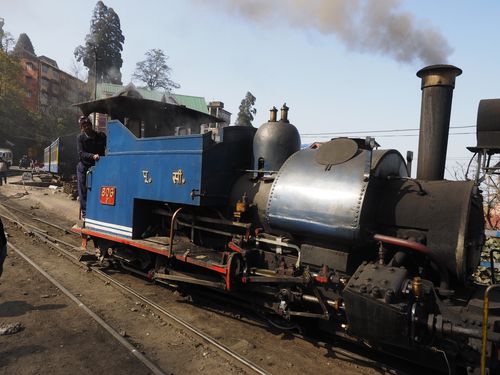
Darjeeling • Toy Train
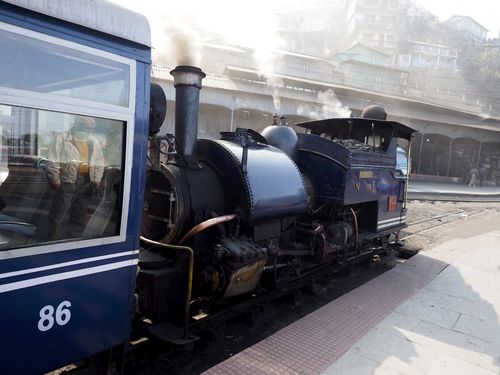
Darjeeling • Toy Train
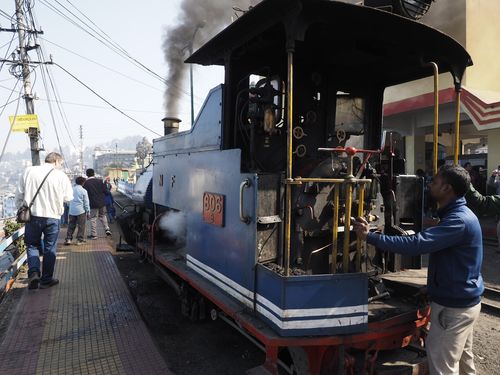
Darjeeling • Toy Train
Monument profile
Toy Train
Monument categories: Iconic vehicles, Railway, Steam train
Monument families: Civil engineering structures (bridges, wells, etc.) and factories • Museum, remarkable architecture or group of buildings
Monument genres: Economic, Cultural or scientific
Geographic location: Darjeeling • West Bengal • India
Construction period: 19th century AD
This monument in Darjeeling is inscribed on the UNESCO World Heritage List since 1999 and is part of the serial property "Mountain Railways of India".See the UNESCO monuments featured on this site
• Links to •
• List of videos about Darjeeling on this site •
Darjeeling • West Bengal, India
• References •
UNESCO: Mountain Railways of India
History of the Darjeeling Toy Train
Political and Social Context of Its Construction
The Darjeeling Toy Train, officially known as the Darjeeling Himalayan Railway (DHR), was created during the late nineteenth century within the broader framework of British colonial expansion in India. At that time, Darjeeling had become an important administrative and strategic hill station for the British Empire. Located in the foothills of the eastern Himalayas, the town offered a cooler climate than the plains of Bengal, making it a preferred seasonal retreat for colonial officials, soldiers, and administrators stationed in Calcutta, the capital of British India until 1911.
Beyond its climatic advantages, the region around Darjeeling was rapidly gaining economic importance due to the development of tea plantations. Beginning in the 1850s, British entrepreneurs established large tea estates in the surrounding hills. Darjeeling tea soon became internationally renowned for its distinctive flavor and quality, and its production became a central component of the regional economy. However, transporting tea from the mountainous plantations to the commercial centers of Bengal posed considerable logistical challenges. The existing roads were narrow, steep, and frequently damaged during the monsoon season.
The idea of constructing a railway connecting the plains with the hill station emerged in the 1870s as a practical solution to these problems. The project aimed to improve transportation efficiency, support the export-oriented tea industry, and reinforce colonial administrative control over the region. At the same time, such an infrastructure project symbolized the technological ambitions of the British Empire, demonstrating its capacity to impose modern transport systems even in difficult mountainous terrain.
The proposal for the railway was championed by Franklin Prestage, an agent of the Eastern Bengal Railway. Prestage suggested building a narrow-gauge railway that could navigate the steep slopes of the Himalayan foothills more effectively than standard railway systems. After discussions with colonial authorities and financial investors, the project was approved, and construction began in 1879.
Construction and Early Development of the Railway
Building the Darjeeling Himalayan Railway required innovative engineering solutions. The route had to climb from the plains of Siliguri, located at an altitude of around 100 meters, to Darjeeling at more than 2,000 meters above sea level. Rather than relying on extensive tunneling or large bridges—which would have greatly increased construction costs—the engineers adopted a design that followed the natural contours of the mountains.
The railway was constructed using a narrow gauge of two feet, allowing the track to accommodate extremely tight curves. Engineers incorporated a series of loops, spirals, and zigzag sections that allowed trains to ascend gradually despite the steep terrain. These techniques made it possible to extend the effective distance traveled by the train, thereby reducing the gradient of the climb.
Construction progressed quickly. The first section of the line opened in 1879, and the railway was completed in 1881. From the moment it began operating, the railway transformed the region’s transportation network. Tea produced in the surrounding hills could now be transported more efficiently to the markets of Calcutta and beyond.
Passenger traffic also increased rapidly. The railway provided a reliable means of travel for colonial officials, merchants, and local inhabitants. It quickly became an essential link between the Himalayan foothills and the economic centers of British India.
Global Context of Railway Expansion
The creation of the Darjeeling Himalayan Railway must be understood within the broader global expansion of railway networks during the nineteenth century. Across Europe, North America, and Asia, railways were transforming transportation and economic systems. By the late nineteenth century, engineers increasingly sought to extend railway networks into mountainous regions that had previously been difficult to access.
Several mountain railways were constructed in Europe during this period, particularly in the Alps. These projects required innovative solutions to overcome steep gradients and unstable terrain. Similar developments occurred in North America and in other parts of the British Empire.
Within this international context, the Darjeeling Himalayan Railway represented a distinctive example of mountain railway engineering adapted to colonial conditions. Unlike many European mountain railways designed primarily for tourism, the Darjeeling line served a dual purpose. It supported both economic production—particularly the tea industry—and the administrative needs of the colonial government.
The railway also contributed to integrating the Himalayan foothills into global trade networks. Tea from Darjeeling could be transported more efficiently to ports and then shipped to markets in Europe and other parts of the world.
Transformations During the Twentieth Century
Throughout the twentieth century, the railway experienced significant changes influenced by political and economic developments in India. During the late colonial period, the railway remained closely associated with British administrative and commercial interests.
Following India’s independence in 1947, the railway was incorporated into the Indian Railways system. Its role gradually evolved from a primarily economic infrastructure to a combination of regional transport service and heritage attraction. While it continued to provide transportation for local communities, it increasingly attracted visitors interested in experiencing the historic mountain railway.
Technological changes also affected the operation of the line. Although steam locomotives remained a defining feature of the Toy Train, diesel locomotives were introduced on certain services to improve operational reliability and reduce maintenance demands.
Urban development also altered the railway’s environment. The expansion of Siliguri transformed the town into a major transport hub in northeastern India. Meanwhile, Darjeeling continued to grow as a tourist destination. In several places along the route, the railway became closely integrated with urban streets and settlements.
Cultural Significance and Contemporary Role
Today, the Darjeeling Toy Train occupies a unique place in India’s cultural and historical landscape. The railway has become a powerful symbol of the region and one of the most recognizable elements of Darjeeling’s identity.
For visitors, traveling on the Toy Train offers an experience that combines historical heritage with the scenic landscapes of the eastern Himalayas. The slow movement of the train through tea plantations, villages, and mountain roads has made it a celebrated attraction for both domestic and international tourists.
The railway also plays a role in local culture and collective memory. It frequently appears in films, literature, and visual representations associated with Darjeeling and the Himalayan foothills. For residents of the region, it remains both a historic landmark and a practical transport link in certain areas.
Special tourist services and heritage rides are often organized to highlight the historical importance of the railway. These activities contribute to maintaining public interest in the line and supporting its continued operation.
Conservation and Modern Challenges
Preserving the Darjeeling Himalayan Railway presents several challenges. The line passes through terrain that is highly susceptible to landslides and heavy rainfall, particularly during the monsoon season. These environmental conditions can damage tracks, embankments, and supporting infrastructure.
Urbanization along the route also creates pressure on the railway corridor. In some areas, the proximity of roads, markets, and residential buildings complicates maintenance and operation.
Despite these difficulties, significant efforts have been made to preserve the railway as a historic infrastructure. Conservation programs focus on maintaining the original engineering features of the line while ensuring safe and reliable operation.
The international recognition of the Darjeeling Himalayan Railway as part of the global heritage of mountain railways has reinforced these preservation initiatives. This status highlights the railway’s importance not only as a transport system but also as a living example of nineteenth-century engineering adapted to the challenges of mountainous landscapes.
Today, the Toy Train continues to operate as both a working railway and a cultural landmark. Its survival reflects the enduring value of historical infrastructure and the continuing fascination with the technological achievements of the railway age.
Architecture and Engineering of the Darjeeling Toy Train
Engineering Concept and Structural Design
The Darjeeling Himalayan Railway, widely known as the Toy Train of Darjeeling, represents one of the most distinctive examples of mountain railway engineering developed during the late nineteenth century. Unlike conventional monuments defined by a single building, the architectural significance of the Toy Train lies in its entire infrastructural system: the railway line, its track layout, stations, bridges, loops, and associated engineering works that together form a coherent technical landscape.
The railway was conceived as a narrow-gauge mountain line capable of climbing the steep slopes between the plains of northern Bengal and the Himalayan hill town of Darjeeling. Engineers faced the challenge of designing a railway that could ascend more than two thousand meters in altitude over a relatively short distance while avoiding the extremely high costs associated with large tunnels or monumental bridges.
To solve this problem, the designers adopted a flexible approach based on adapting the track to the terrain rather than forcing the terrain to accommodate the railway. The route follows the natural contours of the hills, weaving through valleys, ridges, tea plantations, and settlements. This strategy transformed the railway into an architectural infrastructure that interacts closely with the surrounding landscape.
The result is a technical system in which the line itself becomes a structural composition of curves, gradients, and spatial relationships. The railway’s architecture therefore resides not in monumental structures but in the complex interplay between engineering design, topography, and built environment.
Technological Innovations and Mountain Railway Engineering
One of the most remarkable architectural aspects of the Darjeeling Himalayan Railway is its innovative system for overcoming steep gradients. Conventional railways typically require gentle slopes to allow locomotives to pull trains safely. In mountainous terrain, however, maintaining such gradients can require extremely long tunnels or massive bridges.
Engineers working on the Darjeeling line adopted a different strategy. Instead of relying on large-scale structural interventions, they designed a route composed of loops, spirals, and zigzag sections that allowed the train to gain altitude gradually. These features lengthen the effective path traveled by the train, thereby reducing the steepness of the climb.
Loops are among the most characteristic elements of the line’s engineering. In these sections, the railway track curves around a hill or ridge, allowing the train to rise in elevation while maintaining a manageable gradient. The circular geometry of these loops is a distinctive feature of the railway’s spatial design.
Zigzag sections, also known as reverses, provide another ingenious solution. In these segments, the train alternates between forward and backward movements along inclined tracks, gradually climbing the slope. This method allows trains to ascend steep terrain without the need for costly structural works.
Together, these elements form an integrated architectural system that transforms the railway line into a continuous sequence of engineered adaptations to the landscape. The route itself becomes the central architectural feature of the Toy Train.
Materials and Construction Techniques
The materials used in constructing the Darjeeling Himalayan Railway were selected primarily for durability, flexibility, and ease of maintenance in mountainous conditions. The railway track is laid on a bed of crushed stone ballast, which provides stability and allows water to drain away from the rails during heavy rainfall.
Wooden or steel sleepers support the rails and distribute the weight of passing trains across the track foundation. This relatively lightweight structure allows sections of track to be repaired or replaced without extensive reconstruction.
Bridges along the route are typically small steel structures supported by masonry or stone abutments. These bridges allow the railway to cross streams and ravines that descend from the Himalayan slopes. The use of prefabricated steel elements enabled engineers to construct these structures efficiently while ensuring sufficient strength to support the locomotives.
Station buildings along the line generally follow simple architectural forms. Constructed with masonry, timber, or corrugated metal roofing, these structures were designed to withstand the heavy rainfall and fluctuating temperatures typical of the region. Their modest scale reflects their practical function as service points rather than monumental architectural features.
In certain urban areas, the railway track is integrated directly into roadways. This unusual arrangement demonstrates the flexibility of the line’s design and its ability to adapt to changing urban conditions.
Spatial Organization and Route Structure
The Darjeeling Himalayan Railway extends for roughly eighty kilometers between the plains of Siliguri and the hill station of Darjeeling. Along this route, the railway traverses a remarkable range of ecological and topographical zones.
The line begins in the lowland plains, where the terrain is relatively flat. As the railway approaches the foothills, the route gradually begins to climb through dense forests and agricultural landscapes dominated by tea plantations. Higher sections of the line pass through mountain villages and steep slopes before reaching Darjeeling.
The spatial structure of the railway includes several intermediate stations that serve both operational and logistical purposes. These stations function as crossing points for trains traveling in opposite directions and as locations for maintenance and refueling.
One of the most celebrated architectural features of the railway is the Batasia Loop near Darjeeling. This large circular track allows the train to gain elevation while offering panoramic views of the surrounding mountains. The loop represents an elegant example of how geometric design can solve complex topographical challenges.
Throughout the route, the railway interacts closely with settlements and roads. In several towns, the train runs alongside shops, houses, and pedestrian pathways. This integration of railway infrastructure with everyday urban life gives the Toy Train a distinctive spatial character.
Structural Characteristics and Technical Dimensions
The railway’s narrow gauge, measuring two feet between the rails, plays a crucial role in its architectural design. Narrow-gauge railways allow tighter curves and greater adaptability to rugged terrain than standard-gauge lines.
The route includes numerous curves with extremely small radii, some of the tightest found on operational railways anywhere in the world. These curves enable the track to follow the natural contours of the mountains without extensive earthworks.
The line rises from approximately 100 meters above sea level in the plains to more than 2,000 meters in Darjeeling. Achieving this elevation gain over a relatively short horizontal distance required careful planning of gradients and track geometry.
Steam locomotives historically used on the line were specifically designed for mountain operation. Their compact dimensions and powerful traction allowed them to negotiate steep slopes and tight curves effectively.
The railway’s slow operating speed is another defining feature. While this speed results from engineering constraints, it also enhances the experience of traveling through the mountainous landscape.
Cultural and Technical Influences
The architectural design of the Toy Train reflects the broader tradition of nineteenth-century British railway engineering. During this period, British engineers developed numerous railways across mountainous regions of the British Empire, applying similar techniques for overcoming steep terrain.
These techniques included narrow-gauge tracks, flexible alignment strategies, and specialized locomotive designs. The Darjeeling Himalayan Railway represents one of the most successful applications of these principles.
At the same time, the railway’s architecture was influenced by the specific geographical and cultural context of the Himalayan foothills. The integration of the railway into tea plantation landscapes and village environments created a distinctive relationship between infrastructure and local life.
This interaction between imported engineering knowledge and regional conditions produced a unique architectural system that reflects both colonial technological traditions and the particularities of the Himalayan environment.
International Recognition and Conservation Challenges
Today the Darjeeling Himalayan Railway is widely recognized as a landmark of railway engineering. Its architectural significance lies in the preservation of a complete mountain railway system that continues to operate much as it did in the nineteenth century.
The line’s engineering solutions—loops, zigzags, narrow gauge, and integration with the landscape—demonstrate an approach to infrastructure design that prioritizes adaptation rather than domination of the terrain. This philosophy contributes to the railway’s enduring importance within the history of transportation architecture.
However, maintaining the railway presents ongoing challenges. Heavy monsoon rains frequently trigger landslides that damage tracks and embankments. Continuous maintenance is required to ensure the stability of the line and the safety of operations.
Urban expansion along parts of the route has also increased pressure on the railway corridor. Buildings, markets, and road traffic sometimes encroach on the space traditionally occupied by the track.
Despite these challenges, extensive preservation efforts have been undertaken to maintain the Toy Train as a functioning historical railway. Its international recognition as an important example of mountain railway heritage has strengthened conservation initiatives and ensured continued attention to its protection.
As both a working transport system and a historical engineering monument, the Darjeeling Toy Train remains a rare example of nineteenth-century infrastructure that continues to operate in its original landscape, illustrating the enduring legacy of early mountain railway design.