

 Français (France)
  Nederlands (nl-NL)
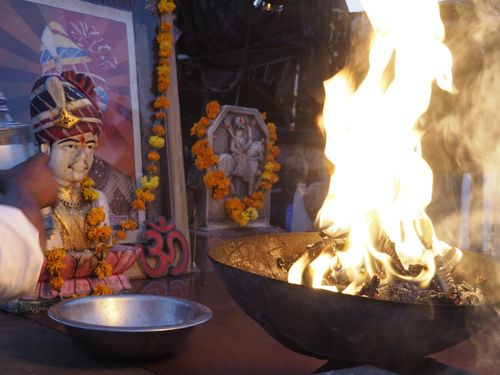
 The Bullet Baba Temple, located in Chotila in the Indian state of Rajasthan, is a distinctive place of popular devotion linked to an unusual local tradition. The shrine attracts many visitors, particularly drivers and travelers who move along the regional highways. The site is widely known for its association with a Royal Enfield motorcycle that devotees regard as a protective symbol for journeys. Over time, the temple has become a recognized cultural landmark where residents and travelers stop to make offerings and prayers before continuing their journeys through the landscapes of Rajasthan.

Chotila • Bullet Baba Temple
Chotila • Bullet Baba Temple

Chotila • Bullet Baba Temple
Monument profile
Bullet Baba Temple
Monument category: Hindu Temple
Monument family: Temple
Monument genre: Religious
Cultural heritage: Hindu
Geographic location: Chotila • Rajasthan • India
Construction period: 20th century AD
• Links to •
• List of videos about Chotila on this site •
Om Banna, an amazing Royal Enfield temple • Rajasthan, India
History of the Bullet Baba Temple at Chotila
Social and cultural context of the shrine’s origin
The Bullet Baba Temple, also known as the Om Banna Temple, represents a distinctive example of a modern devotional site that emerged from local belief and collective memory in the Indian state of Rajasthan. Unlike many temples in India that were established through royal patronage or institutional religious authority, this shrine developed from a relatively recent event that gradually evolved into a place of popular veneration.
The origin of the temple is linked to the death of Om Singh Rathore, a young Rajput man from a local family, during the late twentieth century. Om Singh was travelling on a Royal Enfield Bullet motorcycle along a road connecting the cities of Pali and Jodhpur when he was involved in a fatal accident. The incident occurred near the village of Chotila, in a region characterized by long desert highways and scattered rural settlements.
In the days following the accident, the motorcycle involved in the crash became the focus of unusual stories that circulated among local inhabitants. According to accounts widely repeated in the area, the motorcycle was taken by local authorities to a police station after the accident. However, it was reportedly found again near the accident site on multiple occasions despite efforts to remove it. These events were interpreted by some members of the community as supernatural occurrences associated with the spirit of Om Singh.
Within the cultural context of Rajasthan, where local heroes, saints and protective spirits often become the focus of devotional practices, the memory of Om Singh gradually evolved into a form of spiritual reverence. People began to refer to him as “Om Banna,” a respectful title suggesting both personal honor and spiritual significance. Over time, a small shrine was erected at the location of the accident in order to house the motorcycle and provide a place where travelers could offer prayers.
Development of the shrine and local recognition
The early structure of the Bullet Baba Temple was modest. It consisted primarily of a small roadside sanctuary built to protect the motorcycle and to mark the place associated with the tragic event. As stories about the site spread among local drivers and villagers, increasing numbers of people began stopping there to perform simple rituals before continuing their journeys.
Truck drivers, motorcyclists and long-distance travelers became some of the shrine’s most frequent visitors. Many believed that offering prayers at the site would provide protection against accidents while travelling through the often hazardous desert highways of Rajasthan.
Unlike historical temples that evolved through royal patronage or institutional religious expansion, the Bullet Baba Temple grew largely through grassroots devotion. Visitors began leaving offerings such as flowers, incense, cloth and occasionally bottles of alcohol, which became associated with the local ritual practices surrounding the shrine.
As the number of visitors increased, local authorities and community members gradually expanded the facilities around the shrine. Small structures were added to shelter the sacred object and to create a defined area for prayer and offerings. Over time the site developed into a recognizable roadside temple that attracted travelers from across the region.
Broader historical and global context
The emergence of the Bullet Baba Temple occurred during a period of significant transformation in Indian society. During the second half of the twentieth century, India experienced rapid expansion of road networks and increased motorization. Long-distance highways connected rural areas to major cities, and the movement of goods and people intensified.
In this context, roadside shrines began to appear along many highways in India. These sanctuaries often served as symbolic protectors for drivers navigating long journeys through remote landscapes. The Bullet Baba Temple represents a particularly unusual example of this phenomenon because its central sacred object is not a traditional religious icon but a modern motorcycle.
Comparable practices can be observed in other parts of the world where memorial shrines emerge at sites associated with accidents or tragedies. These places frequently evolve into informal spaces of remembrance where communities express collective grief and spiritual reflection.
The Bullet Baba Temple illustrates how contemporary objects and events can become integrated into religious or quasi-religious traditions. In this sense, the shrine reflects the adaptability of devotional culture within rapidly changing social environments.
Transformations of the site over time
Since its establishment, the temple has undergone several phases of transformation. What began as a simple roadside memorial gradually developed into a structured place of pilgrimage. The motorcycle itself remains the central focus of devotion and is preserved within a protected enclosure that allows visitors to view it while preventing damage.
The surrounding area has been adapted to accommodate increasing numbers of travelers who stop at the site. Additional altars and statues connected to Hindu devotional traditions have been installed in order to integrate the shrine more fully into the broader religious landscape of the region.
The road infrastructure around the temple has also changed over time as traffic increased. The site has become a familiar landmark for drivers traveling along the highway, and stopping at the shrine has become a customary practice for many regular travelers.
Cultural role in contemporary India
Today the Bullet Baba Temple occupies a distinctive place in the cultural landscape of Rajasthan. Although relatively recent in origin, it has gained widespread recognition among travelers and local communities. The shrine symbolizes protection during journeys and reflects the deep connection between travel, faith and local belief systems.
For many visitors, the act of stopping at the temple represents a moment of reflection before embarking on a long journey. Drivers often offer prayers for safety and good fortune. The presence of a modern object at the center of the shrine also contributes to its popularity among motorcyclists and travelers interested in unusual devotional traditions.
The temple has also become a point of cultural curiosity. Visitors from other parts of India and from abroad are often drawn by the unusual nature of the shrine and by the stories associated with its origin.
Preservation and contemporary challenges
Although the Bullet Baba Temple is not an ancient monument, it faces several challenges related to its preservation and management. Its location beside a busy highway exposes the structure to pollution, dust and vibrations caused by passing vehicles.
The increasing number of visitors also creates practical challenges related to safety and traffic management. Authorities must ensure that travelers can stop safely without disrupting the flow of vehicles along the road.
Maintenance of the shrine requires continuous attention, particularly to preserve the motorcycle and the structures that protect it. Local caretakers and community members play an important role in maintaining the site and facilitating the rituals performed by visitors.
Despite its modest scale and recent origin, the Bullet Baba Temple illustrates how contemporary events can give rise to enduring traditions of devotion. The shrine stands as a remarkable example of how local memory, community belief and modern mobility can combine to create a new form of cultural and religious landmark.
Architecture of the Bullet Baba Temple at Chotila
Architectural conception and spatial context
The Bullet Baba Temple, also known as the Om Banna Temple, represents an unusual example of contemporary religious architecture in the Indian state of Rajasthan. Unlike traditional temples built according to established sacred architectural principles, this shrine developed gradually around a specific commemorative object and a roadside location. Its architecture reflects practical adaptation to devotional practices associated with travel rather than the monumental planning characteristic of classical temple complexes.
The shrine is situated along a regional highway that connects several cities in western Rajasthan. Its placement directly beside a heavily used road has strongly influenced its architectural form. The design emphasizes immediate visibility and accessibility, allowing travelers to stop briefly, perform offerings, and resume their journeys without entering an enclosed or complex architectural environment.
At the center of the shrine stands the sacred object associated with the cult of Om Banna: a Royal Enfield Bullet motorcycle. The architectural composition of the temple revolves around the preservation and display of this object. Rather than serving as a secondary element, the motorcycle itself functions as the focal point around which the entire spatial arrangement is organized.
The architectural design is therefore characterized by simplicity and openness. The structure surrounding the motorcycle creates a protected sacred zone while maintaining visual accessibility from the surrounding roadway. This approach reflects the functional requirements of a devotional site frequented primarily by passing travelers.
Technological and architectural adaptations
Although the Bullet Baba Temple does not display the technological innovations typical of monumental historical architecture, it nonetheless illustrates an interesting adaptation of architectural form to contemporary social practices. The shrine demonstrates how religious spaces can evolve in response to modern transportation networks and changing patterns of mobility.
The most significant architectural feature is the protective enclosure constructed around the motorcycle. This enclosure ensures the physical preservation of the object while allowing devotees to view it clearly. The design often incorporates transparent or open elements such as metal grilles or glass panels, creating a balance between security and accessibility.
Another important architectural aspect is the open-air configuration of the shrine. Unlike traditional Hindu temples where the sacred image is located inside a sanctum that requires formal entry, the Bullet Baba Temple allows rituals to be performed from the exterior. This arrangement accommodates the brief visits typical of travelers who stop only momentarily.
The surrounding layout also incorporates space for vehicles to halt safely near the shrine. The architecture thus interacts directly with the road infrastructure, forming a transitional zone between the flow of traffic and the sacred area of the temple.
Materials and construction methods
The construction materials used in the Bullet Baba Temple are characteristic of many small contemporary shrines found along Indian highways. Reinforced concrete and masonry form the primary structural components of the building. These materials provide durability in a region characterized by intense sunlight, dust and seasonal temperature variations.
Concrete allows the creation of stable structural frames capable of supporting protective roofs and enclosures. The use of plaster coatings on exterior surfaces permits decorative painting and maintenance with relatively simple techniques.
Metal elements play a crucial role in the architecture of the shrine. Metal railings and grilles are commonly used to create protective barriers around the motorcycle while maintaining visual contact with the sacred object. These structures prevent physical damage while allowing devotees to deposit offerings.
Painted surfaces contribute significantly to the visual identity of the temple. Bright colors such as red, saffron and yellow are often used in accordance with Hindu devotional traditions. These colors enhance the shrine’s visibility from a distance and reinforce its symbolic association with sacred space.
Architectural influences and symbolic features
The Bullet Baba Temple incorporates architectural features typical of small devotional shrines found throughout rural and semi-urban India. These structures often emerge spontaneously at sites associated with local legends, saints or protective spirits.
Although modest in scale, the shrine reflects symbolic elements commonly found in Hindu religious architecture. Decorative motifs, ritual platforms and small altars may accompany the central object of worship. These elements situate the temple within the broader framework of Hindu devotional practice.
At the same time, the architecture of the shrine departs significantly from traditional temple typology. Instead of a sculpted deity or icon placed within a sanctum, the sacred focus is a modern mechanical object. The architectural framing of the motorcycle transforms it into a ritual centerpiece comparable to a religious idol.
This unusual combination of modern object and sacred architecture illustrates the adaptability of popular religious practices. The temple demonstrates how devotional architecture can incorporate contemporary symbols while maintaining connections to older ritual traditions.
Spatial organization and structural layout
The spatial arrangement of the Bullet Baba Temple is relatively compact but clearly organized. The central area contains the protected motorcycle, which functions as the symbolic heart of the shrine. Around this core space, a small open area allows devotees to approach the enclosure and perform offerings.
Supporting architectural elements such as pillars, small walls or canopies define the sacred boundary of the site. These elements mark the transition from the ordinary environment of the road to the ritual space of the shrine.
The layout often includes a modest platform or altar where offerings can be placed. In some cases, statues or images of Hindu deities are incorporated into the surrounding structure, integrating the local cult of Om Banna into the wider framework of regional religious traditions.
Unlike large temple complexes that feature multiple halls, towers and ceremonial courtyards, the Bullet Baba Temple remains architecturally restrained. Its structure is designed primarily for functionality, clarity and accessibility.
Dimensions and notable architectural characteristics
The temple is relatively small compared with traditional Hindu religious structures. Its compact scale reflects its role as a roadside shrine rather than a pilgrimage complex requiring extensive facilities.
Despite its modest size, the shrine attracts a large number of visitors each day. This constant presence of devotees contributes to the living character of the site and influences the visual appearance of the architecture. Offerings, garlands and ritual objects frequently decorate the central enclosure, transforming the space into an evolving devotional environment.
One of the most distinctive architectural characteristics of the temple is the central positioning of the motorcycle within a protected display structure. This arrangement transforms an everyday mechanical object into a sacred artifact, redefining the conventional relationship between architecture and religious symbolism.
Recognition and conservation challenges
Although the Bullet Baba Temple is not an ancient monument and does not hold formal heritage status, it represents an important example of contemporary popular religious architecture. Its unusual origin and distinctive architectural form have attracted attention from travelers, researchers and cultural observers.
The main conservation challenges facing the shrine stem from its location beside a busy highway. Continuous exposure to traffic pollution, dust and vibrations can affect both the structural elements of the temple and the condition of the motorcycle preserved within it.
The steady flow of visitors also requires careful management to ensure safety along the roadside. Local caretakers and community members are responsible for maintaining the site, cleaning the shrine and preserving the sacred object.
Despite its relatively simple architecture, the Bullet Baba Temple illustrates how new forms of devotional space can emerge within modern environments. Its design reflects a synthesis between traditional religious symbolism and the realities of contemporary mobility, demonstrating how architecture adapts to changing cultural landscapes.