

 Français (France)
  Nederlands (nl-NL)
 The petroglyphs of Cholpon-Ata, located in the Chuy area of Kyrgyzstan, form an extensive open-air collection of rock engravings spread across a wide landscape. Carved into stone surfaces, these images mainly depict animals, hunting scenes, and symbolic figures. The site is considered a key source for understanding early cultural expressions and visual communication in Central Asia. Preserved as a protected area, it is accessible to visitors and contributes significantly to archaeological research and public awareness of the region’s ancient heritage.

Bishkek • Petroglyphs
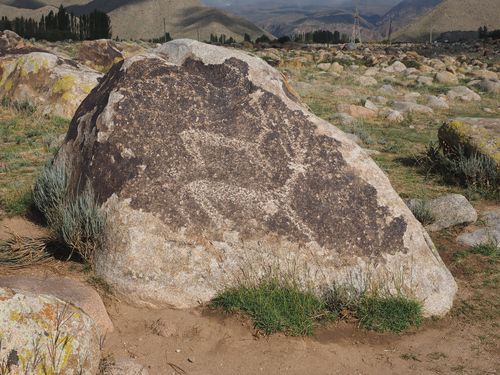
Bishkek • Petroglyphs

Bishkek • Petroglyphs
Monument profile
Petroglyphs
Monument category: Petroglyphs
Monument family: Archaeological
Monument genre: Archaeological site
Geographic location: Cholpon-Ata , Chuy • Kyrgyzstan
Construction period: before the 6th century BC
• Links to •
• List of videos about Bishkek, Chuy Valley, Karakol, Issyk Kul lake on this site •
Kyrgyzstan • a republic in the heart of Central Asia
• References •
Wikipedia EN: Cholpon-Ata
Wikipedia EN: Petroglyph
Historical Analysis of the Petroglyphs of Cholpon-Ata (Chuy, Kyrgyzstan)
The petroglyphs of Cholpon-Ata represent one of the most extensive and significant concentrations of rock art in Central Asia. Unlike monuments conceived as single architectural projects, this site is the result of a long historical process in which successive communities engraved images onto stone surfaces over several millennia. Its history reflects shifting social structures, political transformations, and changing relationships between human groups and their environment in the Issyk-Kul basin.
Political and social context of creation
The creation of the Cholpon-Ata petroglyphs took place in a region characterized by mobility rather than permanent urban settlement. From the Bronze Age onward, the Issyk-Kul area was occupied by pastoral and semi-nomadic societies whose political organization relied on kinship networks, seasonal movement, and control of grazing territories. In this context, the production of petroglyphs did not serve the ambitions of a single ruler or centralized authority. Instead, it functioned as a collective and cumulative form of expression linked to social cohesion, territorial marking, and symbolic communication.
The engravings can be understood as visual statements embedded in a landscape that was constantly traversed. They conveyed shared values related to hunting, animal husbandry, cosmology, and social order. While no sovereign commissioned the site in the conventional sense, the repeated use of the same area suggests a form of communal authority over space. Rivalries between groups, as well as alliances forged through migration and exchange, likely contributed to the diversity of motifs and styles visible on the stones, reflecting the coexistence and succession of different cultural traditions.
Major historical events affecting the site
The Cholpon-Ata petroglyphs were not directly shaped by military events such as sieges or battles, as the site lacked strategic or defensive functions. Nevertheless, broader historical developments left indirect traces. Waves of migration, including Indo-European and later Turkic movements, altered the cultural landscape of Central Asia and introduced new iconographic elements. Changes in political dominance, such as the rise of Turkic khaganates and later Mongol influence, coincided with shifts in symbolic representation, visible in the stylistic evolution of certain engravings.
Over time, the site experienced periods of reduced use, followed by renewed attention. Stones bearing petroglyphs were sometimes displaced or reused, and natural erosion gradually altered the clarity of the images. In the modern period, the absence of formal protection exposed the site to damage caused by human activity. Systematic documentation and preservation efforts began only in the twentieth century, marking a turning point in the site’s historical trajectory.
Global context and comparative perspective
The petroglyphs of Cholpon-Ata belong to a wider global phenomenon of rock art production observed across prehistoric and early historic societies. Comparable traditions emerged in regions as diverse as Western Europe, Southern Africa, Australia, and the Americas. In each case, the engraving of images into stone represented a durable means of communication in societies where written language was absent or limited.
Within this global framework, the Cholpon-Ata site occupies a distinctive position due to its location at the crossroads of Eurasian steppe cultures. The imagery reflects concerns shared across continents—human interaction with animals, ritualized hunting, and symbolic abstraction—while also expressing regional specificities. The site thus forms part of a broader movement toward monumental expression that relied not on constructed architecture but on the symbolic transformation of natural landscapes.
Transformations and changes in use
Throughout its long history, the Cholpon-Ata site underwent transformations that were primarily functional and perceptual rather than architectural. Initially serving as a meaningful space for the communities that created the engravings, it gradually lost its original social function as belief systems and economic practices evolved. By the medieval period, the site appears to have held residual symbolic significance but was no longer a focal point of cultural production.
In the modern era, the site was redefined as an object of scholarly interest and later as a cultural heritage site. Archaeological surveys, documentation campaigns, and protective measures altered its status and function. Urban development in the vicinity of Cholpon-Ata introduced new pressures, reshaping the relationship between the ancient engravings and their surroundings. These transformations reflect changing attitudes toward the past and the increasing institutionalization of heritage management.
Role and cultural importance today
Today, the petroglyphs of Cholpon-Ata play a central role in the cultural landscape of Kyrgyzstan. They are widely regarded as tangible evidence of the deep historical roots of human presence in the region. The site contributes to national narratives that emphasize continuity between ancient societies and modern identity, reinforcing a sense of historical depth within the Kyrgyz cultural framework.
Although the petroglyphs are not associated with active religious practices, they retain symbolic value and are frequently included in educational programs and cultural discourse. Their visibility in tourism and public heritage initiatives has elevated their profile, making them a reference point for both domestic and international audiences interested in Central Asian history.
Conservation status and modern challenges
The preservation of the Cholpon-Ata petroglyphs presents significant challenges. Environmental factors such as temperature fluctuations, wind erosion, and precipitation gradually degrade the stone surfaces. Human impact, including increased tourism and urban expansion, adds further risks, particularly through physical contact and unregulated access.
Conservation policies implemented at the national level aim to balance accessibility with protection. Measures include monitoring, controlled visitor pathways, and public awareness initiatives. Discussions concerning international recognition, including potential inclusion on global heritage lists, highlight the site’s broader significance but also underscore the complexities of long-term preservation. Such recognition could enhance protection efforts while imposing stricter management requirements.
Historical significance in perspective
The historical importance of the Cholpon-Ata petroglyphs lies in their cumulative nature and their capacity to document social and cultural change over an extended period. Rather than representing a single historical moment, the site embodies a layered record of human expression shaped by migration, adaptation, and symbolic continuity. As such, it stands as a crucial reference for understanding the long-term dynamics of Central Asian societies and their place within the wider history of human cultural development.
Architectural Analysis of the Petroglyphs of Cholpon-Ata (Chuy, Kyrgyzstan)
The architecture of the petroglyphs of Cholpon-Ata cannot be approached through the conventional vocabulary of built monuments. It is instead defined by a deliberate structuring of natural space, where stone surfaces function simultaneously as material, support, and architectural framework. This ensemble represents a form of open-air monumental design rooted in landscape manipulation rather than construction, demanding analytical criteria comparable in rigor to those applied to classical architectural complexes.
Technological and architectural knowledge
The production of the Cholpon-Ata petroglyphs reflects a high degree of technical expertise in stone working. Artisans employed successive generations of tools—initially stone implements and later metal instruments—to incise, peck, and polish rock surfaces. The precision of line depth, consistency of contour, and control of surface abrasion demonstrate an advanced understanding of the mechanical properties of stone, including fracture behavior and surface resistance.
Architectural innovation is evident in the strategic selection of rock faces. Surfaces were chosen based on stability, grain cohesion, inclination, and exposure. The engravings are rarely placed on friable or highly erodible stone, indicating empirical knowledge of long-term material performance. Light orientation also played a role: many motifs are positioned to take advantage of natural illumination at specific times of day, enhancing visibility without artificial intervention. This integration of technical skill with environmental conditions constitutes a form of architectural planning adapted to a non-built context.
Materials and construction methods
The sole construction material is locally available stone, primarily erratic boulders and bedrock fragments shaped by geological processes. This reliance on in situ material eliminated the need for transport or assembly while allowing the monument to remain structurally inseparable from its environment. The hardness and texture of the stone influenced both the durability and the visual impact of the engravings, creating a contrast between incised lines and weathered surfaces.
Construction methods were minimal but intentional. In some cases, rock surfaces were lightly prepared through cleaning or superficial leveling to create a suitable engraving plane. No attempt was made to reshape the stone into architectural elements, reflecting a design philosophy centered on adaptation rather than transformation. This approach aligns with a broader architectural logic in which permanence is achieved through material selection and placement rather than structural complexity.
Architectural and artistic influences
The architectural character of the Cholpon-Ata site is informed by traditions common to steppe societies, where monumentality is expressed horizontally rather than vertically. The absence of built forms such as walls, columns, or roofs does not indicate a lack of architectural intent, but rather a different conception of space and durability. The site shares conceptual affinities with other Central Asian rock art complexes, suggesting a regional tradition of spatial organization and visual syntax.
External influences are perceptible in stylistic variations across the site. Certain motifs reflect iconographic conventions associated with broader Eurasian cultural networks, indicating the circulation of ideas along migration and exchange routes. These influences are integrated into a locally coherent architectural system, where new visual elements are incorporated without disrupting the overall spatial logic of the site.
Spatial organization and structural logic
The site is organized as an extensive, unbounded complex, lacking formal enclosures or axes. Instead, spatial coherence emerges from the distribution of engraved stones across a defined area. Clusters of petroglyphs form focal zones, while transitional spaces guide movement between them. This arrangement creates an implicit circulation pattern comparable to that of an open-plan architectural ensemble.
Structural distinction arises from density rather than hierarchy. Unlike temples or palaces, where centrality is defined by scale or elevation, Cholpon-Ata relies on repetition and accumulation. The visitor encounters sequences of engraved surfaces that collectively establish rhythm and continuity. This horizontal architecture encourages progressive engagement, with no single vantage point dominating the experience.
Stability, durability, and environmental integration
Stability at Cholpon-Ata is achieved through reliance on geological permanence. The stones selected for engraving are naturally anchored, reducing the risk of displacement or collapse. This choice reflects an architectural understanding of load, balance, and ground interaction, even in the absence of constructed foundations.
Environmental integration extends to drainage and ventilation. The natural spacing of stones allows air circulation and water runoff, minimizing moisture retention that could accelerate deterioration. These features, inherent to the site’s layout, contribute to the long-term preservation of the engravings and demonstrate an architectural sensitivity to environmental dynamics.
Quantitative characteristics and notable facts
The petroglyph field covers several dozen hectares and includes thousands of individual engravings distributed across hundreds of stone surfaces. This scale places Cholpon-Ata among the largest rock art complexes in Central Asia. The sheer number of motifs, combined with their spatial dispersion, creates an architectural footprint comparable to that of large ceremonial or civic complexes in other cultural contexts.
One notable feature is the superimposition of engravings, where later images partially overlap earlier ones. This phenomenon can be interpreted as an architectural palimpsest, analogous to successive building phases in constructed monuments. Rather than erasing earlier interventions, new engravings coexist with existing ones, reinforcing the site’s cumulative architectural identity.
Legends, narratives, and architectural perception
Although not architectural in a structural sense, local narratives and legends associated with the site influence its perception and use. These stories contribute to the monument’s intangible architecture, shaping how space is understood and navigated. The persistence of such narratives underscores the role of cultural memory in maintaining the relevance of an architectural landscape that lacks physical boundaries or monumental façades.
International recognition and conservation challenges
The architectural significance of Cholpon-Ata lies in its demonstration that monumental design need not rely on constructed form. This conceptual contribution underpins its international recognition as a key example of landscape-based architecture. The site’s protected status reflects acknowledgment of its structural coherence and cultural value.
Conservation challenges stem from the same factors that define the site’s architecture. Continuous exposure to environmental forces and increased visitor access pose risks to the engraved surfaces. Preservation strategies focus on managing movement, limiting direct contact, and maintaining the natural setting that constitutes the monument’s architectural framework. Unlike built heritage, where restoration may involve reconstruction, conservation here prioritizes non-intervention and controlled access.
Architectural significance in perspective
The petroglyphs of Cholpon-Ata exemplify an architectural approach rooted in permanence through integration rather than construction. By transforming natural stone into a structured cultural space, the creators established a durable architectural system that has endured for millennia. The site challenges conventional definitions of architecture, expanding them to include spatial organization, material intelligence, and environmental adaptation. As such, Cholpon-Ata stands as a critical reference for understanding alternative forms of monumental architecture within the global architectural heritage.